The Week The Week
flag of US
US
flag of UK
UK
https://cdn.mos.cms.futurecdn.net/flexiimages/jacafc5zvs1692883516.jpg

SUBSCRIBE & SAVE

Less than $3 per week

Sign in
  • View Profile
  • Sign out
  • The Explainer
  • The Week Recommends
  • Newsletters
  • Cartoons
  • From the Magazine
  • The Week Junior
  • Student Offers
  • More
    • Politics
    • World News
    • Business
    • Health
    • Science
    • Food & Drink
    • Travel
    • Culture
    • History
    • Personal Finance
    • Puzzles
    • Photos
    • The Blend
    • All Categories
  • Newsletter sign up Newsletter
  • The Week Evening Review
    Intra-MAGA feuds, Trump’s ‘Tech Force,’ and glacial extinction

     
    TODAY’S BIG QUESTION

    Is MAGA melting down? 

    The MAGA media universe is made up of influencers, podcasters and thought leaders who rally their conservative listeners and viewers behind President Donald Trump. Now, that right-wing ecosystem is “ripping itself to shreds” over conspiracy theories and petty feuds.

    MAGA’s most prominent personalities are “attacking each other with a fury normally reserved for the left,” said Axios. Podcaster Candace Owens has attacked Turning Point USA after founder Charlie Kirk’s death. Former Fox News host Tucker Carlson is in a feud with Trump ally Laura Loomer over Carlson’s plans to buy a home in Qatar. And YouTube commentator Benny Johnson is threatening to sue over “personal attacks” from longtime provocateur Milo Yiannopoulos. 

    The feuds are hitting high gear as the MAGA movement considers what happens after Trump. The combatants sense the “future of this political movement is up for grabs,” said Open Measures researcher Jared Holt.

    What did the commentators say?
    Owens was MAGA’s “favorite conspiracist,” but her “foray into conspiracy theories” about Kirk’s assassination has proven disruptive inside the movement, said The Washington Post. Owens has made several unfounded charges about Kirk’s death, including the notion that his murder was an “inside job” undertaken by “French or Israeli government agents.” She’s “burning everything down,” said right-wing podcaster Tim Pool. 

    Owens’ antisemitic theories about Kirk’s death are “next-level lunacy,” said Rich Lowry at the National Review. She’s “more alluring and sinister” than disgraced conspiracy-monger Alex Jones in working to “turn MAGA in a direction hostile to Israel, Jews and Judaism.” 

    MAGA influencers are revealing the movement’s “biggest weakness,” said Amanda Marcotte at Salon. The right-wing media ecosystem is “dominated by hustlers” more interested in a payday than the Trumpist “political project.” Aside from Trump, few GOP politicians hold sway over their party’s base. That leaves the job of shaping conservative opinions to the “social media influencer class” that understands “what gets the MAGA audiences going is lurid conspiracy theories.” 

    What next?
    Owens and Charlie’s widow, Erika Kirk, met yesterday in an effort to stem the feud. Both emerged from the “lengthy meeting” suggesting “tensions had eased,” said The Hill. It’s a sign of Owens’ “share of the media market” that Kirk felt the need to give her the “concession” of a meeting, said Chris Stirewalt at The Hill.


    QUOTE OF THE DAY

    ‘He wasn’t thinking about the background of the people he’s saving, the people dying in the street.’

    Mohamed Fateh el Ahmed, the father of Ahmed el Ahmed, applauding his son’s bravery while speaking to ABC after his son wrestled a gun away from one of the assailants who targeted a beachside Hanukkah celebration in Australia


    THE EXPLAINER

    Trump wants to build out AI with a new ‘Tech Force’

    The growing ubiquity of artificial intelligence remains a divisive topic among the public, but the White House is fully leaning into the AI boom. President Donald Trump has announced the creation of a new AI-based U.S. “Tech Force” that will seek to poach employees from the private sector to lure them to government jobs. But this initiative follows a year in which the Trump administration cut thousands of federal employees.

    How will this program work?
    The Tech Force will be a two-year program that will “tackle the most complex and large-scale civic and defense challenges of our era,” said the Tech Force website. The program will involve on-the-job training in the areas of “software engineering, artificial intelligence, cybersecurity, data analytics or technical project management.”

    The program will partner with 28 major tech companies, including Adobe, Amazon, Apple, Dell, Google, Nvidia, OpenAI and Oracle. It will aim to hire about 1,000 people to start. Salaries will range from $130,000 to $195,000, said Office of Personnel Management Director Scott Kupor to reporters.

    What “sets the Tech Force apart from most federal positions is its accessibility,” said Fortune. Unlike most other government jobs, candidates for Tech Force “need not hold traditional degrees or meet minimum experience thresholds,” though they must “demonstrate strong technical skills through work experience.” 

    What next?
    It’s unclear how successful this program will be, given that the government has “long needed more tech workers, but that deficit most likely worsened this year,” said The New York Times. Elon Musk’s Department of Government Efficiency sought to hire tech workers but “made sweeping job cuts as well, including senior technologists.” DOGE slashed about 260,000 federal jobs through firings, buyouts or early retirement, said Reuters.

    Trump’s Tech Force is likely just an “effort to replace the more senior tech talent that DOGE had fired,” said Mathias Rechtzigel, a former government employee with the U.S. Digital Corps, to the Times. It’s a “reaction to DOGE not going well.”

    The administration has acknowledged that the purpose of Tech Force is to “address a technical and early-career talent gap across the government,” said CNN. The government is looking to lure engineers away from private AI companies, which often offer “sizable salaries and other perks.” 


    Statistic of the day

    24%: The percentage by which mass killings are down this year compared to 2024, according to a gun violence database from The Associated Press. There have been 17 mass incidents this year, the lowest number seen in the U.S. since 2006.


    IN THE SPOTLIGHT

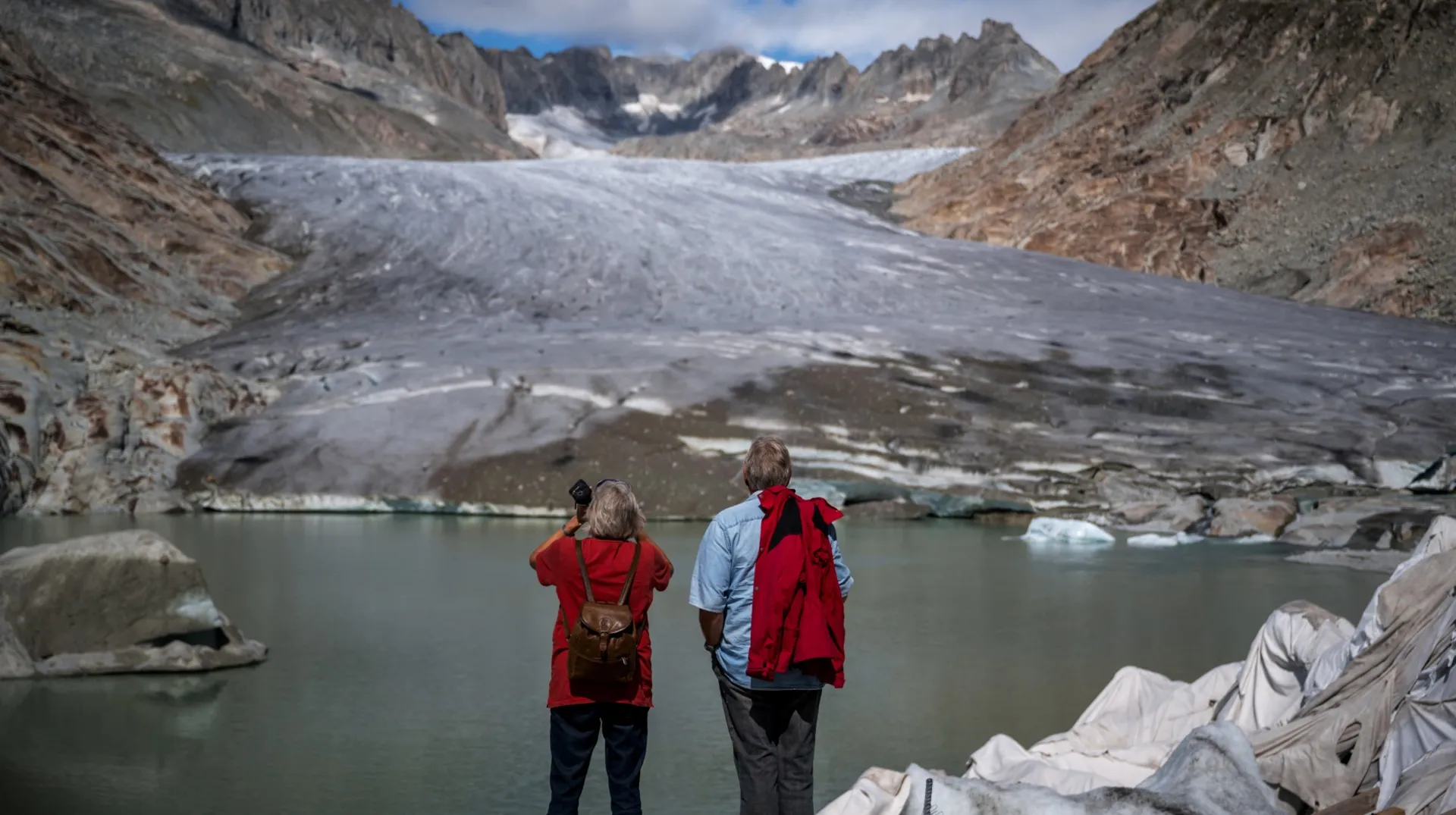
    The Alps start the countdown to ‘peak glacier extinction’

    The world’s supply of glacial ice is quickly approaching an alarming milestone. In a striking study published this week in Nature Climate Change, researchers modeling multiple warming scenarios predict that the number of glaciers that disappear annually is set to dramatically increase in the coming decades.

    The paper introduces the concept of “peak glacier extinction,” defined by researchers as the year in which the “largest number of glaciers is projected to disappear between now and the end of the century.” With the Alps leading our planet’s glacial disappearing act, the next few years may be a turning point for much of Earth’s ice.

    ‘We will lose a lot’
    Although typical glacier studies focus on “mass and area loss,” the newly published research focuses on disappearances of “individual glaciers” — a trend that “directly threatens culturally, spiritually and touristically significant landscapes,” said the study’s authors. They used data on 200,000 glaciers obtained from a “database of outlines derived from satellite images” and applied “three global glacier models” to test the ranges under “different heating scenarios,” said The Guardian.

    Areas featuring the “smallest and fastest-melting glaciers” are “most vulnerable,” unsurprisingly, with about 3,200 glaciers in central Europe set to shrink by 87% by the coming century, even if global temperature rise is limited to 1.5 degrees Celsius.” “The biggest findings are that we will lose a lot of glaciers,” said lead researcher and ETH Zurich glaciologist Lander Van Tricht to ABC News.

    ‘Point of no return’
    The newly published study shows we are at a “point of no return,” said Eric Rignot, a professor of Earth system science at the University of California at Irvine, to CNN. “Reforming a glacier would take decades if not centuries.” The researchers behind the study hope their paper, along with an accompanying database showing the “projected survival rate of each of the world’s 211,000 glaciers,” will help “assess climate impacts on local economies and ecosystems,” said Politico.


    Good day ⚭

    … for monogamy. Humans are more naturally inclined toward monogamous relationships, aligning more with species such as meerkats and beavers than with other primates, according to a study published in Proceedings of the Royal Society B. Humans have a 66% full-sibling rate, ranking seventh among 11 socially monogamous species.


    Bad day 🧠

    … for accurate information. Artificial intelligence chatbots are effective at changing people’s political opinions and are especially persuasive when they use inaccurate information, according to a study published in the journal Science. Among the answers to user questions the bots provided, the most “persuasive models and prompting strategies tended to produce the least accurate information,” said the researchers.


    Picture of the day

    Merry monkeys

    A saki monkey and her baby check out a stocking filled with festive treats from the zookeepers at ZSL London Zoo. The zoo has “festive animal talks” and other holiday-themed events throughout the month to promote children’s wildlife education and conservation.
    Amanda Rose / Alamy Live News


    Puzzles

    Daily crossword

    Test your general knowledge with The Week's daily crossword, part of our puzzles section, which also includes sudoku and codewords

    Play here


    The Week recommends

    The best comedy series of 2025

    Comedy writers had their work cut out for them this year, with the U.S. in political crisis and a mass culture that increasingly revolves around short-form video and manufactured outrage. It was also the year that studios tackled some of these problems directly, resulting in a crop of astute and sometimes discomfiting comedy offerings.

    ‘Adults,’ season 1
    Anton (Owen Thiele), Billie (Lucy Freyer) and Issa (Amita Rao) are twentysomething friends living together in the Queens family home of Samir (Malik Elassal). With their brains “poisoned with all the anxieties of their internet-obsessed cohort,” the characters on FX’s Gen Z hangout comedy connect most successfully when their antics are “just straight-up zany,” said The New York Times. (Hulu)

    ‘Deli Boys,’ season 1
    Mir (Asif Ali) and Raj (Saagar Shaikh) are brothers who inherit what they believe to be a Philadelphia convenience store and retail empire when their father, Baba (Iqbal Theba), is killed in a golfing mishap. But Aunt Lucky (Poorna Jagannathan) is forced to share the bad news that the whole enterprise was a drug-running operation. The Hulu comedy “balances bloody knuckles with a tender heart,” said Time. (Hulu)

    ‘Mo,’ season 2
    Comedian Mo Amer plays Mohammed “Mo” Najjar (pictured above), a somewhat aimless Palestinian who was brought to the U.S. as a child. “Mo,” which concluded with this season, “excels in humanizing people of all stripes and in being as sidesplittingly funny as it is unapologetically dark,” said Hannah J Davies at The Guardian. (Netflix)

    Read more


    Poll watch

    Over two in five Americans who travel internationally (43%) have gone abroad less this year, according to a YouGov survey. Over a quarter of the 1,506 adults polled (28%) cite economic uncertainty as the main reason they traveled less, while 18% cite rising travel costs. 


    INSTANT OPINION

    Today's best commentary

    ‘The Sydney Hanukkah attack didn’t come out of nowhere’
    Aviva Klompas at Newsweek
    The “Jewish families who gathered at Bondi Beach in Sydney to celebrate Hanukkah were targeted for doing exactly what the holiday represents: showing up openly as Jews,” says Aviva Klompas. They were “not caught in a geopolitical dispute.” This “was not the result of a policy disagreement or a misunderstanding about Israel.” The attack was “also not sudden or inexplicable. It was the foreseeable result of a sustained failure to take antisemitism seriously before it turned lethal.”

    ‘Has the world really lost its thirst for Scotch whisky?’
    James Moore at The Independent
    Scotch is one of Scotland’s “most iconic products,” but it’s “not in a happy place,” says James Moore. Scotch distillers have been “caught in a perfect storm, with taxes and tariffs battering both domestic and international consumption.” The “real enthusiasts may choose to swallow higher prices. But casual drinkers? That’s a different matter altogether.” Those “involved in producing scotch could be forgiven for pouring themselves a stiff drink to help drown their sorrows.”

    ‘Will Ford’s $19.5 billion EV charge be another dead end?’
    Liam Denning at Bloomberg
    For “years after General Motors took a bailout from Washington, it was scorned in some quarters of the population as ‘Government Motors,’” and while Ford Motor Co. “lacks the requisite initials, the same epithet could be applied to its latest pivot on electric vehicles,” says Liam Denning. Ford is “reconfiguring for changed political realities, given that the environmental benefits of EVs and lower emissions aren’t rewarded in the market but instead incented by regulation.” But Ford “isn’t an innocent bystander.”


    WORD OF THE DAY

    Janeites

    A word coined in 1894 by literary historian George Saintsbury to describe Jane Austen’s “most ardent fans,” who today celebrate the 250th anniversary of her birth, said The New York Times. The “modern era of fandom” began the moment a “dishevelled Colin Firth appeared in his wet shirt” in the 1995 BBC adaptation of ‘Pride and Prejudice.’


    Evening Review was written and edited by Theara Coleman, Nadia Croes, David Faris, Scott Hocker, Justin Klawans, Joel Mathis, Summer Meza and Rafi Schwartz, with illustrations by Stephen Kelly and Julia Wytrazek.

    Image credits, from top: Illustration by Stephen Kelly / Getty Images; Chip Somodevilla / Getty Images; Fabrice Coffrini / AFP / Getty Images; Eddy Chen / Netflix
     

    Recent editions

    • Morning Report

      US offers Ukraine a security deal

    • Evening Review

      Seeking durable peace

    • Morning Report

      Mass shooting shakes Australia, Jewish communities

    VIEW ALL
    TheWeek
    • About Us
    • Contact Future's experts
    • Terms and Conditions
    • Privacy Policy
    • Cookie Policy
    • Advertise With Us
    • FAQ
    Add as a preferred source on Google

    The Week is part of Future US Inc, an international media group and leading digital publisher. Visit our corporate site.

    © Future US, Inc. Full 7th Floor, 130 West 42nd Street, New York, NY 10036.