The Week The Week
flag of US
US
flag of UK
UK
https://cdn.mos.cms.futurecdn.net/flexiimages/jacafc5zvs1692883516.jpg

SUBSCRIBE & SAVE

Less than $3 per week

Sign in
  • View Profile
  • Sign out
  • The Explainer
  • The Week Recommends
  • Newsletters
  • Cartoons
  • From the Magazine
  • The Week Junior
  • Student Offers
  • More
    • Politics
    • World News
    • Business
    • Health
    • Science
    • Food & Drink
    • Travel
    • Culture
    • History
    • Personal Finance
    • Puzzles
    • Photos
    • The Blend
    • All Categories
  • Newsletter sign up Newsletter
  • Brand Logo
    Boat strike blame, Habba barred and Canada’s EU deal

     
    TODAY’S NATIonAL story

    White House says admiral ordered potential war crime

    What happened
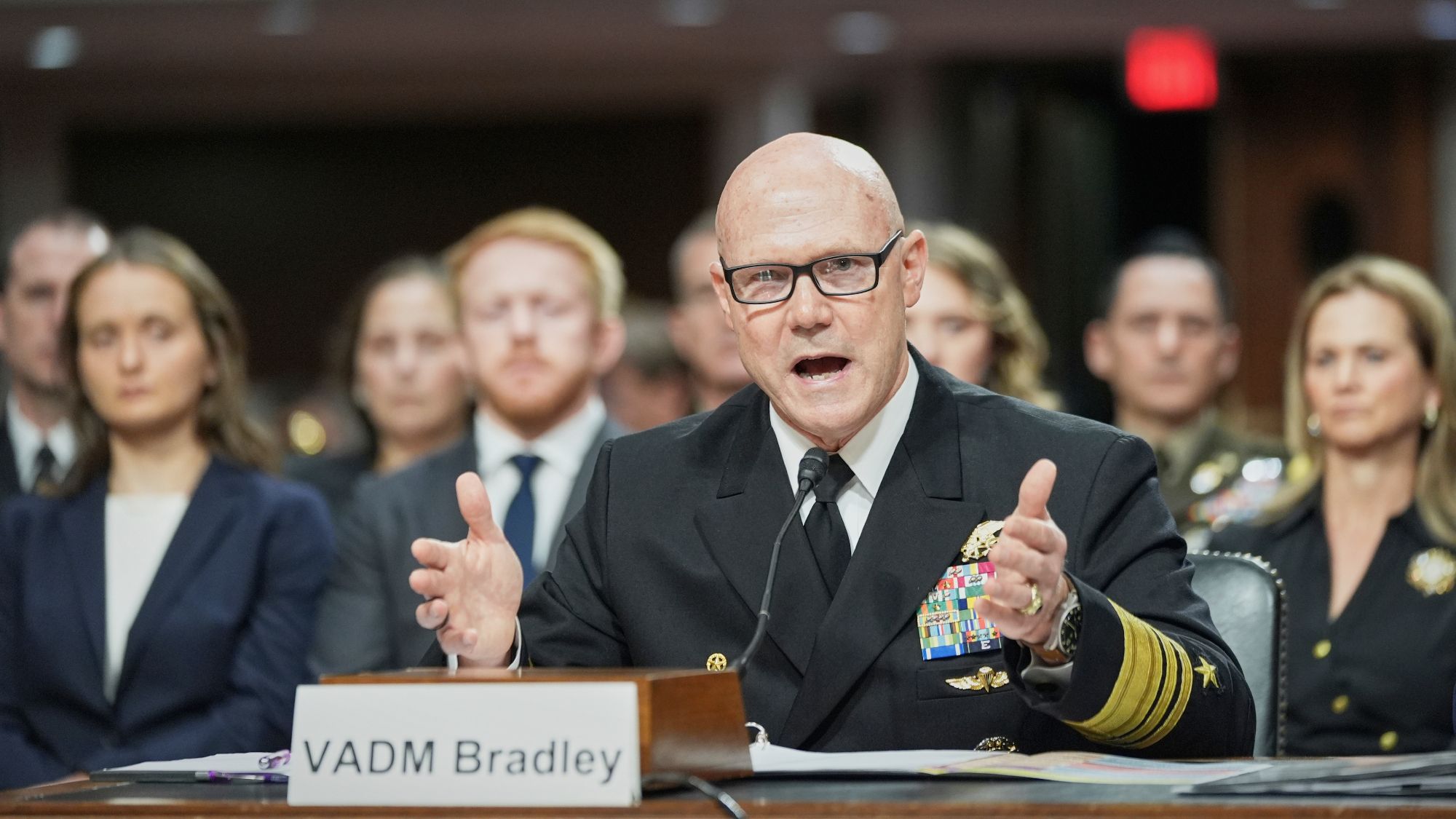
    The White House and Defense Secretary Pete Hegseth yesterday said Navy Vice Adm. Frank “Mitch” Bradley ordered a follow-up strike on an alleged drug-smuggling boat in the Caribbean in September, not Hegseth. The initial strike killed nine people on the boat, and when live video of the attack showed two survivors “clinging to the smoldering wreck,” Bradley ordered a second strike to comply with Hegseth’s verbal command to “kill everybody,” and the “two men were blown apart in the water,” The Washington Post reported Friday, setting off a furor in Washington and bipartisan congressional investigations into potential war crimes.

    Who said what
    Hegseth “authorized” Bradley, now head of U.S. Special Operations Command, to “conduct these kinetic strikes” and the admiral “worked well within his authority and the law directing the engagement to ensure the boat was destroyed” and the “threat” to the U.S. “eliminated,” White House Press Secretary Karoline Leavitt said yesterday. Hegseth later posted on social media that Bradley “is an American hero” and “I stand by him and the combat decisions he has made — on the September 2 mission and all others since.”

    Leavitt’s “scripted remarks” and Hegseth’s post “elicited a furious backlash within the Defense Department,” the Post said, and left lawmakers and Pentagon officials “increasingly concerned that the Trump administration intends to scapegoat” Bradley. “This is ‘protect Pete’ bulls---,’” one military official told the Post. 

    If Hegseth, Bradley “or both targeted shipwrecked survivors,” that would “apparently be a war crime even if one accepts the Trump administration’s disputed argument” that the U.S. is in armed conflict with civilian drug traffickers, The New York Times said. “It would be murder outside of armed conflict,” George Washington University law professor Laura Dickinson told Reuters.

    What next?
    “We’ll all have clarity on Thursday afternoon,” when Bradley provides a classified briefing to key lawmakers, said House Armed Services Committee chair Mike Rogers (R-Ala). “Hegseth made a big point of saying he was running these operations,” said Rep. Adam Smith (Wash.), the committee’s top Democrat, “so ultimately he’s the one who ought to come in and explain it to us.” Congress will “certainly” get access to “all of the audio and all of the video” of the strike, Senate Armed Services Committee chair Roger Wicker (R-Miss.) said, and “we’re going to find out what the true facts are.”


    TODAY’S JUDICIARY story

    Appeals court disqualifies US Attorney Alina Habba

    What happened
    The U.S. 3rd Circuit Court of Appeals yesterday agreed with a lower court that Alina Habba (pictured above left), a former personal attorney to President Donald Trump, has been unlawfully serving as U.S. attorney for New Jersey since July 1. The theory put forward by the government to justify Habba’s appointment was “so broad that it bypasses the constitutional process entirely,” said the three-judge panel. 

    Who said what
    The ruling was a “blow to the Trump administration,” which has installed several U.S. attorneys “through a series of unusual maneuvers” to sidestep a 120-day window for interim appointments, The New York Times said. It is “apparent” that the Trump administration is “frustrated by some of the legal and political barriers to getting its appointees in place,” Judge D. Michael Fisher wrote for the panel. But the “citizens of New Jersey” and lawyers at the U.S. attorney’s office “deserve some clarity and stability.” 

    Yesterday’s ruling “applies only to Habba’s appointment,” The Washington Post said, but it “could have far-reaching implications for other controversial Trump appointments.” Acting U.S. Attorneys Lindsey Halligan in Virginia and Bill Essayli in California have also been “jammed up in court proceedings” over whether Trump “sidestepped the Senate and improperly exploited loopholes in federal vacancy laws” to appoint them, Fox News said.

    What next?
    It “isn’t clear who will lead” New Jersey’s U.S. attorney’s office now, said CNN. Habba’s case “may be the first of its kind to reach the Supreme Court,” the Times said, though Halligan’s appeal of her disqualification “could be expedited by virtue of being entangled with criminal cases against President Trump’s enemies.”


    TODAY’S INTERnATIONAL Story

    Canada joins EU’s $170B SAFE defense fund

    What happened
    Canada yesterday became the first non-European Union country to join the EU’s $170 billion Security Action for Europe initiative, giving Canadian defense firms expanded access to the European market. SAFE is “part of a major drive” to get the EU “ready to defend itself by 2030 amid fears of a Russian attack and doubts about U.S. protection,” Reuters said.

    Who said what
    “Welcome to SAFE, Canada!” European Commission President Ursula von der Leyen said on social media. Canadian Prime Minister Mark Carney said his country’s “participation in SAFE will fill key capability gaps, expand markets for Canadian suppliers and attract European defense investment into Canada.” In a joint statement, the EU and Canada called the agreement the “next step” in their “deepening cooperation” and “symbolic” of their “shared priorities.”

    Carney’s pivot to Europe comes as Canada “looks to diversify its military spending away from the United States” after President Donald Trump’s “actions — including launching a trade war and suggesting Canada become the 51st U.S. state — infuriated Canadians,” The Associated Press said. Canada’s government “continues to review the purchase of U.S. F-35 fighter jets to explore other options.” 

    What next?
    Bringing another G7 partner into SAFE strengthens the program’s credibility as the EU “seeks to coordinate long-term weapons demand and ramp up Europe’s defense industrial base,” Politico said. Talks for the U.K. to join “broke down on Friday.” EU Defense Commissioner Andrius Kubilius yesterday said all 19 participating European nations have submitted their spending plans, financed by low-interest SAFE loans, and 15 of those plans included “billions, not millions” to support Ukraine. 


    It’s not all bad

    The European Union’s 2018 ban on neonicotinoids has helped bird populations recover by 3%, according to a study published in Environmental Pollution. Ornithologists surveyed 57 bird species in 1,900 locations across France. Although 3% is not a massive number, scientists are “confident” the ban is “positively” affecting bird species, said Good News Network. After the pesticide DDT was banned in the U.S. in 1972, it took 10 to 25 years for bird populations to fully recover.


    Under the radar

    Coach salary buyouts raise questions for colleges

    College football coaches are some of the highest-paid bench bosses in all of sports, and they often cash in big with salary buyouts if they are fired. But as these buyouts grow and become more common, some people are questioning the ethics.

    If a college fires its head football coach, it’s generally forced to pay the “liquidated damages stipulated in a coach’s contract if they are fired ‘without cause’ — or, in other words, because they are losing,” said Front Office Sports. Most contracts stipulate that a fired coach is “owed a portion of their future contract earnings.”

    The record payout for a college coach belongs to Jimbo Fisher, who received a $76.8 million severance package when he was fired as the head coach at Texas A&M University in 2023. Other significant buyouts include Louisiana State University’s Brian Kelly, who was paid $53.8 million upon his firing, and Penn State University’s James Franklin, who was given $49 million.

    As the buyouts increase in value, many college administrators are “equal parts dismayed and disgusted at what they believe is nothing shy of fiscal malfeasance,” said CNN. And as college football expenses now typically outstrip revenues, “just where is the money coming from?” 

    “I have no idea,” one college administrator said to CNN. “The money does not exist.” Many officials seem to have accepted the buyouts as just another part of modern college sports. But some are pushing for changes to contract structures. University administrators “should take responsibility in an era of the run-amok supercoach that needs to end now,” said The Athletic.


    On this day

    December 2, 1942

    Scientists at the University of Chicago, led by Enrico Fermi, achieved the world’s first self-sustained nuclear reaction. This breakthrough marked the beginning of the nuclear age and helped the U.S. develop the atomic bomb as part of the Manhattan Project.


    TODAY’S newspaperS

    ‘Pope Leo rallies flock’

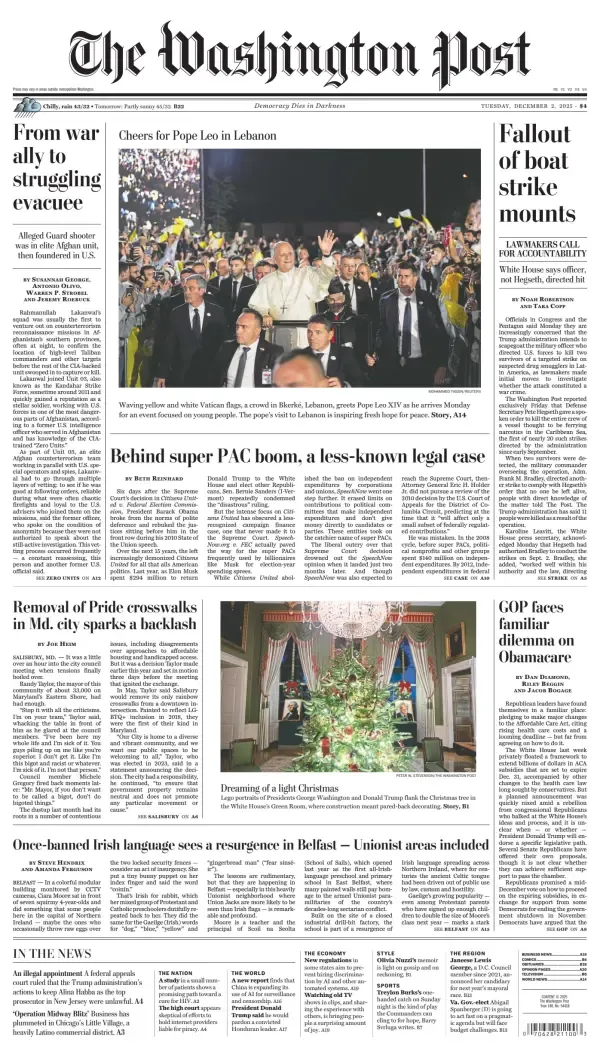
    “Pope Leo rallies flock in cradle of Christianity,” The Wall Street Journal says on Tuesday’s front page. “Israel targets foes at will, even in cease-fires,” The New York Times says. “Parties pulling all the stops in crucial” special congressional race, The Tennessean says. “Midterms may hold the cards for Vance,” says USA Today. “GOP unveils proposed new map” that could erase Indiana’s two Democratic House seats, The Indianapolis Star says. “Missouri AG involves ICE to halt anti-gerrymandering group,” The Kansas City Star says. “Fallout of boat strike mounts” as “lawmakers call for accountability” and “White House says officer, not Hegseth, directed hit,” The Washington Post says. “Trump, Rubio and others are using social media to sell Venezuela policy,” says the Miami Herald.

    ► See the newspaper front pages


    Tall tale

    Say cheese

    Parmesan cheese is ready for its close-up, after Italy’s Parmigiano Reggiano Consortium recently signed with United Talent Agency to get its products placed in television shows and movies. The cheese consortium said having Hollywood representation will allow it to “further its message of gastronomical excellence.” Parmigiano Reggiano is produced in five Italian provinces under strict guidelines: It can only be made with milk from local cows, salt and calf rennet, and must be aged a minimum of 12 months.


    Morning Report was written and edited by Nadia Croes, Catherine Garcia, Scott Hocker, Anya Jaremko-Greenwold, Justin Klawans, Rafi Schwartz, Peter Weber and Kari Wilkin, with illustrations by Stephen Kelly and Julia Wytrazek.

    Image credits, from top: Mariam Zuhaib / AP Photo; Mike Stobe / Getty Images; EU Council / Pool / Anadolu via Getty Images; Illustration by Julia Wytrazek / Getty Images
     

    Recent editions

    • Evening Review

      A GOP health care deal?

    • Morning Report

      Hegseth accused of potential war crimes

    • Morning Report

      Russia's shadow fleet, Education plans, tariffs

    VIEW ALL
    TheWeek
    • About Us
    • Contact Future's experts
    • Terms and Conditions
    • Privacy Policy
    • Cookie Policy
    • Advertise With Us
    • FAQ
    Add as a preferred source on Google

    The Week is part of Future US Inc, an international media group and leading digital publisher. Visit our corporate site.

    © Future US, Inc. Full 7th Floor, 130 West 42nd Street, New York, NY 10036.