The Week The Week
flag of US
US
flag of UK
UK
https://cdn.mos.cms.futurecdn.net/flexiimages/jacafc5zvs1692883516.jpg

SUBSCRIBE & SAVE

Less than $3 per week

Sign in
  • View Profile
  • Sign out
  • The Explainer
  • The Week Recommends
  • Newsletters
  • Cartoons
  • From the Magazine
  • The Week Junior
  • Student Offers
  • More
    • Politics
    • World News
    • Business
    • Health
    • Science
    • Food & Drink
    • Travel
    • Culture
    • History
    • Personal Finance
    • Puzzles
    • Photos
    • The Blend
    • All Categories
  • Newsletter sign up Newsletter
  • Brand Logo
    ICE killing, US unilateralism and shadow-fleet unveiling

     
    TODAY’S NATIONAL story

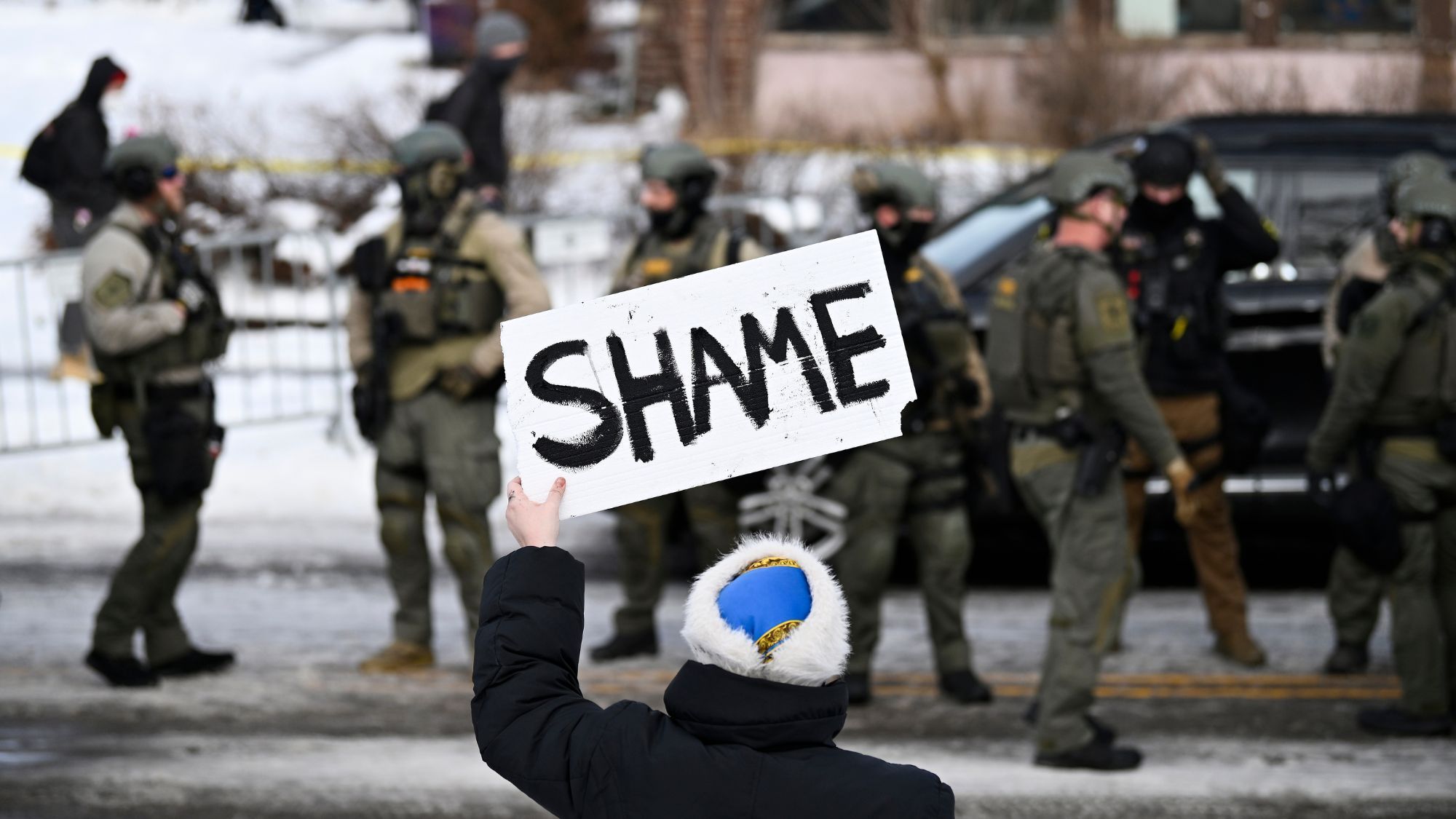
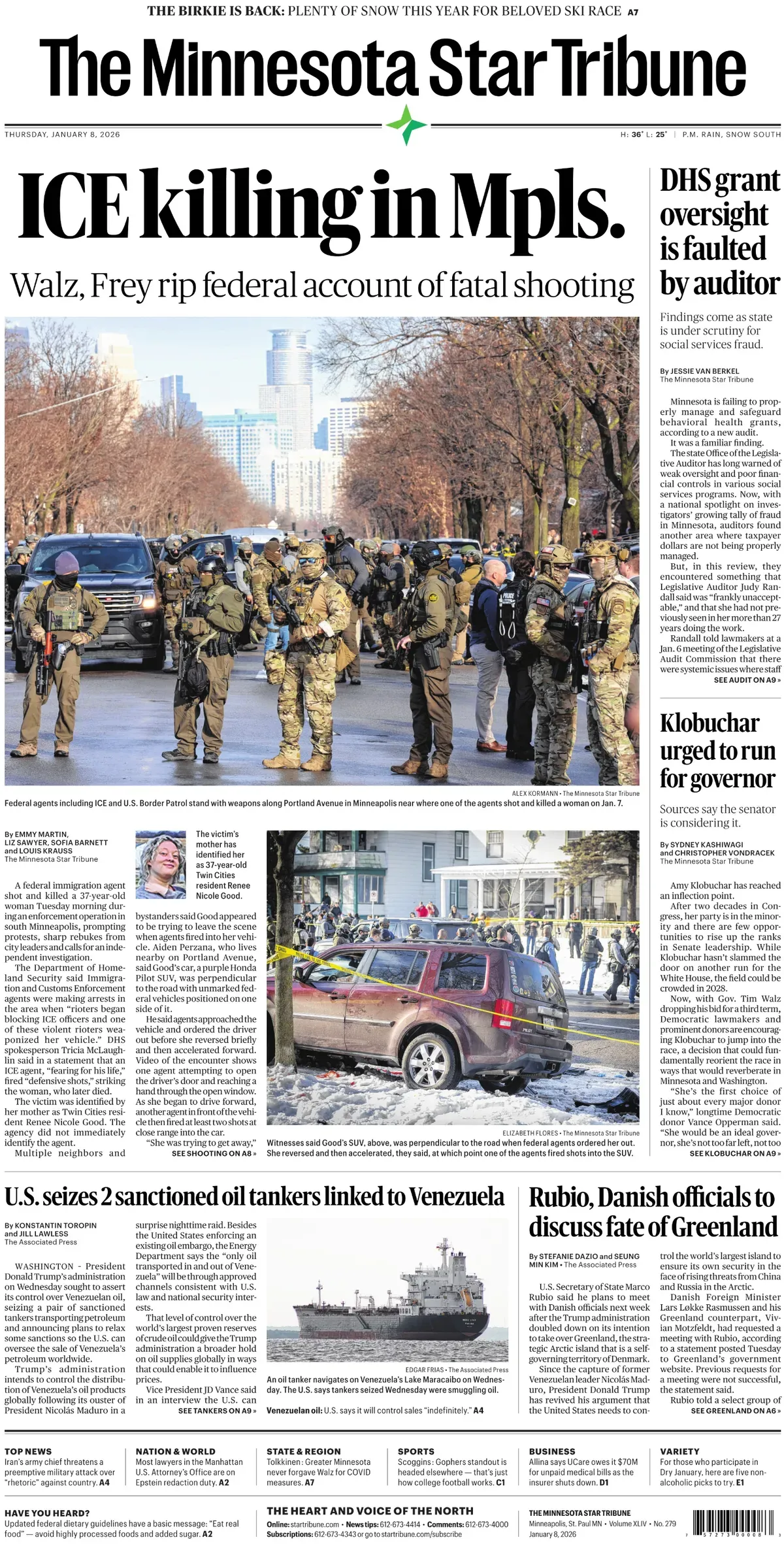
    ICE kills woman during Minneapolis protest

    What happened
    An unidentified ICE agent shot and killed Renee Nicole Good, a 37-year-old woman, yesterday during what federal officials said was an immigration enforcement action on a residential street in Minneapolis. Multiple bystander videos of the shooting show three ICE agents approaching Good’s SUV, which backs up and is moving to drive away when an agent near the front of the car fires three shots into the vehicle. Good’s killing was “at least the fifth death to result from the aggressive U.S. immigration crackdown the Trump administration launched last year,” The Associated Press said, and it “quickly drew hundreds of angry protesters.”

    Who said what
    President Donald Trump claimed on social media shortly after the shooting that Good “violently, willfully and viciously ran over the ICE Officer, who seems to have shot her in self defense.” Homeland Security Secretary Kristi Noem said Good had weaponized her car in an “act of domestic terrorism.” Witnesses and state and local officials disputed those characterizations. 

    “Don’t believe this propaganda machine,” Minnesota Gov. Tim Walz (D) said, calling the shooting the “totally predictable” and “totally avoidable” result of Trump’s surge of ICE officers to the city. Minneapolis Mayor Jacob Frey (D) called the self-defense “spin” a “garbage narrative” and “bullshit” and told ICE to leave town. The “narrative they’re pushing clearly doesn’t match up with the videos we’re all seeing,” Sen. Tina Smith (D-Minn.) said on social media.

    According to eyewitnesses, ICE agents “gave mixed orders” to Good in the moments before opening fire, said Minnesota Public Radio, with one agent “ordering her to drive away from the scene” as another “yelled for her to get out of her car as he reached for the door handle.” The ICE agent who fired into the car “was filmed immediately after the shooting walking without apparent injury,” The Washington Post said.

    What next?
    Walz said he had issued a “warning order” to prepare the Minnesota National Guard for deployment if violence broke out, but he urged Minnesotans not to “take the bait.” Trump and his team “want a show,” he said. “We can’t give it to them.” The FBI and Minnesota’s Bureau of Criminal Apprehension are investigating the shooting, but Minneapolis prosecutors are “pushing hard for a local investigation,” Hennepin County Attorney Mary Moriarty told Fox 9, “which is the only way to ensure full transparency.”


    TODAY’S INTERNATIONAL story

    Trump pulls US from key climate pact, 65 other bodies

    What happened
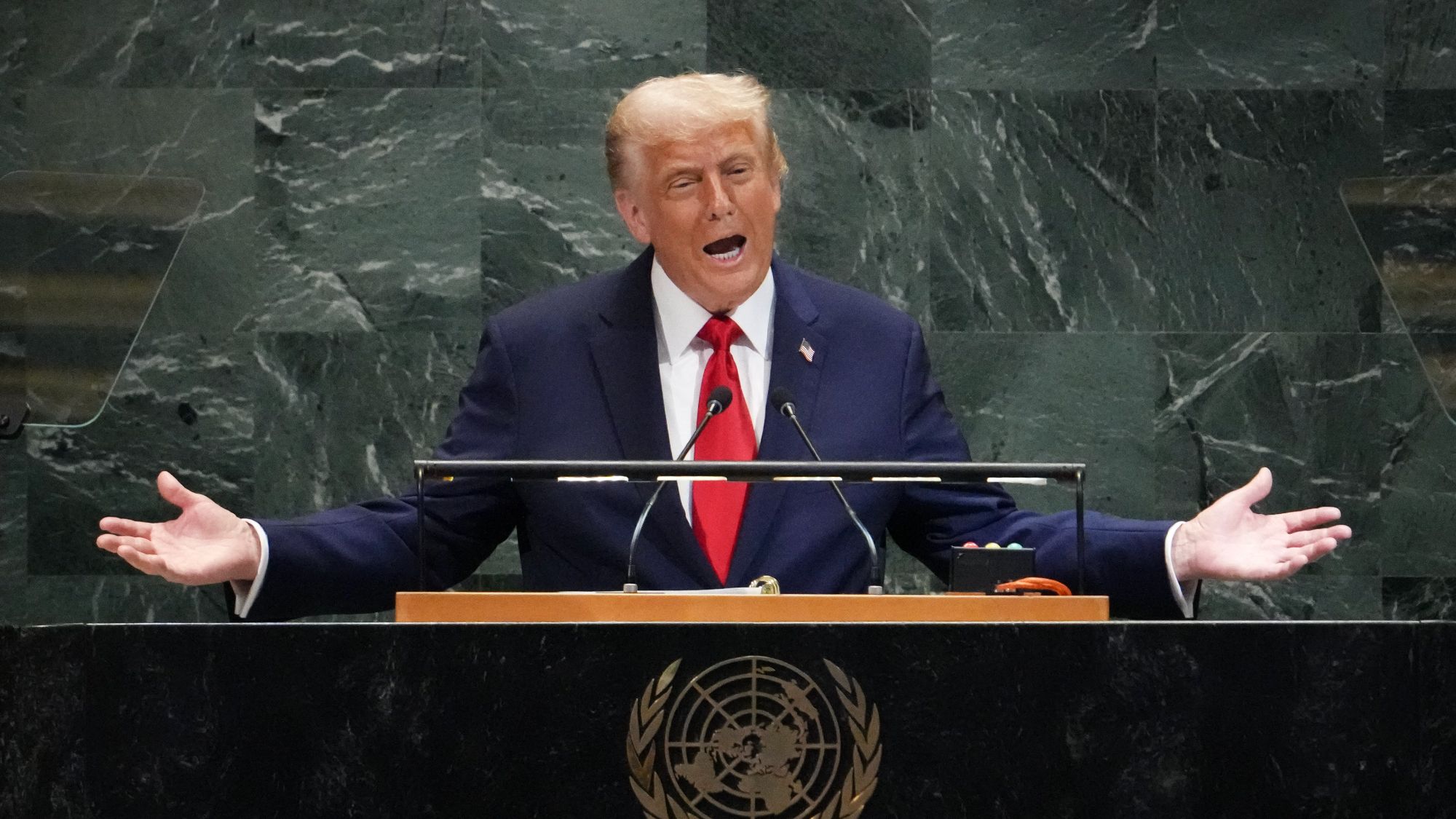
    President Donald Trump yesterday signed an executive order suspending U.S. participation in dozens of international organizations, including the landmark United Nations Framework Convention on Climate Change and the Intergovernmental Panel on Climate Change. The White House said Trump had determined that the 66 treaties and organizations, 31 of which are U.N. entities, “operate contrary to U.S. national interests.”

    Who said what
    Many of the organizations Trump is targeting are obscure or narrow in focus, like the International Cotton Advisory Committee, but the 1992 UNFCCC is the “bedrock international agreement that forms the basis for countries to rein in climate change,” The New York Times said. The U.S. withdrawal, “amid the hottest decade ever recorded,” appears to be Trump’s “latest attempt to destabilize global climate cooperation,” Politico said. 

    Making the U.S. the “only country in the world not a part of the UNFCCC treaty” is “shortsighted, embarrassing and foolish,” said former EPA Administrator Gina McCarthy. Trump is “forfeiting our country’s ability to influence trillions of dollars in investments, policies and decisions that would have advanced our economy.” Other organizations on Trump’s withdrawal list are the Global Counterterrorism Forum, the gender equality–focused UN Women and the U.N’s Population Fund for family planning and maternal health, International Law Commission and Peacebuilding Commission.

    What next?
    The U.S. exit from the UNFCCC, unanimously ratified by the Senate in 1992, will take effect a year after Trump files formal notice with the U.N. Trump’s second-term withdrawal from the Paris climate agreement, which is undergirded by the UNFCCC, becomes official on Jan. 20. The U.S. is also the only country to pull out of the Paris deal.


    TODAY’S OIL Story

    US seizes 2 ‘shadow’ oil tankers, 1 claimed by Russia

    What happened
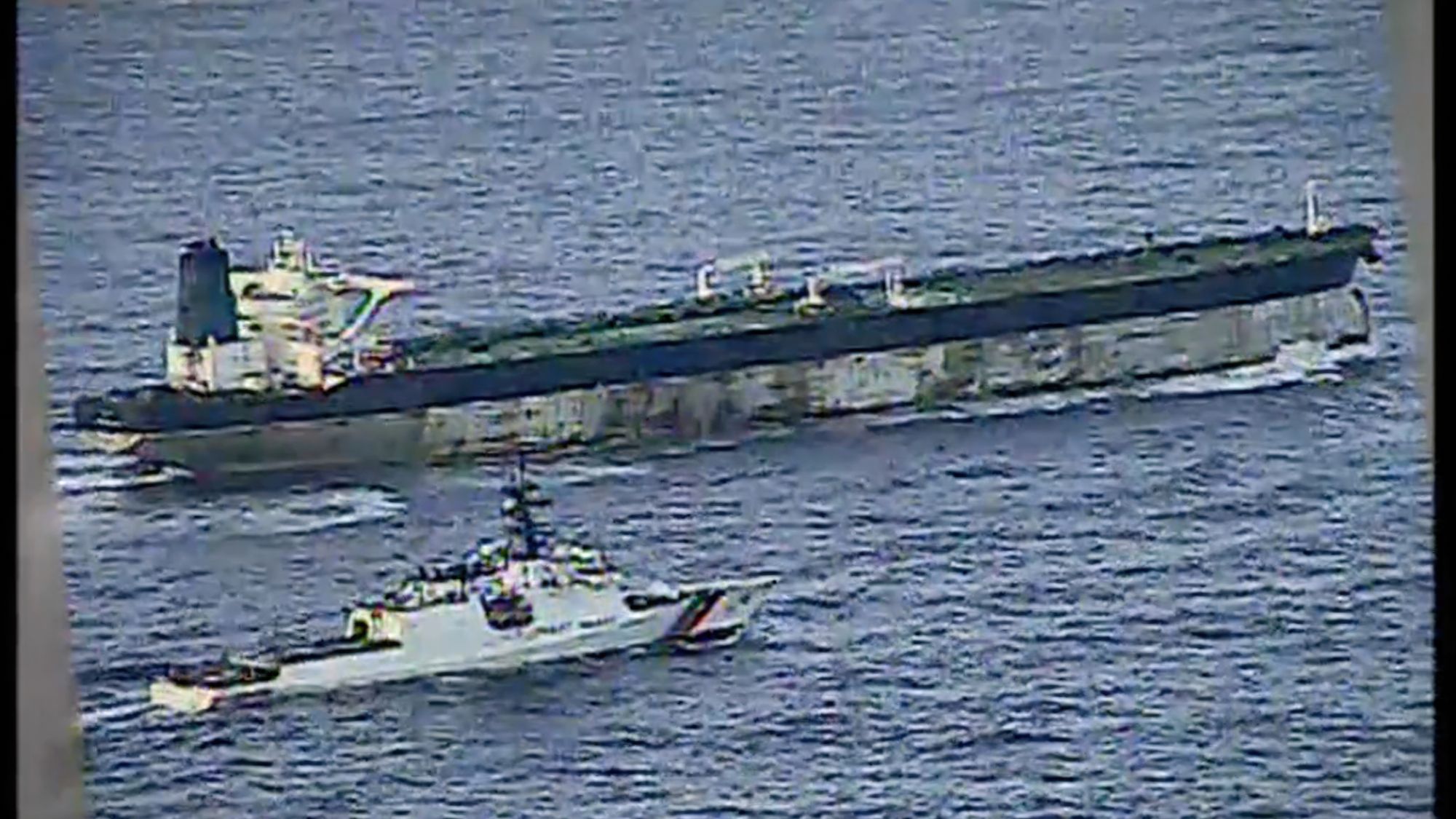
    The U.S. military and Coast Guard yesterday seized two oil tankers in separate operations aimed at controlling the flow of oil out of Venezuela. U.S. special forces boarded the Marinera near Iceland after a weekslong chase across the Atlantic that included the tanker changing its name from Bella 1 and its flag from Guyana to Russia. The U.S. also commandeered another “shadow fleet” tanker, the Sophia, in the Caribbean Sea, alleging unspecified “illicit activities.”

    Who said what
    The seizure of the Marinera drew condemnation from China, the main customer for Venezuela’s sanctioned oil, and Russia, which had added the empty tanker to its Maritime Register of Shipping after the Coast Guard started pursuing it in December. “Adding to the stakes,” The Wall Street Journal said, a “ Russian navy ship and submarine began escorting the ship” days ago.

    The Trump administration said it had legal authority to board the Marinera because it was flying a false flag. The ship’s “embrace of the Russian flag is part of a broader trend in which so-called shadow tanker vessels have sought the imprimatur of Russian protection,” The New York Times said. “For years, aged shadow vessels” have “provided a lifeline to states like Venezuela, Iran and Russia,” but it appears the “shadow fleet is stepping out of the shadows” as “Western nations have stepped up enforcement against the illicit oil trade around the globe.” 

    What next?
    Energy Secretary Chris Wright said yesterday that the Trump administration will allow sanctioned Venezuelan oil to flow again, but only to U.S. refineries, with the sales “done by the U.S. government and deposited into accounts controlled by the U.S. government.”


    It’s not all bad

    Researchers have developed a way to inhibit the protein 15-PGDH, which is more prevalent in the body as people age and contributes to osteoarthritis. Injecting the inhibitor into old mice blocked the protein’s degenerative activity, preventing the loss of knee cartilage and the onset of arthritis after knee injuries, according to a study from Stanford Medicine. The first-of-its-kind inhibitor actually triggers a “dramatic regeneration of cartilage beyond that reported in response to any other drug or intervention,” said study senior author Dr. Nidhi Bhutani.


    Under the radar

    Drones detect a deadly threat to Arctic whales

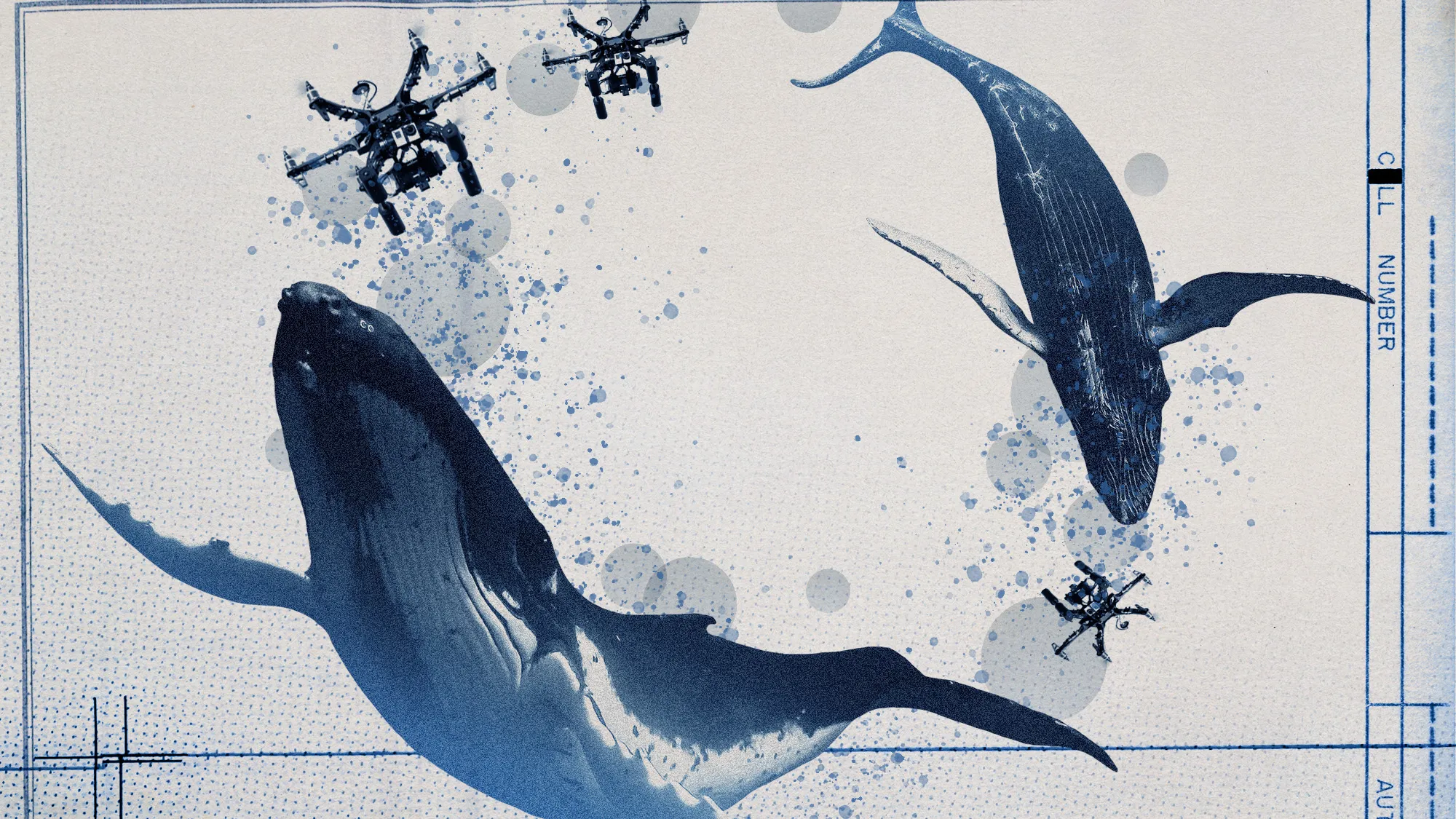
    Arctic marine life is notoriously difficult to study because of its remoteness. But drones have enabled scientists to monitor and diagnose Arctic whales while being minimally invasive, according to a study published in the journal BMC Veterinary Research. 

    The drones collect samples of whale breath, or “blow,” from humpback, sperm and fin whales in the northeast Atlantic to screen for pathogens. And using this data, researchers have “confirmed for the first time that a potentially deadly whale virus” is “circulating above the Arctic Circle,” said a news release about the study. The pathogen, cetacean morbillivirus, can cause “immunosuppression and severe disease in cetaceans,” said NPR. The disease has previously caused “several mass die-offs” of whales, dolphins and porpoises.

    When whales come to the surface of the ocean to breathe, they “release a plume of air mixed with microscopic droplets from their blowholes,” said Discover. The droplets “carry traces of cells, microbes and viruses from the animals’ respiratory systems.” Researchers “hovered the drone over a whale that looked like it was about to blow” and then “captured the exhales on petri dishes,” said NPR. 

    “Drone blow sampling is a game changer,” Terry Dawson, a professor at King’s College in London and a co-author of the study, said in the release. Drone surveillance can also identify deadly threats to other marine life before they spread. 

    Arctic wildlife is facing challenges that include “shifting prey” and shrinking territory, said Discover. Climate change is warming the seas, and the “expanding shipping routes and growing human presence are altering habitats that many species rely on for feeding and migration.” And infectious disease can “compound those pressures, particularly when animals are stressed or concentrated in smaller areas.”


    On this day

    January 8, 1835

    President Andrew Jackson paid off the federal government’s entire debt — the first and only time in U.S. history that the national debt has been $0. His short-lived feat was followed two years later by the Panic of 1837. The national debt hit $38.5 trillion at the start of this year.


    TODAY’S newspaperS

    ‘Edge of disaster’

    “ICE agent shoots, kills woman in Minneapolis,” the Chicago Tribune says on Thursday’s front page. Governor, Minneapolis mayor “rip federal account of fatal shooting,” says The Minnesota Star Tribune. “Twin Cities tragedy echoes Second City ICE shootings,” the Chicago Sun-Times says. “ICE targets Home Depot in Phoenix,” suggesting Arizona “could be next focus for arrests,” the Arizona Republic says. “Trump is emboldened” by “high-risk attacks,” but “U.S. raid on Caracas skirted on edge of disaster,” The New York Times says. “Venezuela muddies Trump’s message,” USA Today says. “Trump Doctrine confounds allies, foes,” The Wall Street Journal says. “New dietary advice favors whole milk and red meat,” says The Washington Post.

    ► See the newspaper front pages


    Tall tale

    Frog-eyed

    The police department in Heber City, Utah, retracted an AI-generated report claiming an officer transformed into a frog. The agency used the software Draft One to scan body-cam footage, and when it picked up a TV in the background playing “The Princess and the Frog,” the AI determined this was the officer turning into an amphibian. Officers now understand the “importance of correcting these AI-generated reports,” Sgt. Rick Keel told Fox 13 News.


    Morning Report was written and edited by Nadia Croes, Catherine Garcia, Scott Hocker, Anya Jaremko-Greenwold, Justin Klawans, Rafi Schwartz, Peter Weber and Kari Wilkin, with illustrations by Stephen Kelly and Julia Wytrazek.

    Image credits, from top: Stephen Maturen / Getty Images; Timothy A. Clary / AFP via Getty Images; Kristi Noem via X; Illustration by Julia Wytrazek / Getty Images
     

    Recent editions

    • Evening Review

      Is the Constitution on ‘firm’ ground?

    • Morning Report

      Trump’s NATO threat

    • Evening Review

      What’s Trump eyeing after Venezuela?

    VIEW ALL
    TheWeek
    • About Us
    • Contact Future's experts
    • Terms and Conditions
    • Privacy Policy
    • Cookie Policy
    • Advertise With Us
    • FAQ
    Add as a preferred source on Google

    The Week is part of Future US Inc, an international media group and leading digital publisher. Visit our corporate site.

    © Future US, Inc. Full 7th Floor, 130 West 42nd Street, New York, NY 10036.