The Week The Week
flag of US
US
flag of UK
UK
https://cdn.mos.cms.futurecdn.net/flexiimages/jacafc5zvs1692883516.jpg

SUBSCRIBE & SAVE

Less than $3 per week

Sign in
  • View Profile
  • Sign out
  • The Explainer
  • The Week Recommends
  • Newsletters
  • Cartoons
  • From the Magazine
  • The Week Junior
  • Student Offers
  • More
    • Politics
    • World News
    • Business
    • Health
    • Science
    • Food & Drink
    • Travel
    • Culture
    • History
    • Personal Finance
    • Puzzles
    • Photos
    • The Blend
    • All Categories
  • Newsletter sign up Newsletter
  • Brand Logo
    Drone chaos, Bondi brawl and tariff revolt

     
    TODAY’S AViATION story

    El Paso airspace closure tied to FAA-Pentagon standoff

    What happened
    The Federal Aviation Administration’s abrupt hourslong closure of El Paso’s airspace yesterday stemmed from a standoff between the Transportation Department, Defense Department and Department of Homeland Security over testing an anti-drone laser weapon, according to news organizations. The FAA late Tuesday grounded all flights in and around El Paso and a nearby stretch of New Mexico for 10 days, citing “special security reasons,” before backtracking yesterday morning amid an outcry in Washington, D.C., and Texas. 

    Who said what
    Transportation Secretary Sean Duffy said on social media that the FAA and Pentagon had “acted swiftly to address a cartel drone incursion” and “the threat has been neutralized.” Trump administration officials have been “slinging blame back and forth in private” about the extraordinary airspace closure, Axios said, but their “official statements mirror Duffy’s language around a drone incursion.” Lawmakers and El Paso officials said that explanation made little sense, in part because drone incursions from Mexico are a daily occurrence along the border.

    The drone “assertion” was also “undercut by multiple people familiar with the situation, who said that the FAA’s extreme move came after immigration officials earlier this week used an anti-drone laser” from Fort Bliss, which abuts El Paso International Airport, The New York Times said. The FAA and Pentagon had a Feb. 20 meeting scheduled to “discuss the safety implications of deploying” the military’s “high-energy laser,” but Customs and Border Protection officials preemptively “deployed the technology” without giving the FAA “enough time to assess the risks to commercial aircraft.” 

    FAA officials are concerned because “high-powered lasers can temporarily blind or distract pilots, leading to eye injuries and potential loss of aircraft control, particularly during takeoffs and landings,” The Wall Street Journal said. In this case, CBP used the laser to “counter what officials believed to be a drone” but “was actually a party balloon.” According to “several sources,” CBS News said, “one balloon was shot down.”

    What next?
    The incident was “yet another in a line of misfires between the FAA and Defense Department, including last year’s 67-fatality midair crash over the Potomac River,” Politico said. Sens. Ted Cruz (R-Texas) and John Cornyn (R-Texas) said they wanted a classified briefing on the incident from the FAA and Pentagon. 


    TODAY’S POLITICS story

    Bondi, Democrats clash over Epstein in hearing

    What happened
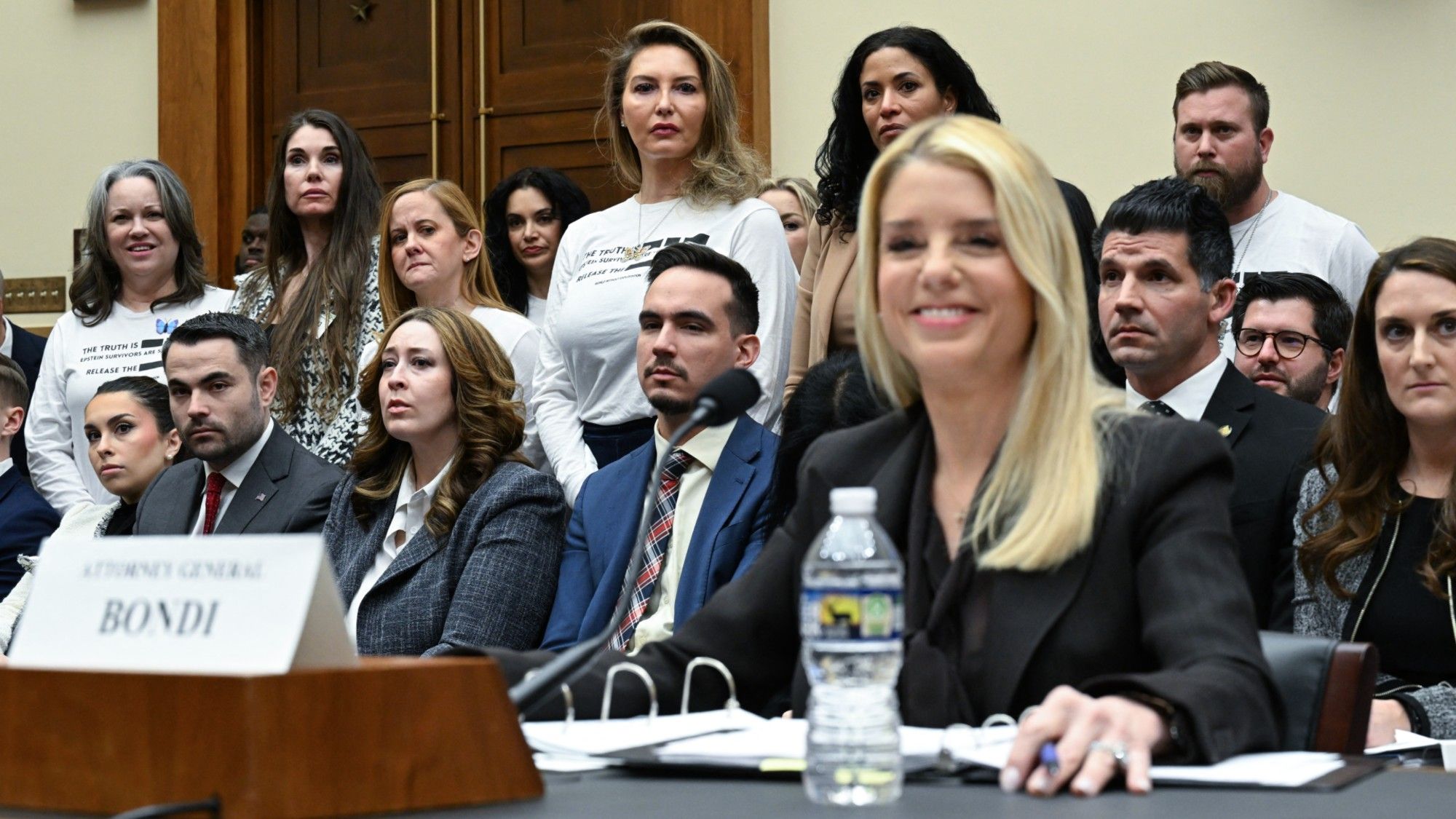
    Attorney General Pam Bondi yesterday sparred with Democrats and praised President Donald Trump in a heated House Judiciary Committee hearing that focused largely on the Justice Department’s handling of the Jeffrey Epstein case. Bondi (pictured above) pointedly refused to apologize to Epstein victims sitting behind her and deflected most questions from Democrats and Rep. Thomas Massie (R-Ky.) with insults drawn from a binder she brought to the hearing. The contentious five-hour hearing also touched on Trump’s immigration actions and Bondi’s efforts to prosecute the president’s perceived enemies. 

    Who said what
    Throughout the “bitter back-and-forth” with Democrats, The New York Times said, Bondi largely imitated Trump’s “tactic of going on the attack when facing tough questions,” offering “few detailed answers” and “no admissions of fault.” Bondi offered a “passionate defense” of Trump but struggled to “turn the page from relentless criticism” of her department’s mishandling of the Epstein files, The Associated Press said.

    Going into yesterday’s hearing, Democrats were expecting Bondi “to be nonresponsive and combative,” Politico said. “They walked out with what they believe to be a more compelling argument for winning back the majority.” Facing “an American public that really does want answers,” CNN said, Bondi instead performed for an “audience of one,” which may end up being “politically unwise.”

    What next?
    Bondi “hinted of further investigations of Trump critics in the works,” The Washington Post said. Rep. Jamie Raskin (D-Md.) told reporters that if Democrats won control of the House in November, “we would subpoena her, and we would require her to answer our questions.” Massie said his fellow Republicans went easy on Bondi because “nobody wants to get on the bad side of Trump,” but “that’ll change once we get past our primaries.”


    TODAY’S GLOBAL TRADE Story

    House votes to end Trump’s Canada tariffs

    What happened
    The House yesterday voted 219-211 to rescind President Donald Trump’s tariffs on Canada, with six Republicans joining all but one Democrat to pass the resolution. The Senate passed similar measures last year, but House Speaker Mike Johnson (R-La.) (pictured above) had blocked such votes in his chamber for the past year through a procedural move that expired last month. Three Republicans joined Democrats on Tuesday to defeat Johnson’s effort to renew the blockade on tariff votes until August. 

    Who said what
    Yesterday’s resolution would rescind the “national emergency” of fentanyl smuggling that Trump declared last year to justify slapping import taxes on Canada. As Johnson’s team was leaning on GOP defectors to switch their vote yesterday, Trump warned on social media that “any Republican, in the House or the Senate, that votes against TARIFFS will seriously suffer the consequences come Election time, and that includes Primaries!”

    The rebuke of the president’s signature economic policy was a “rare instance of GOP defections at a time when Trump still maintains a strong grip over the party,” CNN said. But “Trump’s tariffs have proven politically unpopular,” even among many “self-identified MAGA Republicans,” Politico said. A Pew Research Center survey this month found that 60% of Americans disapprove of Trump’s import taxes. The Congressional Budget Office said yesterday that Americans are paying 95% of the tariff burden.

    What next?
    The Senate now “must vote on the issue again,” and a “simple majority vote” would send the measure to Trump, The Wall Street Journal said. The resolution “stands a good chance of passage in the Senate,” Reuters said, but there aren’t enough GOP votes to override Trump’s certain veto. Still, “it won’t be the last tough tariffs vote for Trump,” CNN said. “Democrats have successfully unlocked a procedural power to force more votes.”


    It’s not all bad

    In a potential new approach to fighting Alzheimer’s disease, researchers used engineered chimeric antigen receptor (CAR) T-cells to target amyloid beta plaques in mice brains. These plaques are a hallmark of Alzheimer’s, and the study from Washington University School of Medicine in St. Louis and Israel’s Weizmann Institute of Science is the first to use CAR-T therapy for a neurodegenerative disease. Researchers also determined that mice treated with CAR-T cells had healthier brains compared to those given control T-cells.


    Under the radar

    The Buddhist monks who crossed the US for peace

    After more than 100 days on the road, a party of Buddhist monks has arrived in Washington, D.C., completing a 2,300-mile “walk for peace” from Texas. The group, which set off from a temple near Fort Worth in late October, numbers about two dozen and includes monks from Thailand, Vietnam, France, Burma and Sri Lanka. They have amassed more than five million followers across Facebook, Instagram and TikTok over the course of their journey, according to Rolling Stone. 

    The monks plan to use their visit to the capital to petition for Vesak — the Buddha’s birthday — to be recognised as a national holiday, said the BBC. But they stressed on Dhammacetiya, their official website, that they were not marching with a political agenda or to “force peace upon the world, but to help nurture it, one awakened heart at a time.”

    The journey has “not been easy,” said The New York Times. The Southern states they passed through experienced an “unusually harsh” winter. And even before the group left Texas, a truck driver accidentally crashed into one of their support vehicles, which in turn struck two of the monks, one of whom was so severely injured that he required a leg amputation. 

    At every stage of the journey, crowds have “swarmed” around the monks, added the Times. These supporters have “transcended racial, religious, economic, educational and geographic lines,” sharing a common belief that the monks were providing “comfort, hope and encouragement” that “otherwise seemed to be in short supply” in the politically polarized nation.


    On this day

    February 12, 1909

    The National Association for the Advancement of Colored People (NAACP) was founded to fight racism and help achieve equality for Black people. The group played a major role in the Civil Rights Movement of the 1960s and remains the country’s oldest civil rights group. Today, it has about 425,000 members.


    TODAY’S newspaperS

    ‘Midterm anxiety’

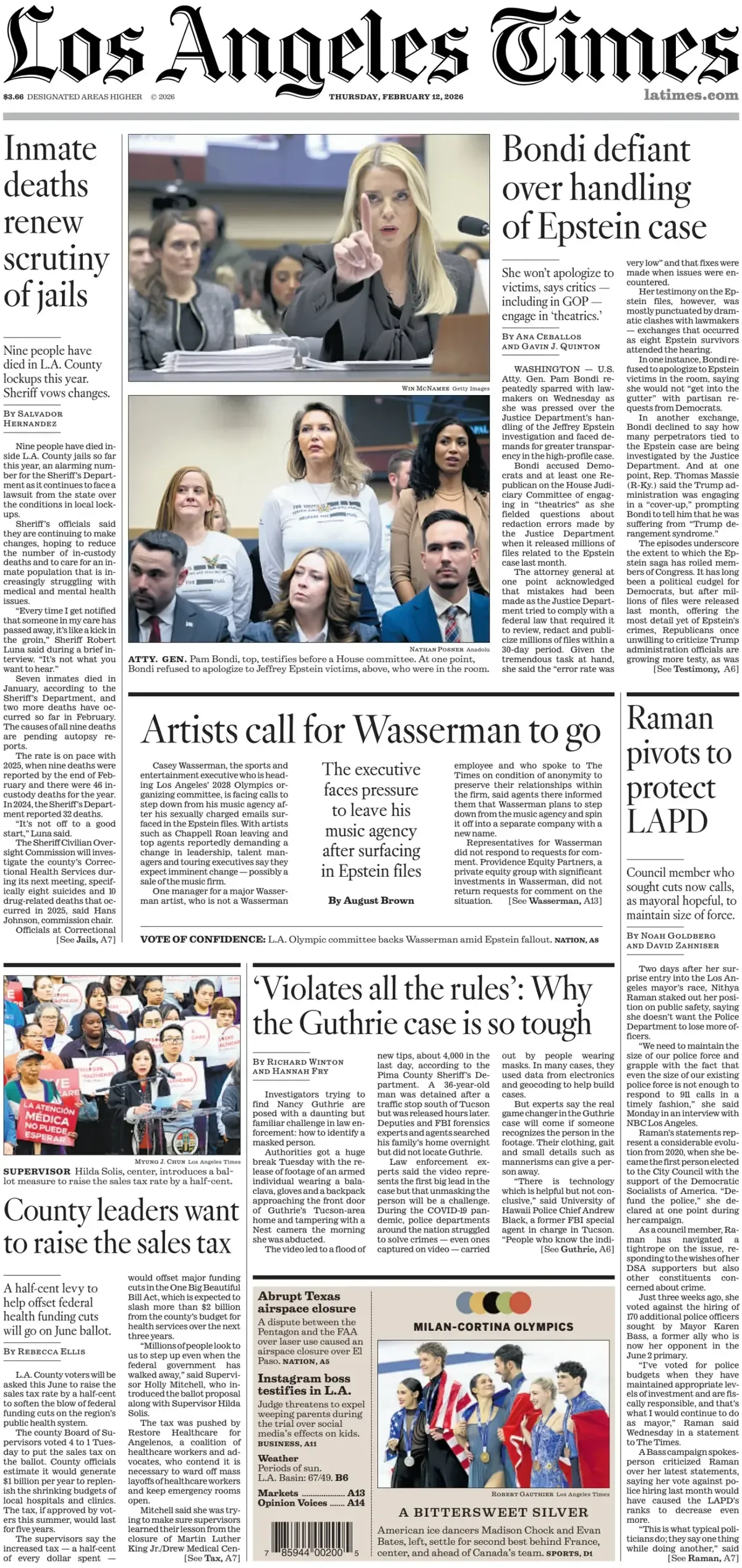
    “Bondi defiant over handling of Epstein case” and “won’t apologize to victims,” the Los Angeles Times says on Thursday’s front page. “Slotkin: Trump failed to indict me,” the Detroit Free Press says. “Lawmaker from N.H. shocked Trump tried to prosecute her,” The Boston Globe says. “Judges are excoriating ICE in their rulings,” USA Today says. “She bounced a $25 check in 2014. ICE tried to deport her,” The Washington Post says. “GOP’s cash lead gives Democrats midterm anxiety,” The New York Times says. “Hiring rebounded in January” but “revisions sharply cut ’25 totals,” says The Wall Street Journal. Search for Savannah Guthrie’s mother “resumes in Tucson,” says the Arizona Republic.

    ► See the newspaper front pages


    Tall tale

    Such great heights

    Almost a year after pulling out of a competition due to his fear of heights, ski jumper Philipp Raimund took home a gold medal at the Milan Cortina Olympics. The 25-year-old German, who entered the Olympics ranked sixth in the world, flew 106.5 meters in the men’s normal hill competition to win the gold. Raimund has been open about his aversion to heights, and winning a top medal at his first Olympics was “un-f—ing-believable,” he said.


    Morning Report was written and edited by Will Barker, Nadia Croes, Catherine Garcia, Scott Hocker, Anya Jaremko-Greenwold, Justin Klawans, Rafi Schwartz, Peter Weber and Kari Wilkin, with illustrations by Stephen Kelly and Julia Wytrazek.

    Image credits, from top: Mehmet Yaren Bozgun / Anadolu via Getty Images; Roberto Schmidt / AFP / Getty Images; Michael M. Santiago / Getty Images; Sean Rayford / Getty Images
     

    Recent editions

    • Evening Review

      Cuba’s fuel crisis

    • Morning Report

      Another grand jury rebuffs Trump

    • Evening Review

      Lines in the sand on ICE

    VIEW ALL
    TheWeek
    • About Us
    • Contact Future's experts
    • Terms and Conditions
    • Privacy Policy
    • Cookie Policy
    • Advertise With Us
    • FAQ
    Add as a preferred source on Google

    The Week is part of Future US Inc, an international media group and leading digital publisher. Visit our corporate site.

    © Future US, Inc. Full 7th Floor, 130 West 42nd Street, New York, NY 10036.