The Week The Week
flag of US
US
flag of UK
UK
https://cdn.mos.cms.futurecdn.net/flexiimages/jacafc5zvs1692883516.jpg

SUBSCRIBE & SAVE

Less than $3 per week

Sign in
  • View Profile
  • Sign out
  • The Explainer
  • The Week Recommends
  • Newsletters
  • Cartoons
  • From the Magazine
  • The Week Junior
  • Student Offers
  • More
    • Politics
    • World News
    • Business
    • Health
    • Science
    • Food & Drink
    • Travel
    • Culture
    • History
    • Personal Finance
    • Puzzles
    • Photos
    • The Blend
    • All Categories
  • Newsletter sign up Newsletter
  • Brand Logo
    Bondi firing, Army purge and the EPA’s MAHA nod

     
    TODAY’S WHITE HOUSE story

    Trump fires Bondi after tumultuous tenure

    What happened
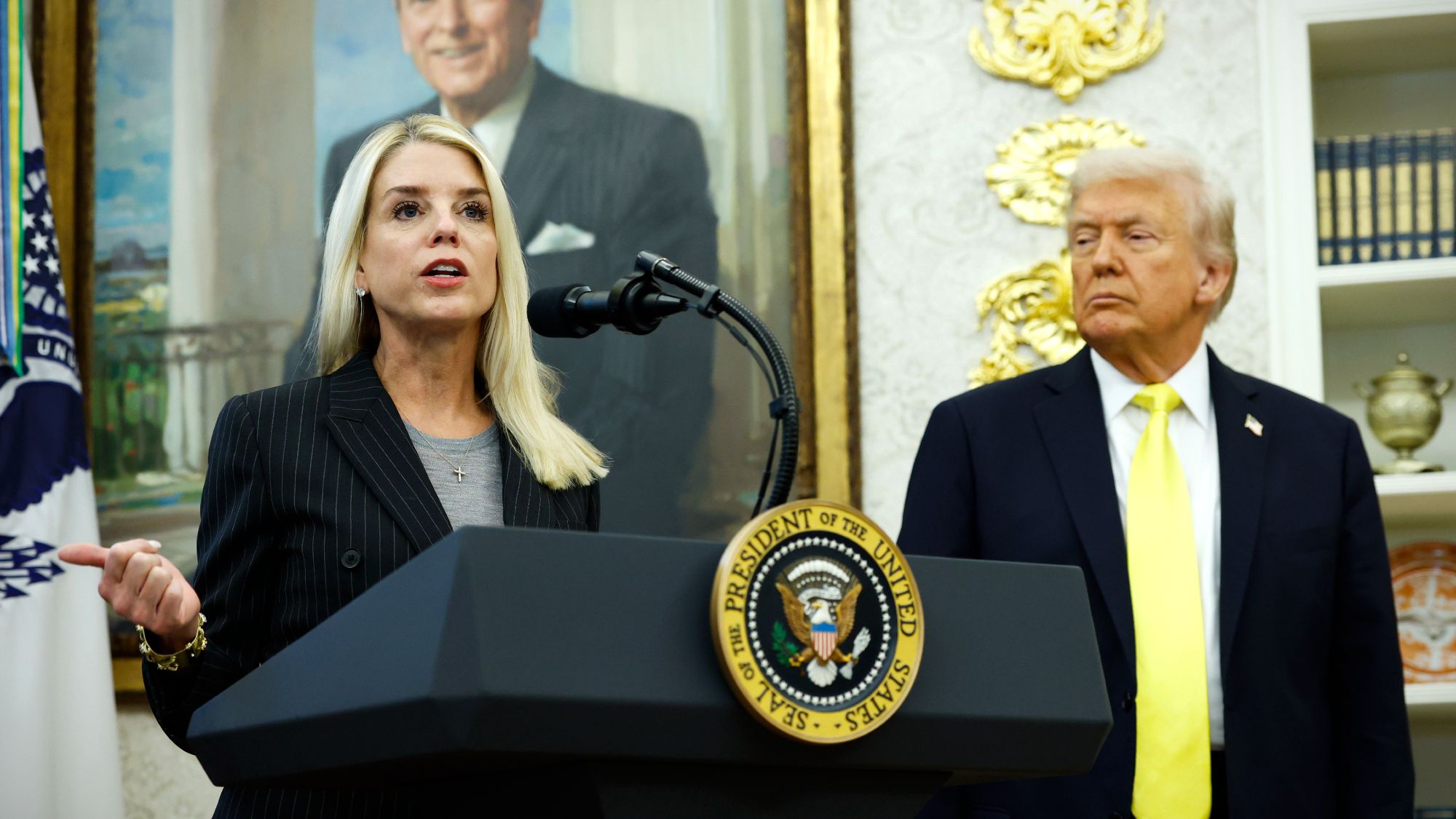
    President Donald Trump yesterday fired Attorney General Pam Bondi, saying in a social media post she would be leaving the Justice Department for an unidentified “much needed and important new job in the private sector.” Trump said Deputy Attorney General Todd Blanche, his former criminal defense lawyer, would serve as acting attorney general. 

    Who said what
    Bondi’s ouster ends a “tumultuous 14-month tenure” that was largely “defined by her unyielding willingness to respond to Trump’s demands and desire to reshape the Justice Department in his image,” The Washington Post said. She “oversaw the hollowing out” of the department, “firing scores of experienced prosecutors deemed insufficiently loyal to the president.”

    Bondi also “quickly set out to do Trump’s bidding” by “opening investigations into his political foes,” The Associated Press said. But Trump became increasingly “incensed that she had not successfully prosecuted a number of his political enemies,” The Wall Street Journal said, and “frustrated she didn’t do more to contain fallout” from the Jeffrey Epstein sex trafficking files.

    “People are going to say it’s Epstein,” a person who discussed the matter with Trump told Axios. But “this was all about his enemies list and Pam wasn’t getting the indictments.” Trump had “many good reasons” to fire Bondi, Jeffrey Toobin said in a New York Times op-ed. “Her failure to serve his need for revenge against his enemies” is the “single bad one.”

    What next?
    Bondi is expected to leave in 45 days, Axios said. EPA chief Lee Zeldin and Blanche are widely reported to be in the running to replace her. Bondi “did almost everything Donald Trump asked” and “it wasn’t enough,” Politico said, so one of the “crucial questions” for her successor is: “How far will you go to avoid Bondi’s fate?” 


    TODAY’S MILITARY story

    Hegseth ousts top Army officer, expanding purge

    What happened
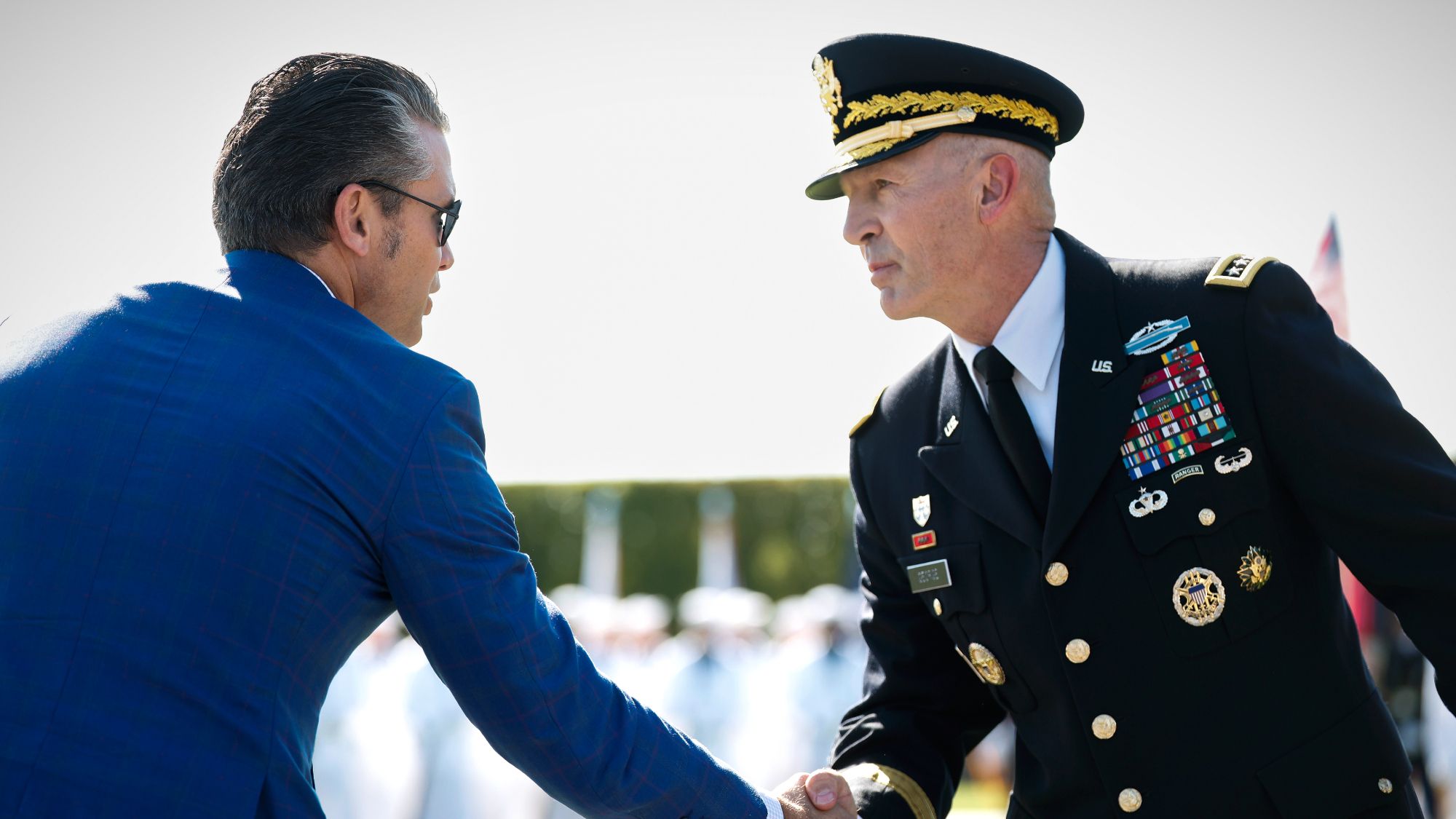
    Defense Secretary Pete Hegseth yesterday ousted Army Chief of Staff Gen. Randy George without explanation. A Pentagon spokesperson said that George (pictured above right, with Hegesth) “will be retiring” as the Army’s top uniformed officer, “effective immediately.” Hegseth also reportedly fired Gen. David Hodne, head of Army’s new Transformation and Training Command, and Maj. Gen. William Green, chief of the Army Chaplain Corp.

    Who said what
    With George’s dismissal, Hegseth has “removed most of the leaders of the military services,” The Wall Street Journal said. He has “moved quickly” to reshape the Pentagon, Reuters said, but “firing a general during wartime is nearly without precedent.”

    “Senior Army officers reacted with anger and frustration” to George’s abrupt removal, The New York Times said. His tensions with Hegseth were “not rooted in substantive differences” over Army policy, but instead reflected Hegseth’s “long-running grievances with the Army,” his “troubled relationship” with Army Secretary Dan Driscoll and a clash over Hegseth’s “highly unusual” decision to block the promotion of four Army officers, two of whom are Black and two women. George had forged a tight partnership with Driscoll, “whom Hegseth has perceived as a threat” due to his close White House ties, CNN said. “Hegseth can’t fire Driscoll,” an administration official told The Washington Post. “So he’s going to make his life hell.”

    What next?
    Hegseth was expected to replace George with Gen. Christopher LaNeve, the recently installed Army vice chief of staff and Hegseth’s former top military aide. 


    TODAY’S PUBLIC HEALTH Story

    EPA puts microplastics, drugs on tap water list

    What happened
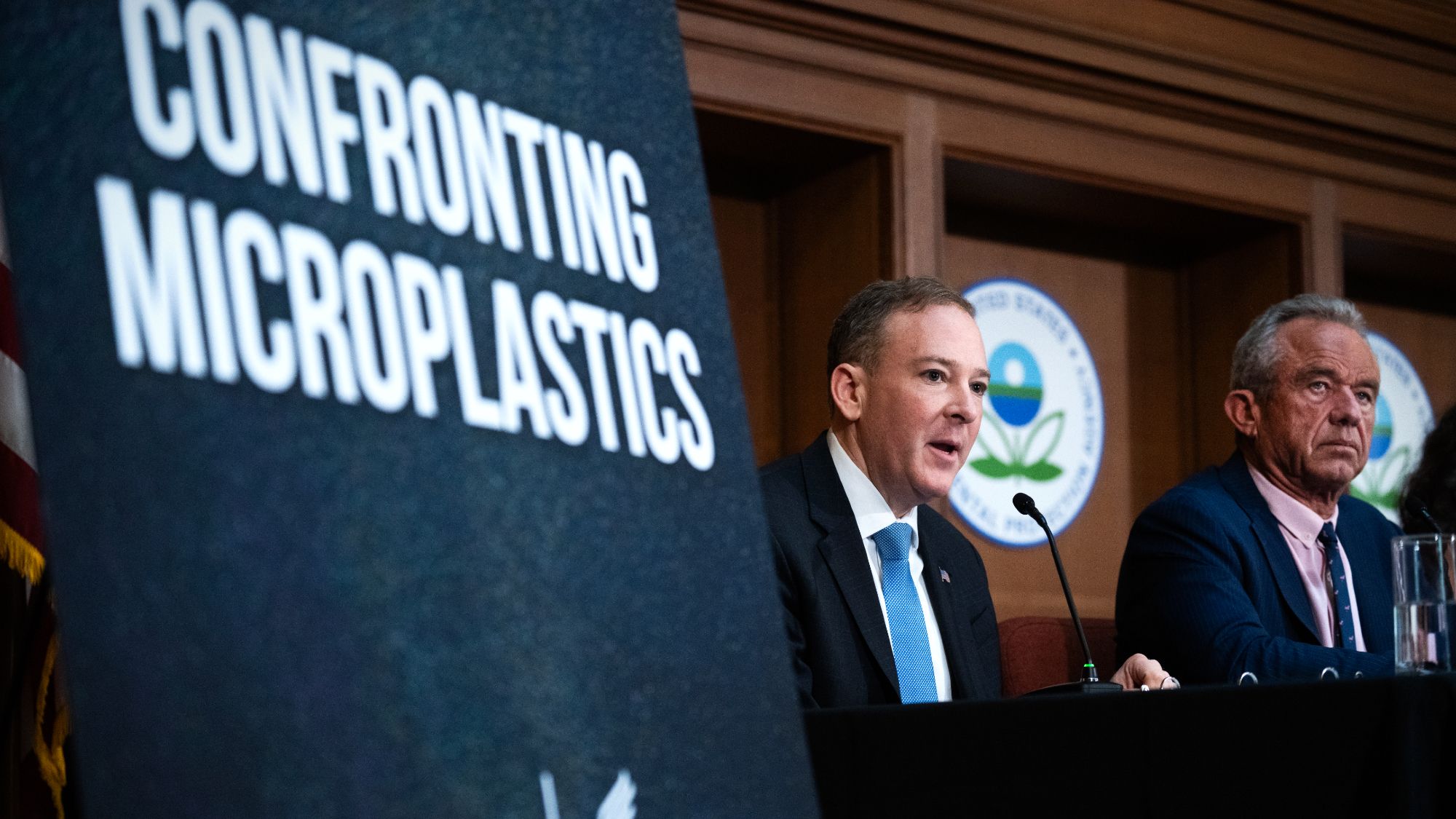
    Environmental Protection Agency chief Lee Zeldin yesterday said his agency has added microplastics and pharmaceuticals to a draft list of contaminants in drinking water, describing it as a “historic step” for the Make America Healthy Again (MAHA) movement. Health and Human Services Secretary Robert F. Kennedy Jr., a MAHA champion, joined Zeldin at yesterday’s briefing to announce a $144 million initiative to study and measure microplastics in drinking water. 

    Who said what
    “This is a direct response to the concern of millions of Americans, who have long demanded answers about what they and their families are drinking every day,” said Zeldin (pictured above, with Kennedy). The EPA is required to update the Contaminant Candidate List every five years under the Safe Drinking Water Act. 

    Adding microplastics and pharmaceuticals to the list “gives local regulators a tool to evaluate risks in their water supply,” NPR said, but it “doesn’t actually guarantee” research or regulatory limits. In fact, the EPA “rarely moves pollutants off the list,” The Associated Press said. “I think it’s fair to call this theater,” Earthjustice attorney Katherine O’Brien told NPR, and a “distraction from the real harm that these very same agencies are doing by undermining actual legal protections” against toxic chemicals in drinking water and food. “This is an important first step,” said Gannon University plastic pollution researcher Sherri Mason, “and I think we should recognize that.”

    What next?
    The draft Contaminant Candidate List will be open for public comment for 60 days and is expected to be finalized by mid-November. 


    It’s not all bad

    A woman has been declared cancer-free after receiving a new dual immunotherapy treatment for Stage 3 colorectal cancer. Mrinali Dhembla, 26, has Lynch syndrome, an inherited genetic condition that increases the risk of developing colorectal cancer early. Because of the mutations in her cancer cells, Dhembla was an “excellent candidate” for immunotherapy, her oncologist, Dr. Nicholas Hornstein, told ABC News. The treatment gave her immune system a “boost” to become “effective at eradicating” the tumors.


    Under the radar

    India’s ‘reversal’ of transgender rights

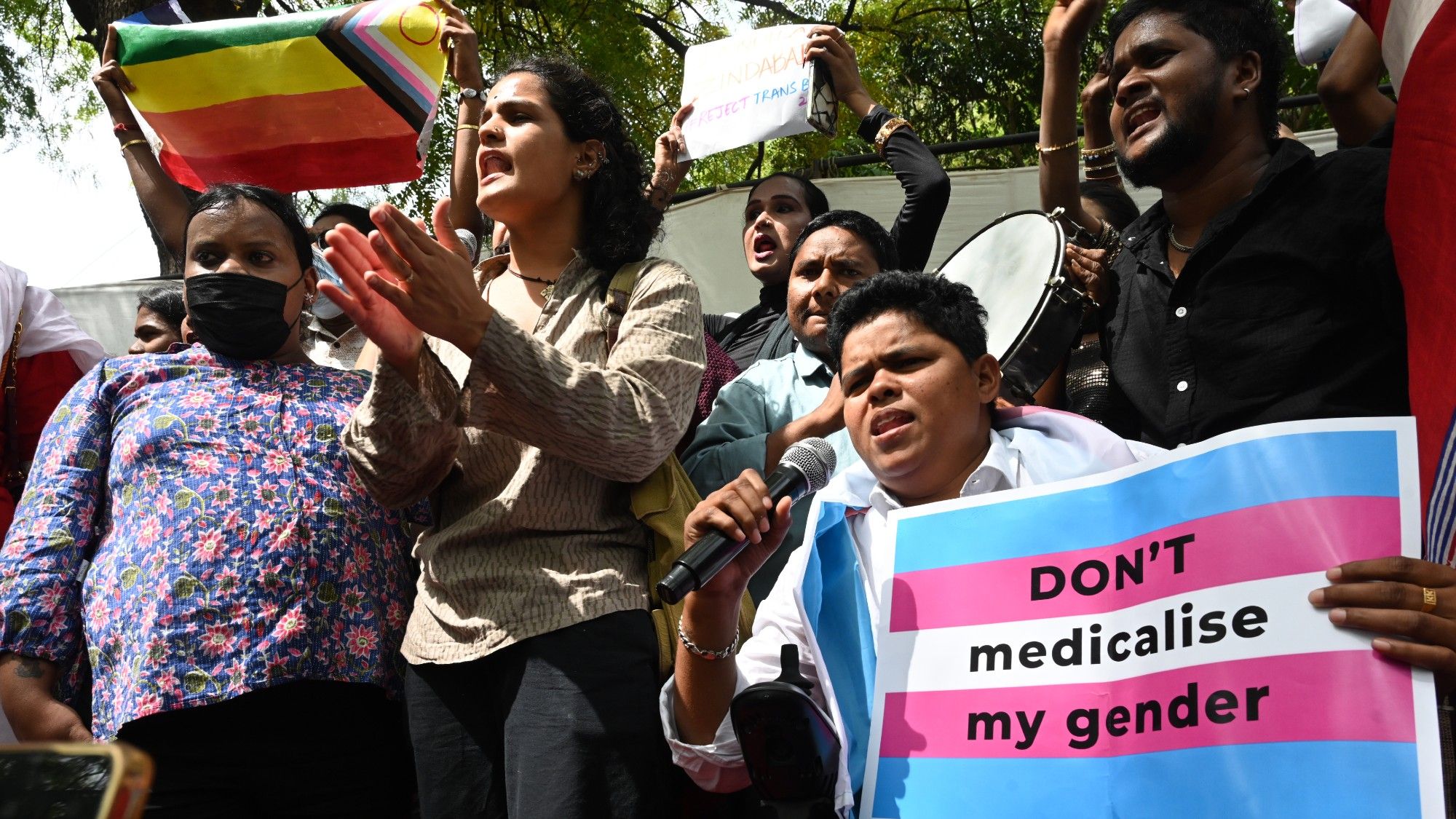
    India has long recognized a “third gender” and was one of the first countries to allow people to legally self-identify as transgender. But its parliament just passed amendments to such laws that remove the right to self-identification and narrow the definition of “transgender.” 

    The Bharatiya Janata Party–led government got the bill through both houses last week despite a boycott by opposition parties and widespread protests by the LGBTQ+ community. Virendra Kumar, the minister for social justice and empowerment, claims the amendments still protect people who “face severe social exclusion due to their biological condition.” But Congress Party leader Rahul Gandhi called it a “brazen attack” on transgender rights. 

    People of a “third gender” have been recognized in India for thousands of years. They feature heavily in Hindu holy texts — for example, the half-male, half-female deity Ardhanarishvara — and were often revered under Muslim rulers of the Mughal Empire. 

    In 2014, India’s Supreme Court officially recognized third-gender people as “being citizens deserving of equal rights.” And that paved the way for the 2019 Transgender Persons (Protection of Rights) Act, which affirmed the right to self-identify as transgender or nonbinary. The new amendments to the 2019 law remove those rights to self-identify, requiring instead a medical certification of gender reassignment. 

    If Indian President Droupadi Murmu signs the bill into law, it will be “a major reversal” of “hard-won rights,” said Jayshree Bajoria, the Asia director of Human Rights Watch. This law, said N. Kavitha Rameshwar at The Times of India, “seeks to be that one rogue wave that will wash away” a decade of progress in transgender rights “as if it were all but a castle of sand.”


    On this day

    April 3, 1966

    The Soviet Union’s Luna 10 became the first spacecraft to orbit the moon. Soviet Russia was also the first country to crash and land a spacecraft on the lunar surface, but only the U.S. has sent people to or around the moon. NASA’s Artemis II, expected to circle the moon next week, marks humanity’s first lunar travel since 1972.


    TODAY’S newspaperS

    ‘Fast start, murky ending?’

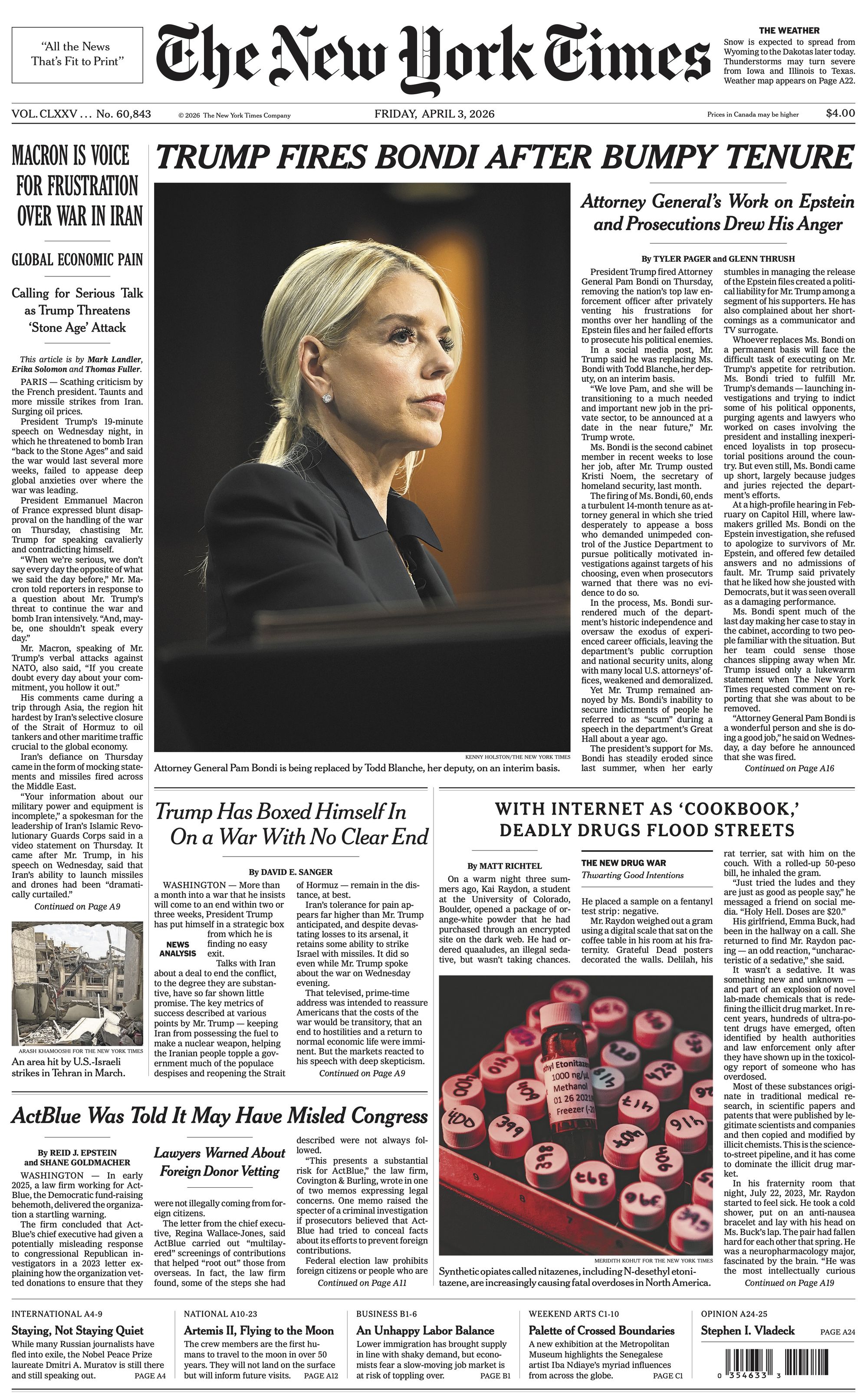
    “Trump has boxed himself in on a war with no clear end,” The New York Times says on Friday’s front page. “Iran war: Fast start, murky ending?” says USA Today. “Trump’s Iran speech fails to allay worries, at home and abroad,” the Los Angeles Times says. “Americans don’t buy president’s Iran pitch,” The Washington Post says. “Iran girds against U.S. ground threat,” The Wall Street Journal says. “Mosque president, activist detained by ICE,” says the Milwaukee Journal Sentinel. “View from space is ‘absolutely phenomenal,’” The Minnesota Star Tribune says. “Bondi is out as attorney general,” The Boston Globe says. “Dems to Bondi: ‘Good riddance,’” says The Philadelphia Inquirer. 

    ► See the newspaper front pages


    Tall tale

    Burgle bungle

    A serial bank robber in New York City accused of hitting six Chase branches over five days walked away with just $605. The suspect, Gustavo DeJesus Torres, allegedly handed the tellers notes demanding money and threatening harm if they didn’t comply, police said. He nabbed $320 from a branch in Queens and $265 from one in Brooklyn, but it was all downhill from there; he walked away with $20 from a Manhattan branch and left three of the banks empty-handed.


    Morning Report was written and edited by Nadia Croes, Catherine Garcia, Scott Hocker, Anya Jaremko-Greenwold, Justin Klawans, Harriet Marsden, Rafi Schwartz, Peter Weber and Kari Wilkin, with illustrations by Stephen Kelly and Julia Wytrazek.

    Image credits, from top: Kevin Dietsch / Getty Images; Kevin Dietsch / Getty Images; Tom Williams / CQ-Roll Call Inc. via Getty Images; Sonu Mehta / Hindustan Times / Getty Images
     

    Recent editions

    • Evening Review

      The US goes rogue

    • Morning Report

      NASA shoots for the moon

    • Evening Review

      Could Kharg Island end the war?

    VIEW ALL
    TheWeek
    • About Us
    • Contact Future's experts
    • Terms and Conditions
    • Privacy Policy
    • Cookie Policy
    • Advertise With Us
    • FAQ
    Add as a preferred source on Google Add as a preferred source on Google

    The Week is part of Future US Inc, an international media group and leading digital publisher. Visit our corporate site.

    © Future US, Inc. Full 7th Floor, 130 West 42nd Street, New York, NY 10036.