The Week The Week
flag of US
US
flag of UK
UK
https://cdn.mos.cms.futurecdn.net/flexiimages/jacafc5zvs1692883516.jpg

SUBSCRIBE & SAVE

Less than $3 per week

Sign in
  • View Profile
  • Sign out
  • The Explainer
  • The Week Recommends
  • Newsletters
  • Cartoons
  • From the Magazine
  • The Week Junior
  • Student Offers
  • More
    • Politics
    • World News
    • Business
    • Health
    • Science
    • Food & Drink
    • Travel
    • Culture
    • History
    • Personal Finance
    • Puzzles
    • Photos
    • The Blend
    • All Categories
  • Newsletter sign up Newsletter
  • Brand Logo
    Ceasefire confusion, Bondi noncompliance and Gilgo guilty pleas

     
    TODAY’S IRAN WAR story

    US-Iran ceasefire teeters as Israel hammers Lebanon

    What happened
    The two-week ceasefire announced by President Donald Trump and Iranian officials on Tuesday faltered yesterday as the U.S., Iran and Israel argued over whether it covered the Israel-Hezbollah fight in Lebanon. Iran also accused the U.S. of violating several tenets of the agreement, and closed the Strait of Hormuz in response to Israeli strikes on Lebanon that killed at least 254 people.

    Who said what
    Pakistan’s Prime Minister Shehbaz Sharif, a key mediator of the ceasefire, said it applied to “everywhere, including Lebanon.” Israel said Lebanon was not included, and President Donald Trump agreed yesterday. U.S. allies, including the leaders of France, Australia and Spain, said Lebanon needed to be covered by the ceasefire. 

    Iranian Foreign Minister Abbas Araghchi said Lebanon was included, and the “ceasefire terms are clear and explicit: the U.S. must choose — ceasefire or continued war via Israel.” Vice President JD Vance called the dispute “a legitimate misunderstanding.” Iran likely “thought that the ceasefire included Lebanon, and it just didn’t,” he told reporters, adding that Israel nevertheless “actually offered to be — frankly, to check themselves a little bit in Lebanon.”

    In Israel, Prime Minister Benjamin Netanyahu “faced swift criticism from political opponents on the left and right” over the U.S.-Iran deal, Politico said. “The ceasefire stopped the Israeli military campaign much sooner than Israel wanted,” and while Netanyahu had “no choice but to go along,” he can claim the Lebanon strikes “as a victory with the Israeli public.” 

    What next?
    Despite yesterday’s “dueling threats to resume attacks if the ceasefire fell apart,” The New York Times said, Trump “seemed determined to plow ahead” with diplomacy, saying Vance would lead a delegation to Islamabad for peace talks starting Saturday. 


    TODAY’S EPSTEIN story

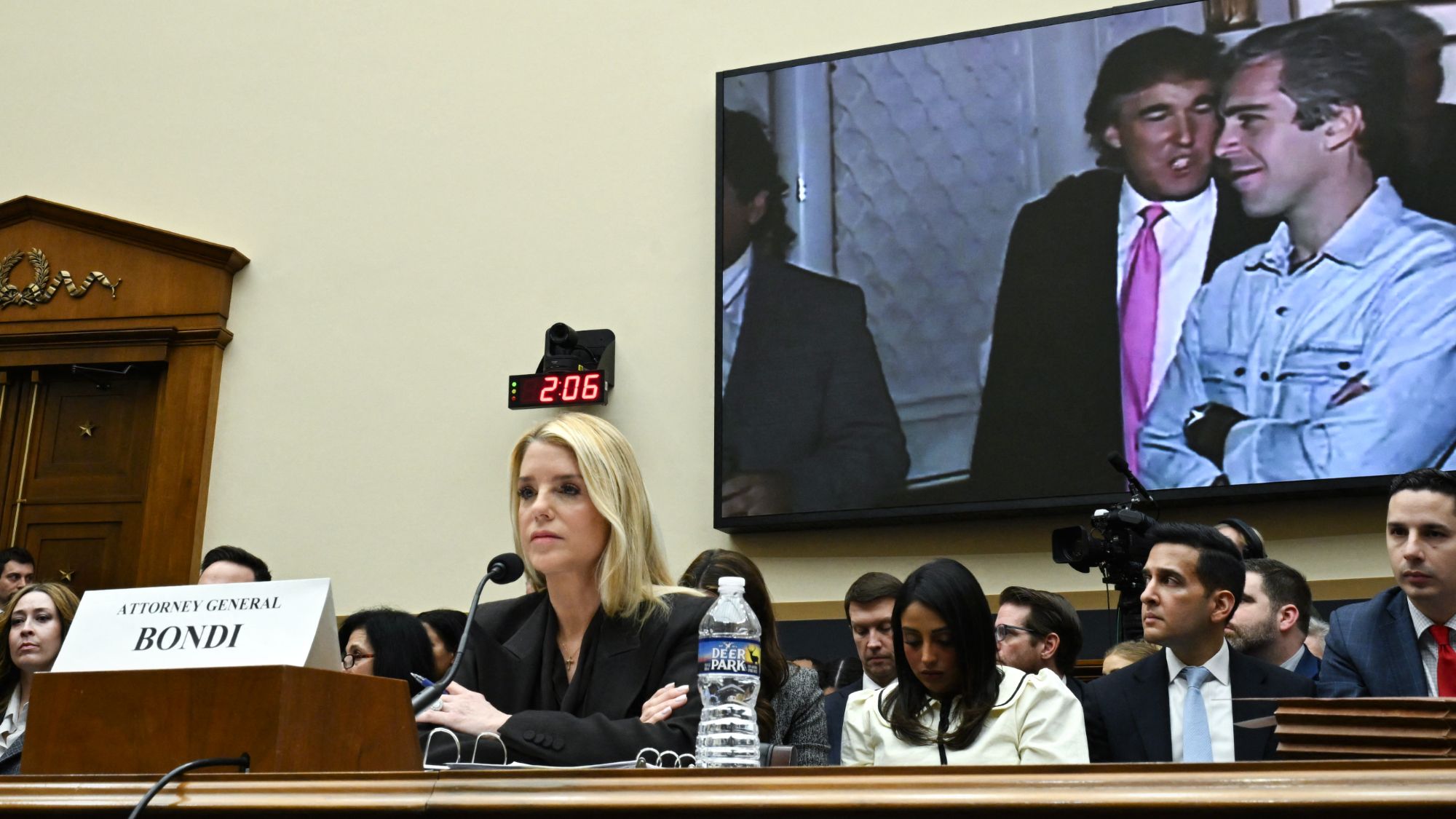
    Bondi to defy House Epstein subpoena

    What happened
    The Justice Department yesterday told the House Oversight Committee that ousted Attorney General Pam Bondi will not honor its bipartisan subpoena to sit for a deposition next week on her handling of the Jeffrey Epstein files, citing her firing last week. The notification “set off frustration” among lawmakers “clamoring for answers” about why she had not, “in their view, fully complied with the Epstein Files Transparency Act,” USA Today said.

    Who said what
    Bondi “cannot escape accountability,” Rep. Nancy Mace (R-S.C.) said on social media. The subpoena “was for Bondi by name, not by title.” If Bondi “defies the subpoena, we will begin contempt charges,” Rep. Robert Garcia (Calif.), the committee’s top Democrat, said in a statement. “The survivors deserve justice.” 

    Mace and four other Republicans “joined Democrats to force the subpoena” over the objection of committee Chair James Comer (R-Ky.), and lawmakers were “concerned” Bondi “would try to avoid the deposition” even before President Donald Trump fired her, The New York Times said. Comer last month promised to honor the subpoena, but according to sources, he and Bondi “had been quietly working together to avoid the deposition.”

    What next?
    The committee will contact Bondi’s “personal counsel” about “scheduling her deposition,” a spokesperson said.


    TODAY’S CRIME Story

    Gilgo Beach serial killer confesses to 8 murders

    What happened
    Rex Heuermann, the Long Island architect long suspected of the so-called Gilgo Beach killings between 1993 and 2010, pleaded guilty yesterday to strangling seven women and dismembering some of them. He also confessed to murdering an eighth woman, Karen Vergata, in 1996. Heuermann (pictured above) initially pleaded not guilty following his 2023 arrest. The remains of several of the women were found near Long Island’s Gilgo Beach in 2010 and 2011.

    Who said what
    Yesterday’s guilty pleas “bring finality to a case that bedeviled investigators, tormented victims’ families and tantalized a true-crime obsessed public for years,” The Associated Press said. The investigation was long “delayed by dysfunction, disarray and corruption,” The New York Times said. It finally ended with yesterday’s “extraordinary proceeding,” where Heuermann “maintained a normal demeanor, as if having a morning chat,” while confessing to serial murders. He “walked among us play-acting as a normal suburban dad” while “obsessively targeting innocent women for death,” Suffolk County District Attorney Ray Tierney said at a post-hearing press conference. 

    What next?
    Heuermann will be sentenced in June to life in prison with no possibility of parole. As part of his plea deal, he also agreed to be interviewed by the FBI’s Behavioral Analysis Units profilers, potentially helping “investigators hunt down others with similarly violent minds,” the Times said.


    It’s not all bad

    Fans around the world cheered over the weekend as Jackie and Shadow, a beloved pair of bald eagles in Big Bear, California, welcomed two eaglets. Jackie and Shadow have been mating since 2018, and the nonprofit Friends of Big Bear Valley operates a webcam that livestreams their nest. About 2.5 million viewers tuned in to watch the eaglets hatch. Both appear to be healthy and will soon have their names chosen by local school children.


    Under the radar

    Lost in space: Sperm can’t navigate without gravity

    Having kids is a decision with a lot of gravity, literally. Scientists have found that sperm in space can’t find their direction during their pursuit to fertilize an egg. Such digressions could pose a problem in the future as human space colonization becomes more likely.

    A lack of gravity “impaired directional navigation and fertilization capacity” of human sperm cells, said a study published in the journal Communications Biology. Researchers tested the navigational abilities of human, pig and mouse sperm by putting them into a “microgravity simulation chamber designed to mimic the female reproductive tract,” said Scientific American. 

    The results showed a “significant reduction in the number of sperm that were able to successfully find their way through the chamber maze in microgravity conditions compared to normal gravity,” said Nicole McPherson, a senior lecturer at Adelaide University’s Robinson Research Institute and the senior author of the study. There may be a way to lead sperm in the right direction, though: the hormone progesterone. Progesterone “works as a chemical signal, a kind of biological homing beacon that the egg releases around the time of ovulation,” McPherson told Scientific American. 

    Having babies in space may be a necessity in the future as humans aim to establish settlements on the moon and Mars. As of now, NASA and other governmental space agencies “maintain that no one has ever had sex in space,” said Scientific American. “But future human spacefarers may want to have families and reproduce while in a microgravity environment.”


    On this day

    April 9, 2003

    U.S. forces occupied Baghdad, three weeks into the Iraq War. Dramatic images of Iraqi dictator Saddam Hussein’s statue being pulled down symbolized the U.S. victory. But instability in Iraq and the broader Middle East has kept U.S. forces in the region — in Afghanistan and Syria, along with Iraq, through to the new Iran war troop surge.


    TODAY’S newspaperS

    ‘Sanity and morality’

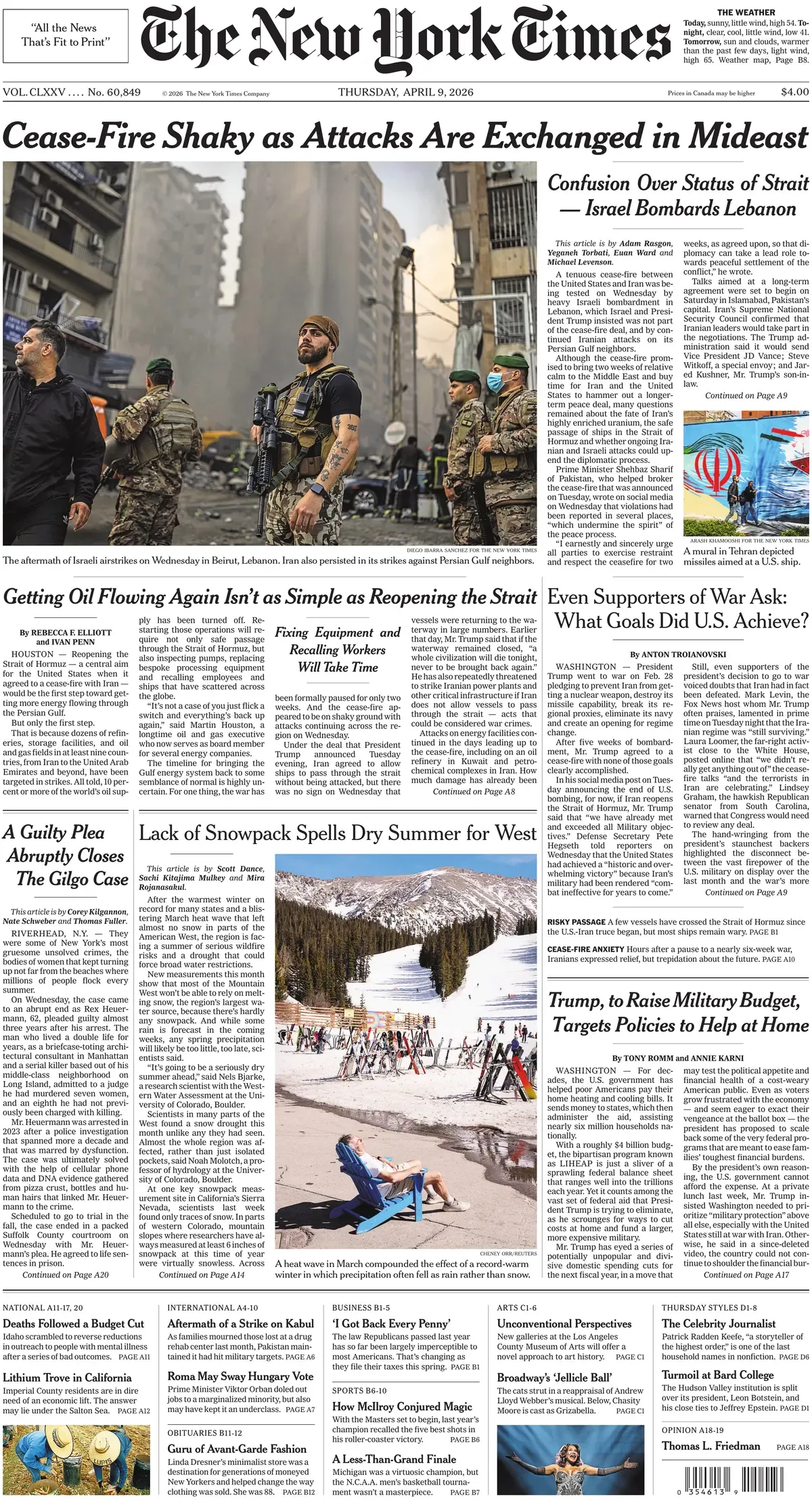
    “Ceasefire threatened” as “Israel expands Lebanon strikes, Tehran closes strait,” The Dallas Morning News says on Thursday’s front page. “Developing fractures show ceasefire fragility,” USA Today says. “Gulf states worry two-week truce left Iran emboldened, empowered,” The Wall Street Journal says. “After U.S. retreat, Tehran has edge,” the Los Angeles Times says. “Even supporters of war ask: What goals did U.S. achieve?” says The New York Times. “Trump’s brinkmanship fuels debate on sanity and morality,” The Washington Post says. “Trump’s threats alarming experts,” The Boston Globe says. “March breaks U.S. heat record,” says The Minnesota Star-Tribune. “End of the lie” after admission of “heinous Gilgo killings,” says the New York Daily News.

    ► See the newspaper front pages


    Tall tale

    Going the distance

    A fish named Blub has set a Guinness World Record for the “greatest distance covered in a motion-sensing vehicle by a goldfish in 1 minute.” Dutch engineer Thomas de Wolf created a robotic car that let Blub “drive” via a motion-sensing camera: when the goldfish swam to one side of his mobile water tank, the vehicle went in that direction. Blub set the record on the Italian program “Lo Show Dei Record,” traveling 40 feet and 3.46 inches in 60 seconds.


    Morning Report was written and edited by Nadia Croes, Catherine Garcia, Scott Hocker, Anya Jaremko-Greenwold, Justin Klawans, Rafi Schwartz, Peter Weber and Kari Wilkin, with illustrations by Stephen Kelly and Julia Wytrazek.

    Image credits, from top: Ibrahim Amro / AFP via Getty Images; Roberto Schmidt / AFP via Getty Images; James Carbone / Pool / Getty Images; Illustration by Julia Wytrazek / Getty Images
     

    Recent editions

    • Evening Review

      Bad news for the global right

    • Morning Report

      Trump pulls back from Iran brink

    • Evening Review

      Are young men turning to religion?

    VIEW ALL
    TheWeek
    • About Us
    • Contact Future's experts
    • Terms and Conditions
    • Privacy Policy
    • Cookie Policy
    • Advertise With Us
    • FAQ
    Add as a preferred source on Google Add as a preferred source on Google

    The Week is part of Future US Inc, an international media group and leading digital publisher. Visit our corporate site.

    © Future US, Inc. Full 7th Floor, 130 West 42nd Street, New York, NY 10036.