The Week The Week
flag of US
US
flag of UK
UK
https://cdn.mos.cms.futurecdn.net/flexiimages/jacafc5zvs1692883516.jpg

SUBSCRIBE & SAVE

Less than $3 per week

Sign in
  • View Profile
  • Sign out
  • The Explainer
  • The Week Recommends
  • Newsletters
  • Cartoons
  • From the Magazine
  • The Week Junior
  • Student Offers
  • More
    • Politics
    • World News
    • Business
    • Health
    • Science
    • Food & Drink
    • Travel
    • Culture
    • History
    • Personal Finance
    • Puzzles
    • Photos
    • The Blend
    • All Categories
  • Newsletter sign up Newsletter
  • Brand Logo
    Russia gas crunch, French heat deaths and Iran war muddle

     
    TODAY’S INTERNATIONAL story

    Putin admits ‘problems’ from Ukraine war

    What happened
    President Vladimir Putin yesterday acknowledged publicly that Russia was experiencing a “certain deficit” of gas and other fuels after Ukrainian drone strikes, but he insisted the “problems” aren’t “critical.” Ukraine “kept up its heavy drone assault on Russia,” setting fire to two more oil refineries yesterday, The Associated Press said. Kyiv’s drone campaign has “choked Russian fuel supplies,” forcing rationing, “long lines at gas stations across the country,” and export halts. 

    Who said what
    Ukrainian President Volodymyr Zelenskyy said last week he had approved a “40-day influence operation” to compel Moscow “to end the war.” Ukraine’s “long-range sanctions,” he said yesterday, reduce the “resources that fuel the Russian war machine,” moving the conflict “another step toward peace.” The “strikes against critical infrastructure in general, and energy infrastructure in particular,” do “create problems, that’s obvious,” Putin said in an interview yesterday, but the Kremlin would fix them by ramping up the production of air defenses and importing fuel to ease the shortages. 

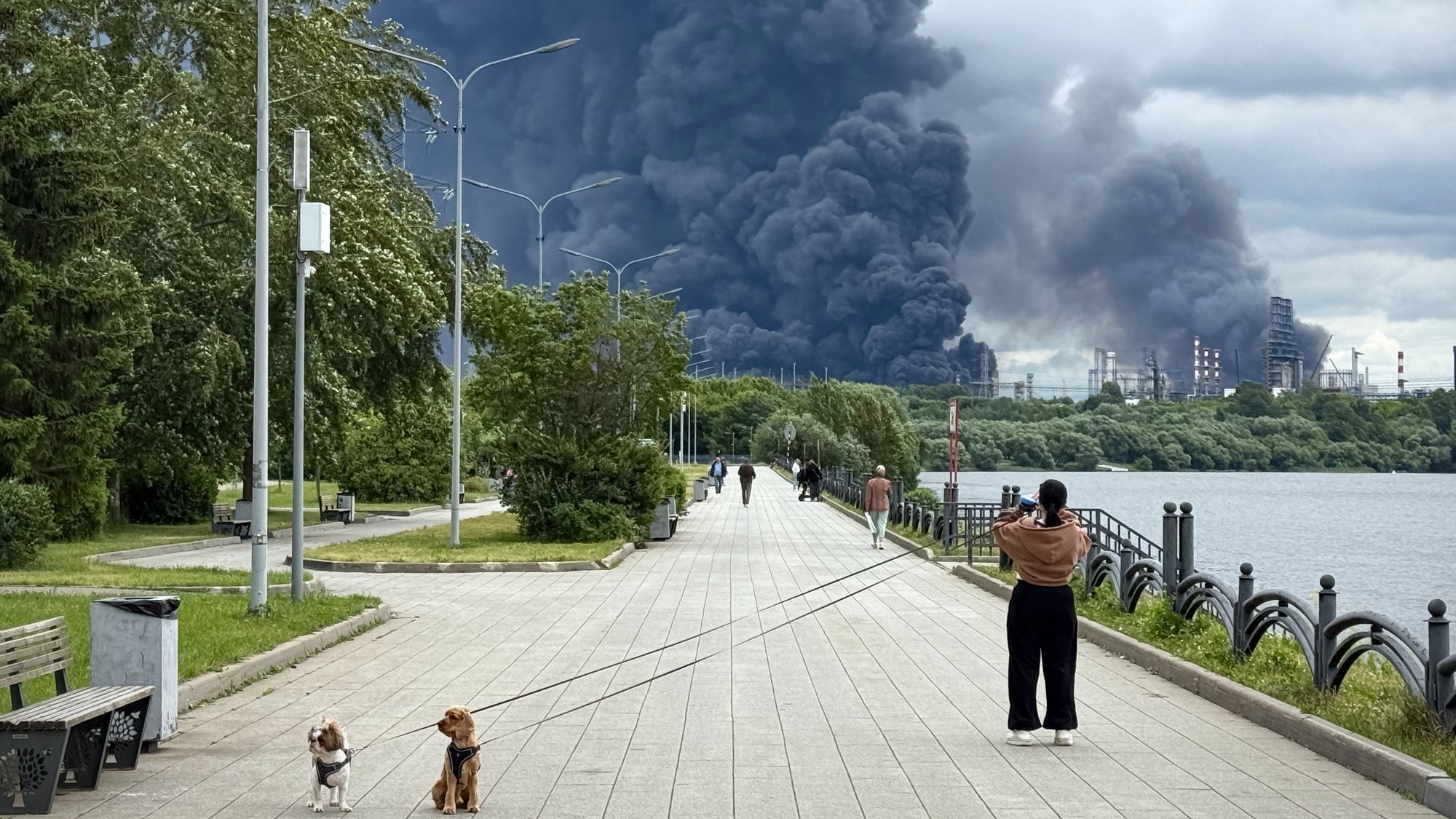
    “Behind the scenes,” there’s “growing panic” in Moscow, The Washington Post said. Over the past week, “swarms of Ukrainian drones hit” semiconductor plants, munitions factories, a satellite communications center and “oil facilities across Russia,” including a “dramatic onslaught on Moscow” (pictured above) that “spread plumes of black smoke over the capital as its main oil refinery went up in flames, halting production possibly until next year.”

    What next?
    Putin said Ukraine’s drone strikes were meant to “cause a split in Russian society and force Russia to halt” its invasion and enter negotiations, but “we will not give them that chance.” 


    TODAY’S CLIMATE story

    France reports 1,000 excess deaths from record heat

    What happened
    Europe’s record-shattering heat wave began shifting eastward yesterday as Public Health France released preliminary estimates that more than 1,000 people died from the heat and humidity. The number of excess deaths since the heat dome descended over France on June 20 is expected to rise as more death certificates come in from homes and eldercare facilities, the agency said, and 85% of the heat-related deaths so far were people 65 and older. 

    Who said what
    “Right now, 150 million people ​are living under extreme heat, hundreds have died, schools are shut, grids are buckling,” World Health Organization chief Tedros Adhanom Ghebreyesus said on social media. “The ‘once-in-a-generation’ heat wave is now occurring nearly annually.” Scientists with World Weather Attribution on Friday said Europe’s record temperatures would have been “virtually impossible” without human-caused climate change. “I’m getting hundreds of calls,” Paris mortician Zouhaeir Hertelli told The Associated Press, but “we’re really full, full, full.” 

    What next?
    Europe’s heat wave has already “disrupted power generation, damaged infrastructure and overwhelmed healthcare systems,” Reuters said, and yesterday it moved to Austria, the Czech ​Republic, Germany and Poland. A “dangerous and prolonged heat wave” could also “reach record-breaking levels” in the U.S. Midwest and East Coast this week, The New York Times said. But about 90% of U.S. homes have air conditioning, versus only 20% do in Europe.


    TODAY’S IRAN WAR Story

    Iran and US trade strikes in Hormuz power struggle

    What happened
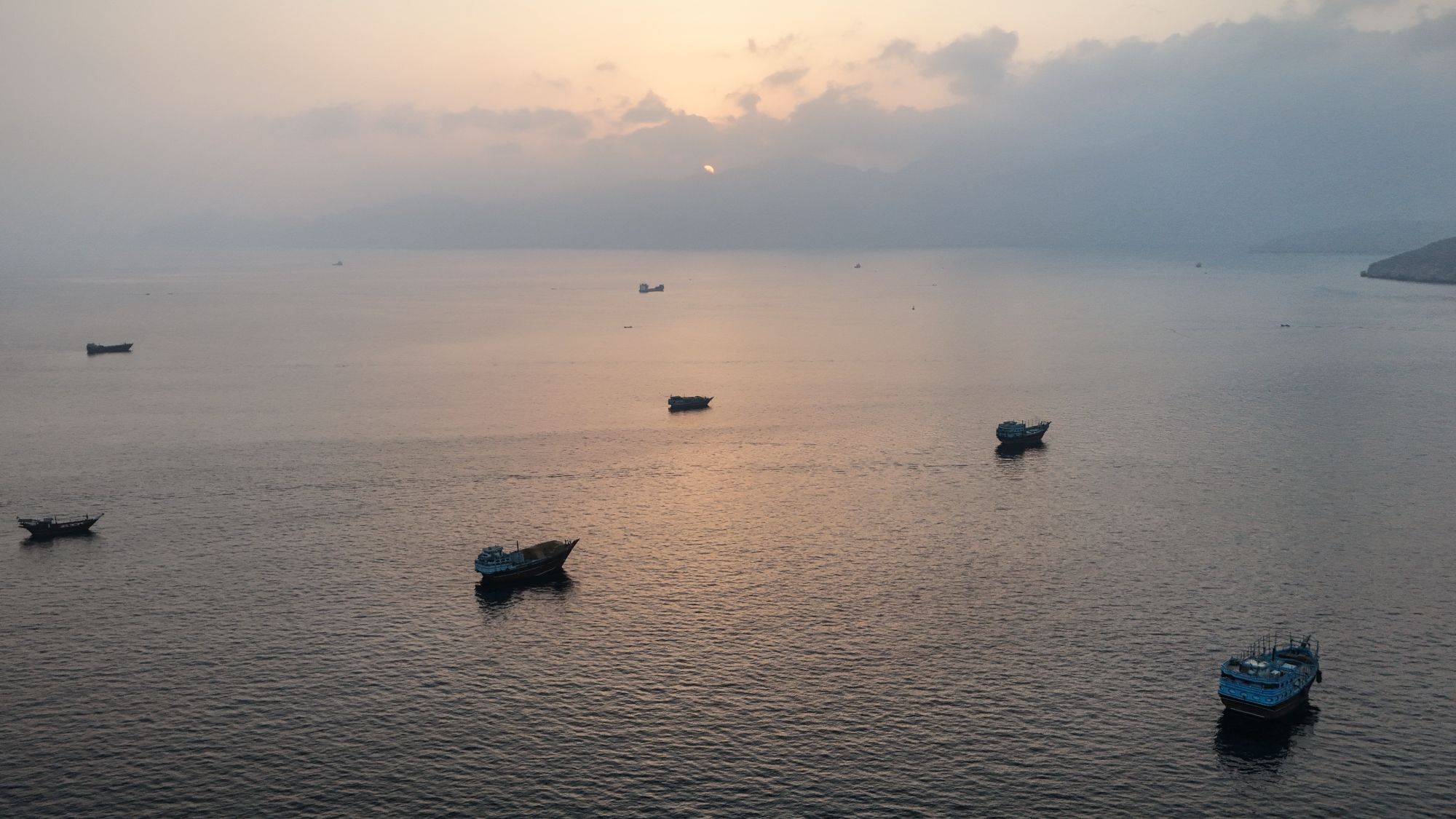
    The U.S. attacked Iranian targets twice over the weekend and Iran struck an oil tanker in the Strait of Hormuz and fired drones and missiles at U.S. military sites in Kuwait and Bahrain. The “renewed fighting was sparked by competing interpretations of the memorandum of understanding” to end the war, Axios said, especially regarding the strait. 

    Who said what
    Hours after Saturday’s oil tanker strike, President Donald Trump warned on social media that if Iran kept violating the ceasefire, the U.S. might be “forced to militarily complete the job” in Iran. Iranian Foreign Minister Abbas Araghchi yesterday said the MOU gave Tehran sole responsibility for “the management and full restoration of maritime traffic in the Strait of Hormuz.” 

    Attacking ships transiting the economically “pivotal” waterway “through Omani waters” was a risky but “necessary gambit” for Tehran, The New York Times said. Its “newfound power to disrupt traffic” in the strait is “critical leverage it cannot afford to lose — either at the negotiating table or back at war.”

    What next?
    After the weekend’s fighting, “both sides will stand down for now and vessels can move freely,” a Trump administration official told news organizations last night. “Iran has yet to confirm an agreement,” the Times said. U.S. officials said talks with Iran will resume tomorrow in Qatar.


    It’s not all bad

    Six new electric school buses in Colorado are doubling as backup batteries for the Denver area’s power grid. Buses will be kept in a barn with “two-way charging flows,” so they can “put power from their batteries back on the grid at peak times,” said The Colorado Sun. Electric buses need less maintenance, and the Cherry Creek school district’s partnership with Highland Electric Fleets and Xcel Energy “works to support our environmental goals while delivering long-term operations savings,” said Interim Superintendent Jennifer Perry.


    Under the radar

    Men also get postpartum depression

    While postpartum depression is widely known as an issue that affects mothers, fathers are “at risk for the same things that mothers go through,” perinatal clinical psychologist Sheehan Fisher told The New York Times. About 10% of dads — half as much as mothers — develop symptoms of PPD like depression and anxiety during the perinatal period, from pregnancy through the first year after childbirth.

    This percentage might be even higher because men “may be less likely to seek help” than women, said the Times. Paternal postpartum depression can go undiagnosed because men have been taught that “seeking support for their mental health is a sign of weakness,” psychologist Adam Borland said to the Cleveland Clinic. 

    In addition, fathers with PPD “often have different symptoms” than mothers, said the Times. They are more prone to expressing aggravation, annoyance or even rage, said psychologist Daniel Singley.

    Nearly half of postpartum depression cases in women start during pregnancy, but for men, the typical window is three to six months after babies are born, Fisher told the Times. This is possibly related to the “infants’ growing needs and activity or to the mothers returning to work.” 

    One major risk factor is a “prior history of depression,” said Psychology Today. Men also “typically experience a decrease in testosterone levels during the woman’s pregnancy,” which can contribute to a higher risk of depression. But the No. 1 determinant for paternal postpartum depression, Singley told the Times, is “maternal postpartum depression.” 


    On this day

    June 29, 2007

    The first iPhone hit the shelves, sparking a massive boost in sales for Apple and kickstarting a new generation of cellphone technology. Apple continues to dominate the smartphone market, but its newly announced price hikes on Macs and iPads, a result of AI-driven memory and processor chip inflation, angered some customers. 


    TODAY’S newspaperS

    ‘Partisan cloud’

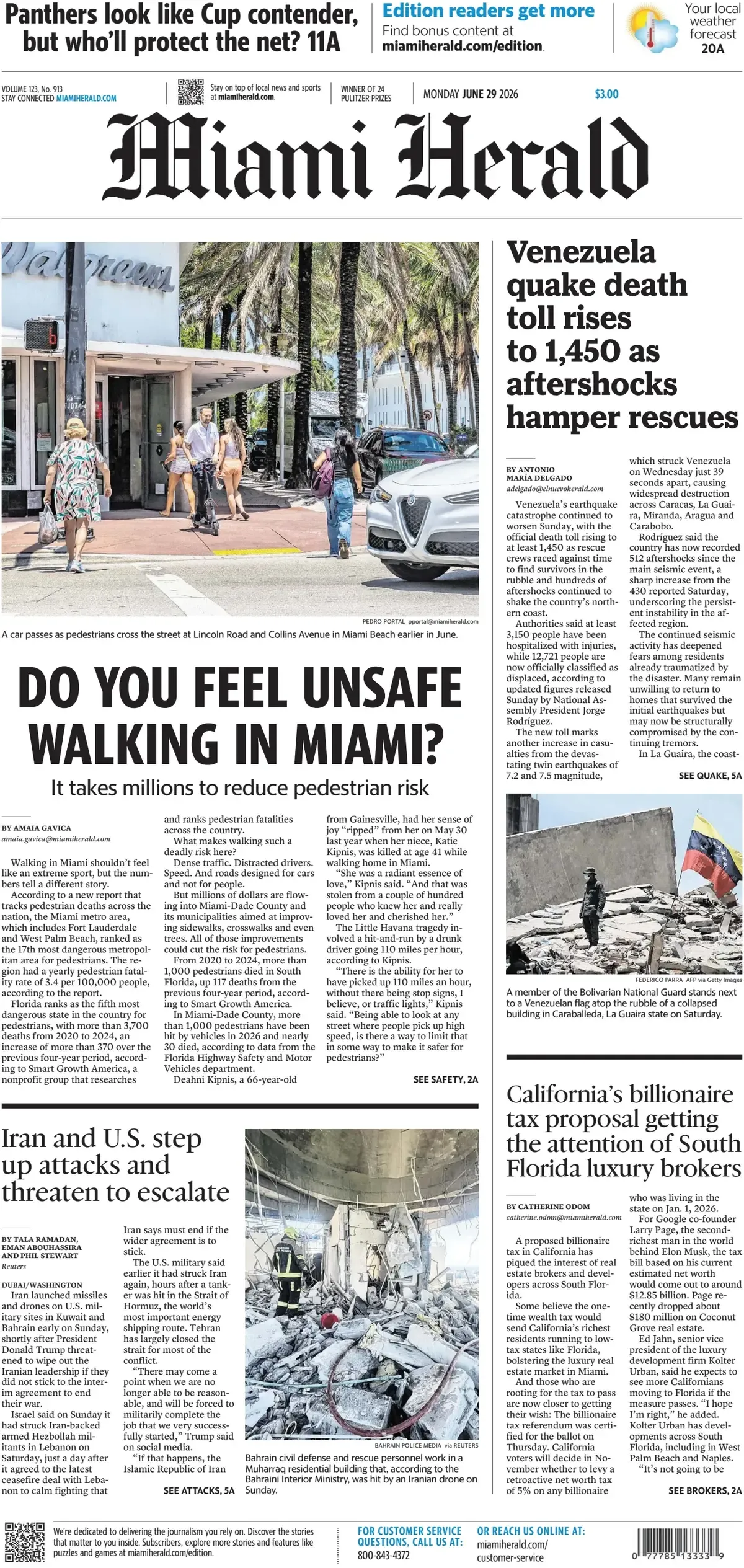
    “Venezuela quake death toll rises to 1,450 as aftershocks hamper rescues," the Miami Herald says on Monday’s front page. “Trump cut big mine deal, and sons stand to gain,” furthering “pattern of self-enrichment,” The New York Times says. “Trump digging in on election changes,” The Washington Post says. “Trump’s Great American State Fair” is — “and isn’t — what you’d think,” The Boston Globe says. “Partisan cloud hangs over nation’s birthday,” The Philadelphia Inquirer says. “Expect tight security for 250th party,” says USA Today. “Records: U.S. deported man in ‘error,’” the Chicago Tribune says. “No relief as heat wave fans out across Europe,” The Wall Street Journal says. “Power of pride” at Chicago Pride Parade, the Chicago Sun-Times says. “Masses join in resistance, love,” says the San Francisco Chronicle. 

    ► See the newspaper front pages


    Tall tale

    Can you hear my ‘now’?

    An Australian air-conditioner repair technician and honorary town crier broke the world record for loudest shout ever recorded. Joseph McGrail-Bateup yelled “now” at an “ear-splitting” 122.4 decibels — the equivalent of a clap of thunder or chainsaw, said Sky News. The 58-year-old experimented with different words before settling on “now,” and it took him seven attempts to break the previous record of 121.7 decibels. McGrail-Bateup said his voice was “shot” for days afterward.


    Morning Report was written and edited by Nadia Croes, Catherine Garcia, Scott Hocker, Anya Jaremko-Greenwold, Justin Klawans, Rafi Schwartz, Peter Weber and Kari Wilkin, with illustrations by Stephen Kelly and Julia Wytrazek.

    Image credits, from top: AFP via Getty Images; Ditmar Dilkoff / AFP via Getty Images; AFP via Getty Images; Illustration by Julia Wytrazek / Getty Images
     

    Recent editions

    • Sunday Shortlist

      Sincerity and hilarity

    • Saturday Wrap

      Trump gets swamped

    • Evening Review

      China’s yuan grows against the dollar

    VIEW ALL
    TheWeek
    • About Us
    • Contact Future's experts
    • Terms and Conditions
    • Privacy Policy
    • Cookie Policy
    • Advertise With Us
    • FAQ
    Add as a preferred source on Google Add as a preferred source on Google

    The Week is part of Future US Inc, an international media group and leading digital publisher. Visit our corporate site.

    © Future US, Inc. Full 7th Floor, 130 West 42nd Street, New York, NY 10036.