The Week The Week
flag of US
US
flag of UK
UK
https://cdn.mos.cms.futurecdn.net/flexiimages/jacafc5zvs1692883516.jpg

SUBSCRIBE & SAVE

Less than $3 per week

Sign in
  • View Profile
  • Sign out
  • The Explainer
  • The Week Recommends
  • Newsletters
  • Cartoons
  • From the Magazine
  • The Week Junior
  • Student Offers
  • More
    • Politics
    • World News
    • Business
    • Health
    • Science
    • Food & Drink
    • Travel
    • Culture
    • History
    • Personal Finance
    • Puzzles
    • Photos
    • The Blend
    • All Categories
  • Newsletter sign up Newsletter
  • Brand Logo
    USPS whistleblower, Putin’s Iran boost and funding stopgap

     
    TODAY’S VOTING story

    USPS whistleblower warns of Trump-ordered ballot tool

    What happened
    The U.S. Postal Service is poised to roll out a “secretive, rushed” and error-riddled online portal for states that could “derail” mail-in voting in the midterm elections, according to a whistleblower complaint released yesterday by Sen. Richard Blumenthal (D-Conn.). The tool was created in three months, sometimes in defiance of court orders, to comply with President Donald Trump’s executive order to limit mail voting before the midterms, a USPS official said in the complaint. The “slapdash” development effort and a “zero percent failure” verification requirement mean “potentially millions of American voters may not receive their mail-in ballot this election cycle in a timely manner, or at all.” 

    Who said what
    A federal judge in Boston has temporarily halted USPS from forcing states to use its new Federal Ballot Mail Portal system. But if the stay is lifted or overturned, USPS would require states to submit lists of mail ballot recipients and get approval for envelopes and ballots with individualized bar codes. If the system worked as designed, the whistleblower said, entire batches of tens of thousands of ballots would be rejected if there were a problem with “even one barcode on one single ballot.” Blumenthal told reporters the new system “is intended to fail.” 

    What next?
    Blumenthal gave Postmaster General David Steiner until Friday to respond to the claims detailing “USPS’s ​seemingly illegal plot to interfere in November’s midterms.” A USPS spokesperson said the Postal Service was “carefully reviewing” the allegations but will roll out the portal “soon” to states that want to use it.


    TODAY’S IRAN WAR story

    Putin pledges support for Iran as US war reignites

    What happened
    Russian President Vladimir Putin yesterday told Iranian President Masoud Pezeshkian at a summit in Kyrgyzstan that Moscow will continue supplying “the assistance you need” and “the necessary goods” during “this difficult period.” Since President Donald Trump “launched his war against Iran” in February, The New York Times said, “Russia has backed the Iranians with intelligence, including on U.S. assets in the Persian Gulf,” and “drone components.” Moscow has also been secretly helping Iran develop advanced supersonic cruise missiles, the Financial Times reported yesterday. The U.S. and Iran traded airstrikes last night, in their “first serious combat since July,” Reuters said. 

    Who said what
    Russia’s transfer of the “strategically important military technology” to build supersonic missiles “would require political approval from Russia’s top leadership,” Conflict Armament Research analyst Fabian Hinz, told the Financial Times. Such missiles would be a “qualitatively new strategic weapons system capable of threatening U.S. Navy ships,” said former CIA military analyst Jim Lamson.

    Iran has already done considerable damage to U.S. military bases in the Middle East with a new ballistic missile it calls “the Kheibar Shekan, or ’Castle Breaker,’” USA Today said. The missile, “likely” developed “with the help of Chinese and Russian technology,” can “evade American air defenses and strike with far greater precision.”

    What next?
    Tehran vowed to respond to last night’s airstrikes with more “crushing and devastating blows” and claimed its own counterstrikes killed several U.S. personnel in Jordan and Kurdish Iraq.


    TODAY’S CONGRESS Story

    House clears spending bill, averting shutdown

    What happened
    The House yesterday passed a Senate-approved stopgap funding bill that will avert a government shutdown at the end of the month. The “lopsided” 370-48 vote punts the expected fiscal 2027 “spending fight until after the midterm elections,” The New York Times said, and allows lawmakers to “quickly return to the campaign trail for the critical final weeks before the elections.”

    Who said what
    The stopgap measure is “simple by design,” said Rep. Tom Cole (R-Okla.), chair of the House Appropriations Committee, in a statement. “No poison pills, no divisive wish lists and no political gimmicks.” At a closed-door meeting yesterday, Rep. Rosa DeLauro (Conn.) (pictured above), the top Democrat on the Appropriations Committee, “said the bill was much improved from the product that passed the House earlier this summer on a mostly party-line basis,” according to The Associated Press. In its bipartisan rewrite, the Senate “made some changes, some that we don’t support,” GOP Whip Steve Scalise (La.) told The Washington Post. But “it’s much more important for the country to avoid a government shutdown.”

    What next?
    Once President Donald Trump signs the bill, the government will be funded at current levels through Dec. 11. That gives lawmakers time to “find compromise on a full-year measure,” said the AP, which will “likely be quite difficult.”


    It’s not all bad

    An endangered Kemp’s ridley sea turtle is on the road to recovery after being swept by a strong ocean current from the Gulf of Mexico to Wales. When Rhossi was discovered on a beach in 2023, he weighed just 2 pounds. He was nursed back to health at the Anglesey Sea Zoo and was flown to the Houston Zoo last month for final rehabilitation. Rhossi is now 46 pounds and active and, once he gets over lingering pneumonia, will be returned to the Gulf of Mexico.


    Under the radar

    Incredible edibles: cookies made from plastic

    The sweet treat of the future could be plastic. Scientists have found a way to transform plastic waste, along with food additives and other ingredients, into edible cookies called µBites. The method could be used to manage refuse and provide sustenance in remote or disaster locations, or even in space someday. However, many people are understandably wary about eating plastic. 

    Polyethylene terephthalate (PET) from plastic bottles and “discarded sweet corn plant stalks and leaves” were put through a process called “oxidative hydrothermal dissolution,” which “uses heat to break down the materials into components that microbes can digest,” said New Scientist. The components are “fed to yeast that has been genetically altered,” allowing it to “convert the components into a variety of useful ingredients.” Then “fiber, starch and sweetener are added, and the paste is extruded through a 3D printer into any desired shape.”

    This may nibble around the edges of the problem, but “we produce 400 million tons a year of plastic waste,” Jason Hallett, a professor and researcher at Imperial College London, told New Scientist. It’s “not a solution to the plastic-waste crisis.”

    But becoming a mainstream treat isn’t the primary goal. The “µBites system is a tunable and portable device that integrates all necessary components” to be “deployed in submarines or disaster relief vehicles to produce on-demand, on-site food,” said Lahiru Jayakody, a Southern Illinois University Carbondale microbiologist who worked on the product, to ScienceAlert. The process is “particularly suited for using carbon waste in extreme environments such as deserts, the Arctic or the Antarctic,” and potentially even “Mars or the lunar surface.”


    On this day

    September 2, 1945

    Japan formally surrendered aboard the battleship USS Missouri in Tokyo Bay, bringing World War II to an end. The instrument of surrender concluded the deadliest war in human history, with up to 75 million estimated deaths. The USS Missouri is now a museum ship at the Pearl Harbor site in Hawaii. 


    TODAY’S newspaperS

    ‘Frequent Flockers’

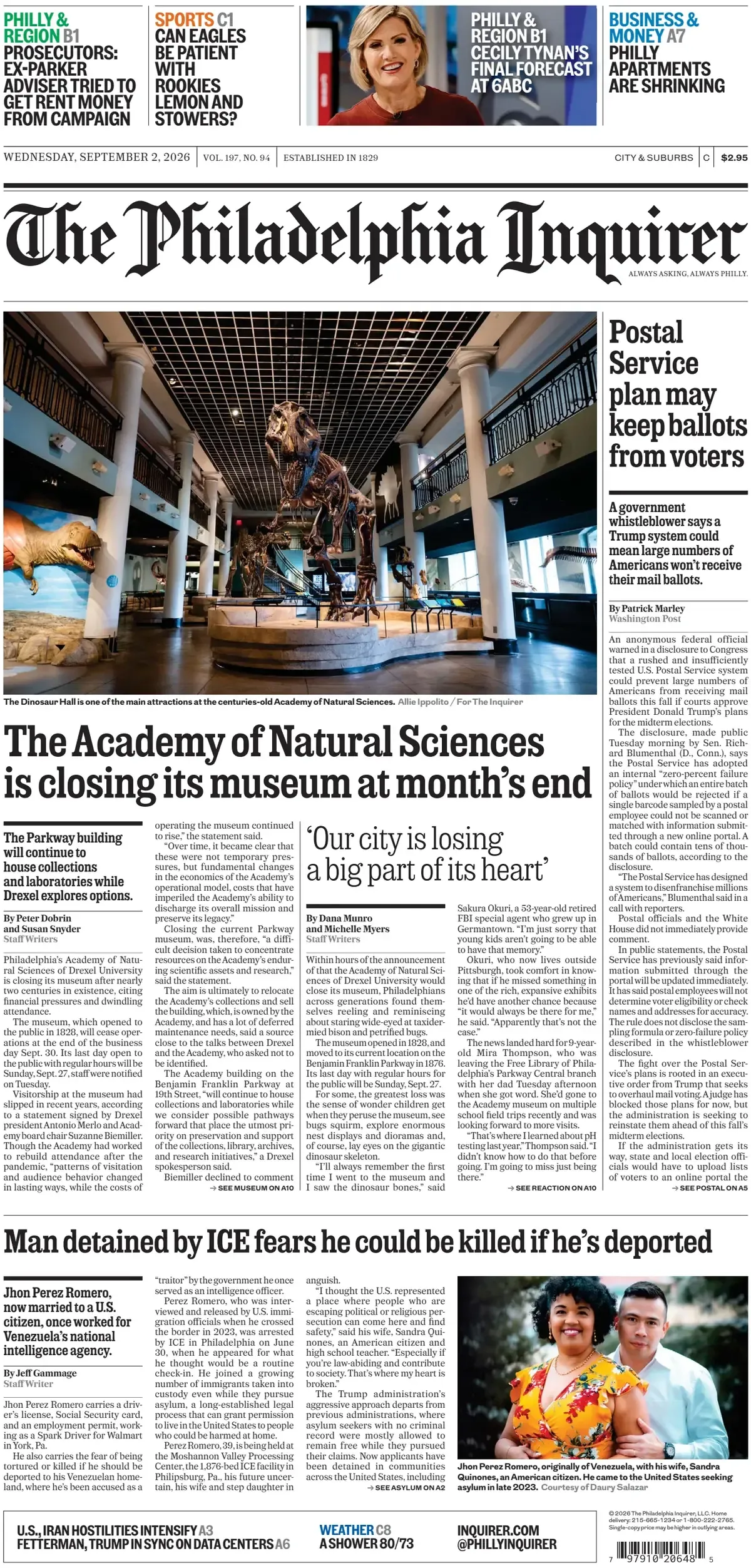
    “Bond rout deepens around globe,” The Wall Street Journal says on Wednesday’s front page. “Iran war drives turmoil as yields hit highest levels in decades,” The New York Times says. “U.S. hits Iran as fighting flares up,” says the Austin American-Statesman. “Putin pledges to back Iran,” The Washington Post says. Sen. Ed Markey (Mass.) scores “convincing win” in Democratic primary as “focus on 80-year-old senator’s age seems to have little effect,” says The Boston Globe. “Repeat searches” by “frequent Flockers” prompt “officer firings, arrests,” says USA Today. “Florida DOT bans Flock cameras,” The Palm Beach Post says. “Rams owner to buy Angels for $4 billion,” says the Los Angeles Times. “The Academy of Natural Sciences is closing its museum at month’s end,” says The Philadelphia Inquirer. 

    ► See the newspaper front pages


    Tall tale

    Cooler heads

    Two fishermen were rescued last month after five days at sea without any food or water. The Mexican Navy found the men floating inside a large fishing cooler, 150 miles off the coast of Chiapas. They were airlifted to a hospital and have since been released. “It was the hardest thing imaginable,” one of the men said in a video released by the Mexican Navy. “I wouldn’t wish it on anybody — not even my worst enemy.”


    Morning Report was written and edited by Nadia Croes, Catherine Garcia, Scott Hocker, Anya Jaremko-Greenwold, Justin Klawans, Rafi Schwartz, Peter Weber and Kari Wilkin, with illustrations by Stephen Kelly and Julia Wytrazek.

    Image credits, from top: Ken Cedeno / AFP via Getty Images; Vyacheslav Prokofyev / Pool / AFP via Getty Images; Andrew Harnik / Getty Images; Iryna Veklich / Getty Images
     

    Recent editions

    • Evening Review

      Russia tests NATO

    • Morning Report

      Army loses another leader

    • Evening Review

      Trump’s South Carolina victory

    VIEW ALL
    TheWeek
    • About Us
    • Contact Future's experts
    • Terms and Conditions
    • Privacy Policy
    • Cookie Policy
    • Advertise With Us
    • FAQ
    Add as a preferred source on Google Add as a preferred source on Google

    The Week is part of Future US Inc, an international media group and leading digital publisher. Visit our corporate site.

    © Future US, Inc. Full 7th Floor, 130 West 42nd Street, New York, NY 10036.