The Week The Week
flag of US
US
flag of UK
UK
https://cdn.mos.cms.futurecdn.net/flexiimages/jacafc5zvs1692883516.jpg

SUBSCRIBE & SAVE

Less than $3 per week

Sign in
  • View Profile
  • Sign out
  • The Explainer
  • The Week Recommends
  • Newsletters
  • Cartoons
  • From the Magazine
  • The Week Junior
  • Student Offers
  • More
    • Politics
    • World News
    • Business
    • Health
    • Science
    • Food & Drink
    • Travel
    • Culture
    • History
    • Personal Finance
    • Puzzles
    • Photos
    • The Blend
    • All Categories
  • Newsletter sign up Newsletter
  • Brand Logo
    DHS voter hunt, NYC AI ban and Clippers sanctions

     
    TODAY’S VOTING story

    DHS ramps up hunt for elusive illegal voters

    What happened
    The Department of Homeland Security has assigned hundreds of agents to an “intensive, weekslong hunt” for noncitizen voters, though such “election fraud is exceedingly rare,” The New York Times said yesterday. DHS is “pulling agents” from “investigating such serious crimes as human trafficking and terrorism” to scour state voter rolls, sometimes by “effectively posing as individual voters.” 

    Any suspected noncitizen voters, or people who registered to vote before they became citizens, are referred to ICE’s Homeland Security Investigations unit. HSI agents were assigned this week to a new “Criminal Voter Fraud surge initiative,” CNN reported. ICE is also “preparing to award” a multimillion-dollar outside contract for a “massive national database of voters,” that will include “voter registration,” often “voting history” and potentially “party affiliation,” Wired said.

    Who said what
    The Trump administration has been aggressively “targeting noncitizen voting to allege it could be a source of significant fraud during the midterm elections,” The Associated Press said. “Given the decades of evidence showing how rare noncitizen voting is, it’s unclear what the administration will discover” in its new efforts or “how verifiable any findings will be,” the Times said. President Donald Trump has already used his repeated “falsehoods about election fraud” to “sow doubt and distrust in the electoral process” and “justify sweeping voting restrictions” he is attempting to enact. 

    What next?
    An immigrant rights group sued the Trump administration in federal court yesterday, seeking to block DHS from “using federal databases that it alleged are being used to target naturalized citizens who are eligible to vote,” the AP said.


    TODAY’S EDUCATION story

    New York City bans AI in schools through 8th grade

    What happened
    New York City yesterday announced that AI tools will be banned in public grade and middle schools and sharply limited for high school students. Mayor Zohran Mamdani’s office called the one-year moratorium the country’s “most expansive” limits on AI in schools. The “sweeping new policy” for the nation’s largest school district will also bar individual screens for students until third grade, The New York Times said. “So-called companion chatbots” will be “banned in all grades,” and “all high schoolers will be taught about AI literacy.”

    Who said what
    “The tech industry wants us to believe that AI in early education is not only inevitable, but that it is necessary,” Mamdani said yesterday. “We do not see it that way.” A “backlash” from parents “against the growing use of digital devices and AI in the classroom” has pushed many school districts to enact new restrictions, the Times said. The Los Angeles school district — the nation’s second-largest — just began “temporarily blocking access to generative AI tools on student devices across all grades,” The Associated Press said. Other schools are “working to teach children how to incorporate the technology while preventing them from relying too heavily on it or using it to cheat.”

    What next?
    New York’s new rules will be in place for this school year, which begins next week, and can be extended or amended.


    TODAY’S SPORTS Story

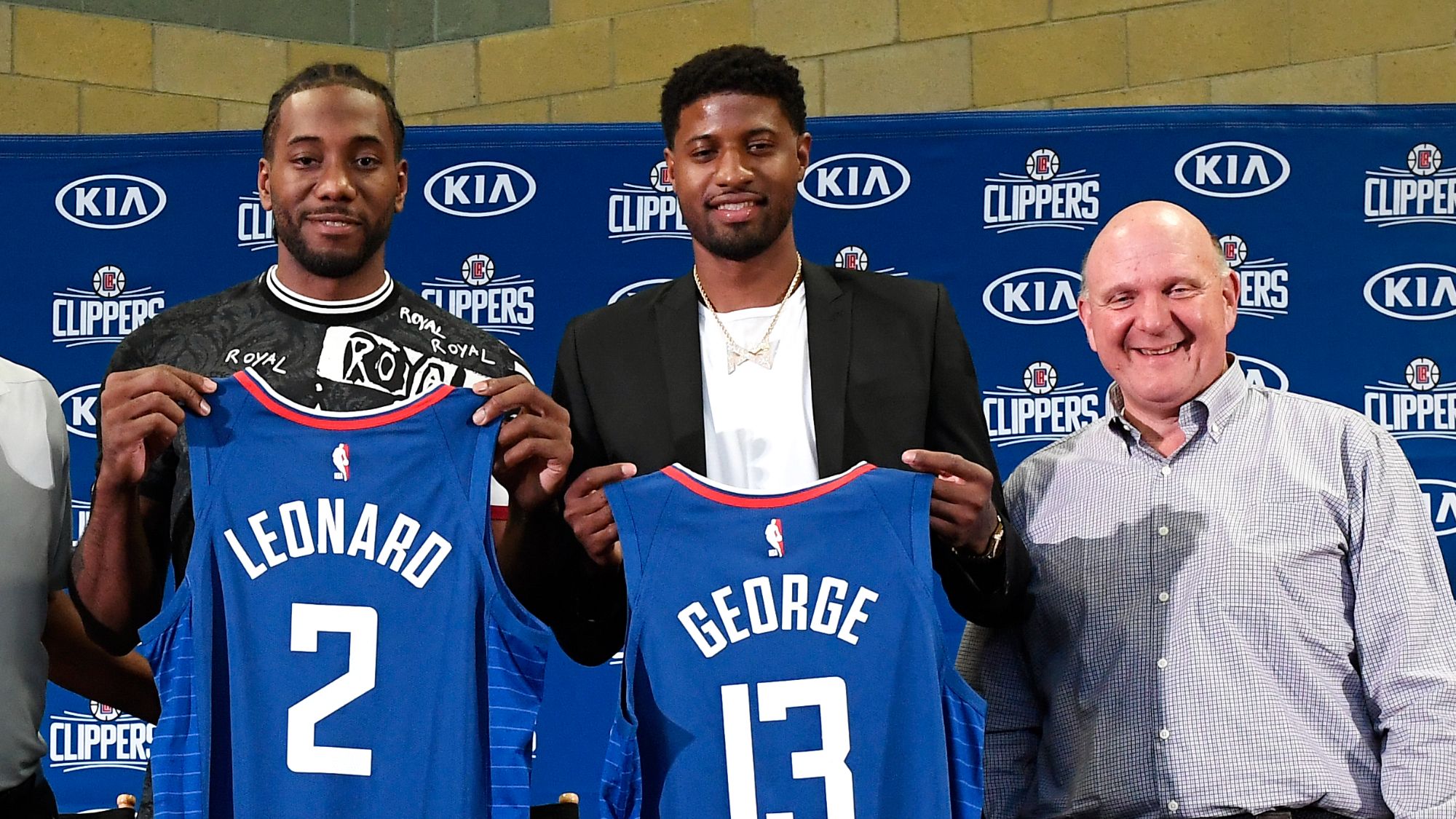
    NBA fines Clippers $30M, hits owner over Leonard pay

    What happened
    The NBA yesterday punished the Los Angeles Clippers with the largest sanctions in league history after finding that owner Steve Ballmer and other team executives violated salary cap rules to funnel millions of dollars to star forward Kawhi Leonard. The Clippers were fined $30 million and stripped of five first-round draft picks, from 2029 to 2033. Leonard was fined $700,000, and Ballmer was banned from all team and league activities for a year. 

    Who said what
    A one-year independent investigation found that the Clippers had improperly “covered personal expenses for Leonard,” CNN said, and “funneled off-court endorsement opportunities” to him through corporate partners who were rewarded with lucrative “team business.” Paying Leonard via a team sponsor would strike “at the very heart of the NBA’s most important financial rules” to ensure a “roughly level playing field” across the league, The Wall Street Journal said. NBA Commissioner Adam Silver said he was “deeply disappointed by the flagrant violations,” and “the severity of the penalties reflects” their “seriousness.”

    What next?
    The Clippers said they “vehemently reject” the NBA’s “heavily biased investigation” and “intend to vigorously challenge these findings and penalties through every avenue available to us.” There is “no appeal or arbitration process available to the team,” The Athletic said, citing a league source.


    It’s not all bad

    South African researchers have created a solar-powered system that turns polluted river water into agricultural irrigation using stones, sand and heat-treated wood. The Water Hub, designed at the University of Cape Town, is being tested on the Stiebeuel River, filtering 36,000 liters a day for vegetable cultivation. The chemical-free, low-cost system removes 99% of toxins and pathogens from the water, and researchers hope it can aid communities facing food and water security due to climate change.


    Under the radar

    Cyborg cockroaches are coming to the rescue

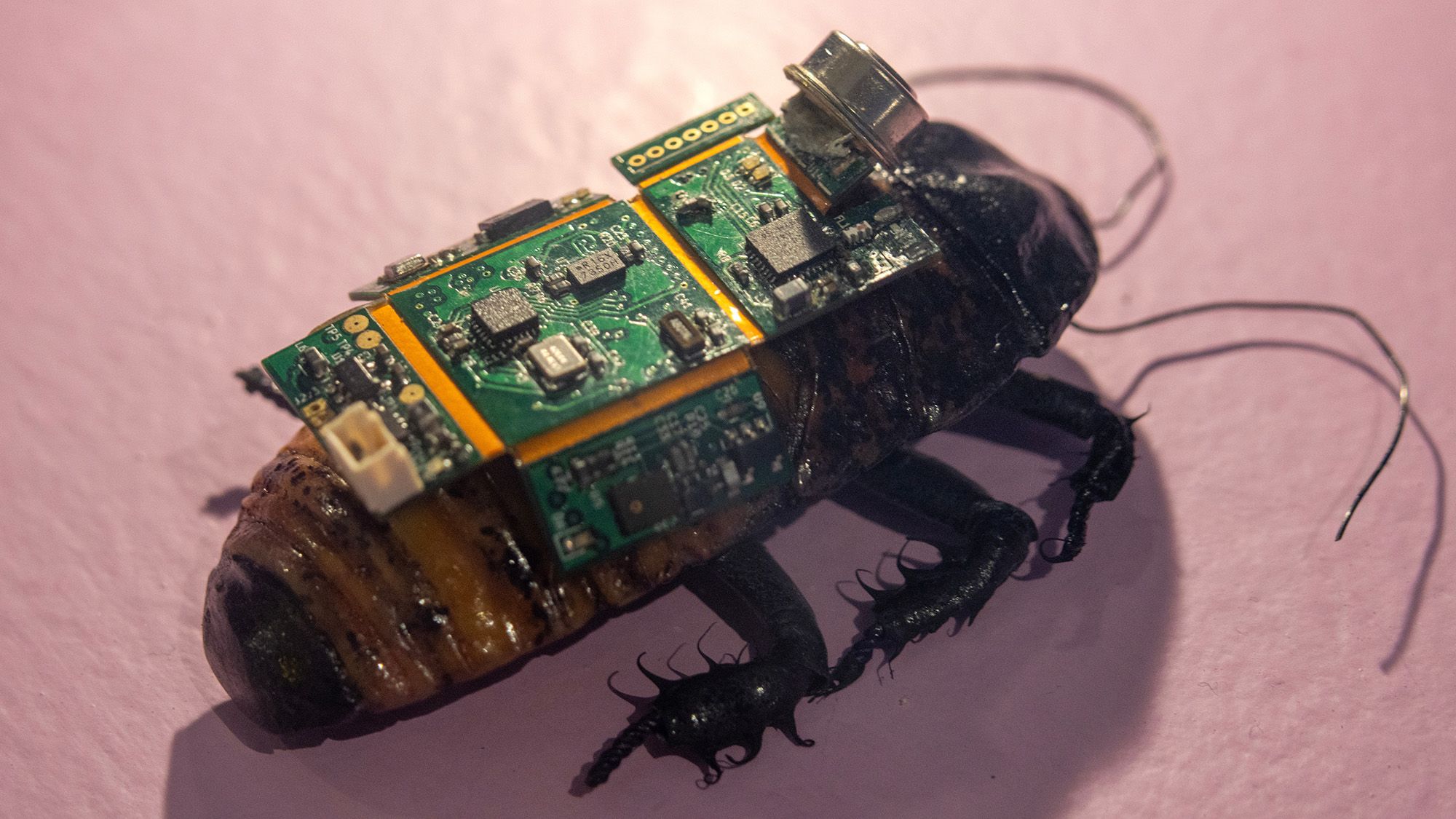
    The newest search-and-rescue recruits are cockroaches. Scientists have outfitted the insects with capabilities to locate and administer medical care to people in remote or hard-to-reach locations. 

    Paramedic cyborg cockroaches, called Paraborgs, can be a “field-deployable medical intervention,” said a study published in the journal Advanced Science. The robotic roaches carry “cameras and miniature medical injectors” that could “deliver supervised emergency care to people trapped in collapsed buildings, caves or other places too dangerous for rescuers to reach,” Australia’s University of Queensland said in a news release on the study. 

    To create the cyborgs, scientists fitted North Queensland giant burrowing cockroaches (Macropanesthia rhinoceros), the “heaviest cockroach species in the world that ​measure up to 3.3 inches, with backpacks containing syringe cylinders and cameras,” said Reuters. “Once we implant an electrode into the insect,” said biorobotics ‌engineer and study co-author Thang Vo-Doan, “we can apply a small electrical signal to activate or stimulate the nerve system so that they can respond to our command.” 

    “Ethical guidelines for invertebrate research are not yet standardized,” said the study. But the cockroaches were “provided with a suitable living environment” and “decent nutrition.” 

    The Paraborgs had a 95% success rate at performing close-range injections in proof-of-concept experiments. “The long-term goal is targeted human-supervised intervention in places conventional medical technologies cannot access,” said Thanh Nho Do, a medical robotics associate professor at the University of New South Wales who worked on the study.


    On this day

    September 3, 1928

    Scottish physician Alexander Fleming discovered that secretions from a spot of mold, later identified as Penicillium notatum, killed harmful bacteria, paving the way for the development of the groundbreaking antibiotic penicillin. Fewer than 1% of people are likely allergic to penicillin, despite widespread misperception, according to UConn Health data.


    TODAY’S newspaperS

    ‘Trump goes in circles’

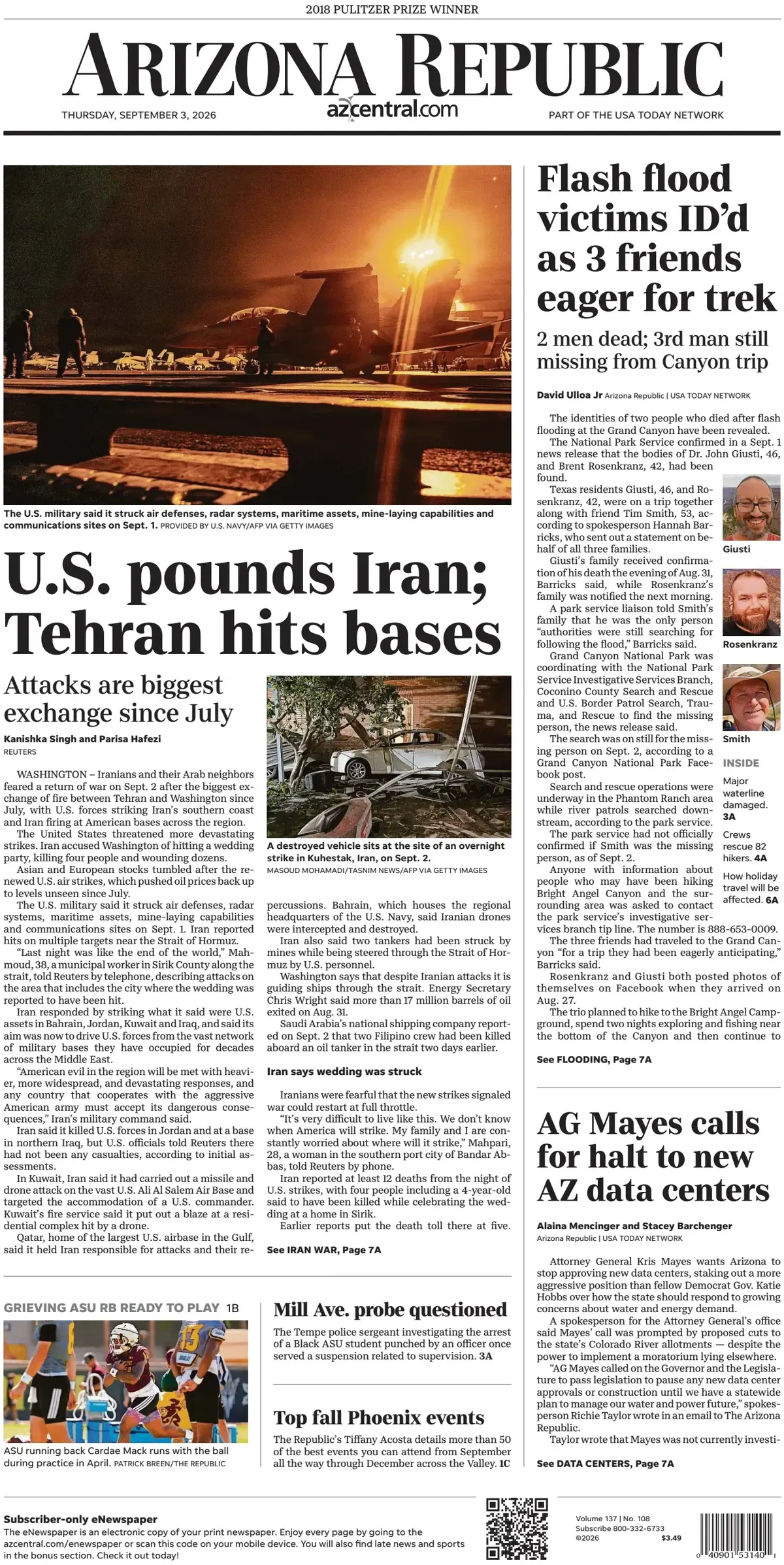
    “U.S. pounds Iran; Tehran hits bases,” the Arizona Republic says on Thursday’s front page. “Iran strategy enters reruns” as “after 6 months of war, Trump goes in circles,” The New York Times says. “Access to secret intel is pulled” after “article on Iran concerns,” The Washington Post says. “Google avoids breakup of its ad business,” The Wall Street Journal says. U.N. declares “humanity fails climate goals,” The Minnesota Star Tribune says. “Ankle monitor and loss of TPS blamed for Haitian college student’s death,” the Miami Herald says. “Mistrial might be nearing” as jurors “deadlocked” in Lindsay Clancy case, says The Boston Globe. Tiger Woods “convicted of lesser charges” in DUI case, says The Palm Beach Post. 

    ► See the newspaper front pages


    Tall tale

    Castles in the air

    About 1,800 people joined forces in Japan last month to move a 360-ton castle 6 feet. Volunteers used the hikiya method — an ancient preservation technique that involves placing a structure on rollers and then pulling it with ropes — to drag Hirosaki Castle to its original site. Participants came from across Japan and as far away as the U.S. to help. “There’s absolutely no other opportunity to pull a castle,” volunteer Motoharu Nakata told the Sankei Shimbun newspaper. “It was fantastic.”


    Morning Report was written and edited by Nadia Croes, Catherine Garcia, Scott Hocker, Anya Jaremko-Greenwold, Justin Klawans, Rafi Schwartz, Peter Weber and Kari Wilkin, with illustrations by Stephen Kelly and Julia Wytrazek.

    Image credits, from top: Probal Rashid / LightRocket via Getty Images; Daniel de la Hoz / Getty Images; Kevork Djansezian / Getty Images; Tang Yan Song / Shutterstock
     

    Recent editions

    • Evening Review

      What will decide the midterms?

    • Morning Report

      USPS ballot tool draws whistleblower warning

    • Evening Review

      Russia tests NATO

    VIEW ALL
    TheWeek
    • About Us
    • Contact Future's experts
    • Terms and Conditions
    • Privacy Policy
    • Cookie Policy
    • Advertise With Us
    • FAQ
    Add as a preferred source on Google Add as a preferred source on Google

    The Week is part of Future US Inc, an international media group and leading digital publisher. Visit our corporate site.

    © Future US, Inc. Full 7th Floor, 130 West 42nd Street, New York, NY 10036.