The Week US
flag of US
US
flag of UK
UK
https://cdn.mos.cms.futurecdn.net/flexiimages/jacafc5zvs1692883516.jpg

SUBSCRIBE & SAVE

Less than $3 per week

Sign in
  • View Profile
  • Sign out
  • The Explainer
  • The Week Recommends
  • Newsletters
  • Cartoons
  • From the Magazine
  • The Week Junior
  • More
    • Politics
    • World News
    • Business
    • Health
    • Science
    • Food & Drink
    • Travel
    • Culture
    • History
    • Personal Finance
    • Puzzles
    • Photos
    • The Blend
    • All Categories
  • Newsletter sign up Newsletter
  • The Week’s Saturday Wrap
    Trump’s lame-duck era, stolen treasures, and publicly funding discrimination

     
    controversy of the week

    Midterms: Is this the end of Trumpism?

    Do you hear that “whooshing, gurgling sound?” asked Alexander Burns in Politico. That’s “the power draining out of President Trump’s White House.” The sheer “breadth and depth” of his party’s losses in this week’s midterm elections “would be calamitous for any president.” But for Trump, the damage is even worse. More than any president in U.S. history, Trump has governed through fear and intimidation, using threats to bully lawmakers, corporations, universities, the media, and even foreign countries into doing his bidding. But all “that’s over” and his “aura of invincibility” is gone. Trump now faces two brutal years of opposition and investigation by a Democratic House and Senate, and knows that the GOP no longer has the numbers, or the political incentive, to defend him. For those Republicans who survived the midterms, navigating this new world will be “complicated,” said Eli Lake in The Free Press. The coalition that swept them into power in 2024 has been shattered, but Trump still holds sway over the GOP “rank and file.” What’s an ambitious Republican congressperson to do? Woo the base by doubling down on fealty to Trump—even knowing the political era he defined is “all but over?” Or take this moment to break with a “lame duck” president, and a MAGA movement, whose plans for America just came “crashing down to Earth?” 

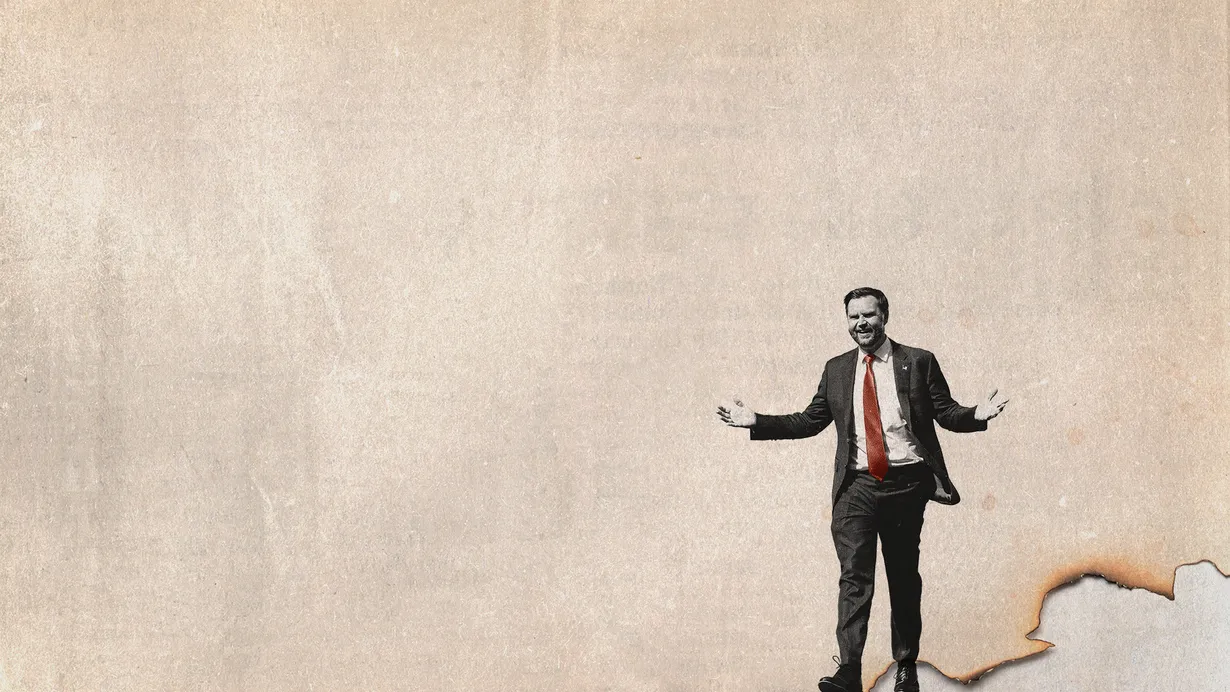
    What went wrong here is not complicated, said Michael Brendan Dougherty in National Review. When Trump bypassed Congress to attack Iran in February, he broke his promise that he would launch “no new wars,” particularly not in the Middle East. That betrayal of “America First” voters might by itself have cost Republicans the midterms, but the war also spiked energy prices, with devastating consequences for “every single household budget in America.” And it’s why 74% of voters in exit polls said the Iran war was a “major” or “crucial” factor in their vote. If anything, the Iran debacle has strengthened the case for “America First conservatism,” said Jude Russo in The American Conservative. A true populist like Vice President JD Vance—who this week squarely cited the war as “the reason we lost”— is well positioned to start rebuilding the MAGA coalition, with a forward-looking message of “promises unfulfilled.” 

    Vance is doomed if he runs in 2028, said Jonathan V. Last in The Bulwark, because “the one guy who can give him the Republican nomination is a poison pill.” But anyway, the idea that Trump will now begin a dignified withdrawal from the political scene, gracefully ceding the spotlight to his successors, is delusional. “The worst is yet to come,” said David Frum in The Atlantic. For the next two years, Trump will abuse the substantial powers he still enjoys— over the military, the security services, and a politicized Justice Department—to wreak untold havoc and to “punish a nation that, in his view, has ungratefully rejected him.” 

    This lame duck will “not go quietly,” said Jonathan Lemire, also in The Atlantic. But Trump cannot defeat “the unrelenting calendar.” Nothing he does now can change the fact that America’s “next national election will be the one to replace him.” If a flair for bullying was one of Trump’s superpowers, another was his preternatural gift for grabbing attention, for being and staying “omnipresent” in our national discourse. But that too has reached its limit. The 2028 presidential race is now underway. Trump will soon start to “slip in the headlines” and finally, after a lifetime in the spotlight, come face-to-face with what is “arguably his greatest fear: irrelevance.”


    VIEWPOINT

    Political types

    “There are three kinds of politicians. The first is the person of real integrity, who professes high standards and largely lives by them. The second is the hypocrite, who professes those same standards and falls short. The third is the shameless ‘authentic’ figure, who professes nothing and so can never be caught failing moral standards. All else equal, we want the first, and we should never stop hoping for, looking for, and electing such leaders. But the nature of politics, and the fallen nature of man, means we won’t always get the first kind. And when we don’t, a hypocrite who still answers to real standards is far better than a leader who has discarded them entirely.” 

    Logan Tantibanchachai in The Dispatch


    briefing

    The great art heist

    Museums are grappling with a surge of smash-and-grab robberies. Can they protect their treasures?

    When did this crime wave start? 
    The blitz began on a Sunday morning in Paris in October 2025. The Louvre had already opened its doors to visitors when thieves climbed up the outside of the building on a truck-mounted ladder, opened a window with power tools, and slipped into the venerable museum’s Apollo Gallery, home to France’s crown jewels. After threatening security guards, they cut through glass display cases to nab more than $100 million worth of national treasures. The whole thing took less than seven minutes, and of that haul only one crown, dropped by the robbers on their way out, has been recovered. Several people were arrested in connection with the break-in, but that hasn’t prevented “a plague of copycats,” Arthur Brand, a private art detective, told The New York Times. “Thieves all around the world see the Louvre and they think ‘Hey, don’t we have a local museum?’” 

    Which other museums have been hit? 
    There have been more than a dozen big heists over the last year, nearly all in Europe, spanning the continent from Wales to the Mediterranean. Hours after the Louvre heist, thieves lifted 2,000 gold and silver coins from a museum three hours from Paris that’s dedicated to philosopher Denis Diderot. Near Parma, Italy, in March this year, a gang busted through the gate of the Magnani Rocca Foundation with a tractor and left with paintings by Renoir, Cézanne, and Matisse. A Burgundy museum lost its prized gold artifact, the 2,500-year-old torque of Vix, after a daytime robbery in July. The following month, maskless thieves paid for tickets to Vienna’s Museum of Applied Arts (MAK), where they freed a 200- carat diamond-and-platinum necklace from its display case with 41 hammer blows. Burglars swiped two Renoirs from the artist’s eponymous French Riviera museum in September. The trend hasn’t yet hit the U.S., but more than 1,000 historic artifacts were stolen from an Oakland museum’s off-site storage facility last year. 

    What happens to the stolen items? 
    Contraband paintings are tough to sell, because reputable art dealers can easily sniff them out. And black-market customers, knowing the risk of buying a recognizable work, will typically only cough up about 10% of the actual value. More commonly, thieves will try to force the museums to pay a ransom for the paintings, hold them as collateral in criminal deals with other gangs, or use them as a bargaining chip to negotiate for a lighter sentence in a different crime. That means paintings are a bit easier to recover: Works from the Parma and Renoir museums have now been returned. Coins, crowns, and jewels, though, are often melted down or recut into smaller gems, obliterating their historical value and making them harder to trace. “This destroys us,” said Fulgencio José Cerdán, the mayor of a Spanish town that saw its Bronze Age collection of gold artifacts stolen from a local museum in August. “It’s part of our heritage.” Thieves seek gold because the price has surged, hitting nearly $5,600 an ounce earlier this year—up 134% over 2024 prices. That makes even the riskiest break-ins worthwhile, and it’s why the recent thefts are much more brazen than the sneaky capers of the past. 

    What’s different about these heists? 
    They are faster and more violent. Museum theft “has always existed,” said Anthony Amore, head of security at Boston’s Isabella Stewart Gardner Museum, but “is without question spiking.” In 1990, the Gardner lost 13 masterpieces worth a combined $500 million, an unsolved robbery that was heavy on subterfuge, with the suspects disguising themselves as cops and spending over an hour inside. In 1911, one Louvre employee hid in the museum overnight and nicked the Mona Lisa; he was caught when he tried to sell it. But today’s burglars, who often form ad hoc teams recruited via social media, have replaced deception with brute force. According to an August Europol report, they’re “breaching premises and display cases using tools such as sledgehammers, axes, crowbars and, in some instances, explosives,” often in broad daylight. They’re also quick, sometimes getting in and out in as little as three minutes. 

    Why are museums so vulnerable? 
    Museums are soft targets that tend to have much less security than high-end jewelry stores. The Louvre’s single security camera outside the Apollo Gallery didn’t cover the window the thieves used to enter and exit. Vienna’s MAK only installed metal detectors after the necklace robbery. Many European museums even lack a dedicated security chief. Lack of funding has played a role—France cut its heritage spending by $46 million in 2025—but so has architecture. Europe’s museums are often housed in former palaces or mansions, and curators don’t want to “undermine the beauty or historical integrity” with security retrofits, says cultural heritage lawyer Walker Schulte Schneider. Modern museums may have better security technology than their predecessors, but their designs aren’t foolproof, either. Glass facades enhance visibility, skylights serve as entry points, and spacious open galleries create blind spots. 

    What is being done to harden them? 
    Museum officials everywhere are waking up. Weeks after the Louvre heist, the museum announced an $89 million security plan and put in charge the veteran police officer who had modernized security for the Paris transport system. For smaller museums, some of which have remained closed since being targeted, experts recommend displaying replicas in lieu of their most cherished possessions or even taking priceless exhibits down altogether. While ramping up security seems like a no-brainer, museums have to consider the effect on the visitor experience. People “engage more deeply when they can approach an object, examine its detail,” Guy Turton, an audience strategist, told the BBC. “Greater distance and more prominent barriers can weaken that connection.”




    Only in America

    A Texas high school student is suing her school district for sex discrimination after she was barred from playing a male character in a musical. Ana Mota, 17, was cast as Seymour in Little Shop of Horrors, but administrators removed her, citing a 2025 state law restricting schools from, among other things, teaching about gender identity. Mota’s lawsuit argues that the law is silent on the sex of actors portraying fictional characters, calling cross-gender casting a “centuries-old theatrical tradition.”


    talking points

    Supreme Court: Greenlighting bigotry?

    “The Supreme Court is poised to make taxpayers fund anti-LGBTQ discrimination,” said Ian Millhiser in Vox. The justices this week heard arguments in St. Mary Catholic Parish v. Roy, a case that “squarely presents the question of whether the Constitution authorizes discrimination by religious schools.” Colorado has offered universal preschool for 4-year-olds since 2023, allowing families to choose from a wide range of public and private providers, including religious institutions. But schools that participate in the program must be open to all children—including those with gay and transgender parents. The St. Mary Catholic Parish preschool outside Denver argues that this requirement conflicts with its Catholic mission and violates its First Amendment rights. The court’s conservative majority seems to agree, with Chief Justice John Roberts saying Colorado’s law looked “pretty much the same” as a Maine law the court struck down in 2022 that excluded religious schools from a public tuition assistance program. Given the conservative majority’s track record of siding with religious plaintiffs, St. Mary will almost certainly end in “victory for religious groups that wish to exclude sexual or gender minorities.” 

    It should, because Colorado’s preschool program is a “blatant attack on religious liberty,” said Tim Busch in National Review. The state gladly funds “preschools that enforce and evangelize the most aggressive” LGBTQ ethic, yet it balked at a “school’s requirement that families uphold Catholic teaching, including the sanctity of marriage and the reality of biological sex.” Such unequal treatment is “inconsistent with the First Amendment.” By denying Catholic preschools funding, the state is saying “religious views are inferior”—and that Catholics are “second-class citizens the moment they try to live out their faith.” 

    “Those religious beliefs don’t exist in a vacuum,” said Adam Laats in Slate. In this case, religious freedom is interpreted to mean the freedom to exclude LGBTQ families “from a publicly funded educational program.” And the Catholic institutions want all Coloradans, including those excluded families, to “subsidize their discriminatory religious beliefs.” The court is unlikely to rule for Colorado, said Aaron Tang in the Los Angeles Times, but the conservative justices should “pause before handing a victory to the religious schools.” If the court sides with the plaintiffs, Colorado has a “glaringly obvious policy response”: follow California’s example and fund universal pre-K through public schools. That would eliminate a program that directs over $9.5 million a year to faith-based preschools and is “quite popular” with conservatives. The Left and Right may both “loathe this next ruling.”


    people

    Brolin’s wild childhood

    Josh Brolin has met all the greats in Hollywood, said Richard Grant in The Telegraph (U.K.), but none had a personality as big as his mother’s. Jane Cameron Agee was a cocktail-chugging casting director and wildlife activist who brought wolves, cougars, and other rescued animals to live on their family ranch in California. “Me and my brother, as little kids, were always ready to run for our lives from whatever predator might come after us,” says Brolin, 58. “I’ve got a photograph of me in a crib with a juvenile mountain lion. How’s that for irresponsible parenting?” His mother was funny but also volatile, given to screaming and smashing windows. “She had a really loud voice, and I can hear it right now: ‘Get out here and spend some time with this wolf!’” He was 16 when Cameron Agee and his father, actor James Brolin, divorced; she died in a drunk-driving accident nine years later. Brolin, who has been sober for 12 years, inherited a lot from her. “That’s where I get my alcoholism and my instinct to go toward danger. But it’s nurture too. She wanted me to be a hard-drinking, fighting cowboy type, because that’s what she admired.” He can still picture his mother’s proud smile when she visited him in a juvenile detention center, the first time he was locked up. “Even as a kid, I knew how f---ed up that was. I was trapped in that persona of what she wanted me to be for a long time.”


    Saturday Wrap was written and edited by Theunis Bates, Susan Caskie, Allan Kew, Bruno Maddox, Scott Meslow, Rebecca Nathanson, and Tim O’Donnell.

    Image credits, from top:  Getty; Getty; Getty
     

    Recent editions

    • Evening Review

      What the midterms mean for Israel

    • Morning Report

      Newsom empties death row

    • Evening Review

      JD Vance pivots

    VIEW ALL
    TheWeek
    • About Us
    • Contact Future's experts
    • Terms and Conditions
    • Privacy Policy
    • Cookie Policy
    • Advertise With Us
    • FAQ
    Add as a preferred source on Google Add as a preferred source on Google

    The Week US is part of Future US Inc, an international media group and leading digital publisher. Visit our corporate site.

    © Future US, Inc. Full 7th Floor, 130 West 42nd Street, New York, NY 10036.