Sign up to get Today’s Best Articles in your inbox
Join 350,000+ subscribers and keep yourself informed with a selection of
The Week’s most interesting, enlightening and entertaining stories - plus daily puzzles.
You are now subscribed
Your newsletter sign-up was successful
Want to add more newsletters?
An account already exists for this email address, please log in.
The Black Bloc group blamed for French riots
Protest network ‘like an orchestra who knows the music so well that they do not need a conductor’
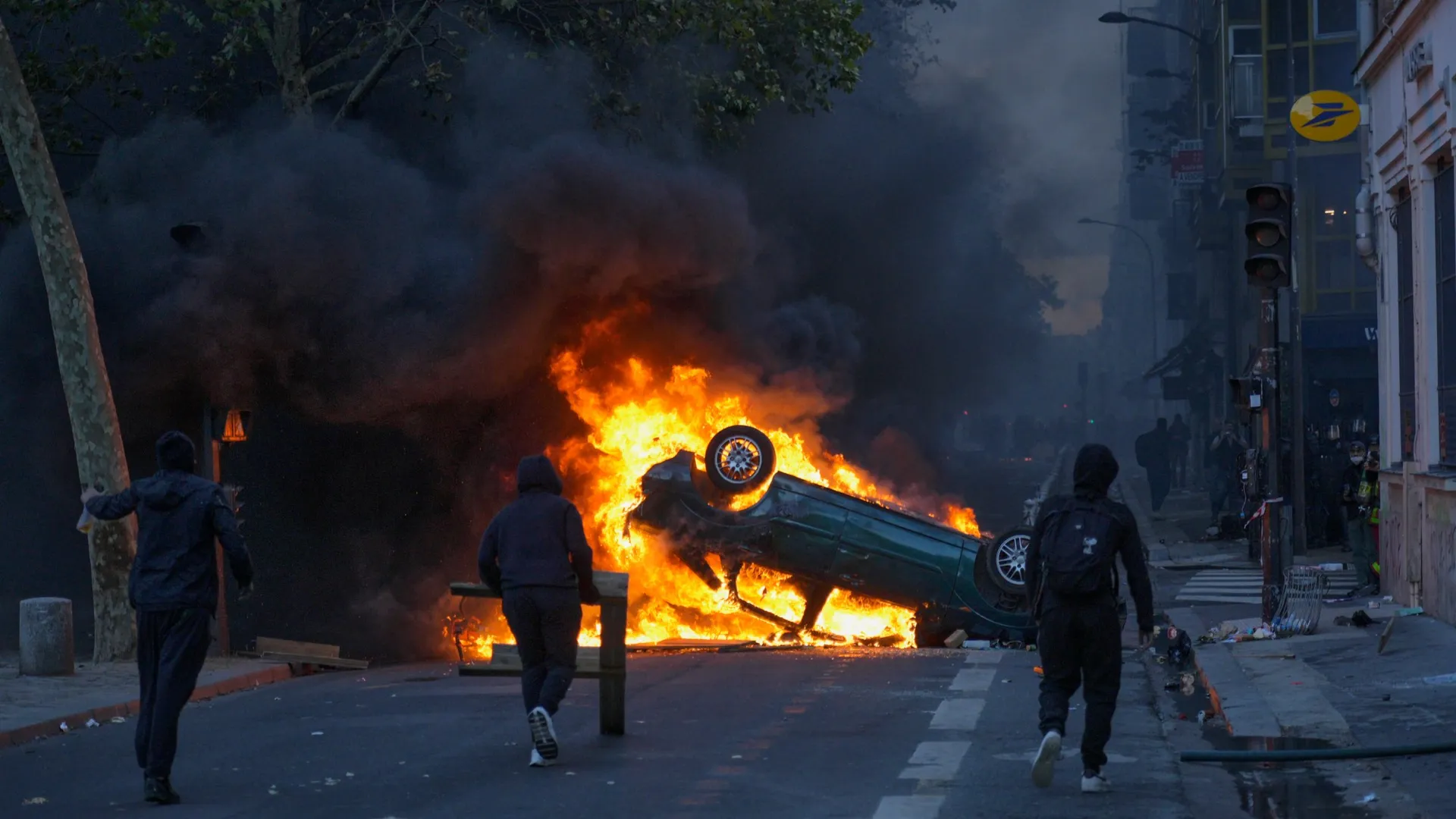
Masked protesters clad all in black have been a feature of protests around the world for decades. But the “Black Bloc” are back in the news this week, accused by the French government of turning peaceful protests into rioting and violence.
Originating among anarchist and radical left activists in West Germany in the 1980s, the Black Bloc are “temporary groups formed for a specific protest” that “operate without hierarchy”, said Canadian professor Francis Dupuis-Déri on The Conversation back in 2017.
Their tactics spread through activist networks in the US and Canada in the 1990s, culminating in the infamous “Battle of Seattle” during the 1999 World Trade Organization summit. Since then they have been prominent in the anti-austerity movements of the 2010s, and recent youth-led protests that have gripped France and other countries in Asia and South America.
The Week
Escape your echo chamber. Get the facts behind the news, plus analysis from multiple perspectives.
Join more than 350,000 subscribers and keep yourself informed with a selection of The Week’s most interesting, enlightening and entertaining stories - plus daily puzzles.
Join more than 350,000 subscribers and keep yourself informed with a selection of The Week’s most interesting, enlightening and entertaining stories - plus daily puzzles.
Ideologically identified with “anarchist, anti-capitalist and anti-fascist movements, Black Bloc participants eschew political parties and hierarchical organisations”, said the Financial Times.
They “pose a big problem” for both the police and for trade unions, “who do not want chaos to mar their traditional demonstrations” against government policies.
“They are very well co-ordinated, but in a horizontal way,” said Guillaume Farde, from Sciences Po university in Paris. They have no organised leadership, tactics are disseminated via social media or encrypted messaging apps, and gatherings are often impromptu. “It is like an orchestra who knows the music so well that they do not need a conductor.”
‘Free spirits’
The “founding fathers” of the Black Bloc were “autonomist and anarchist activists”, said Le Monde, “but the spectrum has broadened to include more individuals” who “define themselves as free spirits”.
Sign up to get Today’s Best Articles in your inbox
A free daily email with the day’s biggest news and analysis – and the best features from TheWeek.com
The movement is certainly “difficult to pin down, both politically and socially”, said historian Sylvain Boulouque in Le Monde in 2019. “It forms a heterogeneous ensemble with variegated political traditions.”
France’s domestic intelligence service “partially shares this analysis”, said Le Monde, citing a police source that said: “Behind the black blocs, real ideologists are developing a doctrine and structure that unifies and deploys propaganda.”
Others see this as an attempt by the authorities to make the Black Bloc into something they are not. “Black bloc doesn’t mean anything”, Henri, a 40-year-old who does not define himself as an anarchist, autonomist or extreme leftist, told Le Monde. “Black is just because it’s not distinctive. It’s the best way not to be identified. We’re all in the same boat.”