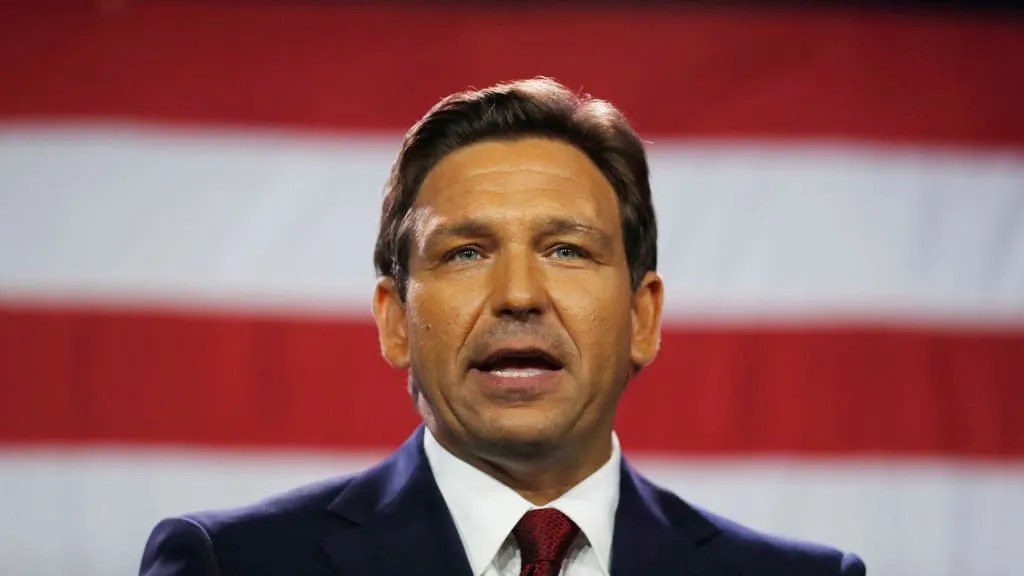
Ron DeSantis asks people to 'chill' about a potential rivalry with Trump
Florida Gov. Ron DeSantis (R) downplayed the idea of a feud between him and former President Donald Trump on Wednesday, saying people "just need to chill out a little bit."
DeSantis was asked during a news conference about Trump's Tuesday night announcement that he intends to run for president in 2024. For now, he said, the focus needs to be off any beef between him and Trump and on the Dec. 6 Georgia Senate runoff race between Sen. Raphael Warnock (D) and Republican Herschel Walker. This is "very important for Republicans to win," DeSantis said.
It's long been speculated that DeSantis plans on entering the 2024 presidential race, and during an October debate with Democratic challenger Charlie Crist he would not commit to serving out his full gubernatorial term if re-elected. DeSantis easily won a second term on Nov. 8, and on Wednesday called this "the biggest bright spot" of the midterms. "It was not so bright in many other parts of the country," he added. "It was a substandard performance given the dynamics that are at play."
The Week
Escape your echo chamber. Get the facts behind the news, plus analysis from multiple perspectives.
Sign up for The Week's Free Newsletters
From our morning news briefing to a weekly Good News Newsletter, get the best of The Week delivered directly to your inbox.
DeSantis was a strong Trump supporter, and touted his loyalty to him when running for governor in 2018, releasing an ad where he calls himself "Pitbull Trump Defender" and puts his baby in a "Make America Great Again" onesie. Trump did not return the favor this election cycle, going to Florida to stump for Republicans like Sen. Marco Rubio but not DeSantis. Trump, who recently dubbed DeSantis "Ron DeSanctimonious" and called him "average" and "desperate," reminded his followers on Truth Social about DeSantis' fealty, sharing the ad and writing, "Thanks, Ron!"
A free daily email with the biggest news stories of the day – and the best features from TheWeek.com
Catherine Garcia has worked as a senior writer at The Week since 2014. Her writing and reporting have appeared in Entertainment Weekly, The New York Times, Wirecutter, NBC News and "The Book of Jezebel," among others. She's a graduate of the University of Redlands and the Columbia University Graduate School of Journalism.
-
Exploring ancient forests on three continentsThe Week Recommends Reconnecting with historic nature across the world
-
How oil tankers have been weaponisedThe Explainer The seizure of a Russian tanker in the Atlantic last week has drawn attention to the country’s clandestine shipping network
-
The rise of the spymaster: a ‘tectonic shift’ in Ukraine’s politicsIn the Spotlight President Zelenskyy’s new chief of staff, former head of military intelligence Kyrylo Budanov, is widely viewed as a potential successor
-
Trump threatens Minnesota with Insurrection ActSpeed Read The law was passed in 1807 but has rarely been used
-
Why is Trump threatening defense firms?Talking Points CEO pay and stock buybacks will be restricted
-
‘The security implications are harder still to dismiss’Instant Opinion Opinion, comment and editorials of the day
-
Judge clears wind farm construction to resumeSpeed Read The Trump administration had ordered the farm shuttered in December over national security issues
-
Trump DOJ targets Fed’s Powell, drawing pushbackSpeed Read Powell called the investigation ‘unprecedented’
-
What are Donald Trump’s options in Iran?Today's Big Question Military strikes? Regime overthrow? Cyberattacks? Sanctions? How can the US help Iranian protesters?
-
Maduro’s capture: two hours that shook the worldTalking Point Evoking memories of the US assault on Panama in 1989, the manoeuvre is being described as the fastest regime change in history
-
Trump’s power grab: the start of a new world order?Talking Point Following the capture of Nicolás Maduro, the US president has shown that arguably power, not ‘international law’, is the ultimate guarantor of security