UK spy chief: Russian soldiers are refusing to carry out orders in Ukraine
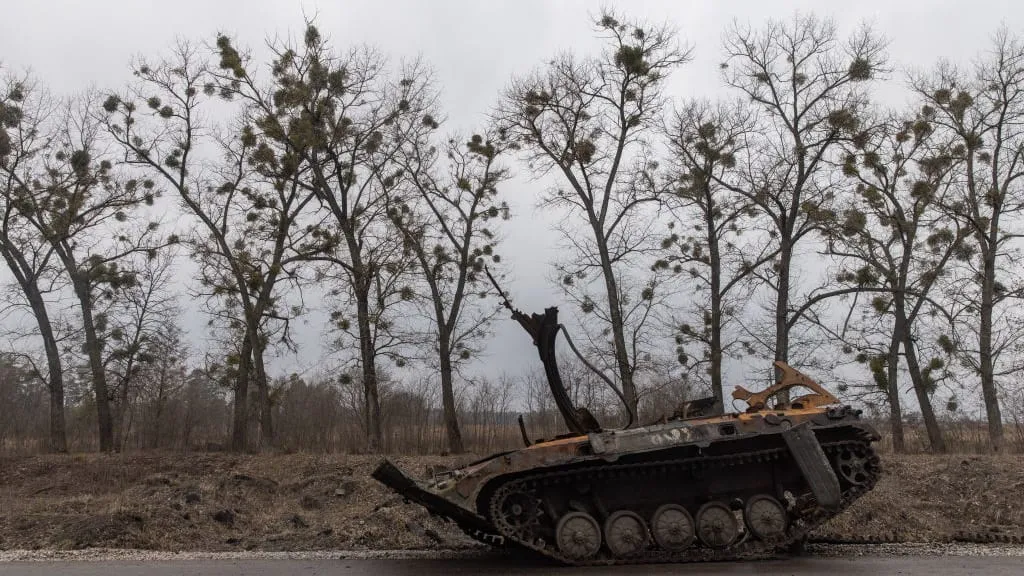
New intelligence out of Ukraine shows that some Russian troops are refusing to carry out orders, even going so far to sabotage their equipment, Jeremy Fleming, head of Britain's Government Communications Headquarters (GCHQ), said on Wednesday.
The spy chief shared the information during a speech at the Australian National University in Canberra. He said Russian President Vladimir Putin "massively misjudged" the capabilities of his military, adding, "We believe Putin's advisers are afraid to tell him the truth."
Ukraine has fought back harder than Putin expected, Fleming said, and "we've seen Russian soldiers — short of weapons and morale — refusing to carry out orders, sabotaging their own equipment, and even accidentally shooting down their own aircraft."
The Week
Escape your echo chamber. Get the facts behind the news, plus analysis from multiple perspectives.
Sign up for The Week's Free Newsletters
From our morning news briefing to a weekly Good News Newsletter, get the best of The Week delivered directly to your inbox.
Additionally, it's estimated that Russia is experiencing failure rates as high as 60 percent for some of its precision-guided missiles, three U.S. officials with knowledge of the intelligence told Reuters. Russia's defense ministry denies the reports of discord, and has accused the West of lying about the invasion of Ukraine.
A free daily email with the biggest news stories of the day – and the best features from TheWeek.com
Catherine Garcia has worked as a senior writer at The Week since 2014. Her writing and reporting have appeared in Entertainment Weekly, The New York Times, Wirecutter, NBC News and "The Book of Jezebel," among others. She's a graduate of the University of Redlands and the Columbia University Graduate School of Journalism.
-
Film reviews: ‘Hamnet,’ ‘Wake Up Dead Man’ and ‘Eternity’Feature Grief inspires Shakespeare’s greatest play, a flamboyant sleuth heads to church and a long-married couple faces a postmortem quandary
-
Poems can force AI to reveal how to make nuclear weaponsUnder The Radar ‘Adversarial poems’ are convincing AI models to go beyond safety limits
-
The military: When is an order illegal?Feature Trump is making the military’s ‘most senior leaders complicit in his unlawful acts’
-
Is conscription the answer to Europe’s security woes?Today's Big Question How best to boost troop numbers to deal with Russian threat is ‘prompting fierce and soul-searching debates’
-
Trump peace deal: an offer Zelenskyy can’t refuse?Today’s Big Question ‘Unpalatable’ US plan may strengthen embattled Ukrainian president at home
-
Vladimir Putin’s ‘nuclear tsunami’ missileThe Explainer Russian president has boasted that there is no way to intercept the new weapon
-
The Baltic ‘bog belt’ plan to protect Europe from RussiaUnder the Radar Reviving lost wetland on Nato’s eastern flank would fuse ‘two European priorities that increasingly compete for attention and funding: defence and climate’
-
How should Nato respond to Putin’s incursions?Today’s big question Russia has breached Nato airspace regularly this month, and nations are primed to respond
-
Russia’s war games and the threat to NatoIn depth Incursion into Poland and Zapad 2025 exercises seen as a test for Europe
-
What will bring Vladimir Putin to the negotiating table?Today’s Big Question With diplomatic efforts stalling, the US and EU turn again to sanctions as Russian drone strikes on Poland risk dramatically escalating conflict
-
The mission to demine UkraineThe Explainer An estimated quarter of the nation – an area the size of England – is contaminated with landmines and unexploded shells from the war