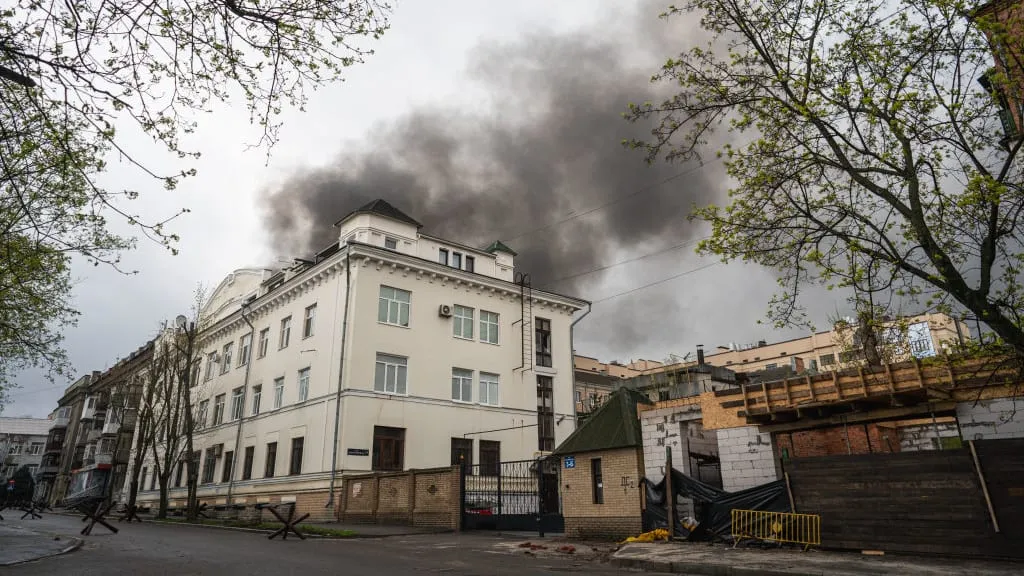
Missile strike in Kharkiv injures 4 World Central Kitchen workers
Kharkiv, Ukraine's second-largest city, is under heavy shelling, with attacks on Saturday and Sunday killing at least seven people and injuring dozens of others, including four workers with chef José Andrés' World Central Kitchen.
World Central Kitchen is a nonprofit organization that goes to areas affected by natural disasters or conflict and teams up with partner restaurants to provide meals to local residents. World Central Kitchen CEO Nate Mook on Saturday tweeted a video showing the aftermath of a strike that hit near a partner kitchen. "People live here, people work here, people cook here, and that's it," he said. "I don't know what else to say. Just absolutely horrific brutality."
On Sunday, Mook provided an update on the injured World Central Kitchen workers, calling them "brave" and "in good spirits" while receiving treatment at a local hospital. Andrés also tweeted on Sunday that the team in Kharkiv is "ready and willing to start cooking in another location. ... All our friends are TRUE heroes! Many ways to fight, we do it with food!"
The Week
Escape your echo chamber. Get the facts behind the news, plus analysis from multiple perspectives.
Sign up for The Week's Free Newsletters
From our morning news briefing to a weekly Good News Newsletter, get the best of The Week delivered directly to your inbox.
Since the Russian invasion of Ukraine on Feb. 24, World Central Kitchen says it has distributed nearly 300,000 meals to people across the country, delivering them to the frontlines, bomb shelters, and hospitals.
Ukrainian officials said the rocket attacks in Kharkiv on Saturday and Sunday hit apartment buildings, markets, and shops, with many catching on fire.
A free daily email with the biggest news stories of the day – and the best features from TheWeek.com
Catherine Garcia has worked as a senior writer at The Week since 2014. Her writing and reporting have appeared in Entertainment Weekly, The New York Times, Wirecutter, NBC News and "The Book of Jezebel," among others. She's a graduate of the University of Redlands and the Columbia University Graduate School of Journalism.
-
Nasa’s new dark matter mapUnder the Radar High-resolution images may help scientists understand the ‘gravitational scaffolding into which everything else falls and is built into galaxies’
-
Is the US about to lose its measles elimination status?Today's Big Question Cases are skyrocketing
-
‘No one is exempt from responsibility, and especially not elite sport circuits’Instant Opinion Opinion, comment and editorials of the day
-
What is ‘Arctic Sentry’ and will it deter Russia and China?Today’s Big Question Nato considers joint operation and intelligence sharing in Arctic region, in face of Trump’s threats to seize Greenland for ‘protection’
-
What would a UK deployment to Ukraine look like?Today's Big Question Security agreement commits British and French forces in event of ceasefire
-
Would Europe defend Greenland from US aggression?Today’s Big Question ‘Mildness’ of EU pushback against Trump provocation ‘illustrates the bind Europe finds itself in’
-
Did Trump just end the US-Europe alliance?Today's Big Question New US national security policy drops ‘grenade’ on Europe and should serve as ‘the mother of all wake-up calls’
-
Is conscription the answer to Europe’s security woes?Today's Big Question How best to boost troop numbers to deal with Russian threat is ‘prompting fierce and soul-searching debates’
-
Trump peace deal: an offer Zelenskyy can’t refuse?Today’s Big Question ‘Unpalatable’ US plan may strengthen embattled Ukrainian president at home
-
Vladimir Putin’s ‘nuclear tsunami’ missileThe Explainer Russian president has boasted that there is no way to intercept the new weapon
-
The Baltic ‘bog belt’ plan to protect Europe from RussiaUnder the Radar Reviving lost wetland on Nato’s eastern flank would fuse ‘two European priorities that increasingly compete for attention and funding: defence and climate’