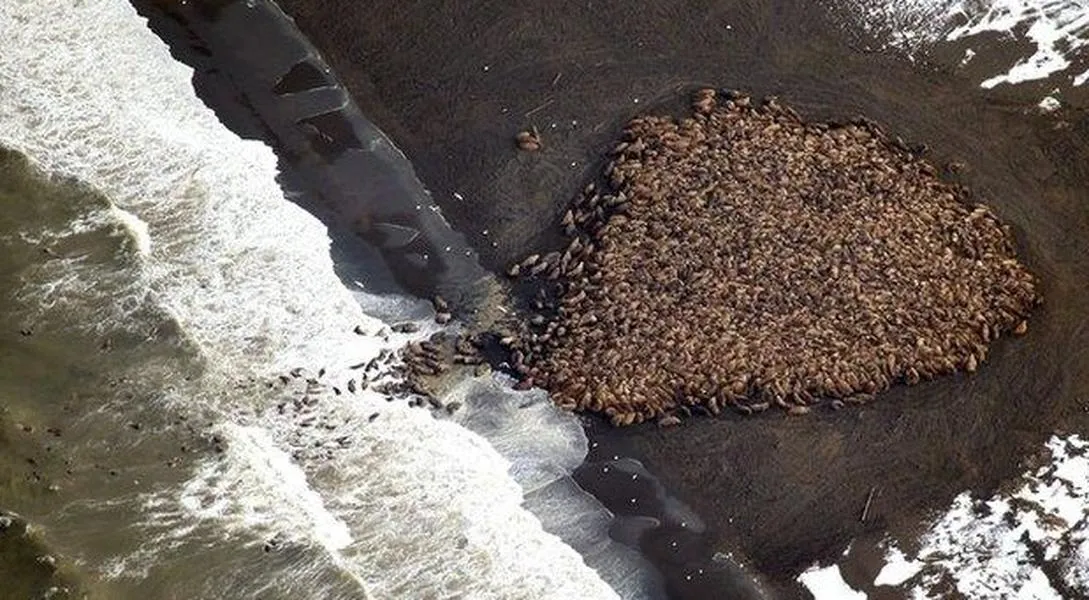
An estimated 35,000 Pacific walrus who could not find sea ice to rest on have come ashore in Alaska.
The walrus have descended upon a beach five miles north of Point Lay, an Inupiat Eskimo village 700 miles northwest of Anchorage. They usually spend their winters in the Bering Sea, where females give birth on sea ice, and the ice is used as a platform for the walrus to dive in and eat clams, worms, and snails. As sea ice recedes due to warmer temperatures, the water becomes too deep for the walrus, and they cannot dive to the bottom to eat.
"It's another remarkable sign of the dramatic environmental conditions changing as the result of sea ice loss," Margaret Williams, managing director of the World Wildlife Fund's Arctic program, told The Associated Press. "The walruses are telling us what the polar bears have told us and what many indigenous people have told us in the high Arctic, and that is that the Arctic environment is changing extremely rapidly and it is time for the rest of the world to take notice and also to take action to address the root causes of climate change."
The Week
Escape your echo chamber. Get the facts behind the news, plus analysis from multiple perspectives.
SUBSCRIBE & SAVE
Sign up for The Week's Free Newsletters
Join more than 350,000 subscribers and keep yourself informed with a selection of The Week’s most interesting, enlightening and entertaining stories - plus daily puzzles.
Join more than 350,000 subscribers and keep yourself informed with a selection of The Week’s most interesting, enlightening and entertaining stories - plus daily puzzles.
Latest Videos FromThe Week US