July 7, 2015

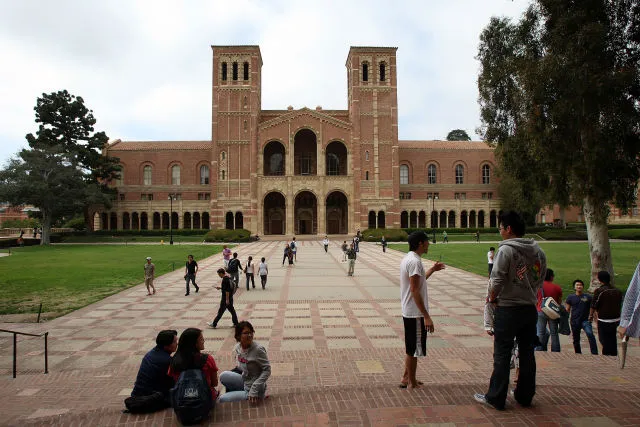
A report from the Federal Reserve Bank of New York suggests that federal student aid programs are doing more harm than good. When subsidized federal loans have the effect of "relaxing students' funding constraints," universities respond by raising tuition to collect the newly available cash.

The resultant tuition hikes can be substantial: The researchers found that each additional dollar of Pell Grant or subsidized student loan money translates to a tuition jump of 55 or 65 cents, respectively. Of course, the higher tuition also applies to students who don't receive federal aid, making college less affordable across the board.

The report also found that subsidized federal loans do not appear to increase enrollment. "[W]hile one would expect a student aid expansion to benefit recipients," the study authors wrote, "the subsidized loan expansion could have been to their detriment, on net, because of the sizable and offsetting tuition effect." Bonnie Kristian

2:26 p.m.

There's a growing likelihood that the first round of Pfizer's coronavirus vaccine will be rolled out in just a few weeks. If and when that happens, only high priority groups, like health care workers, are expected to have access. Theoretically, the pool will grow over time, but children will probably have to wait a while. That's partly because younger people, though far from invulnerable to COVID-19, are less susceptible to severe cases, but it also has to do with the fact that the youngest people to receive Pfizer's candidate in trials were between 12 and 14 years old, Dr. Moncef Slaoui, the White House vaccine czar, told CNN's Jake Tapper on Sunday.

As things stand, there's no data about the vaccine's efficacy or safety for younger children, but Slaoui says the plan is to run trials at an expedited pace over coming months, first with younger adolescents, then toddlers, and, finally, infants. If that goes well, Slaoui, expects most kids will be able to get vaccinated by the middle of next year, while infants may not be approved until the end of 2021. Tim O'Donnell

1:53 p.m.

Retired U.S. Army Lt. Gen. H.R. McMaster, who previously served as President Trump's national security adviser, on Sunday called Trump's order to further reduce the number of American troops in Afghanistan by mid-January "abhorrent."

CBS News' Margaret Brennan asked McMaster if Trump was "handing the Taliban a victory on the way out the door." McMaster answered in the affirmative, adding that Trump has "paradoxically doubled down on all the flaws of the Obama administration's approach to Afghanistan." As McMaster sees it, if the Taliban establishes control over large parts of Afghanistan, they will offer "safe haven" for terrorist groups, making the U.S. "far less safe."

But the real issue, McMaster argues, is that the U.S. would be leaving after previously "empowering" the Taliban, citing the fact that U.S.-Taliban negotiations led to the Afghan government releasing 5,000 Taliban prisoners. "If we were gonna leave," he said. "Just leave." Tim O'Donnell

1:17 p.m.

Former New Jersey Gov. Chris Christie (R) says it's time for President Trump to wave the white flag and accept the presidential election results.

During Sunday's edition of ABC's This Week, Christie told host George Stephanopoulos that Trump's campaign has had enough time to present evidence of voter fraud, but they have failed to do so. He said the legal challenge has turned into a "national embarrassment," singling out Sidney Powell for accusing Georgia Gov. Brian Kemp (R) of a crime and then refusing to back it up with evidence.

Christie noted that he has supported Trump throughout his presidency and voted for him both this year and in 2016, but said "we cannot continue to act as if something happened here that didn't happen." Tim O'Donnell

12:25 p.m.

There are members of the Republican Party who are worried that Ronna McDaniel's desire to remain as the chair of the Republican National Committee could mean President Trump will retain control of the group and, therefore, the GOP even after he's out of the White House, The New York Times reports. McDaniel is a close ally of Trump, and wary Republicans suspect she could allow for Trump to mobilize the party against incumbents he doesn't consider loyal enough.

But McDaniel has reportedly attempted to assure the doubters that she'll remain independent of Trump and his family, four Republicans told the Times on condition of anonymity. Besides, if it's not her, the risk of an ever more pro-Trump chair could emerge, she reportedly told one party leader, warning her successor could be someone like Donald Trump, Jr. or his girlfriend, Kimberly Guilfoyle.

Aides to Trump Jr. and Guilfoyle have said neither is interested in the job, but the possibility could be enough for McDaniel to reel in the support she needs, given the party's concern of continuing to lose its grip on suburban voters. Read more at The New York Times. Tim O'Donnell

11:31 a.m.

Pfizer's coronavirus vaccine, which was submitted to the Food and Drug Administration for an emergency use authorization this week and could be rolled out by mid-December, must be kept in ultra-cold conditions and will initially be shipped in boxes that hold a minimum of 975 doses. Once a vial is thawed and diluted to make five shots, people receiving the vaccine (early on that is expected to be health care workers), will then have just six hours to get inoculated, Politico reports. Whatever is left over will then spoil.

While there's great excitement about the vaccine's pending authorization, the concern about wasted shots is very real, "especially early on when it will be practically liquid gold," Douglas Hoey, CEO of the National Pharmacists Association told Politico.

States are trying to come up with ways to mitigate the risk, but spoiled doses are inevitable. Maryland health officials told the Centers for Disease Control and Prevention that as much as 5 percent of the vaccine the state is allocated could go unused in the initial rollout, especially because rural counties may not be able to use up all 975 doses on their own. To counter, Maryland is considering creating regional clinics where people in high priority groups from different rural communities could come to get vaccinated.

Oregon is considering contracting emergency medical providers to drive around and divy up the vaccine among remote areas, Politico reports. And North Dakota wants to repackage the vaccine into smaller boxes — Pfizer says it's working on a smaller pack size that won't be ready until next year — while also identifying people in the next priority group to get a shot if there are any doses left over.

Regardless, the situation will be tricky, but Moderna's vaccine, which will also soon be up for FDA authorization, is expected to be a bit easier to distribute than Pfizer's. Read more at Politico. Tim O'Donnell

10:39 a.m.

The Food and Drug Administration on Saturday issued an emergency use authorization for Regeneron's antibody cocktail, a treatment that was given to President Trump in October after he tested positive for COVID-19. Trump credited the cocktail for aiding his recovery.

For now, the authorization applies only to high-risk patients — people over the age of 65 or those who have underlying conditions — and the treatment is meant to be administered in the early stages of an infection; it has not been authorized for patients hospitalized with COVID-19 or those who require oxygen therapy.

Demand is likely to outpace supply with infections rising rapidly across the U.S., but Regeneron said it hopes to have enough doses for 80,000 patients by the end of November, 200,000 by the first week in January, and 300,000 by the end of January.

The cocktail consists of two monoclonal antibodies that target the spike protein the coronavirus uses to enter cells. A similar therapy developed by Eli Lilly was granted an emergency use by the FDA earlier this month. Read more at Bloomberg and CNN. Tim O'Donnell

8:18 a.m.

U.S. District Court Judge Matthew Brann — a conservative jurist — on Saturday threw out yet another lawsuit filed by the Trump campaign seeking to block the certification of the presidential election results in Pennsylvania.

The campaign's attorneys argued Pennsylvania counties violated the Constitution's guarantee of equal protection under the law by taking different approaches to notifying voters before the election about mistakes on their mail-in ballots — some counties allowed voters to fix the errors, while others didn't notify them at all. Brann dismissed the argument entirely. He wrote that plaintiffs "seeking such a startling outcome" should "come formidably armed with compelling legal arguments and factual proof of rampant corruption," but instead the campaign presented "strained legal arguments without merit and speculative accusations." He likened the campaign's allegations of an equal protection violation to Frankenstein's monster, writing that it "has been haphazardly stitched together from two distinct theories in an attempt to avoid controlling precedent."

Brann's decision sealed the deal for Sen. Pat Toomey (R-Pa.), who, much to President Trump's chagrin, congratulated President-elect Joe Biden and Vice President-elect Kamala Harris on their victory shortly after it was made.

The Trump team isn't giving up in this instance, however. Trump's personal attorney Rudy Giuliani, along with legal adviser Jenna Ellis, released a statement arguing Brann's ruling actually helps their case because it will speed up their path to the Supreme Court. Read more at The Wall Street Journal and The Associated Press. Tim O'Donnell

See More Speed Reads