The Week The Week
flag of US
US
flag of UK
UK
https://cdn.mos.cms.futurecdn.net/flexiimages/jzblygzdxr1769609154.gif

SUBSCRIBE

Try 6 weeks free

Sign in
  • View Profile
  • Sign out
  • The Explainer
  • Talking Points
  • The Week Recommends
  • Podcasts
  • Newsletters
  • From the Magazine
  • The Week Junior
  • More
    • Politics
    • World News
    • Business
    • Health
    • Science
    • Food & Drink
    • Travel
    • Culture
    • History
    • Personal Finance
    • Puzzles
    • Photos
    • The Blend
    • All Categories
  • Newsletter sign up Newsletter
  • The Week Evening Review
    The 25th Amendment, the MoD funding gap, and a ‘literary treasure hunt’

     
    TODAY’S BIG QUESTION

    Can Democrats remove Trump from office?

    Since Donald Trump returned to the White House, Democrats in Congress have mostly “steered clear” of threatening to impeach him or remove him using the 25th Amendment to the US Constitution, said The New York Times. But the “dynamic has shifted dramatically” following the president’s threat last week to wipe out Iranian civilization. His “erratic behaviour and extreme comments” have “turbocharged” discussion of his mental fitness.

    House Democrats yesterday put forward a bill to create a bipartisan panel empowered under the 25th Amendment to assess Trump’s fitness for office and potentially move to remove him. But it’s a “long-shot”, said Axios.

    What did the commentators say?
    The “fate of the Earth depends” on Trump’s removal from office, said Will Bunch in The Philadelphia Inquirer. The president’s growing list of “embarrassingly profane and unspeakably evil” social media posts shows that he is “mentally and physically deteriorating”, and that he poses a danger as the commander of the “planet’s largest air force and a large cache of nuclear weapons”. The threat is too urgent to wait for Democrats to potentially win control of Congress in November. Americans should join a general strike called for 1 May by the organisers of the “No Kings” protests. “It is a time for action.”

    Democrats’ talk of impeachment “plays into Iran’s hand”, said Peter Lucas in The Boston Herald. Despite his threats, Trump “will not end civilization in Iran”. But he will end Iran’s attempt to develop its own nuclear weapon. Democrats are looking for an excuse to “impeach him anyway if they gain control of the House” this autumn. They should instead acknowledge that Trump “saved the day” by taking action against Iran.

    What next?
    “Even in the unlikely event” that yesterday’s bill is passed, said Axios, removing Trump would require sign-off from Vice President J.D. Vance and a two-thirds majority vote in both chambers, which seems unlikely.

    The 25th Amendment is “having a moment”, said Ian Millhiser on Vox, but it is unlikely to be used against this president. The process is designed to replace an executive who is “physically or mentally incapacitated”, rather than one who is “merely bad at being president”. Other democracies make it easier to remove an “incompetent, unfit or unpopular leader”. The US should do likewise.


    THE EXPLAINER

    Why the UK is not ready for war

    Rachel Reeves is proposing to increase defence spending by less than £10 billion over the next four years, despite a £28 billion funding gap and a warning from former Nato secretary general George Robertson yesterday that Britain’s “national security and safety is in peril”.

    What has the government pledged?
    The UK government currently spends 2.4% of GDP on defence. Keir Starmer has committed to increasing that to 2.5% from April next year, and then to 3% “at some point during the next parliament”, said The Times. But some critics argue that the UK “should be hitting the 3% target now”. More broadly, the government also committed last June to a Nato-wide agreement to spend 5% of GDP on national security.

    What state are the Armed Forces in?
    In 1990, at the end of the Cold War, the British Army had “153,000 regular soldiers in its ranks”, said the BBC. Now, it has just 73,790, according to the Ministry of Defence.

    In terms of equipment, the Royal Navy had 13 destroyers and 35 frigates in 1990, which has since dropped to six and 11 respectively. The RAF had 300 combat jets, compared with its current 137 Eurofighter Typhoons and 37 Joint Strike Fighter F-35 Lightning IIs, although these are “technically superior” and supplemented by unmanned drones.

    What needs to be done?
    Public attention is mostly focused on the tangibles – such as planes, tanks and ships – but they are the “baubles on the Christmas tree”, said George Robertson in Prospect. “We need to focus on the tree itself” and address “crises in logistics, engineering, cyber, ammunition, training and medical resources”.

    The government is also “under increasing pressure” to deliver its “long-delayed” Defence Investment Plan, said The i Paper. This promises to “overhaul Britain’s military capabilities with about £300 billion of investment over a decade”. Initially scheduled for release last October, it is now not expected “until June at the earliest”, due to concerns over the MoD funding gap.


    QUOTE OF THE DAY

    “From my perspective, our kids are our upgrades.”

    Prince Harry shares his views on parenthood, which is “evolving all the time”. There’s always “room for improvement”, the Duke of Sussex said at the Melbourne launch of a report into fathers’ mental health by the charity Movember.


    Poll watch

    Dolly Parton is America’s most popular global figure, according to a poll of 1,000 US adults by YouGov and the University of Massachusetts. The 11-time Grammy winner and philanthropist had a net favourability rating of 65%, well ahead of runners-up Barack Obama (+14) and Volodymyr Zelenskyy (+13).


    IN THE SPOTLIGHT

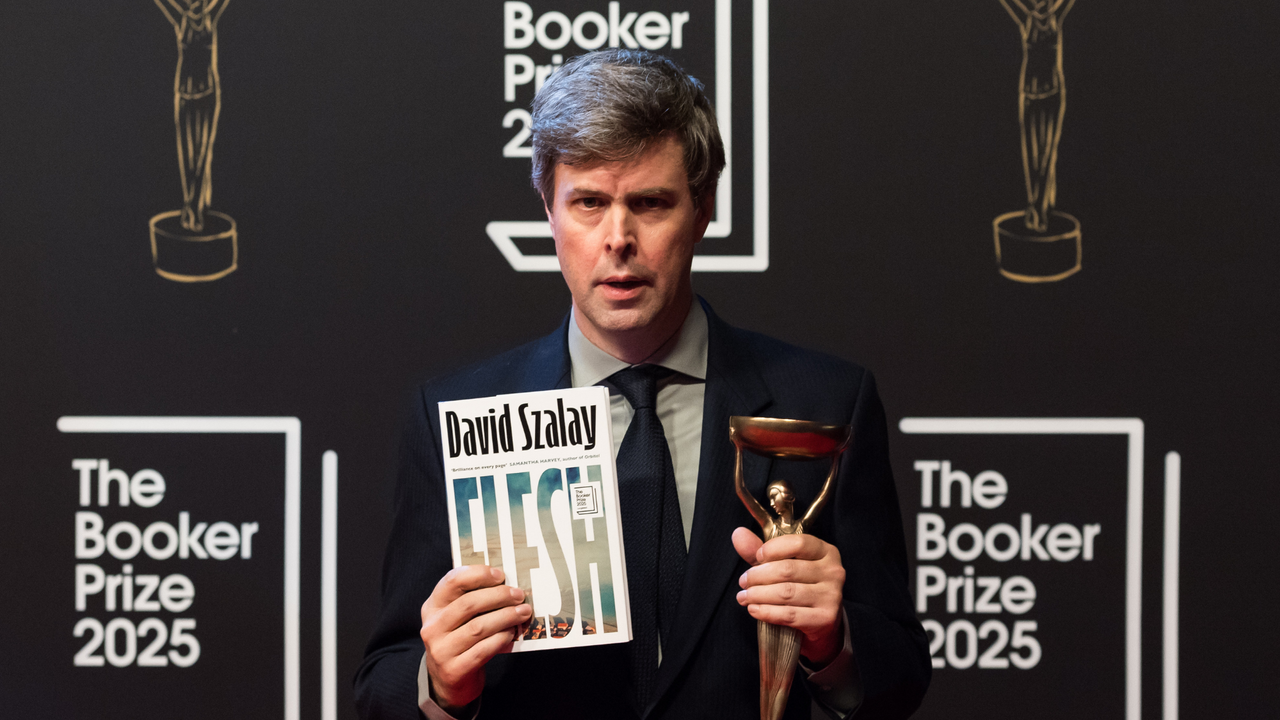
    David Szalay plays down parallels with Kubrick film

    David Szalay’s pared-back novel “Flesh” was “praised by the judges for its originality” when it scooped the Booker Prize last year, said The Times. “Yet some readers have found it strangely familiar.”

    Critics have noticed “striking similarities” between “Flesh” and Stanley Kubrick’s 1975 film “Barry Lyndon”, which in turn was adapted from William Thackeray’s 1844 novel. While some are “flummoxed” by Szalay’s reluctance to acknowledge the extent of the parallels, others are convinced he is “playing a game with readers, sending them on a literary treasure hunt”.

    ‘Near-identical trajectories’
    Szalay’s rags-to-riches tale begins in Hungary, where 15-year-old Istvan lives with his mother in a housing estate. While the eponymous lead in “Barry Lyndon” hails from Ireland, the characters “follow near-identical trajectories: they enlist in the army, marry wealthy women, grieve their sons and clash with their stepsons, and lose everything they have earned later in their lives”.

    Despite the almost indistinguishable plot, few critics pointed this out when “Flesh” won the Booker Prize. One of the first to note the similarities was writer Aled Maclean-Jones, who in a Substack post last November described “Flesh” as “quite clearly a near beat-for-beat mirror” both of Thackeray’s novel and Kubrick’s movie, “to such a level I’d almost call it a retelling”.

    Reader ‘sleuthing’
    Asked by book critic Anthony Cummins about the similarities, in an interview for The Observer, Szalay said he had seen “Barry Lyndon” when he was 20, “and the rags-to-riches arc was an influence”.

    But in an episode of BBC Radio 4’s “This Cultural Life” due to air this week, Szalay “downplays the connection”, said The Times. When asked about whether the film is a “direct reference”, the author told host John Wilson that “I wouldn’t go that far”. “Kubrick wasn’t really at the front of my mind, I don’t think,” he added.

    But Cummins had his own theory as to why Szalay won’t own up. “I think he is more artful than people are willing to credit,” he told The Times. The similarities could be “more akin to ‘Easter eggs’ in films, hidden messages for fans” to try to find. “Maybe he feels, ‘Why spoil it by talking people through the book in that way?’ There’s fun for the reader in sleuthing.”


    Good day 🎨

    … for rewarding good deeds, after a French art enthusiast who bought a €100 ticket for a charity raffle won a €1 million Picasso painting. Software engineer Ari Hodara initially asked whether it was “a prank” when Christie’s auction house called to say he’d won the draw, which raised €11 million for Alzheimer’s research.


    Bad day 🦋

    … for butterfly diversity, amid warnings that more than half of Britain’s 58 native species are in decline. According to 50 years of data from the UK Butterfly Monitoring Scheme, 33 species are becoming increasingly rare as their populations shrink, including the high brown fritillary and the white-letter hairstreak.


    PICTURE OF THE DAY

    Tough as boots

    Barcelona’s Fermín López gets kicked in a collision with Atletico Madrid goalkeeper Juan Musso. Despite a bloody nose, the Spanish midfielder returned to the Champions League game, but his side failed to score enough goals to reach the semi-finals.

    Javier Soriano / AFP / Getty Images


    Puzzles

    Guess the number

    Try The Week’s daily number challenge in our puzzles and quizzes section

    Play here


    THE WEEK RECOMMENDS

    ‘Gently bonkers’ Malcolm in the Middle reboot is a joy

    Old sitcoms have a “habit” of making “tired” or “lazy” returns to our screens, said Stuart Heritage in The Guardian. “But that particular memo didn’t reach” the team behind the “Malcolm in the Middle” reboot. “Faster and funnier than before”, and with more emotional depth, it’s “miraculous how well it works”.

    The action picks up 20 years after the original show. Frankie Muniz is back as Malcolm, “the child genius prone to fits of stress-induced sociopathy”. Nearing 40, he’s now a single dad raising his teenage daughter, Leah (Keeley Karston). Malcolm has turned out “alarmingly normal”, having “put distance (physical and emotional) between himself and the full-blown chaos of his family life”.

    “Unfortunately”, his parents, Hal (Bryan Cranston) and Lois (Jane Kaczmarek), are throwing a party for their 40th wedding anniversary, said Rebecca Nicholson in the Financial Times, and the couple (pictured above) are “determined that it will be a full and inclusive family affair”.

    Most of the original cast have returned, giving the “short, sweet four-parter” the “confidence of a well-oiled machine”. The reboot succeeds largely because it doesn’t try to “modernise itself”: instead, it feels like the team has “banded together to make another handful of ‘Malcolm in the Middle’ episodes”. As we follow Malcolm’s attempts to reunite with his dysfunctional family “without losing his mind”, there is something “comforting about the sameness of it all”. The “gently bonkers escapades are soothingly familiar”.

    Yet the final showdown between mother and son had me “clenching a pillow” for “emotional support”, said Kristy Puchko on Mashable. “I couldn’t have predicted how much it would mean to me to see Hal, Lois, Malcolm, and the whole gang back again.”


    Statistic of the day

    One in 4.9: Lotto players’ new odds of winning a prize, up from one in 9.3, under a major shake-up of the National Lottery game. From 7 June, every £2 line will give players two chances to win rather than one, a change expected to increase the annual number of Lotto millionaires from 140 to around 345.


    instant opinion

    Today’s best commentary

    Hungary beware: authoritarianism can be checked, but it is rarely dismissed with a single blow
    Blanche Leridon in The Guardian
    Viktor Orbán lost despite having the “explicit support of Donald Trump”, an “electoral map gerrymandered in his favour and a locked-down media”, writes Blanche Leridon. This is a “Budapest spring”, but as Poland’s experience shows, “national-populist episodes” leave “deep scars”. Péter Magyar’s task as Hungary’s new leader is “daunting”. Orbán “enshrined his illiberalism” in the state’s “foundations” and his “loyalists remain entrenched in every public structure”. If Magyar fails, the “ghost of the old regime” will be “ready to return”.

    Why I still watch PMQs
    Isabel Hardman in The Spectator
    The relevance of Prime Minister’s Questions is a frequent topic in Westminster “when the Wednesday lunchtime ding-dong between the two party leaders has ended up being particularly low-rent – and it has definitely fallen into that category” recently, writes Isabel Hardman. “Too often”, our politicians “don’t have the answers to the big questions, or the confidence to make the difficult arguments”. But while that can make TBQs “tedious”, “we’d still rather it revealed that truth”.

    As a TV critic, I know programme bosses do indeed think we’re stupid
    Carol Midgley in The Times
    I watch “industrial amounts of brain-mulching crud”, so I can confirm claims that many people in television “think we are thicker than lard pudding”, writes Carol Midgley. Factual programmes seem “aimed at people with all the brainpower of a bluebottle”, and drama executives “think you’re very dim too”. Some viewers are “quite stupid”, but “most of us feel a bit insulted” when yet another character drinks from a “mug that is clearly empty”, or “recovers instantly” after “being beaten to a pulp”.


    word of the day

    Double-bunking

    Squeezing into a single bed with another person, which will be banned in Air New Zealand’s new “Skynest” sleeping pods. From next month, economy passengers on the airline’s 17-hour flight between Auckland and New York will be able to book four-hour slots in six newly installed bunk-beds, for an additional fee of £215.


    Evening Review was written and edited by Hollie Clemence, Jamie Timson, Joel Mathis, Will Barker, Irenie Forshaw, Chas Newkey-Burden, Adrienne Wyper, Steph Jones and Kari Wilkin, with illustrations from Stephen P. Kelly.

    Image credits, from top: illustration by Stephen P. Kelly / Getty Images / Shutterstock; Finnbarr Webster / Getty Images; Anadolu / Getty; Javier Soriano / AFP / Getty Images; Disney

    Morning Report and Evening Review were named Newsletter of the Year at the Publisher Newsletter Awards 2025
     

    Recent editions

    • Morning Report

      Israel and Lebanon hold rare direct talks

    • Evening Review

      Why wasn’t the Southport killer stopped?

    • Morning Report

      US Navy begins blockade of Iranian ports

    VIEW ALL
    TheWeek
    • About Us
    • Contact Future's experts
    • Terms and Conditions
    • Privacy Policy
    • Cookie Policy
    • Advertise With Us
    • FAQ
    Add as a preferred source on Google Add as a preferred source on Google

    The Week UK is part of Future plc, an international media group and leading digital publisher. Visit our corporate site.

    © Future Publishing Limited Quay House, The Ambury, Bath BA1 1UA. All rights reserved. England and Wales company registration number 2008885.