The Week The Week
flag of US
US
flag of UK
UK
https://cdn.mos.cms.futurecdn.net/flexiimages/jzblygzdxr1769609154.gif

SUBSCRIBE

Try 6 weeks free

Sign in
  • View Profile
  • Sign out
  • The Explainer
  • Talking Points
  • The Week Recommends
  • Podcasts
  • Newsletters
  • From the Magazine
  • The Week Junior
  • More
    • Politics
    • World News
    • Business
    • Health
    • Science
    • Food & Drink
    • Travel
    • Culture
    • History
    • Personal Finance
    • Puzzles
    • Photos
    • The Blend
    • All Categories
  • Newsletter sign up Newsletter
  • WeekDay AM: 10 Things you need to know this morning
    Israel strikes Lebanon, Russian warship in Channel, and culturally specific dating apps

     
    today’s international story

    Iran closes Strait amid Israeli strikes on Lebanon

    What happened
    Iran has blocked oil tankers from navigating the Strait of Hormuz following the deaths of hundreds of people in Israeli strikes on Beirut. The Israeli Defense Forces launched a sweeping series of air raids across Lebanon last night, striking targets in Beirut’s southern suburbs, the Bekaa Valley and the country’s south, marking one of the most intense bombardments in the current fighting. The escalation came despite a ceasefire arrangement involving Iran, which Israeli and US officials said did not apply to Lebanon.

    Who said what
    Israel's “aggressive new attacks” on Beirut signal that it has no intention of offering relief for Lebanon, said Chris Brown on CBC News. There were signs on Tuesday that the “wider diplomatic conversation, mediated in Pakistan between the US and Iran, had come to a conclusion without Israel’s immediate input”, said Dan Sabbagh in The Guardian. 

    The Israeli opposition leader Yair Lapid said Benjamin Netanyahu had failed both politically and strategically. “There has never been such a political disaster in all of our history. Israel wasn’t even at the table when decisions were made concerning the core of our national security”, he wrote on social media.

    What next? 
    “You wonder tonight just how sustainable this wider ceasefire is”, said Nick Beake on the BBC. “Just a reminder: 1,500 people have been killed in Lebanon in the last six weeks”. As Israel continues its attacks “the accompanying death and destruction is putting a considerable strain on this fragile truce”.


    today’s defence story

    Putin ‘mocks Starmer’ with warship in Channel

    What happened
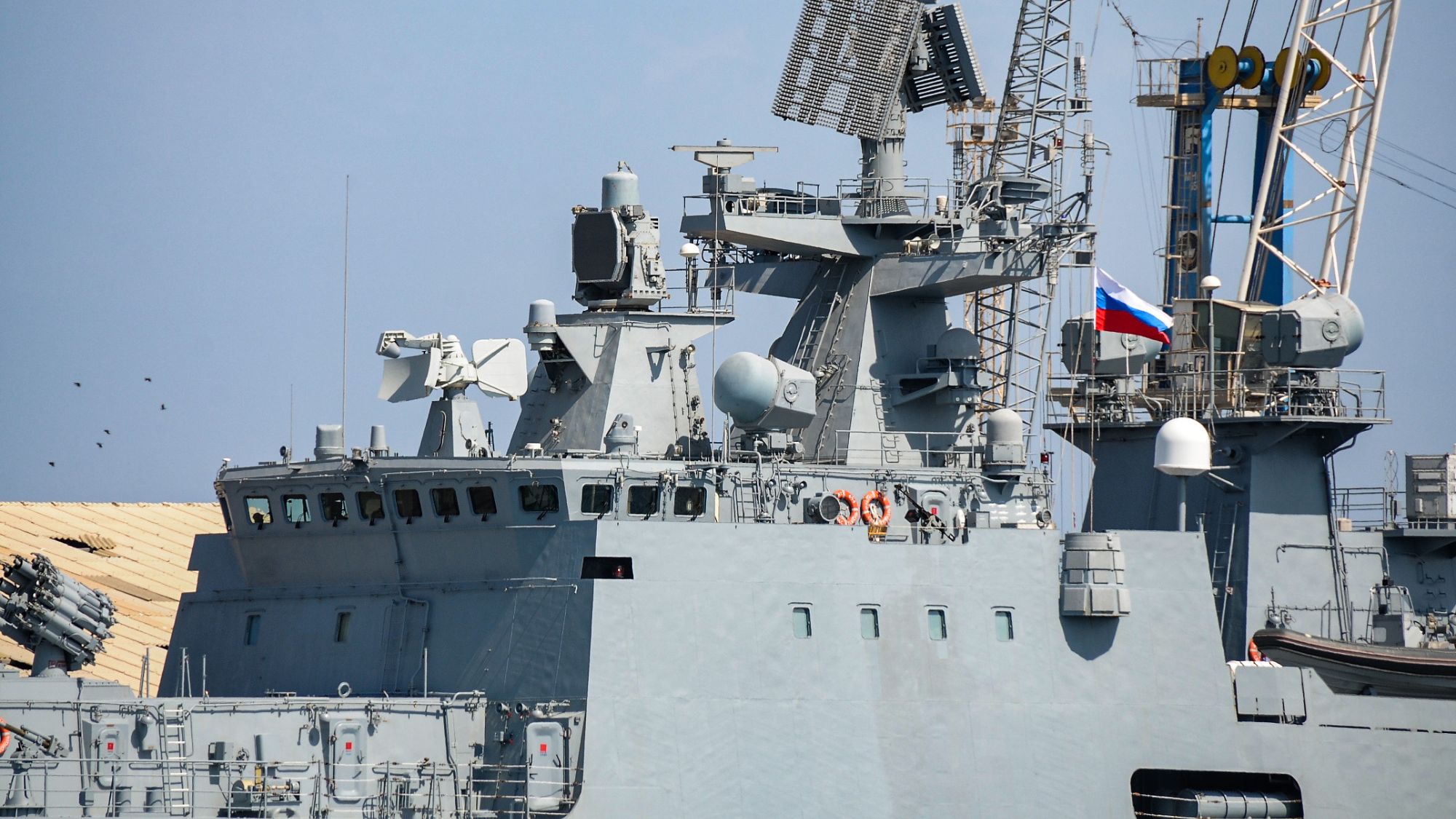
    A Russian naval vessel has escorted sanctioned oil tankers through the English Channel, despite warnings from Keir Starmer that such ships could be seized. The frigate Admiral Grigorovich (pictured above) travelled alongside two tankers, Universal and Enigma, as they moved along England’s south coast. The ships are linked to Moscow’s so-called shadow fleet, used to transport oil exports that help sustain its war effort in Ukraine.

    Who said what
    By “openly defying” Keir Starmer’s threat to seize sanctioned Russian vessels, Vladimir Putin “mocked” the prime minister, said Tom Cotterill in The Telegraph.

    The Russians are “desperate to keep that oil flowing and keep the war in Ukraine going” Andrew Fox, a retired parachute regiment major and senior fellow at the Henry Jackson Society think tank, told the paper. “They are running rings around Starmer right now”.

    What next?
    The incident comes as Starmer “faces mounting criticism over the readiness of the Royal Navy”, said The Times. Donald Trump has called the Navy’s two aircraft carriers “toys” and his defence secretary Pete Hegseth mocked Britain’s “big, bad Royal Navy”.


    Today’s health story

    Russian hackers using wifi routers for spying 

    What happened
    GCHQ has warned that hacking groups linked to the Russian state are turning wifi routers into espionage devices.

    Fancy Bear, also known as APT28 and Forest Blizzard, is a group believed to be a unit of Russian military intelligence. It was accused of hacking into the Democratic National Committee during the 2016 US presidential election.

    Who said what
    The National Cyber Security Centre said on Tuesday the operations were “believed to be opportunistic in nature” and “targeting a wide pool of victims” through commonly sold internet routers such as TP-Link and MikroTik.

    “Although this Russian group is highlighted in this particular campaign, it’s almost inevitable other routers will have vulnerabilities yet to be identified”, said Alan Woodward, professor of cybersecurity at Surrey University. This technique is an “an oldie but goodie” as devices such as routers are “often forgotten about and so not updated”.

    What next?
    The NCSC encourages people to upgrade from older devices and update the software on routers. If not, “it’s almost bound to happen again”, said Woodward.


    It’s not all bad

    Britain’s sunny spring has driven record-breaking solar power, with output hitting 14.1GW on Monday and rising again to 14.4GW on Tuesday. The milestone comes as the government approves its largest solar farm yet in Lincolnshire, set to power 180,000 homes. Alongside recent wind energy highs, the UK is accelerating towards a cleaner grid, with enough approved projects to supply up to 12.5 million homes and cut reliance on fossil fuels.


    under the radar

    The rise of culturally specific dating apps

    A new dating service has sprung up in Japan, aiming to get around the country’s ban on married couples having different surnames. 

    In a series of match-making events held this spring, every participant shared the same family name. The concept, the organisers said, is simply that “two people who already have the same last name won’t have to agonise over which one to use after marriage”.

    Japan’s current civil code, which dates back to the 19th century, specifies that a husband and wife must use the same family name. While there is no stipulation which name the couple adopts, in the country’s male-dominated society it is the man’s in 95% of cases. Critics claim this affects women’s employment prospects, contributes to Japan’s low birth rate and leaves young couples with an added pressure when trying to find a life partner.

    For would-be couples in Iceland, the problem is being related to your partner. With a population of just 330,000, the risk of pairing up with someone genetically similar to you is high.

    “Now, as social media and apps expand the dating pool”, many people are turning to a website “to ensure they aren’t swimming in the same gene pool,” said The Wall Street Journal. 

    In China, meanwhile, some parents are taking matters into their own hands to find partners for their children, with many “increasingly turning to ‘find a daughter-in-law’ or ‘find a son-in-law’ platforms online, turning partner-seeking into direct negotiations between parents”, said South China Morning Post.

    “Instead of trying to persuade single young adults who resist matchmaking”, a few “sharp-eyed businesses” are now “directly targeting a different demographic: anxious parents with strong purchasing power”.


    on this day

    9 April 1838

    The National Gallery moved to its current site in Trafalgar Square, where it has stood for 188 years. As we reported yesterday, the gallery has just announced that Japanese architect Kengo Kuma will design its new wing in the largest and most significant transformation of the gallery since its creation.


    Today’s newspapers

    ‘Fragile ceasefire’

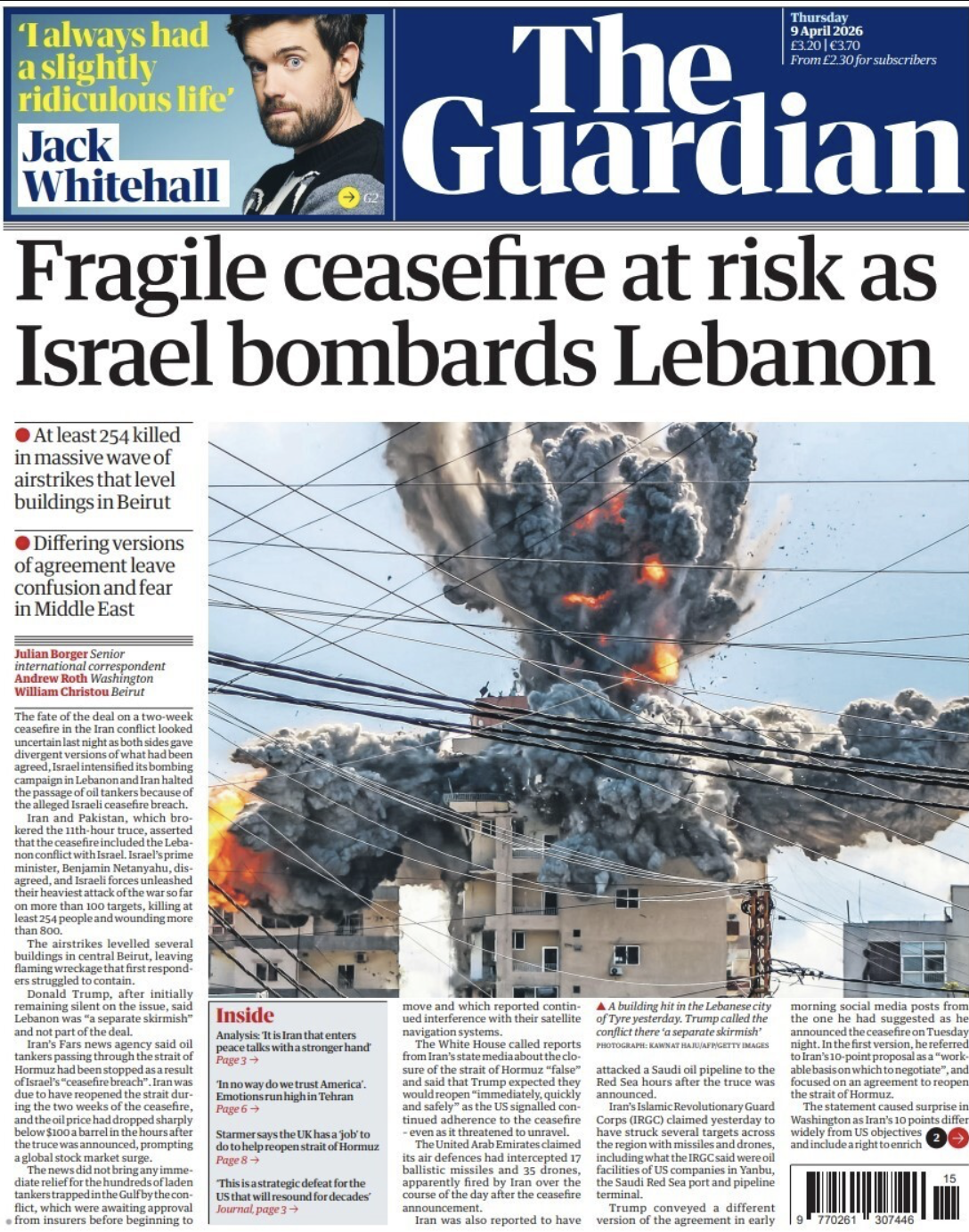
    The “fragile ceasefire” is “at risk” as Israel “bombards Lebanon”, says The Guardian. The “airstrikes” risk “blowing the fragile ceasefire apart”, says The Times. “And still it goes on”, The Mirror says. The two-week ceasefire is “a bizarre kind of victory”, says the Daily Mail, but it’s “oil over bar the shouting”, Metro says. 

    See the newspaper front pages


    tall tale

    Not the Real Thing

    A sushi shop in Wellington has apologised after accidentally selling a bottle of Coca-Cola filled with soy sauce to an unwitting customer. The man was “immediately sick” after taking a large swig back on his worksite. The bottle had been used on display as a dummy to target thieves, but had been accidentally placed in the fridge by a member of staff. The man said, however, that this episode would not put him off returning to the store. “I know they’re honest, hardworking people, and, you know, I enjoy their sushi,” he said.


    Morning Report was written and edited by Arion McNicoll, Will Barker, Ross Couzens, and Chas Newkey-Burden, with illustrations by Julia Wytrazek.

    Image credits, from top: AFP / Getty Images; Ibrahim Ishaq / AFP / Getty Images; Simpson33 / Getty Images; Illustration by Julia Wytrazek / Getty Images.

    Morning Report and Evening Review were named Newsletter of the Year at the Publisher Newsletter Awards 2025
     

    Recent editions

    • Evening Review

      The cost of a ceasefire

    • Morning Report

      Trump pauses Iran strikes at eleventh hour

    • Evening Review

      Is there a Nato without the US?

    VIEW ALL
    TheWeek
    • About Us
    • Contact Future's experts
    • Terms and Conditions
    • Privacy Policy
    • Cookie Policy
    • Advertise With Us
    • FAQ
    Add as a preferred source on Google Add as a preferred source on Google

    The Week UK is part of Future plc, an international media group and leading digital publisher. Visit our corporate site.

    © Future Publishing Limited Quay House, The Ambury, Bath BA1 1UA. All rights reserved. England and Wales company registration number 2008885.