The Week The Week
flag of US
US
flag of UK
UK
https://cdn.mos.cms.futurecdn.net/skoGBi9qKFoUtnNWkovjJQ.jpg

SUBSCRIBE

Try 6 Free Issues

Sign in
  • View Profile
  • Sign out
  • The Explainer
  • Talking Points
  • The Week Recommends
  • Podcasts
  • Newsletters
  • From the Magazine
  • The Week Junior
  • More
    • Politics
    • World News
    • Business
    • Health
    • Science
    • Food & Drink
    • Travel
    • Culture
    • History
    • Personal Finance
    • Puzzles
    • Photos
    • The Blend
    • All Categories
  • Newsletter sign up Newsletter
  • Brand Logo
    Boat strike footage, gerrymander revival and visa clampdown

     
    TODAY’S MILITARY story

    Boat strike footage rattles some lawmakers

    What happened
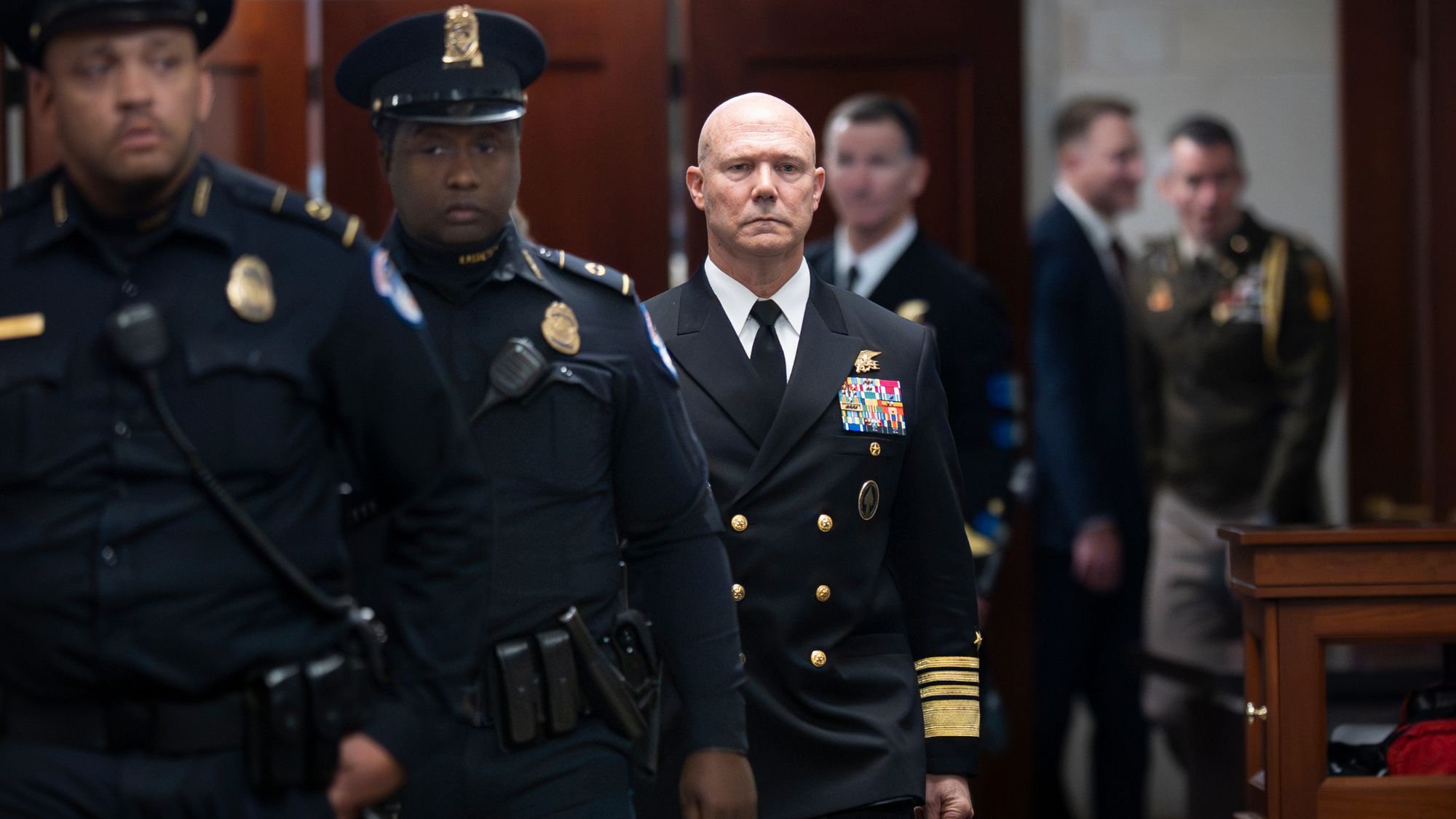
    A select group of lawmakers yesterday viewed video of the Sept. 2 military strike on an alleged cocaine-trafficking boat, including the follow-up strike that killed two survivors clinging to portions of the destroyed vessel. Following a series of classified briefings by Adm. Frank “Mitch” Bradley, who ordered the second strike, Democrats called the footage “disturbing” and urged its public release, while some Republicans defended both the strike and President Donald Trump’s broader campaign to blow up suspected drug traffickers. A 22nd boat strike, announced yesterday evening, killed four more people, bringing the total death toll to 87.

    Who said what
    The footage of the Sept. 2 strike showed that after the first missiles destroyed most of the boat, “two survivors, shirtless, clung to the hull, tried unsuccessfully to flip it back over, then climbed on it and slipped off into the water, over and over,” The New York Times said, citing lawmakers and staffers. Before Bradley ordered the second strike that killed the survivors, military officials spent 41 minutes discussing “what to do as they watched the men struggle to overturn what was left of their boat,” CNN said. The survivors did not radio or call for assistance or backup, as previously claimed by defense officials. 

    “What I saw in that room was one of the most troubling things I’ve seen in my time in public service,” said Rep. Jim Himes (Conn.), the top House Democrat on the Intelligence Committee. Sen. Jack Reed (R.I.), the Senate Armed Services Committee’s top Democrat, said he was “deeply disturbed” by the video and the briefing “confirmed my worst fears” about Trump’s “military activities.” His GOP counterpart, Sen. Roger Wicker (Miss.), declined to comment after the briefing. 

    Senate Intelligence Committee chair Tom Cotton (R-Ark.) said the strikes were “righteous” and “entirely lawful and needful.” He said he "saw two survivors trying to flip a boat loaded with drugs bound for the United States back over so they could stay in the fight.” Rep. Mike Turner (R-Ohio) told reporters he was “concerned” about the strikes because, if the survivors had been rescued, they “would be put in jail,” not “subject to capital punishment.” 

    What next?
    Congressional Republicans have “turned back attempts to put a check on Trump’s power to engage in the missile campaign,” which Defense Secretary Pete Hegseth “has vowed will continue,” The Associated Press said. 


    TODAY’S ELECTIONS story

    Supreme Court revives Texas gerrymander, aiding GOP

    What happened
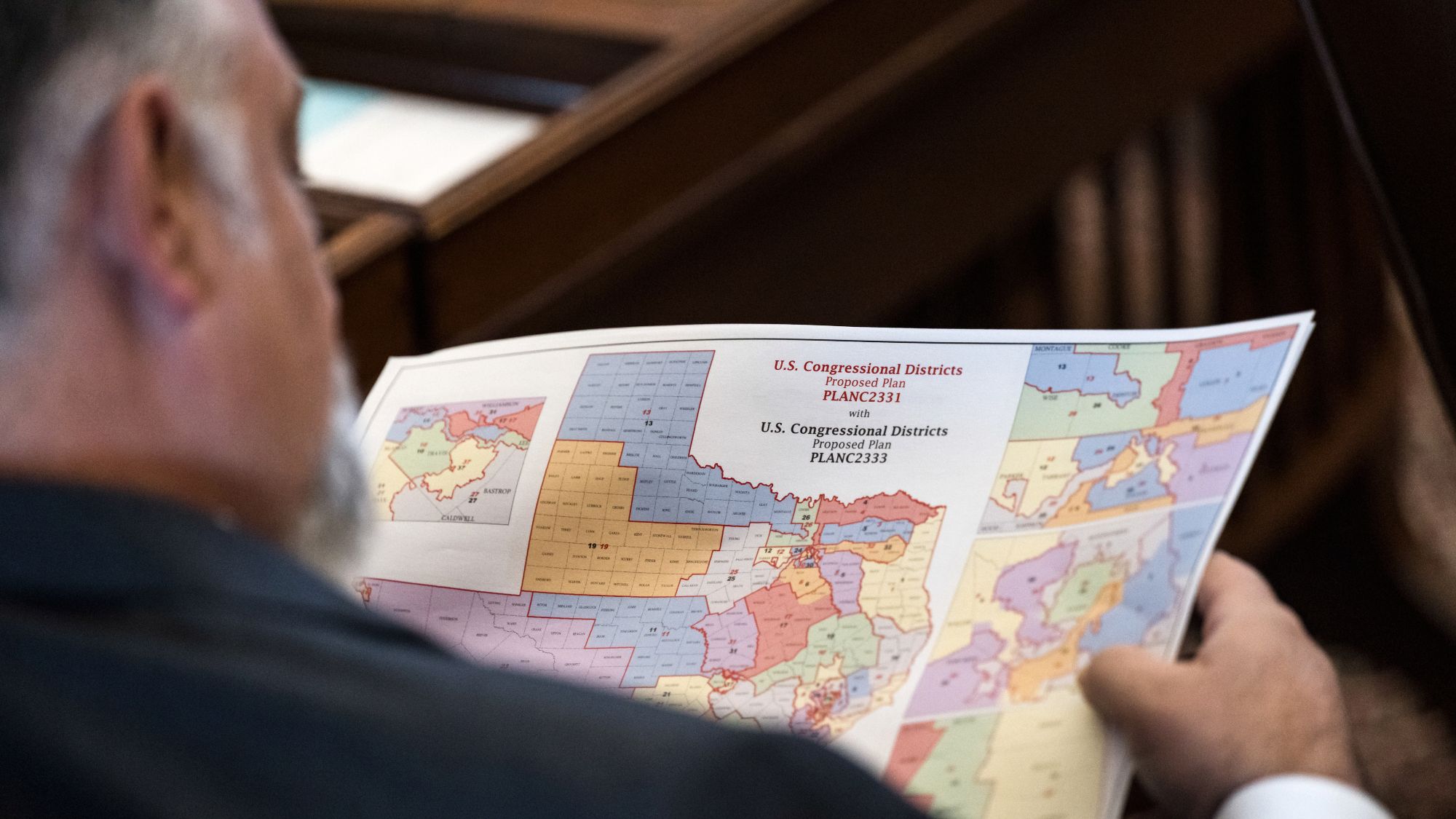
    The Supreme Court ruled yesterday that Texas Republicans can use the congressional map they approved in August, at President Donald Trump’s urging. The court’s three liberal justices dissented. A divided three-judge panel in Texas last month threw out the new map, which could flip up to five Democratic-held seats, with a Trump appointee ruling it an impermissible racial gerrymander.

    Who said what
    The ruling was a “major win for Republicans in Texas and nationally,” boosting their odds of keeping their “narrow majority” in next year’s midterms, The Texas Tribune said. The lower court “improperly inserted itself into an active primary campaign, causing much confusion and upsetting the delicate federal-state balance in elections,” the Supreme Court said in its unsigned “shadow docket” ruling. 

    Justice Samuel Alito, writing separately in an opinion joined by two other conservatives, argued that it was “indisputable” Texas Republicans were seeking “partisan advantage pure and simple.” Justice Elena Kagan, writing for the court’s liberals, said the ruling “disrespects” the lower court’s diligent work and “ensures that many Texas citizens, for no good reason, will be placed in electoral districts because of their race. And that result, as this court has pronounced year in and year out, is a violation of the Constitution.”

    What next?
    Trump’s push for Texas Republicans to redraw their map mid-decade sparked a nationwide scramble that has led to GOP gerrymanders in Missouri and North Carolina and a Democratic redistricting in California. Other states are considering joining the battle. The high court just gave “a green light for there to be even more re-redistricting, and a strong message to lower courts to butt out,” UCLA election law expert Richard Hasen said at Election Law Blog. 


    TODAY’S IMMIGRATION Story

    Trump tightens restrictions for work visas

    What happened
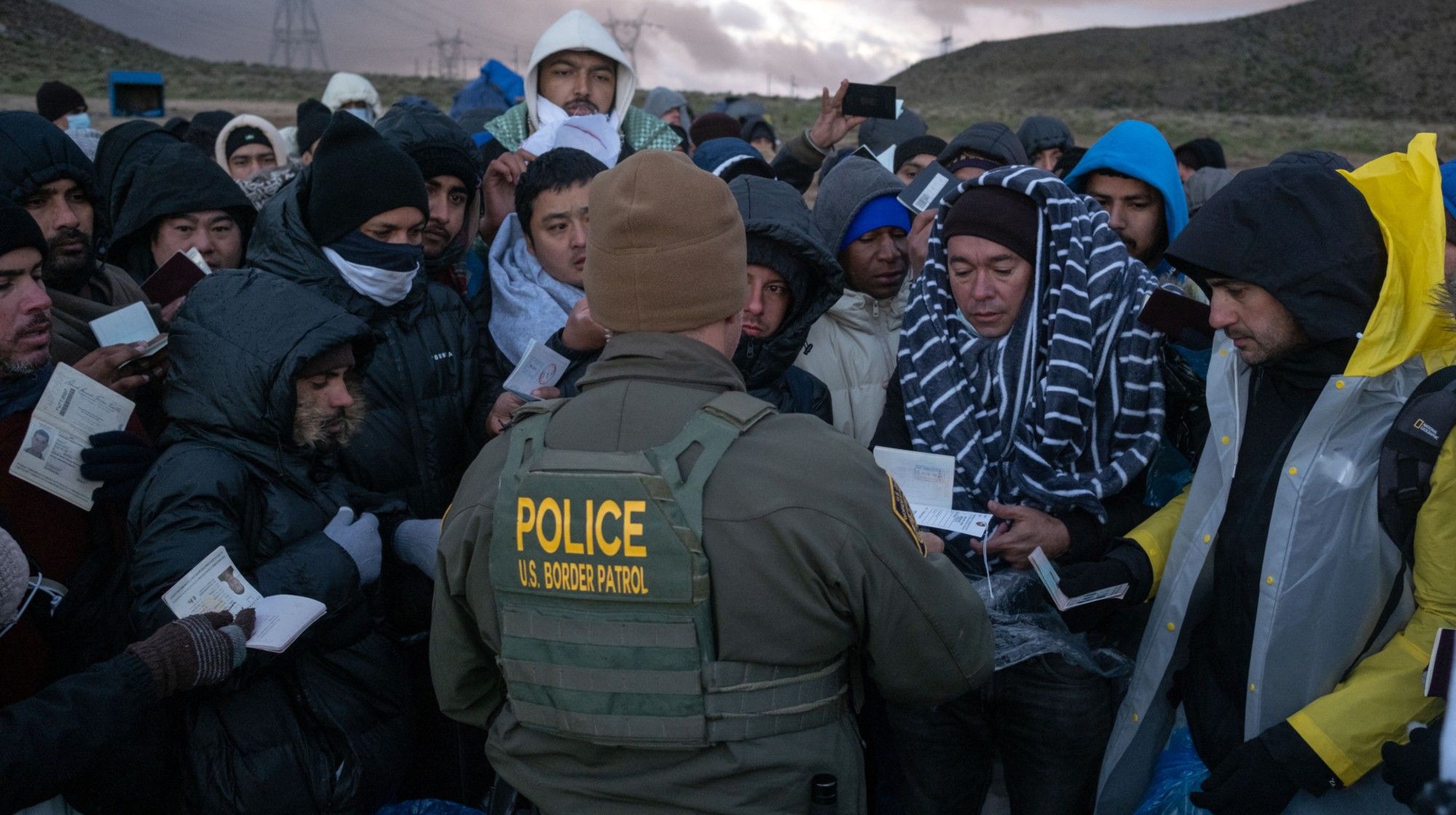
    The Trump administration yesterday dramatically shortened the length of work permits for asylum seekers, refugees and other immigrants seeking humanitarian protections. New permits will be valid for 18 months, from five years previously. The State Department separately ramped up its vetting for H-1B work visas, blocking applicants if they or their family members “have worked in areas that include activities such as misinformation, disinformation, content moderation, fact-checking” and other forms of “censorship,” Reuters reported. 

    Who said what
    The Department of Homeland Security said “forcing immigrants to renew their work permits more often” will give the government “more opportunities to re-vet them,” The Wall Street Journal said. But the “hundreds of thousands of people” likely affected by the change are the backbone of “meatpacking companies,” construction, and senior care, among other industries. 

    H-1B visas, reserved for highly skilled workers, are “crucial for U.S. tech companies which recruit heavily from countries including India and China,” Reuters said. The instruction to search LinkedIn and résumés to weed out any applicant “responsible for, or complicit in, censorship or attempted censorship of protected expression” was conveyed in a Dec. 2 cable to all U.S. missions. 

    What next?
    A State Department spokesperson declined to comment on “allegedly leaked documents,” but said President Donald Trump “himself was the victim of this kind of abuse when social media companies locked his accounts” and “he does not want other Americans to suffer this way.” The visa moves “align with” Trump’s “threats of a slew of aggressive actions to curtail legal migration” after a National Guard member was killed outside the White House last month, Bloomberg said. 


    It’s not all bad

    Oklahoma City school bus driver Tina Hutcherson is using her upgraded knitting machine to create warm hats for every kid on her route. The machine was a birthday gift from her daughter, and now that it takes only 30 minutes to make a beanie, she decided she had to “make all my babies some hats on the bus now,” Hutcherson told ABC News. She is working on 100 reversible hats, and she lets each student choose the colors they want.


    Under the radar

    How AI chatbots are ending marriages

    American attorneys are seeing a rise in divorce filings where one partner’s attachment to an AI chatbot has played a significant role in the marital breakdown. With people forming increasingly intimate bonds with bots such as ChatGPT, marriages are being upended. 

    As ChatGPT “worms its way into more people’s personal lives,” couples are “having to navigate what it means to juggle relationships with both a human and AI,” said The Cut. They wonder if you are “obligated to tell your spouse that you’re sexting with ChatGPT,” and “if you don’t, are you cheating or simply pioneering some yet-to-be-defined category of love?” 

    The “uncanny dynamic is unfolding across the world,” said Futurism. “One person in a couple becomes fixated” on a bot for “some combination of therapy, relationship advice or spiritual wisdom,” then “ends up tearing the partnership down” as the technology “makes more and more radical interpersonal suggestions.” 

    This has opened a “new legal frontier” in family law, and it’s “rewriting the rules of marital misconduct,” said Wired. An AI affair is “now grounds for divorce,” as courts are increasingly seeing clients “cite emotional bonds with AI companions as reasons for marital strain.” 

    But sometimes AI is credited with saving marriages, handing out helpful relationship advice or even mediating marital disputes. Emma Bowman told NPR she used ChatGTP “as a couple’s counselor,” and it “offered a valid analysis of our communication styles and defused some disagreements.” But the chatbot also “could be hasty to choose sides” and jump to erroneous conclusions, she said, so “it’s hard to put trust in the machine when it comes to something as important as relationships.”


    On this day

    December 5, 1848

    President James K. Polk confirmed that gold had been discovered in California. This led to a rush of people moving to the region, turbocharging Western expansion. The gold rush still plays a prominent role in California’s culture, including its nickname, the Golden State, and sports teams like the San Francisco 49ers. 


    TODAY’S newspaperS

    ‘Strike footage shocks’

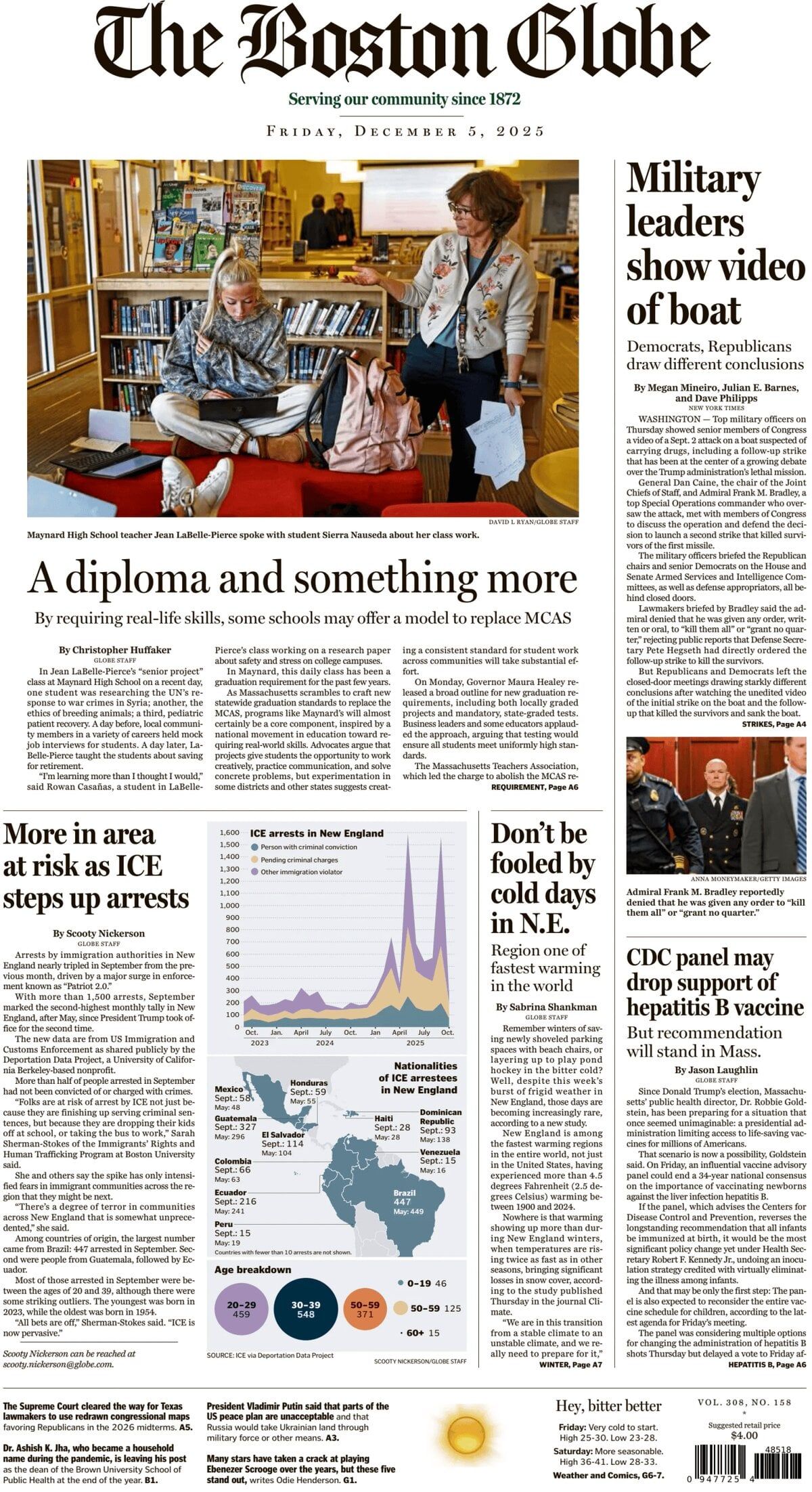
    “Military leaders show video of boat,” The Boston Globe says on Friday’s front page. “Strike footage shocks critics,” says The Washington Post. “Trump’s allies orchestrated ex-Honduran leader’s pardon,” freeing “cocaine trafficker,” The Wall Street Journal says. “Affordability concerns sink Trump ratings,” the Los Angeles Times says. “Women voice GOP discontent about speaker” in “sign of Republican rift ahead of midterms,” The New York Times says. “Man arrested in DC pipe bomb case,” the Chicago Tribune says. “Waste, fraud cost U.S. $29.2B” in Afghanistan, USA Today says. “CDC may end push for hep B baby shot” that “caused new infections to plummet,” says The Atlanta Journal-Constitution.

    ► See the newspaper front pages


    Tall tale

    Booze bandit

    A Virginia liquor store employee recently found a surprising intruder inside the shop’s bathroom: a passed-out raccoon. The tiny trespasser fell through the ceiling and then went on a “full-blown rampage, drinking everything,” animal control officer Samantha Martin told The Associated Press. Several broken bottles of whisky and Scotch were strewn on the store’s floor near where the raccoon had entered. After several hours of sleep, the uninjured animal was released back into the wild.


    Morning Report was written and edited by Nadia Croes, Catherine Garcia, Scott Hocker, Anya Jaremko-Greenwold, Justin Klawans, Chas Newkey-Burden, Rafi Schwartz, Peter Weber and Kari Wilkin, with illustrations by Stephen Kelly and Julia Wytrazek.

    Image credits, from top: J. Scott Applewhite / AP Photo; Eli Hartman / Bloomberg via Getty Images; Guillermo Arias / AFP / Getty Images; Illustration by Julia Wytrazek / Getty Images
     

    Recent editions

    • Evening Review

      Time for Europe to fight fire with fire?

    • Morning Report

      Streeting orders review into mental health overdiagnosis

    • Evening Review

      The chances of a Reform-Tory pact

    VIEW ALL
    TheWeek
    • About Us
    • Contact Future's experts
    • Terms and Conditions
    • Privacy Policy
    • Cookie Policy
    • Advertise With Us
    • FAQ
    Add as a preferred source on Google

    The Week UK is part of Future plc, an international media group and leading digital publisher. Visit our corporate site.

    © Future Publishing Limited Quay House, The Ambury, Bath BA1 1UA. All rights reserved. England and Wales company registration number 2008885.