The Week The Week
flag of US
US
flag of UK
UK
https://cdn.mos.cms.futurecdn.net/flexiimages/jzblygzdxr1769609154.gif

SUBSCRIBE

Try 6 weeks free

Sign in
  • View Profile
  • Sign out
  • The Explainer
  • Talking Points
  • The Week Recommends
  • Podcasts
  • Newsletters
  • From the Magazine
  • The Week Junior
  • More
    • Politics
    • World News
    • Business
    • Health
    • Science
    • Food & Drink
    • Travel
    • Culture
    • History
    • Personal Finance
    • Puzzles
    • Photos
    • The Blend
    • All Categories
  • Newsletter sign up Newsletter
  • Brand Logo
    Ukraine turmoil, Iran war costs and Saudi nuclear deal

     
    TODAY’S UKRAINE WAR story

    Zelenskyy fires top general after mass protests

    What happened
    Ukrainian President Volodymyr Zelenskyy yesterday dismissed the country’s top military commander, Gen. Oleksandr Syrskyi, and replaced him with Maj. Gen. Mykhailo Drapatyi. The switch  “comes amid ongoing mass protests” that erupted across Ukraine after Zelenskyy’s ouster last week of “popular reformist” Defense Minister Mykhailo Fedorov, who had clashed with Syrskyi, The Kyiv Independent said. 

    Demonstrators said Zelenskyy should have sacked Syrskyi instead when he picked sides in the dispute. Drapatyi, the widely respected commander of day-to-day combat operations, had publicly backed Fedorov.

    Who said what
    Fedorov (pictured above in protester cutout) had “emphasized the strategic importance of new military technology, particularly drones,” CNN said,  and his “six-month tenure as defense minister coincided with Ukraine’s recent success on the battlefield” and in damaging Russia. Syrskyi, by contrast, was widely seen as a “Soviet-school commander reluctant to implement radical changes in the army,” the BBC said.

    As the protests swelled, “it became clear” that for many Ukrainians, Fedorov “embodied a tech-driven path to victory that might spare lives,” while “Syrskyi had come to represent the darkest, most punishing realities” of the war, The New York Times said. The clash of visions fueled “concerns that the national unity that had helped the country survive nearly five years of war was in danger of fracturing.”

    What next?
    After meeting with Fedorov yesterday, Zelenskyy “offered him what he called a respected position in the government,” The Associated Press said. “It wasn’t clear if Fedorov accepted,” but he congratulated Drapatyi, calling his promotion a “new hope in the fight of free people for freedom and justice.” 


    TODAY’S IRAN WAR story

    Hegseth puts Iran war cost at $37.5B, seeks $67B more

    What happened
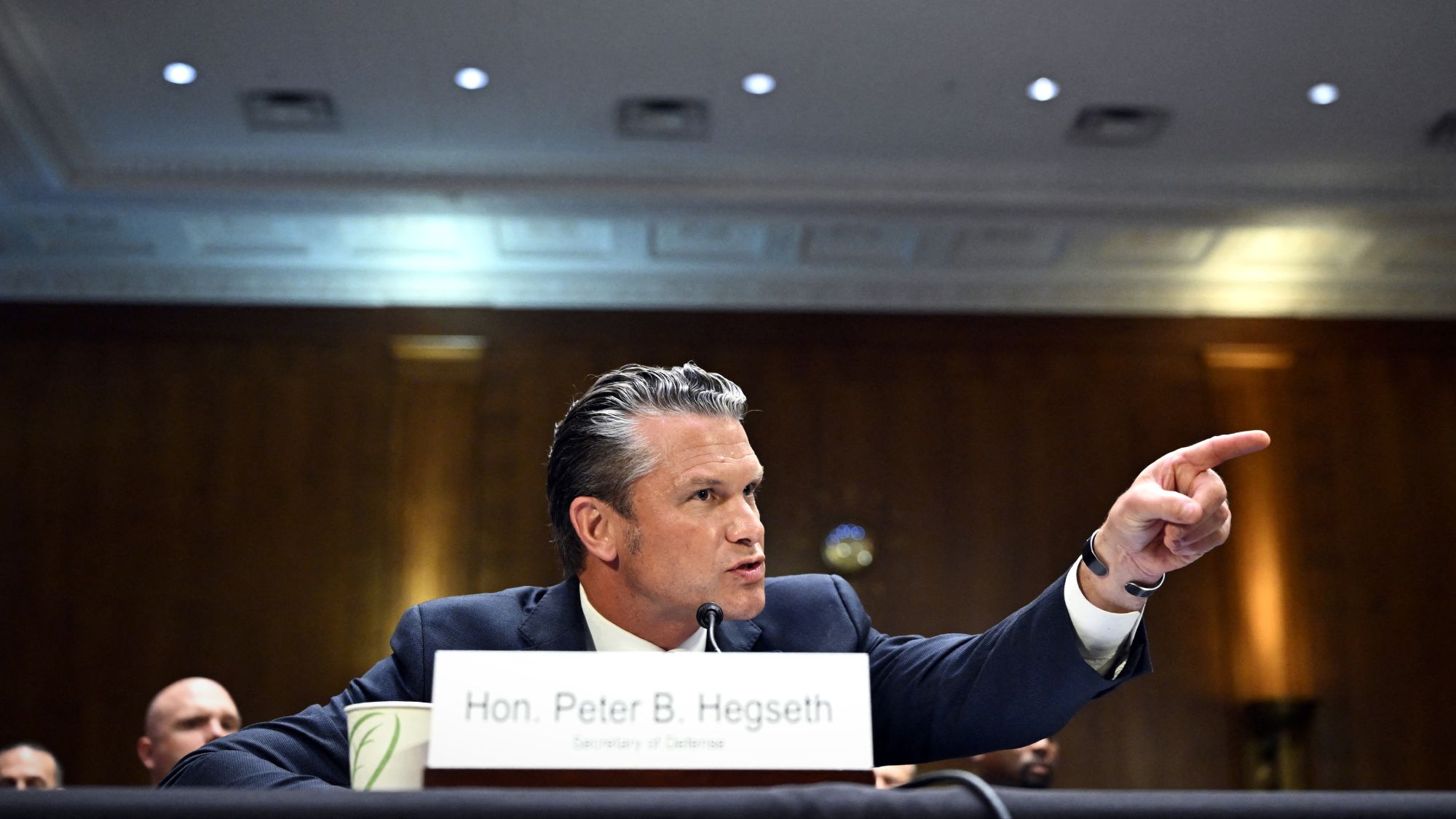
    Defense Secretary Pete Hegseth yesterday told a Senate committee that President Donald Trump’s Iran war had cost an estimated $37.5 billion so far and said the $67 billion in requested supplemental war funding was an “urgent, necessary” stopgap as Congress debates Trump’s $1.5 trillion annual Pentagon budget request. He faced “fiery questions,” mostly from Democrats, during the “combative Senate Appropriations Committee hearing,” The Associated Press said. But the scrutiny from “frustrated lawmakers” was “bipartisan,” The Washington Post said, as they pressed Hegseth to “explain the Trump administration’s strategy for the war in Iran amid renewed hostilities.” 

    Who said what
    Hegseth’s appearance “represented an attempt by the administration to sell the unpopular conflict as a necessary expense,” Politico said, but Senate Democrats “questioned both the success of the war so far and the need for more military money, citing $75 billion in unused funds” from last year’s huge GOP-only spending package. “The problem is not a lack of money, but poor planning,” Sen. Patty Murray (D-Wash.) told Hegseth. “This war is now spiraling out of control again,” and Trump is “asking for $70 billion more — and for us to just trust him it’ll all work out fine.”

    What next?
    The House plans to leave Washington tomorrow “for a month-long recess,” the Post said, “leaving any deal on military funding weeks away at the earliest.” 


    TODAY’S NUCLEAR Story

    Trump approves nuclear deal with Saudi Arabia

    What happened
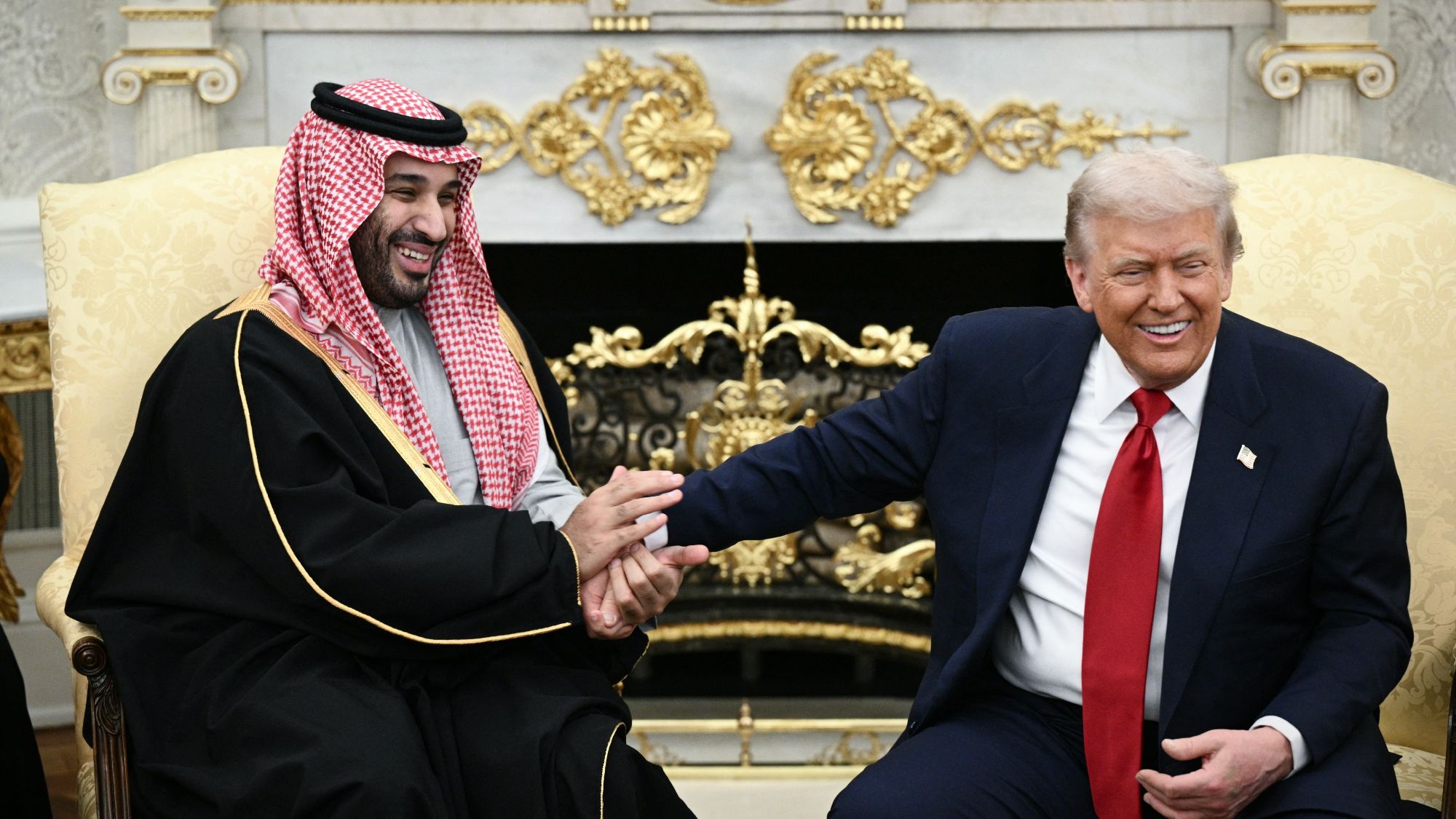
    President Donald Trump has approved a nuclear deal with Saudi Arabia that could open the door to uranium enrichment inside the kingdom, multiple news organizations reported last night, citing U.S. officials. The 30-year agreement is “designed to give American companies a central role” in developing Saudi Arabia’s civilian nuclear infrastructure, The Wall Street Journal said. But it’s “certain to prove controversial” among U.S. allies and lawmakers opposed to the “spread of nuclear technology in the volatile Middle East.”

    Who said what
    The nuclear cooperation agreement “has been under discussion for years,” The New York Times said. Trump dropped a Biden administration stipulation that the Saudis first normalize relations with Israel, and to “get the deal done with Crown Prince Mohammed bin Salman,” he “had to agree to terms that may limit international inspectors” from visiting sites “they think could be a pathway to diverting fuel to weapons projects.” Bin Salman has vowed to build nuclear weapons if Iran does.

    The White House argues that the U.S. role “would ensure enrichment remains peaceful,” the Journal said. But if the Saudis can enrich uranium, “so goes the United Arab Emirates, Turkey and Egypt,” said Henry Sokolski at the Nonproliferation Policy Education Center. “The idea that this will have a happy ending is delusional.”

    What next?
    U.S. and Saudi officials are expected to sign the accord today.


    It’s not all bad

    Europe’s air quality is improving, thanks in part to sulphur oxide and nitrogen oxide emissions dropping by 3% to 5% every year since 2015, according to a report from the European Union’s Copernicus Atmosphere Monitoring Service. The toxic gases, which irritate the respiratory system, are released by burning fossil fuels. Governments across the EU are making “sustained efforts” to reduce these emissions from transportation, industry and residential heating, resulting in “steady progress” toward cleaner air, said CAMS Director Laurence Rouil.


    Under the radar

    Scientists could soon live on the ocean floor

    A new underwater research facility is making waves. Deep, a U.K. ocean engineering company, has installed a subsea human habitat almost 60 feet underwater in the Tennessee Reef, part of the Florida Keys National Marine Sanctuary. Called Vanguard, the habitat allows for four aquanauts to live in a dry environment underwater for five days without needing to resurface. And Vanguard is just the first of Deep’s proposed network of underwater habitats.

    To install Vanguard, engineers “first needed to install a base foundation and then lower the habitat onto the platform using a boat crane,” said Popular Science. It’s “tethered to a surface buoy,” a “bright-yellow structure” that “holds multiple vital support services, such as communications arrays, breathable air and power.” The habitat has received the “green light from Det Norske Veritas, an internationally recognized accreditation institution used by oceanographic organizations and companies,” so it should be a safe environment for aquanauts.

    Underwater facilities are not new. They have been used for professions such as underwater welding and in the energy and defense industries. The Florida Keys are also home to another underwater research habitat, Florida International University’s Aquarius Reef Base. Deep hopes to enable permanent underwater living in more sophisticated habitats by as soon as 2027.

    The National Oceanic and Atmospheric Administration has designated the Tennessee Reef as a “research-only zone.” The goal of Vanguard, Deep said in a statement, is to allow scientists to conduct marine science research, mainly related to “coral reef restoration, long-term monitoring, climate impact studies, human performance research and training for extreme environments.”


    On this day

    July 22, 1933

    Aviator Wiley Post completed the first solo flight around the world, accomplishing the feat in seven days. Post died in a plane crash two years later, but his legacy remains, with two airports named after him. His record-breaking airplane is also on display at the National Air and Space Museum.


    TODAY’S newspaperS

    ‘Plea for war clarity’

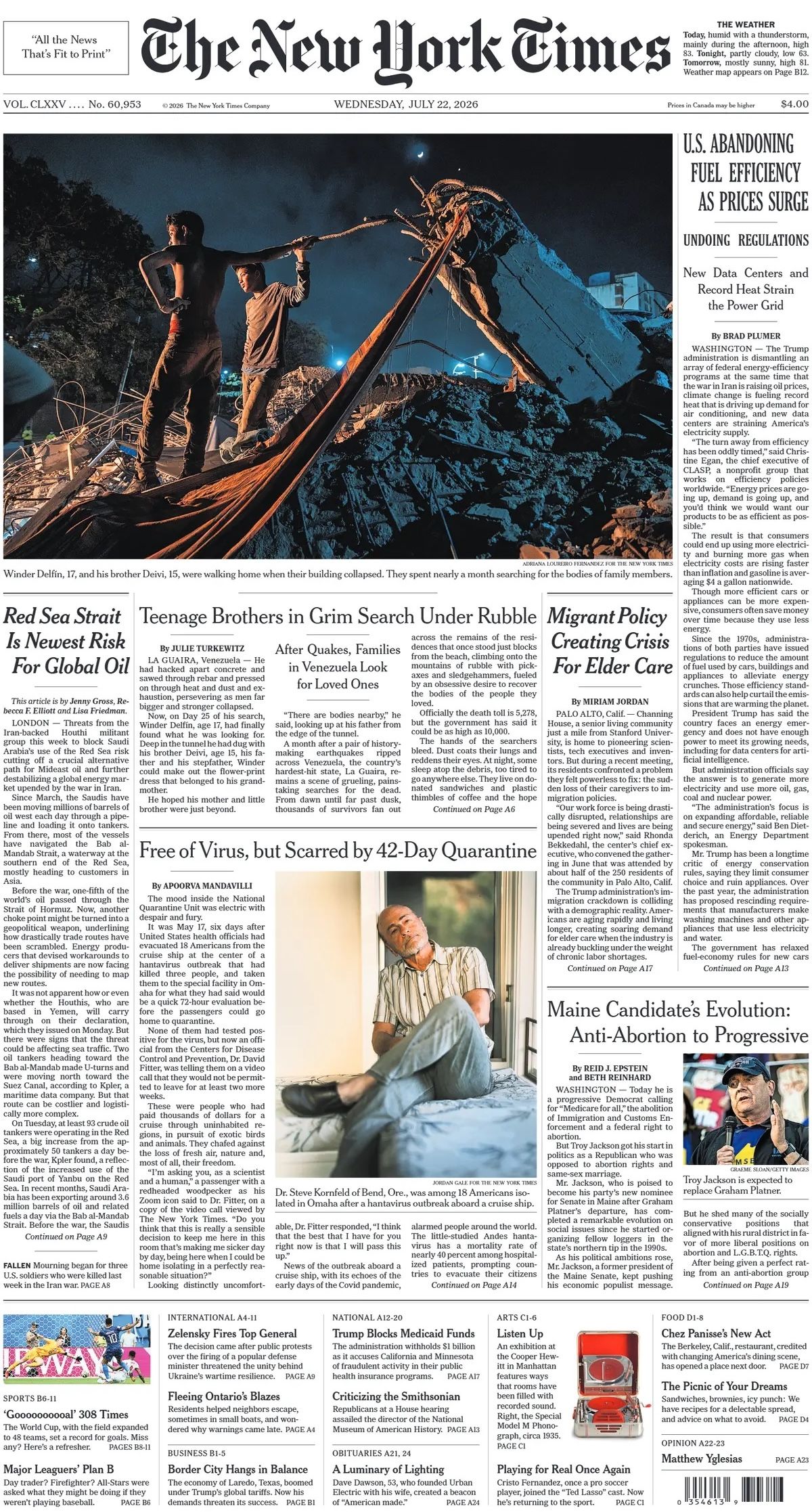
    “Pentagon seeks $70 billion as Iran war drags on,” the Los Angeles Times says on Wednesday’s front page. In Congress, “a plea for war clarity” as “fighting intensifies,” The Washington Post says. “U.S. launches 11th night of strikes” on Iran, overshadowing “diplomatic efforts to salvage ceasefire,” the Houston Chronicle says. “Tehran’s missile barrage shows U.S. hasn’t erased lethal threat,” The Wall Street Journal says. “U.S. abandoning fuel efficiency as prices surge” and “Red Sea strait” threat poses new “risk for global oil,” The New York Times says. “Trump officials seek to bypass public review of major projects,” says The Philadelphia Inquirer. New study finds that “multiple cups” of coffee won’t harm your health, says USA Today, but “for java benefits, how you drink it matters.”

    ► See the newspaper front pages


    Tall tale

    Too smart for your own good

    After a student in Tampa graduated with an 11.99 weighted grade point average, his Hillsborough County school district is recalculating how it determines GPAs. Vaibhav Bhaskar set a Florida record with his nearly 12-point GPA — on a nominal scale of 0 to 4 — by taking 20 advanced placement classes and 24 dual enrollment college courses. The district said its new policy will discourage students from trying to “achieve an inflated GPA,” as that can cause “stressful and unhealthy learning habits and mental health concerns.”


    Morning Report was written and edited by Nadia Croes, Catherine Garcia, Scott Hocker, Anya Jaremko-Greenwold, Justin Klawans, Rafi Schwartz, Peter Weber and Kari Wilkin, with illustrations by Stephen Kelly and Julia Wytrazek.

    Image credits, from top: Paula Bronstein / Getty Images; Alex Wroblewski / AFP via Getty Images; Brendan Smialowski / AFP via Getty Images; Illustration by Stephen P. Kelly / Getty Images / Shutterstock
     

    Recent editions

    • Evening Review

      A new front in the Middle East conflict?

    • Morning Report

      Healey becomes chancellor in cabinet reshuffle

    • Evening Review

      How to take on Burnham

    VIEW ALL
    TheWeek
    • About Us
    • Contact Future's experts
    • Terms and Conditions
    • Privacy Policy
    • Cookie Policy
    • Advertise With Us
    • FAQ
    Add as a preferred source on Google Add as a preferred source on Google

    The Week UK is part of Future plc, an international media group and leading digital publisher. Visit our corporate site.

    © Future Publishing Limited Quay House, The Ambury, Bath BA1 1UA. All rights reserved. England and Wales company registration number 2008885.