The Week UK The Week UK
flag of US
US
flag of UK
UK
https://cdn.mos.cms.futurecdn.net/flexiimages/jzblygzdxr1769609154.gif

SUBSCRIBE

Try 6 weeks free

Sign in
  • View Profile
  • Sign out
  • The Explainer
  • Talking Points
  • The Week Recommends
  • Podcasts
  • Newsletters
  • From the Magazine
  • The Week Junior
  • More
    • Politics
    • World News
    • Business
    • Health
    • Science
    • Food & Drink
    • Travel
    • Culture
    • History
    • Personal Finance
    • Puzzles
    • Photos
    • The Blend
    • All Categories
  • Newsletter sign up Newsletter
  • Brand Logo
    Measles milestone, Russian plague fears and Trump ad reversal

     
    TODAY’S PUBLIC HEALTH story

    NY sets measles emergency as Pennsylvania cases top 1k

    What happened
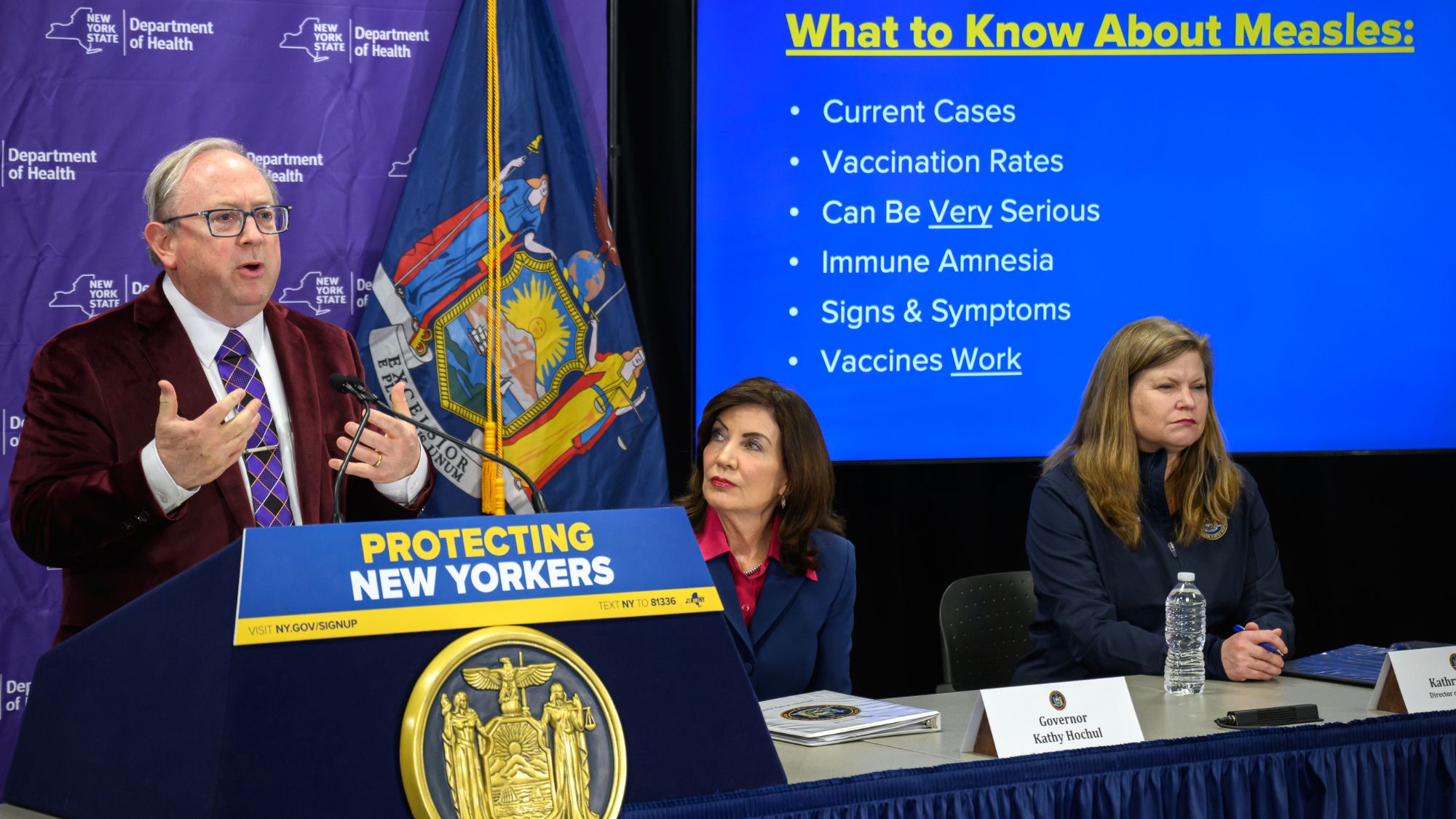
    Pennsylvania yesterday said its measles outbreak has risen to 1,004 cases this year, including five related deaths, making it the largest outbreak in any U.S. state since 1991. Nationally, a decades-high 3,887 cases have been recorded, according to the Centers for Disease Control and Prevention. New York Gov. Kathy Hochul (pictured above center) yesterday declared a statewide emergency over the rising measles cases in rural counties and from neighboring states, including Pennsylvania. 

    Who said what
    New York’s disaster emergency, which runs through Nov. 4, will “strengthen our ongoing efforts to confront” the state’s measles outbreak, now at 108 cases, Hochul said. “No one should get seriously ill or die from a vaccine-preventable disease.” It was the “first such declaration by a U.S. state since cases ​began surging in 2025,” Reuters said. Between 2000, when measles was declared eliminated in the U.S., and last year, the U.S. averaged “just 180 measles cases per year.”

    Measles has surged “as fewer kids get routine vaccines due to parental waivers, healthcare access issues and rampant disinformation,” The Associated Press said. Texas, Utah and South Carolina have also recorded large outbreaks since last year. The “deaths of three adults highlight the consequences of vaccination gaps that stretch back decades,” The Washington Post said, “not just the recent decline in childhood immunization.”

    What next?
    International health officials will meet next month to “determine if the U.S. and Mexico have lost their measles-free status,” the AP said. 


    TODAY’S INTERNATIONAL story

    Russia isolates dozens after anti-plague lab worker death

    What happened
    The death of a 28-year-old woman who worked at an anti-plague lab in Siberia prompted international concern yesterday as the Kremlin urged calm. Rospotrebnadzor, Russia’s consumer welfare and public health agency, said late Sunday that the woman had pneumonia of “unknown” origin, and “extensive” testing had found “no microorganisms” tied to her “professional activities” at the Irkutsk Anti-Plague Research Institute in Shelekhov. But “the case has raised alarm,” The Associated Press said, “after unconfirmed media reports suggested she might have died of pneumonic plague” following a lab accident. 

    Who said what
    “At least one hospital” in Shelekhov was under quarantine, NBC News said, and “nearly 200 people who had been in contact with the woman” were reportedly under medical observation. Kremlin spokesperson Dmitry Peskov yesterday said people should “rely on official statements from Rospotrebnadzor” and not “rumors and speculation.” 

    Russia needs to “share accurate information quickly and openly,” the U.S. State Department said. “It’s a rough disease,” President Donald Trump told reporters yesterday. “We’re looking at it very strongly, we just heard about it,” and the U.S. would help Russia “as much as we can.”

    What next?
    Pneumonic plague is “virulent” and “almost always fatal when untreated,” but easily treated with antibiotics when caught early, The Washington Post said. If that’s what this is, the odds it “becomes a larger outbreak” are “exceedingly low,” former White House Covid-19 coordinator Dr. Ashish Jha said to NBC News. But “if there were weapons programs, biological weapons programs in these labs, that would be much more concerning.”


    TODAY’S POLITICS Story

    Trump says his PAC will now fund pro-Trump ads

    What happened
    President Donald Trump yesterday said he would start using his super PAC, not government funds, to pay for campaign-style ads promoting himself and his policies. “More than $10 million in taxpayer-funded ads” have run on network and cable TV since last month, The New York Times said, after Trump “personally instructed his budget director to use taxpayer money” for them. The “Radical Left is upset” that “U.S.A. money” is paying for this “positive promotion for our Great U.S.A.,” Trump said yesterday on social media, so “I have decided” to “pay for them myself, and with money I raised for MAGA, Inc.”

    Who said what
    Trump has “faced bipartisan criticism for the spots,” which may violate at least two federal laws, Politico said. The dozen-plus ads developed so far include “one entitled ‘God made Trump.’” If he uses MAGA Inc. funds for the ads, Trump “will be dipping into a deep well” of about $400 million, The Wall Street Journal said. But that would also “add fodder to another formal complaint” about him “violating federal election laws by directing his super PAC” spending decisions, the Times said. 

    What next?
    Trump did not say if he or his super PAC “would repay the U.S. government for the money already spent or just pay for ads going forward,” the Journal said. 


    It’s not all bad

    Slag, a waste product in steel production, can be used to build roadways, according to a study published in the journal Communications Earth & Environment. It’s “ideal for pavement” because of its “high strength and angular structure,” making it more durable than conventional pavement, said Science Alert. The improved durability saves fuel and wear-and-tear costs for the cars and trucks that drive on the pavement, reduces carbon emissions and repurposes industrial waste.  


    Under the radar

    Cape Town seeks a fix for ballooning baboon numbers

    Chacma baboons are increasingly coming into conflict with human residents of South Africa’s capital. The baboons can be “intimidating,” Reuters said — males can grow more than 3 feet tall and weigh about 110 pounds — and they have adapted to city life, raiding garbage cans, cars and houses for food. So Cape Town authorities plan to round up about 60 of these monkeys and move them to a newly built sanctuary. 

    This has “triggered a bitter dispute” over ‌whether the baboons should be “confined, culled or allowed to coexist with residents,” said Reuters. Protests are ongoing, and the issue could play a major role in Cape Town’s upcoming municipal elections.

    Problems with baboons in the city stretch back decades, but they have hit a “boiling point” over the past two years, said The Guardian. In the early 2000s, city authorities stopped culling baboon troops in response to public pressure, but the population has since swelled by a third to roughly 500.

    Geography is “partially to blame,” said The Guardian. The baboons are “boxed in” between the steep landscape of the Table Mountain National Park and “sprawling urban development that stretches to the Atlantic Ocean.”

    The “best solution to resolving conflicts is to prevent them,” said Shirley C. Strum, an anthropology professor at the University of California San Diego, at The Conversation. Preventing undesirable baboon behavior, such as stealing food, is easier than tackling it once it has become ingrained with translocation and culls. And “conflict between baboons and humans won’t change unless human behavior and attitudes change.”


    On this day

    October 6, 1973

    Egypt and Syria launched a coordinated attack on neighboring Israel on Yom Kippur, the holiest day of the Jewish calendar. The Yom Kippur War ended 19 days later with a U.N.-backed Israeli-Egyptian ceasefire treaty. Israel still occupies the Golan Heights, captured from Syria during the conflict.


    TODAY’S newspaperS

    ‘Grim milestone’

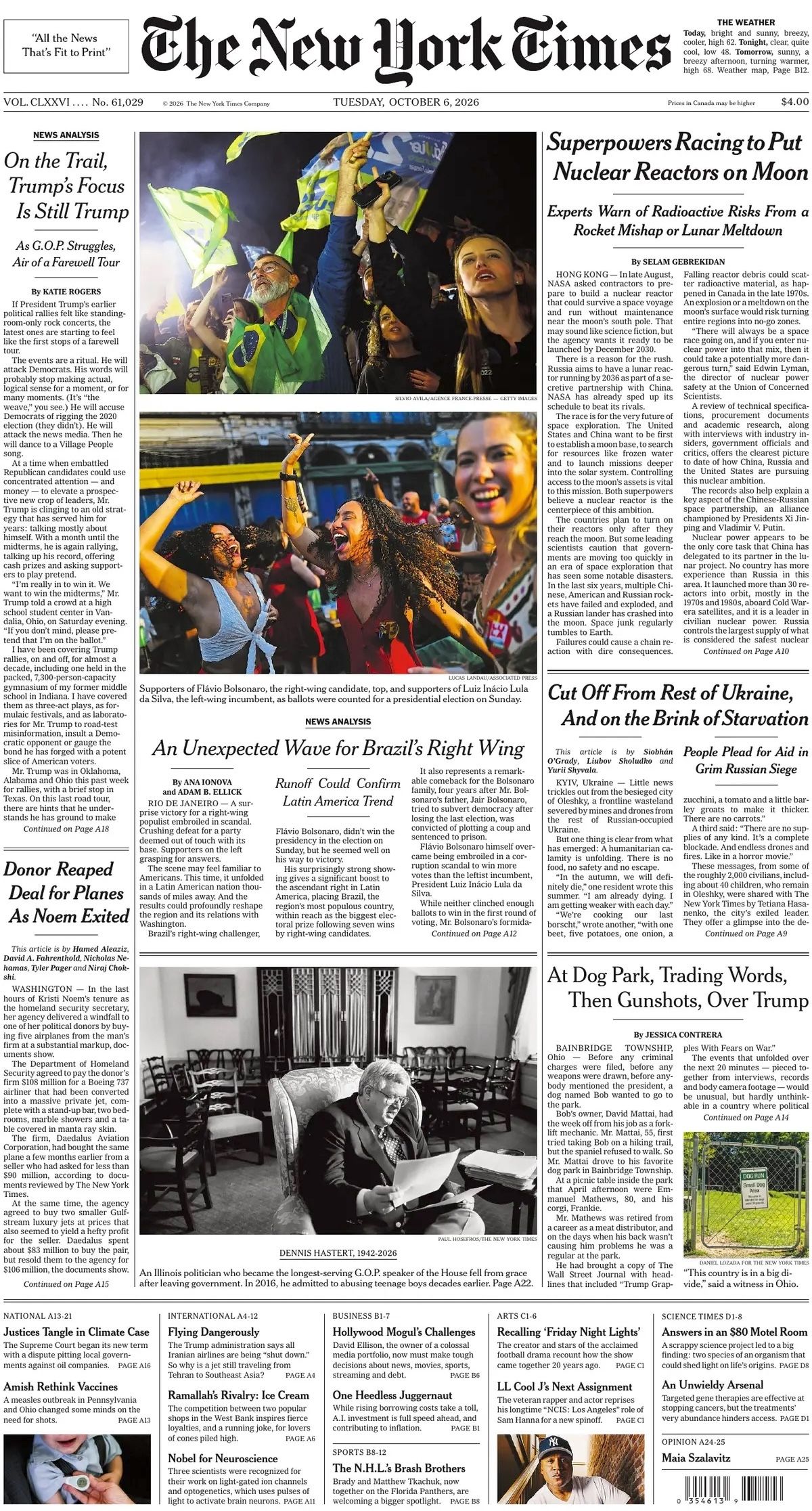
    “Trump uses federal power to boost GOP” before midterm elections, USA Today says on Tuesday’s front page. “Trump’s pledge of dividends draws fire,” The Washington Times says. Pennsylvania “measles outbreak surpasses 1,000 cases, a grim milestone,” The Philadelphia Inquirer says. “Justices question states’ oil litigation,” the Los Angeles Times says. “Big Oil liability is at center of case” as Supreme Court mulls “climate decision,” The Washington Post says. “Exxon warns against ruling,” the Houston Chronicle says. “Superpowers racing to put nuclear reactors on moon,” The New York Times says. “Yemeni government forces retake strait,” the Arizona Republic says. “To calm AI fears, tech firms use cuddly mascots,” says The Wall Street Journal.

    ► See the newspaper front pages


    Tall tale

    Haute dogs

    A Michelin-starred chef has given a large pack of dogs the chance to “enjoy a version of the haute cuisine” served to their humans, said The Times. France’s “greatest gastronomic canine dinner,” held by candlelight at the Carnavalet history museum in Paris, treated 40 pooches to pan-fried chicken served with rice and rapeseed flowers. “Maybe some people treat dogs like humans a bit too much,” said chef Thierry Marx, but “what matters is that the dogs are well treated.”


    Morning Report was written and edited by Will Barker, Nadia Croes, Scott Hocker, Anya Jaremko-Greenwold, Justin Klawans, Rafi Schwartz, Peter Weber and Kari Wilkin, with illustrations by Stephen Kelly and Julia Wytrazek.

    Image credits, from top: Jim Franco / Albany Times Union via Getty Images; Igor Ivanko / AFP / Getty Images; Kent Nishimura / AFP via Getty Images; Illustration by Julia Wytrazek / Getty Images
     

    Recent editions

    • Evening Review

      Kemistry test

    • Morning Report

      US pulls bombers from RAF Fairford

    • Sunday Shortlist

      Sky’s ‘delicious’ new divorce drama

    VIEW ALL
    TheWeek
    • About Us
    • Contact Future's experts
    • Terms and Conditions
    • Privacy Policy
    • Cookie Policy
    • Advertise With Us
    • FAQ
    Add as a preferred source on Google Add as a preferred source on Google

    The Week UK is part of Future plc, an international media group and leading digital publisher. Visit our corporate site.

    © Future Publishing Limited Quay House, The Ambury, Bath BA1 1UA. All rights reserved. England and Wales company registration number 2008885.