Sign up to get Today’s Best Articles in your inbox
Join 350,000+ subscribers and keep yourself informed with a selection of
The Week’s most interesting, enlightening and entertaining stories - plus daily puzzles.
You are now subscribed
Your newsletter sign-up was successful
Want to add more newsletters?
An account already exists for this email address, please log in.
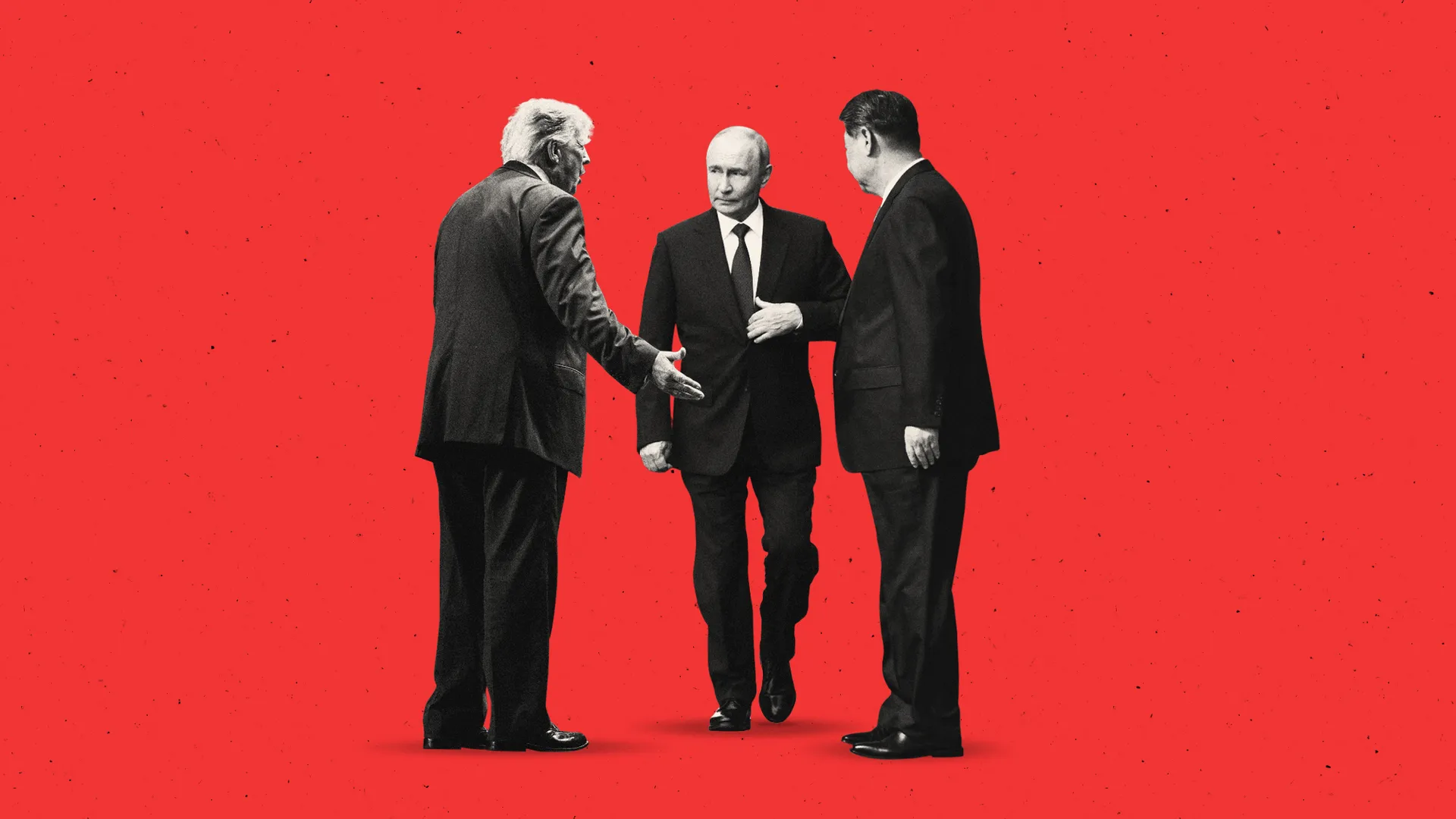
When President Harry S. Truman, Soviet General Secretary Joseph Stalin and British Prime Minister Winston Churchill met at Potsdam in 1945, the goal was for World War II’s victorious leaders to coordinate plans for postwar Europe. Eighty years later, Russian President Vladimir Putin has proposed another seismic trilateral meeting — this time between himself, President Donald Trump and Chinese President Xi Jinping. Meanwhile, Russia continues its attempted invasion of Ukraine, a country conspicuously left off the invitation list.
What did the commentators say?
Putin is attempting to “capitalize on warming ties” between himself and Trump in the hopes of negotiating an end to the war in Ukraine that “would favor Moscow,” said The Wall Street Journal. But by omitting Ukraine, Putin’s “unprecedented” summit would “send alarm bells ringing in European capitals and beyond.” Coordinating a summit of global superpowers “appeals to Trump’s idealized view of the world” — a vision that would entail powerful leaders carving up territory with Trump “taking his seat, recognized by all, as one of those great powers,” said Slate.
Publicly, Trump has shown interest in Putin’s summit as an opportunity to address atomic weaponry. “I would do it, not so much for Ukraine,” he said to reporters this week, per Bloomberg. “We would have it to talk about denuclearization.” For years, Trump has had an “aspiration to reach a deal” with Russia and China regarding nonproliferation, said Axios. But “so far, Putin and Xi haven’t shown much openness to the idea.”
The Week
Escape your echo chamber. Get the facts behind the news, plus analysis from multiple perspectives.
Join more than 350,000 subscribers and keep yourself informed with a selection of The Week’s most interesting, enlightening and entertaining stories - plus daily puzzles.
Join more than 350,000 subscribers and keep yourself informed with a selection of The Week’s most interesting, enlightening and entertaining stories - plus daily puzzles.
While the three countries have “overlapping interests,” they lack a “common strategic vision,” said Denis Simon, of the Quincy Institute for Responsible Statecraft, to the South China Morning Post. Nuclear weapons offer the “most obvious potential starting point,” yet issues like Ukraine, Taiwan and the “broader international order” would “inevitably enter any conversation” among the trio.
What next?
Chinese officials have “privately welcomed” the potential talks but “have not pushed aggressively for them,” said the Morning Post. There is “no clear understanding yet regarding the meeting itself or its potential agenda,” said Kremlin spokesperson Dmitry Peskov to the Journal. Still, all three parties “acknowledge the hypothetical possibility of such a meeting taking place.”
Sign up to get Today’s Best Articles in your inbox
A free daily email with the day’s biggest news and analysis – and the best features from TheWeek.com
Rafi Schwartz has worked as a politics writer at The Week since 2022, where he covers elections, Congress and the White House. He was previously a contributing writer with Mic focusing largely on politics, a senior writer with Splinter News, a staff writer for Fusion's news lab, and the managing editor of Heeb Magazine, a Jewish life and culture publication. Rafi's work has appeared in Rolling Stone, GOOD and The Forward, among others.