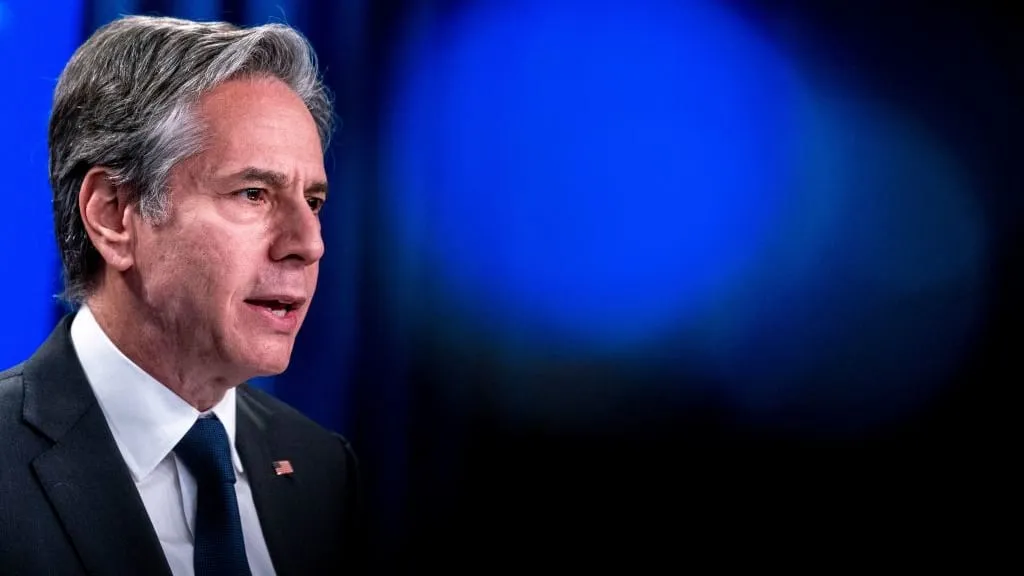
U.S., Russia to hold high-stakes talks on Ukraine
Secretary of State Antony Blinken and Russian Foreign Minister Sergei Lavrov will meet Friday in Geneva, capping off a week of diplomacy as the United States aims to fend off a possible Russian invasion of Ukraine.
Over the last year, Russia has been shifting its troops, and it's estimated that about 100,000 are stationed near the border with eastern Ukraine. Russia recently deployed more troops to its ally Belarus for military exercises, a move that one U.S. official told The Guardian NATO didn't know about in advance. These troops, the official added, are in "numbers beyond what we'd expect in regard to a normal exercise."
The Biden administration has warned that Russia could be planning a false-flag attack, sending operatives into Ukraine to launch an assault that would give pretext to an invasion. On Tuesday, White House press secretary Jen Psaki said at this stage, "Russia could at any point launch an attack on Ukraine."
The Week
Escape your echo chamber. Get the facts behind the news, plus analysis from multiple perspectives.
Sign up for The Week's Free Newsletters
From our morning news briefing to a weekly Good News Newsletter, get the best of The Week delivered directly to your inbox.
During their meeting, Blinken and Lavrov will discuss "if there is a possible diplomatic off-ramp to this crisis," a State Department official told reporters on Tuesday. The United States is "prepared to continue to engage with Russia on security issues in a meaningful, reciprocal dialogue," the official added. "We will see this Friday if Russia is prepared to do the same." Before the summit, Blinken will meet with Ukrainian President Volodymyr Zelensky in Kyiv, as well as his French, German, and British counterparts in Berlin.
Russia says that its troops, heavy weaponry, and tanks along the border do not indicate that an invasion is imminent. Citing security concerns, Moscow is insisting that the West not let Ukraine and Georgia into NATO, a demand the Biden administration has said it will not entertain.
A free daily email with the biggest news stories of the day – and the best features from TheWeek.com
Catherine Garcia has worked as a senior writer at The Week since 2014. Her writing and reporting have appeared in Entertainment Weekly, The New York Times, Wirecutter, NBC News and "The Book of Jezebel," among others. She's a graduate of the University of Redlands and the Columbia University Graduate School of Journalism.
-
Metaverse: Zuckerberg quits his virtual obsessionFeature The tech mogul’s vision for virtual worlds inhabited by millions of users was clearly a flop
-
Frank Gehry: the architect who made buildings flow like waterFeature The revered building master died at the age of 96
-
Is MAGA melting down?Today's Big Question Candace Owens, Tucker Carlson, Laura Loomer and more are feuding
-
US offers Ukraine NATO-like security pact, with caveatsSpeed Read The Trump administration has offered Ukraine security guarantees similar to those it would receive from NATO
-
Hong Kong court convicts democracy advocate LaiSpeed Read Former Hong Kong media mogul Jimmy Lai was convicted in a landmark national security trial
-
Australia weighs new gun laws after antisemitic attackSpeed Read A father and son opened fire on Jewish families at Sydney’s Bondi Beach, killing at least 15
-
How Bulgaria’s government fell amid mass protestsThe Explainer The country’s prime minister resigned as part of the fallout
-
Europe sets 2027 deadline to wean itself from Russian gasIN THE SPOTLIGHT As negotiators attempt to end Russia’s yearslong Ukraine invasion, lawmakers across the EU agree to uncouple gas consumption from Moscow’s petrochemical infrastructure
-
Benin thwarts coup attemptSpeed Read President Patrice Talon condemned an attempted coup that was foiled by the West African country’s army
-
Is Europe finally taking the war to Russia?Today's Big Question As Moscow’s drone buzzes and cyberattacks increase, European leaders are taking a more openly aggressive stance
-
Pushing for peace: is Trump appeasing Moscow?In Depth European leaders succeeded in bringing themselves in from the cold and softening Moscow’s terms, but Kyiv still faces an unenviable choice