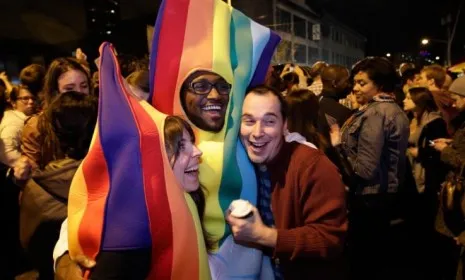
President Obama was hardly the only big Democratic winner on Election Night. Supporters of gay marriage and legalized marijuana also emerged victorious at the polls, while the ideological makeup of the Senate became decidedly more liberal. Indeed, the electorate swung heavily behind liberal causes and candidates, a trend that bodes ill for the Republican Party. "The 2012 election marked a cultural shift as much as a political one," says Ben Smith at BuzzFeed. "The future of the Grand Old Party will be determined by how well it adapts to the brand-new Liberal America — indeed the Obama America — that is now here to stay." Here, four ways Liberal America won big on Election Night:
1. Gay marriage
"For the first time, after more than 30 losses, gay marriage won approval at the ballot box," says Molly Ball at The Atlantic. Maine, Maryland, and Washington became the first states in U.S. history to legalize same-sex marriage by popular vote, while Minnesotans rejected a state constitutional amendment that would have made same-sex marriage illegal. That offers just the latest evidence that gay marriage, politically toxic only a few short years ago, is becoming more mainstream. "The American people have changed their minds on this issue," says Jennifer Rubin at The Washington Post, "and fighting this one is political flat-earthism."
The Week
Escape your echo chamber. Get the facts behind the news, plus analysis from multiple perspectives.
SUBSCRIBE & SAVE
Sign up for The Week's Free Newsletters
From our morning news briefing to a weekly Good News Newsletter, get the best of The Week delivered directly to your inbox.
From our morning news briefing to a weekly Good News Newsletter, get the best of The Week delivered directly to your inbox.
Latest Videos From
2. An openly gay Senator
Tammy Baldwin, a Democrat from Wisconsin, became the first openly gay politician to win election to the Senate, defeating former Gov. Tommy Thompson. Supporters of LGBT rights were thrilled by her victory, as well as the fact that her sexual orientation did not become a point of attack for her Republican challenger. "Though Baldwin's sexual orientation makes her victory notable," says Emanuella Grinberg at CNN, "it rarely came up during the campaign." And remember, all but one county in Wisconsin voted to ban gay marriage six years ago, a remarkable indication of the public's shifting attitude toward gays.
3. Legalized pot
Colorado and Washington both voted to legalize recreational marijuana, a massive victory for stoners across America, many of whom undoubtedly voted for the president who introduced "Intercepted!" to the weed-smoking lexicon. However, it remains unclear whether the two states will become the U.S. equivalent of Amsterdam. "Federal law still says marijuana is an illegal drug, so don't break out the Cheetos or Goldfish too quickly," quipped Colorado Gov. John Hickenlooper, harshing on mellows across the land.
4. A more liberal Senate
In the 113th Congress, Democrats will control 55 Senate seats, up from 53 in the 112th Congress, and the makeup of the Democratic caucus will be more liberal than it is now. Elizabeth Warren, a populist hero on the left, defeated Republican Sen. Scott Brown to win back Ted Kennedy's longtime seat in Massachusetts. Baldwin, a champion of LGBT causes and women's rights, replaced retiring Sen. Herb Kohl, a more moderate Democrat. Connecticut's Chris Murphy is replacing Sen. Joe Lieberman, an independent who has long been a thorn in the Democrats' side. And with Democrat Heidi Heitkamp winning a tight race in North Dakota to replace retiring Sen. Kent Conrad, the Senate now has 20 female members, a record.
Sources: The Associated Press, The Atlantic, Buzzfeed, CNN, MSNBC, The New York Times, Slate, The Washington Post