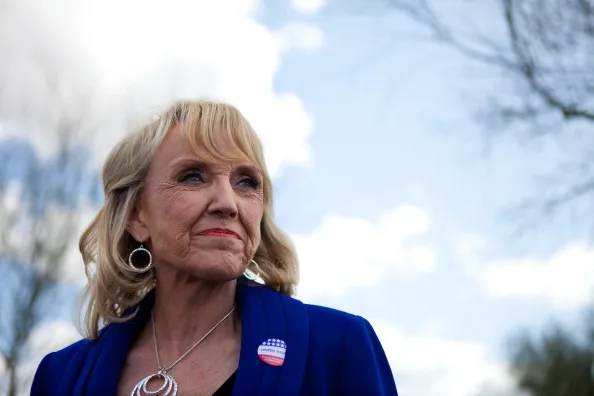
Jan Brewer, the former governor of Arizona, announced on Sunday that she is willing to run on the Republican ticket alongside Donald Trump.
During an appearance Sunday on CNN's State of the Union, Brewer was shown a list of possible running mates for Trump, including Sen. Marco Rubio (R-Fla.) and former Speaker of the House Newt Gingrich. Host Jake Tapper asked Brewer if she would be willing to be considered, and she answered in the affirmative. "Of course I would be," she said. "I would be willing to serve in any capacity that I could be of help with Donald on."
Brewer also said she doesn't think it's necessary for the presumptive Republican nominee to choose a woman as his vice president. "This woman thing has gotten way out of control, I believe," she said. "And I think it's been driven by the left." Catherine Garcia
Kellyanne Conway, Donald Trump's new campaign manager, said some pretty critical things about her new boss when she worked on rival presidential campaigns in the spring, and George Stephanopoulos showed her some of those clips on Sunday's This Week. "So what changed for you, and do you stand by those comments?" he asked. "I do, and the reason is I don't like when people hurl personal insults. That will never change," Conway said. When Stephanopoulos asked if Trump would stop insulting people, she said Trump "doesn't hurl personal insults."
Stephanopoulos circled and asked if Conway stood by her remarks that Trump should be transparent in releasing his tax returns. "I'm glad he's transparent about a number of things," she said. "I've learned since being on the inside that this audit is a serious matter and that he has said that when the audit is complete, he will release his tax returns." Conway added that she knows "as a pollster that what concerns people most about 'taxes' is their own tax liability, and so we appreciate people being able to see Hillary Clinton's plan and Donald Trump's plan and figure out who will really get the middle-class tax relief."
Conway was also on CNN on Sunday, and Dana Bash also asked if she stands by her call for Trump to release his taxes. "So now that I'm on the inside I know something I didn't know then, which is that he's under audit and what that means," she said. "And he has said very clearly, and I back him up completely, that when the audit is completed, he will release the tax returns." When Bash noted that Trump's returns from 2002 to 2008 are no longer under audit, Conway said she doesn't think Trump should release those, either. "No, I would not, and this entire tax return debate is somewhat confounding to me in the following sense: I don't think that it creates one job, gets one more individual who does not have health insurance covered by health insurance."
Conway took every chance she could to turn the conversation to Hillary Clinton, whom she called "the least accountable, least transparent, I think, joyless candidate in presidential political history." Clinton has released her tax returns from 2007 through 2015, and no major party candidate has declined to release his returns since 1976. Conway did not just discuss taxes, though. She told Stephanopolous that Trump has had his "best week so far," specifically mentioning his "what the hell do you have to lose?" pitch to black voters: "Those comments are for all Americans. And I live in a white community, I'm white, I was very moved by his comment." Peter Weber
Officials in Oregon estimate it cost about $37 million to fight the Stouts Creek Fire last summer, and the two men they say started it have to pay up.
The fire, which broke out on July 30 and burned for more than a month, scorched over 26,000 acres. It took investigators several months to determine that the fire was started by 70-year-old Dominic Decarlo of Days Creek, Oregon, and 64-year-old Cloyd Deardorff of Yuma, Arizona, when they used their lawnmowers. The fire started in the afternoon, and at the time, mowing the lawn was forbidden between 10 a.m. and 8 p.m.
Because Oregon holds individuals responsible for the costs of fire suppression, the men will receive an itemized invoice showing the cost of everything from helicopters to bulldozers to food for firefighters. Both men have already been fined for unlawful use of fire and Deardorff was cited for unlawful entry into a restricted forestland area, with Decarlo paying $110 and Deardorff $440. Bills can be challenged, and when they are this high, they're usually sent to an insurance company or lawyer, and a settlement is negotiated or a lawsuit is filed. "We're trying to make people aware that they have some responsibility... so people know there are consequences when you start [a wildfire]," Jeff Bonebrake, fire investigation and cost recovery coordinator for the Oregon Department of Forestry, told The Oregonian. "If we can prevent one, that saves everyone a lot of grief." Catherine Garcia
"It's back to school season, and for millions the school they'll be attending will be a charter school — the thing that politicians love to praise," John Oliver said on Sunday's Last Week Tonight. Charter schools, taxpayer-funded public schools that are privately run, started 20 years ago, and now there are 6,700 of them in the U.S., educating nearly 3 million students, and some of them even have celebrity endorsers, Oliver explained. "And look, when Pittbull has a charter school, it seems like it might be worth taking a look at them."
"First, let me acknowledge that this is a controversial area," Oliver said, understatedly, with both strong defenders and strident critics. "Now for this piece — and I know this is going to make some people on both sides very angry — we're going to set aside whether charter schools are a good idea in principle, because whether they are or not, in 42 states and D.C., we're doing them. So instead, we're going to look at how they operate in practice." And the problem with how they operate in practice is that the quality of charter schools is really uneven, and oversight is often lax.
Oliver specifically looked at charters schools in Florida, Pennsylvania, and Ohio, noting the high failure rate — some fold after 6-7 weeks — lax approval process, and a shockingly high number of administrators arrested for theft or embezzlement. He spent a few minutes shaking his head over online charters, which serve 180,000 students, and ended with a look at the argument, like that put forward by Ohio Gov. John Kasich (R), that public schools should face competition, like "pizza shops." "The problem with letting the free market decide when it comes to kids is that kids change faster than the market," Oliver said. "And by the time it's obvious a school is failing, futures may have been ruined. So if we are going to treat charter schools like 'pizza shops,' we should monitor them at least as well as we do pizzerias." Watch below for some truly terrible stories about charter schools, and sage advice from a Philly magazine: Google your charter school before you entrust it with your children. Peter Weber
Pills discovered at Prince's home Paisley Park after his death were labeled hydrocodone but actually contained the opioid fentanyl, a source told the Minneapolis Star Tribune.
Prince's autopsy report says he died from an accidental, self-administered overdose of fentanyl, a synthetic opioid more powerful than heroin. At the time of his death on April 21, the musician weighed just 112 pounds, and the source says the amount of fentanyl in his system was so high it would have killed anyone.
Investigators are not sure yet how Prince, who did not have a prescription for fentanyl, got his hands on the drug, the source said, but they believe he took the pills not knowing they contained fentanyl. The Drug Enforcement Agency says traffickers are selling illicit fentanyl as heroin and producing fake pills containing the drug. Catherine Garcia
Sean Hannity has turned his prime time Fox News show into an unabashed platform to promote Donald Trump's presidential campaign, and he has also spent months offering his advice to Trump off-camera, to the point where "three separate denizens of the hall of mirrors that is Trump World told me they believed Mr. Hannity was behaving as if he wanted a role in a possible Trump administration," Jim Rutenberg writes in The New York Times. Hannity said that last part isn't true, but did not deny offering advice to Trump.
"Do I talk to my friend who I've known for years and speak my mind? I can't not speak my mind," Hannity told Rutenberg. "I don't say anything privately that I don't say publicly," he added, and "I'm not hiding the fact that I want Donald Trump to be the next president of the United States.... I never claimed to be a journalist." This lack of pretense, in fact, makes him "more honest" than reporters who hide their bias, Hannity said, and his dedicated viewers no doubt agree.
"I'm not a jouralist" is also, incidentally, the line used by topical late-night comedians such as Jon Stewart and John Oliver, who, like Hannity, sit behind news anchor desks and talk about the news. On the other hand, Hannity's show is in a prime spot on a cable channel called Fox News, while The Daily Show is on at 11 p.m. on a network called Comedy Central. Also, the comedy shows rely on a crew of fact checkers. Hannity and the comedy news hosts do have one last thing in common, though: They will probably all feel some sort of letdown when the election is over. You can read more about Hannity and Trump at The New York Times. Peter Weber
In the wake of stabbing attacks and a shooting rampage last month, the German government is planning to tell citizens they should prepare themselves for a catastrophic event by having a stockpile of food and water, a German newspaper reports.
On Sunday, the Frankfurter Allgemeine Sonntagszeitung said the Interior Ministry has prepared a 69-page "Concept for Civil Defense" that states the "population will be obliged to hold an individual supply of food for 10 days" and have enough drinking water to last five days. This would be the first time Germany issues such an order since the end of the Cold War.
The paper says the report calls for Germans to "prepare appropriately for a development that could threaten our existence and cannot be categorically ruled out in the future," and says there needs to be a better plan in place to protect buildings and offer mental health support. An Interior Ministry spokesman said the cabinet will discuss the plan on Wednesday, but he would not share any other details. Catherine Garcia
If he has to go — and we all have to, eventually — Gord Downie, lead singer of the iconic Canadian band The Tragically Hip, is at least leaving the stage on his own terms. On Saturday night in Kingston, Ontario, The Tragically Hip played their final show, after a summer tour kicked off with the announcement that Downie, 52, has terminal brain cancer. The last show, in the band's hometown, sold out in minutes. It was broadcast live, shown in public screenings at hockey areas and town squares, in restaurants and bars.
Dear World,
Please be advised that Canada will be closed tonight at 8:30 p.m ET.
Have a #TragicallyHip day.
^vk pic.twitter.com/TMRah6JTG3— Toronto Police (@TorontoPolice) August 20, 2016
Prime Minister Justin Trudeau, a fan since he was a teenager, was at the concert, wearing a black Tragically Hip T-shirt.
On behalf of Canadians, I thank Gord Downie and the Hip for their decades of service to Canadian music. Forever in our hearts and playlists.
— Justin Trudeau (@JustinTrudeau) August 21, 2016
"There is a Canadianness that runs through them to the point where new citizens should be given a Tragically Hip CD after they take the oath," says music historian Alan Cross. The Tragically Hip is "our Stones, our Hendrix, our Zeppelin, our Bob Dylan, all wrapped up in one awesome band," fan Wes Guidry told The New York Times. The Canadian Broadcasting Corp., in its interactive tour of the Canadian locales the band references in its songs, called Downie "Canada's unofficial poet laureate." The band, whose first of 14 studio albums was released in 1989, never quite took off outside of Canada, and Canadians loved them for it.
"We're a country that hasn't really embraced its history just yet," Broken Social Scene's Kevin Drew, who helped produce The Hip's last album, told The New York Times. "We're still trying to figure out what makes us Canadian, and we have one of the loudest neighbors in the world, so this band helped a country, and Gord helped people lyrically, slowly start to try to define themselves." You get the same message from fans CTV spoke with in Kingston before the final show.
"It's been such a gift that they've let us say thank you with this tour," said Canadian actress and filmmaker Sarah Polley, who saw one of their final shows. Downie has had to rely on a teleprompter for the lyrics, but the band's final performances "were exceptional," said Broken Socials Scene's Drew. "The detail, the care — they were there and they were present. They pushed themselves."
The Tragically Hip did not end their last hurrah on a tragic note, but with "Ahead by a Century," which The New York Times' Melena Ryzik describes as "a 1996 acoustic-based pop song about childhood innocence, beloved and performed by gymnasiums full of Canadian schoolchildren for years." If you loved the band or never heard of them, here's the song they chose to go out on. Peter Weber