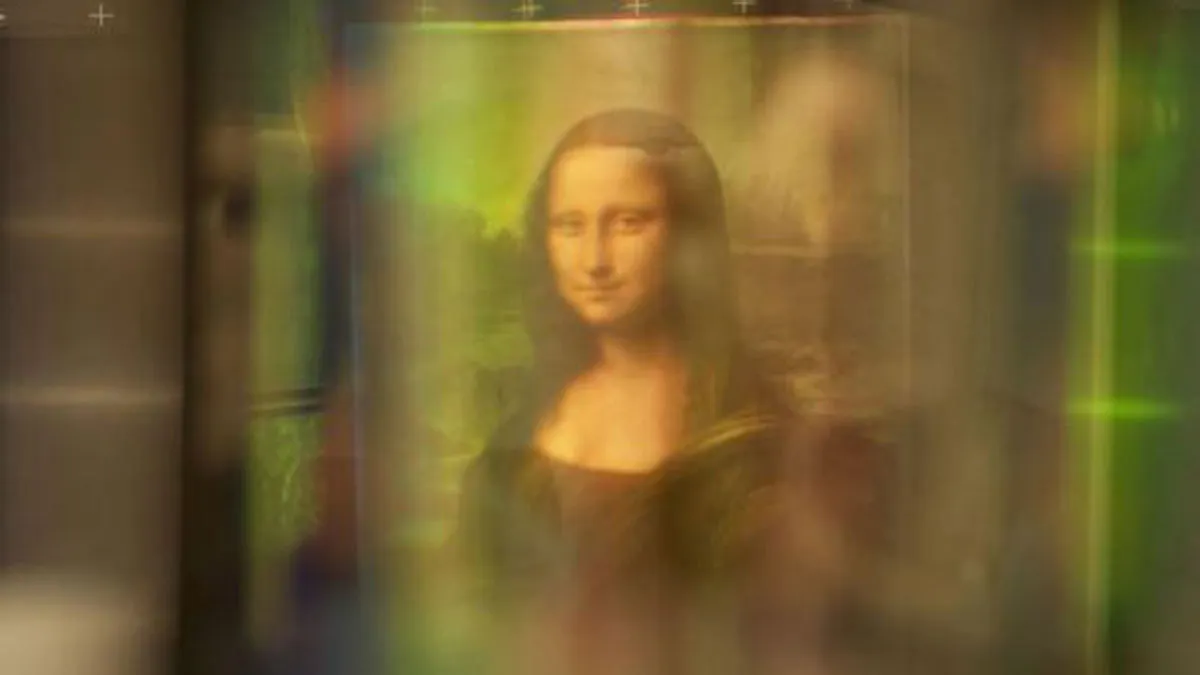
A French scientist has claimed that Leonardo da Vinci's Mona Lisa, the world's most recognised painting, conceals another portrait beneath it – of an entirely different woman.
Pascal Cotte, who has studied the painting for more than ten years, examined it using a technique called the Layer Amplification Method, which involves exposing the poplar board to intense lights.
His reconstruction of a layer behind the familiar image of the Mona Lisa appears to show a woman looking off to the side rather than gazing ahead with her famous faint smile.
The Week
Escape your echo chamber. Get the facts behind the news, plus analysis from multiple perspectives.
SUBSCRIBE & SAVE
Sign up for The Week's Free Newsletters
Join more than 350,000 subscribers and keep yourself informed with a selection of The Week’s most interesting, enlightening and entertaining stories - plus daily puzzles.
Join more than 350,000 subscribers and keep yourself informed with a selection of The Week’s most interesting, enlightening and entertaining stories - plus daily puzzles.
Latest Videos FromThe Week US
Cotte claims this underlying portrait is the real-life 'Mona Lisa', long unidentified but now widely believed to be Lisa Gherardini, the wife of a Florentine merchant.
"She is totally different to Mona Lisa today. This is not the same woman," Cotte argues.
Artists have often painted over their work – sometimes to adjust details, perhaps for political reasons, and sometimes to save money by painting a new work over an unfinished or unsatisfactory old one.
In the 1930s, X-ray technology revealed that Thomas Gainsborough's famous Blue Boy was painted over an incomplete portrait of a man.
The art world is divided on Cotte's Mona Lisa theory. Professor Martin Kemp, Emeritus Professor of the History of Art at the University of Oxford, put forward a different explanation of Cotte's discovery, arguing the lower layer is a draft of the finished product.
"They are ingenious in showing what Leonardo may have been thinking about. But the idea that there is that picture, as it were, hiding underneath the surface is untenable," Kemp told the BBC.
He added: "I do not think there are these discreet stages which represent different portraits. I see it as more or less a continuous process of evolution.
"I am absolutely convinced that the Mona Lisa is Lisa. "