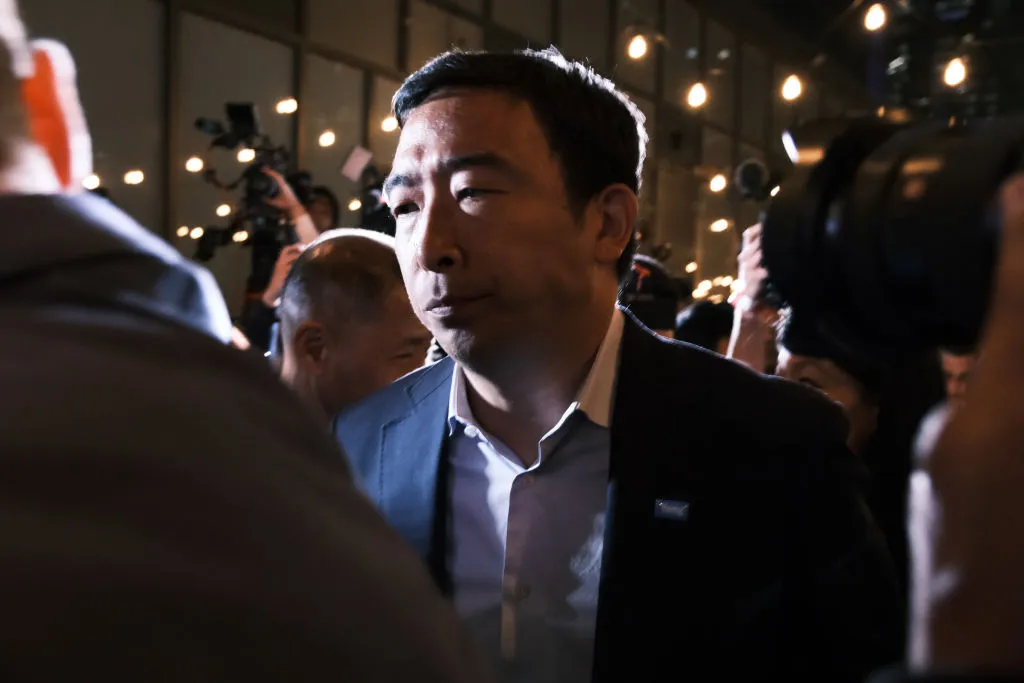
Andrew Yang explains why Americans should worry about how campaigns affect their political leaders
In a first-hand account for Politico, former Democratic presidential candidate Andrew Yang says he received a "crash course in how we treat the very powerful" while making his bid for the White House, bluntly acknowledging that "it was weird." But Yang follows that up with a not-so-flippant statement, writing that the experience was "more than just a head rush." Instead, "there are direct psychological consequences to being treated this way for months on end."
Yang doesn't go into too many specifics about how he personally dealt with the situation, but he does note that he "could clearly see how politicians become susceptible to growing so out of touch." That's because they spend so much time around people whose "schedules and actions revolve around you," he explains. And by the time things really get going, the candidate is no longer the CEO of the campaign, but the "product." Subsequently, Yang writes, "empathy becomes optional or even unhelpful" and "leadership becomes the appearance of leadership."
That's not an ideal scenario in Yang's point of view, and he argues that "it should worry us that all our leaders are subject to it." Read Yang's full piece at Politico.
The Week
Escape your echo chamber. Get the facts behind the news, plus analysis from multiple perspectives.
Sign up for The Week's Free Newsletters
From our morning news briefing to a weekly Good News Newsletter, get the best of The Week delivered directly to your inbox.
A free daily email with the biggest news stories of the day – and the best features from TheWeek.com
Tim is a staff writer at The Week and has contributed to Bedford and Bowery and The New York Transatlantic. He is a graduate of Occidental College and NYU's journalism school. Tim enjoys writing about baseball, Europe, and extinct megafauna. He lives in New York City.
-
Courgette and leek ijeh (Arabic frittata) recipeThe Week Recommends Soft leeks, tender courgette, and fragrant spices make a crisp frittata
-
Trump’s power grab: the start of a new world order?Talking Point Following the capture of Nicolás Maduro, the US president has shown that arguably power, not ‘international law’, is the ultimate guarantor of security
-
Unrest in Iran: how the latest protests spread like wildfireIn the Spotlight Deep-rooted discontent at the country’s ‘entire regime’ and economic concerns have sparked widespread protest far beyond Tehran
-
The billionaires’ wealth tax: a catastrophe for California?Talking Point Peter Thiel and Larry Page preparing to change state residency
-
Hegseth moves to demote Sen. Kelly over videospeed read Retired Navy fighter pilot Mark Kelly appeared in a video reminding military service members that they can ‘refuse illegal orders’
-
Trump says US ‘in charge’ of Venezuela after Maduro grabSpeed Read The American president claims the US will ‘run’ Venezuela for an unspecified amount of time, contradicting a statement from Secretary of State Marco Rubio
-
Bari Weiss’ ‘60 Minutes’ scandal is about more than one reportIN THE SPOTLIGHT By blocking an approved segment on a controversial prison holding US deportees in El Salvador, the editor-in-chief of CBS News has become the main story
-
CBS pulls ‘60 Minutes’ report on Trump deporteesSpeed Read An investigation into the deportations of Venezuelan migrants to El Salvador’s notorious prison was scrapped
-
Trump administration posts sliver of Epstein filesSpeed Read Many of the Justice Department documents were heavily redacted, though new photos of both Donald Trump and Bill Clinton emerged
-
Trump HHS moves to end care for trans youthSpeed Read The administration is making sweeping proposals that would eliminate gender-affirming care for Americans under age 18
-
Jack Smith tells House of ‘proof’ of Trump’s crimesSpeed Read President Donald Trump ‘engaged in a criminal scheme to overturn the results of the 2020 presidential election,’ hoarded classified documents and ‘repeatedly tried to obstruct justice’