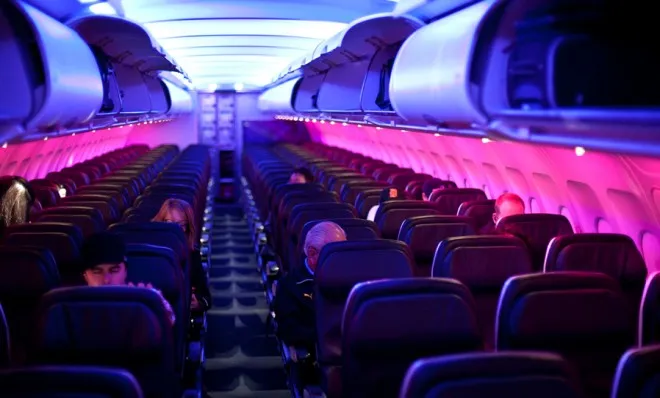
This blog post is not an endorsement, per se, of Virgin America, the upstart airline with a cool vibe that takes me across the country.
It is an endorsement of what Virgin America has done with the interior of their jets. I've noticed that passengers tend to be calm and tranquil as they board, as they fly, as they depart. When situations arise that would normally flare a temper or two, for some reason, the flares are extinguished almost immediately. It's as if something is in the air. Or maybe it's the New Age-y music that plays before you have to turn your electronic devices off. Maybe it's the youth and vitality of the flight attendants or the casual, calming cockpit voices.
Or maybe it's the color of the walls. Browse through these photos. Kinda futuristic, yeah, but... they're relaxing. Especially the gradient blues and the pinks. There is some evidence that prolonged exposure to these colors, or immediate immersive exposure, which is what happens when you move from the terminal into the plane, changes your neurophysiology. There is also plenty of skepticism. A new book, Drunk Tank Pink by NYU marketing professor Adam Alter, takes you through the history of the science and intuition about mood lighting. Many of the studies showing correlation between blues, pinks, and tranquility were done by sports psychologists in the 1980s and have not been replicated.
The Week
Escape your echo chamber. Get the facts behind the news, plus analysis from multiple perspectives.
SUBSCRIBE & SAVE
Sign up for The Week's Free Newsletters
Join more than 350,000 subscribers and keep yourself informed with a selection of The Week’s most interesting, enlightening and entertaining stories - plus daily puzzles.
Join more than 350,000 subscribers and keep yourself informed with a selection of The Week’s most interesting, enlightening and entertaining stories - plus daily puzzles.
Latest Videos FromThe Week US
But something happens aboard the Virgin planes.
My guess is that a combination of sound, color schemes and music and the sudden exposure to it — nothing happens gradually in this real-life interaction with the environment — resets the chemical architecture of our mood. The transition is the key. You step from the chaotic world of the terminal to the tranquil world of the airplane. And then your brain adjusts itself to the environment accordingly. I don't know if this works across categories of experience; the Transportation Security Administration has experimented by altering the lighting and ambient sound at some of their checkpoints. But going into the security zone is gradual, not sudden.
Maybe Michael Bloomberg will decide to repaint the walls of every city-owned building in the city. Now THAT would be a field experiment.