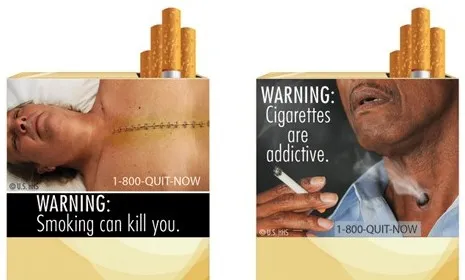
Five of the six large U.S. tobacco companies are suing the federal government over new graphic labels required on cigarette packages starting in September 2012, claiming the images of dead and diseased smokers amount to unconstitutional "compelled speech." The companies, led by Lorillard and R.J. Reynolds, argue that since their product is legal, the government has no right to "require a cigarette pack to serve as a mini-billboard for the government's antismoking campaign." Do they have a case?
Cigarette firms are being unfairly singled out: Everyone knows smoking can be deadly, says Sheila Marshall in The Thomaston, Ga., Times. But "believe it or not, folks, there are more things in this life that are detrimental to good health than smoking cigarettes." Where are the grotesque labels on ice cream cones, french fries, video games, and alcohol, for instance? It is wrong to "place such a stigma only on tobacco companies."
The Week
Escape your echo chamber. Get the facts behind the news, plus analysis from multiple perspectives.

Sign up for The Week's Free Newsletters
Join more than 350,000 subscribers and keep yourself informed with a selection of The Week’s most interesting, enlightening and entertaining stories - plus daily puzzles.
Join more than 350,000 subscribers and keep yourself informed with a selection of The Week’s most interesting, enlightening and entertaining stories - plus daily puzzles.
-
-
 talking pointsA leadership power vacuum may await Republicans
 -
 QUOTE OF THE DAY‘What kind of culture looks at sexual violence and sees an opportunity for profit? This is rape culture. And it should disturb every single one of us.’
 -
 today’s big questionHow long can US consumers continue their spending spree?
-
-
-
talking pointsA leadership power vacuum may await Republicans
-
QUOTE OF THE DAY‘What kind of culture looks at sexual violence and sees an opportunity for profit? This is rape culture. And it should disturb every single one of us.’
-
today’s big questionHow long can US consumers continue their spending spree?
-