Sign up to get Today’s Best Articles in your inbox
Join 350,000+ subscribers and keep yourself informed with a selection of
The Week’s most interesting, enlightening and entertaining stories - plus daily puzzles.
You are now subscribed
Your newsletter sign-up was successful
Want to add more newsletters?
An account already exists for this email address, please log in.
The rising abortion rate: 3 theories
When the recession took hold, the U.S. abortion rate ticked higher for the first time in 20 years. Why?
For the first time in two decades, the U.S. abortion rate didn't fall in 2008. It actually rose slightly, according to the Guttmacher Institute's latest survey of abortion providers. And the total number of abortions performed also ticked up slightly, to 1.212 million in 2008 from 1.206 million in 2005, the year of Guttmacher's last survey. Abortions had been steadily declining, so why have the numbers leveled off now? Here, three theories:
Blame the recession
The reason for this "slight uptick" in the abortion rate is "fairly straightforward," says Michael J. New in National Review. It's the weak economy. According to several experts, the worst recession since the 1930s caused many women to make "the painful economic calculus to skip a few routine bills to cover a $400 to $600 abortion rather than face supporting another child," says Rob Stein in The Washington Post. That's especially true for poor women, "who in better economic times might have decided to carry to term, but since they or their partner lost their job, decided they couldn't," says Rachel Jones, the lead author of the Guttmacher study.
The Week
Escape your echo chamber. Get the facts behind the news, plus analysis from multiple perspectives.
Join more than 350,000 subscribers and keep yourself informed with a selection of The Week’s most interesting, enlightening and entertaining stories - plus daily puzzles.
Join more than 350,000 subscribers and keep yourself informed with a selection of The Week’s most interesting, enlightening and entertaining stories - plus daily puzzles.
The recession is affecting the abortion rate in another way, too, says Planned Parenthood. It makes it harder for women to buy birth control pills and other contraception. "While many factors contribute to the abortion rate in the United States, this country's very high rate of unintended pregnancy is the most important one of all," the group said. So to resume the decline in abortions, "the first step we can take as a nation is to increase access to affordable contraception."
The "abortion pill" has made abortion more palatable
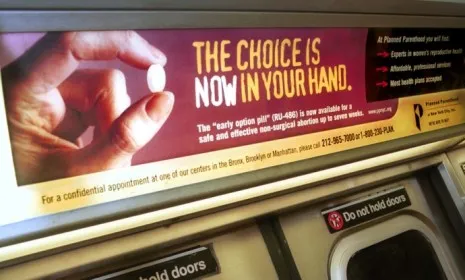
About 17 percent of the abortions (199,000) in 2008 were via medication, mostly mifepristone (previously known as RU-486), a 24 percent jump from 2005. Guttmacher study author Jones says that trend is good news, since medication abortion is only administered early in pregnancies, when abortion is safest. But anti-abortion groups say the "abortion drug," approved in 2000, is being used to "eliminate the surgical implications that repel many women," says Dave Bohon in The New American. Women didn't like the painful, "gross" nature of abortion, says Randall O'Bannon of National Right to Life. "So the abortion industry comes along and says, 'Now it's just a matter of popping a pill.'"
Sign up to get Today’s Best Articles in your inbox
A free daily email with the day’s biggest news and analysis – and the best features from TheWeek.com