The Week The Week
flag of US
US
flag of UK
UK
https://cdn.mos.cms.futurecdn.net/flexiimages/jacafc5zvs1692883516.jpg

SUBSCRIBE & SAVE

Less than $3 per week

Sign in
  • View Profile
  • Sign out
  • The Explainer
  • The Week Recommends
  • Newsletters
  • Cartoons
  • From the Magazine
  • The Week Junior
  • Student Offers
  • More
    • Politics
    • World News
    • Business
    • Health
    • Science
    • Food & Drink
    • Travel
    • Culture
    • History
    • Personal Finance
    • Puzzles
    • Photos
    • The Blend
    • All Categories
  • Newsletter sign up Newsletter
  • Brand Logo
    ICE fight, Harvard demand and Iran engagement

     
    TODAY’S NATIONAL story

    House ends brief shutdown, tees up ICE showdown

    What happened
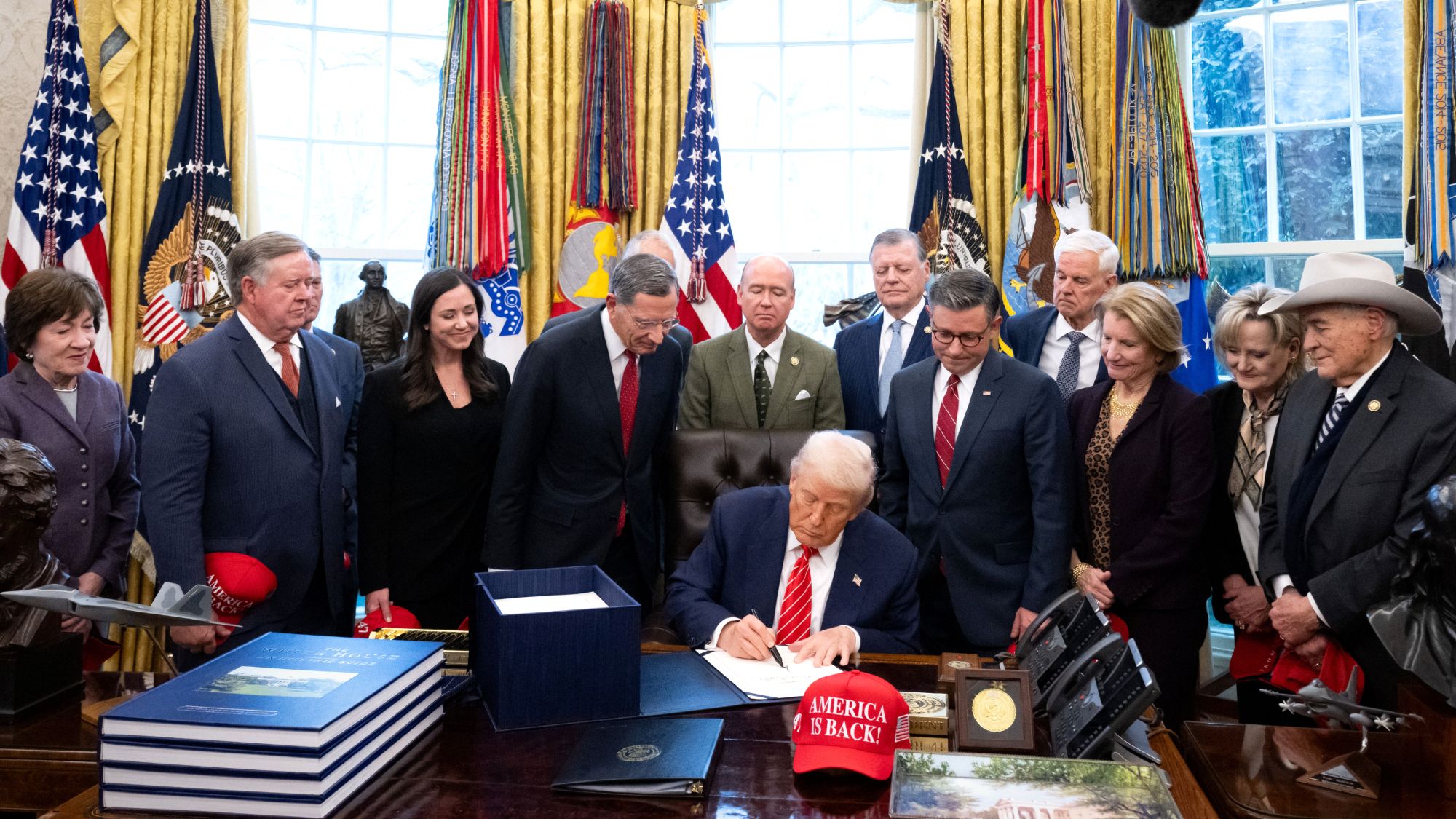
    The House yesterday narrowly approved legislation to fund most of the federal government through Sept. 30 and the Department of Homeland Security through Feb. 13. The $1.2 trillion package passed 217-214, with 21 Democrats joining most Republicans to vote yes and 21 Republicans voting no. President Donald Trump signed the bill, ending the brief partial government shutdown that began Saturday. 

    Who said what
    The funding bill had “provisions that appealed to both parties,” The Associated Press said. Republicans “avoided a massive, catchall” package and Democrats “were able to fend off some of Trump’s most draconian proposed cuts while adding language that helps ensure funds are spent as stipulated by Congress.” The bill revoked a controversial provision that allowed a handful of Senate Republicans to sue the government for millions over a subpoena of their phone records.

    But the legislation’s passage “kicks off a 10-day sprint for Republicans and Democrats to agree on policy changes regarding how Immigration and Customs Enforcement agents operate during immigration raids,” The Washington Post said. House Speaker Mike Johnson (R-La.) said he hoped Democrats “will operate in good faith over the next 10 days as we negotiate this.” 

    “There’s not much optimism about a deal,” Politico said. Immigration enforcement is “one of the thorniest issues in national politics,” and Republicans are already “rejecting central demands from Democrats,” like requiring judicial warrants and banning federal agents from wearing masks. “We need dramatic change” to ensure that ICE and other DHS agencies “are conducting themselves like every other law enforcement organization in the country,” Minority Leader Hakeem Jeffries (D-N.Y.) said. “Absent that, then a full-year appropriations bill is in deep trouble.”

    What next?
    Democrats were galvanized into taking a stand after immigration agents killed Alex Pretti and Renee Good in Minneapolis. But Republicans “think that they have a strong bargaining position, given that Trump’s signature 2025 law” ensured ongoing mass deportations with “an extra $75 billion for ICE,” The Wall Street Journal said. While ICE “would largely have a free hand to continue immigration enforcement,” Politico said, a “lengthy DHS shutdown could be uncomfortable quickly for both parties,” with lapsed TSA funding “potentially snarling airports” and Coast Guard members going without pay. 


    TODAY’S EDUCATION story

    Trump demands $1B from Harvard, deepening feud

    What happened
    President Donald Trump yesterday doubled his $500 million demand from Harvard University, ramping up his long-running feud with the university over disputed claims of antisemitism. Harvard is “feeding a lot of ‘nonsense’ to the Failing New York Times” about the cash demand being dropped, Trump said in a series of social media posts Monday night and yesterday morning. “We are now seeking One Billion Dollars in damages, and want nothing further to do, into the future, with Harvard University.”

    Who said what
    Trump’s “blistering attack” on Harvard followed a New York Times report that he “privately told negotiators he was willing to drop his demand for a $200 million payment” and $300 million workforce training investment if it “would secure an agreement,” the Times said. This “sudden shift was characteristic” of Trump’s “vacillating demands” while trying to “hammer out a Harvard deal” he views as central to his “broader push to alter the culture of a higher education system he had derided as a factory of ’woke’ ideology.”

    With the new cash demand, “both sides appear to move further from reaching a deal,” The Associated Press said. Trump’s “outburst” leaves Harvard and the White House “firmly entrenched” in a conflict that he has repeatedly “said was nearing an end” since June. 

    What next?
    Trump “fired a new shot in his war with Harvard,” but “the battleground has changed” in the university’s favor, The Wall Street Journal said. Harvard “rode into 2026 on the back of significant court victories” that restored $2.2 billion in funding and “halted Trump’s bids to block international students.” The fight isn’t over, the Times said, but Harvard has “seen that it can survive bombardment from the White House.”


    TODAY’S INTERNATIONAL Story

    Iran and US prepare to meet after military skirmishes

    What happened
    The U.S. yesterday shot down an Iranian uncrewed drone in the Arabian Sea and intervened when two Iranian military vessels intercepted a U.S. merchant ship in the Strait of Hormuz, U.S. Central Command said. The incidents occurred amid heightened tensions in the region as President Donald Trump ramps up the U.S. military presence in the region and both countries prepare for bilateral talks later this week. 

    Who said what
    A U.S. Navy F-35C fighter jet shot down an Iranian Shahed-139 drone that "aggressively approached" the aircraft carrier Abraham Lincolnwith “unclear intent,” about 500 miles from Iran’s southern coast, U.S. Central Command spokesperson Capt. Tim Hawkins said in a statement. Several hours later, the guided missile destroyer USS McFaul intervened and escorted the Stena Imperative to safety after Islamic Revolutionary Guard Corps forces, backed by another drone, “harassed” and attempted to board the U.S.-flagged and U.S.-crewed ship.

    Trump threatened to attack Iran last month “after its government brutally crushed anti-government protests,” killing thousands of demonstrators, The New York Times said. “As the protests have ebbed,” he “shifted his focus to demanding a deal that would end Iran’s nuclear program,” among other stipulations. Iranian President Masoud Pezeshkian said on social media yesterday his envoys would “pursue fair and equitable negotiations” with the U.S., but only in a “suitable environment” that is “free from threats and unreasonable expectations.”

    What next?
    Yesterday’s skirmishes strained but did not derail “already tenuous negotiations over the staging” of the upcoming meeting, The Washington Post said. Multilateral talks were scheduled to begin Friday in Istanbul, but Tehran “requested a new format and location for the meeting,” and now just Iranian and U.S. envoys are expected to meet in Oman. 


    It’s not all bad

    The Guatemalan government is not renewing an oil extraction lease on land near the Laguna del Tigre Biosphere Reserve, instead turning the acreage over to the military so it can keep a “closer eye” on wildlife and stop illegal activities, said Good News Network. Laguna del Tigre is part of the larger Mayan Biosphere Reserve, and protecting this ecosystem is important for the “good of Guatemalans and for the world,” said Environment and Natural Resources Minister Patricia Orantes.


    Under the radar

    Why quitting your job is so difficult in Japan

    A “niche but increasingly popular” industry in Japan is helping workers break out of the “salaryman” cycle, according to The Washington Post. For a fee of up to 50,000 yen ($320), dissatisfied employees can hire “proxy quitters” to resign from their jobs for them. 

    This rise in proxy quitters has revealed a “darker side of Japan’s work culture” to the rest of the world, said Singapore news site CNA. Bosses often have “disproportionate power over employees,” which leads to expectations of “long hours and unpaid overtime.” 

    Workers are bound by the concept of “messhi hoko,” or “self-sacrifice for the public good,” which is “ingrained” in the Japanese working culture, said CNA. The expectation to prioritize company needs over personal ones is often cited as one of the culprits for Japan’s declining birth rate. At its most extreme, it can “even be fatal.” The term “karoshi” refers to the phenomenon of “death by overwork.” 

    Yet, evidence suggests that more and more people are defying traditional taboos and choosing to change jobs, said The Japan Times. According to government data, about 940,000 people switched from one full-time position to another in 2023 compared with 750,000 in 2018. 

    The increase in labor fluidity has caused Japan’s rigid worker pay structures to loosen, with salaries catching up with the rest of the world due to workforce demands. Employers may be bracing for the impact of an influx of young, empowered workers, said The Economist, but the change could “inject dynamism into Japan’s ossified institutions.”


    On this day

    February 4, 2012

    Florence Green, the last surviving veteran of World War I, died at age 110. Green served as a steward in the U.K.’s Women’s Royal Air Force. More than 45,000 World War II veterans are still alive in the U.S. alone, according to the National World War II Museum.


    TODAY’S newspaperS

    ‘Tool for retribution’

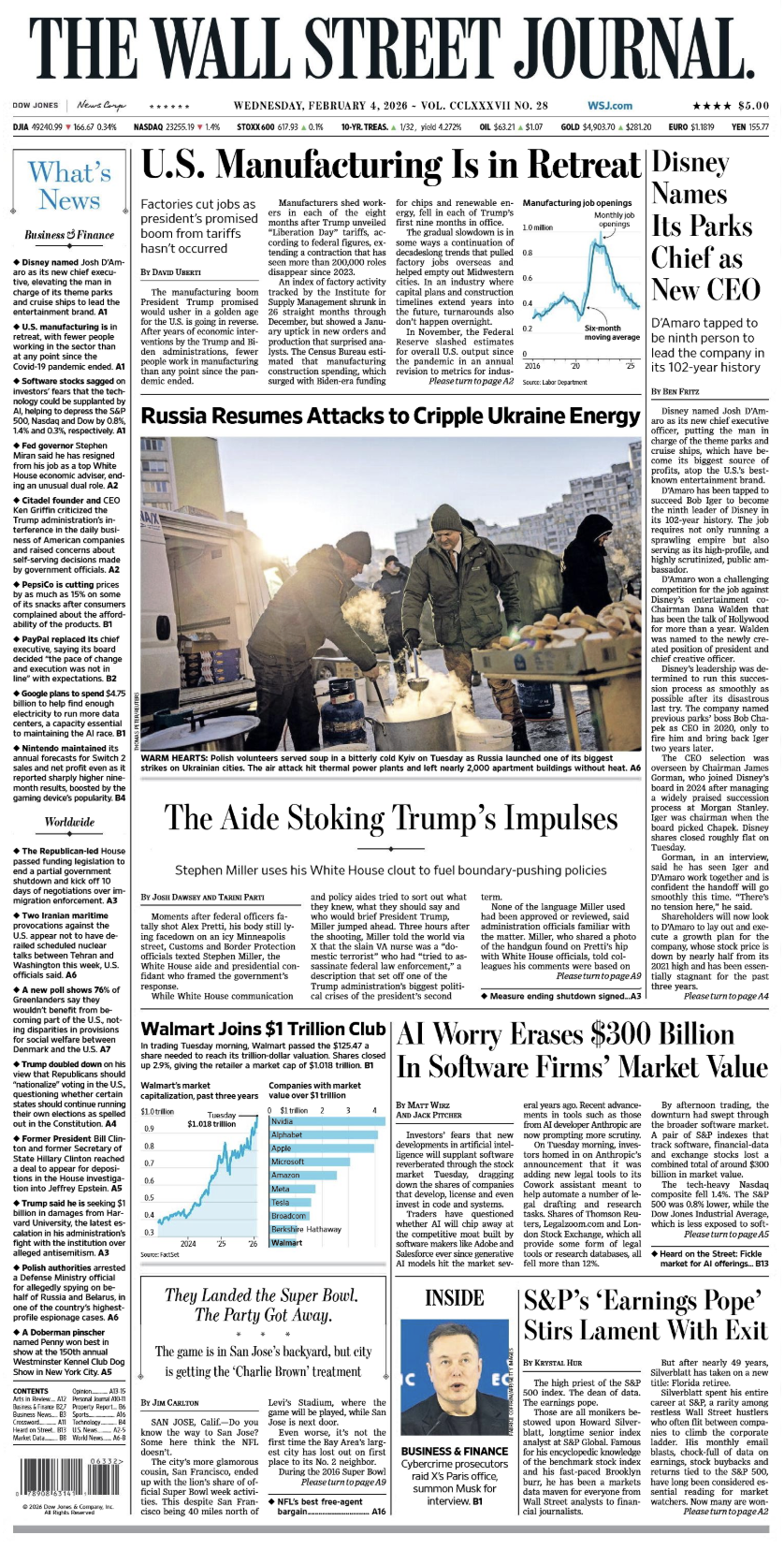
    “Trump’s fraud sweep” serves as “tool for retribution against rivals as allies get pardons,” The New York Times says on Wednesday’s front page. “Secretive legal tool deployed by DHS,” The Washington Post says. “8 more federal prosecutors resign” in Minneapolis, making “14 exits” in a month, The Minnesota Star-Tribune says. “Haitians get 11th-hour reprieve,” The Columbus Dispatch says. “Body cam footage shows chaos at FBI raid,” The Atlanta Journal-Constitution says. “Hefty bills catch patients off guard,” says USA Today. “U.S. manufacturing is in retreat” despite “president’s promised boom from tariffs,” The Wall Street Journal says. “Trump storms, Harvard carries on,” The Boston Globe says. “Disney names longtime insider to be next CEO,” says the Los Angeles Times. 

    ► See the newspaper front pages


    Tall tale

    Pig in the pen

    A Missouri man was arrested on charges of burglary after a woman discovered an empty container of pulled pork in her kitchen and notified authorities. The homeowner’s suspicions were raised because the container had been “full and in the refrigerator” when she went to bed the night before, said KY3, and she grew alarmed when she spotted an unfamiliar backpack on her porch. Using personal items found inside the bag, police tracked down the hungry suspect.


    Morning Report was written and edited by Will Barker, Nadia Croes, Catherine Garcia, Scott Hocker, Anya Jaremko-Greenwold, Justin Klawans, Rafi Schwartz, Peter Weber and Kari Wilkin, with illustrations by Stephen Kelly and Julia Wytrazek.

    Image credits, from top: Saul Loeb / AFP via Getty Images; Scott Eisen / Getty Images; Daniel Kimmelman / U.S. Navy via AP; Illustration by Julia Wytrazek / Getty Images
     

    Recent editions

    • Evening Review

      ICE’s escalating surveillance

    • Morning Report

      Gabbard in the spotlight

    • Evening Review

      Regime change in Cuba?

    VIEW ALL
    TheWeek
    • About Us
    • Contact Future's experts
    • Terms and Conditions
    • Privacy Policy
    • Cookie Policy
    • Advertise With Us
    • FAQ
    Add as a preferred source on Google

    The Week is part of Future US Inc, an international media group and leading digital publisher. Visit our corporate site.

    © Future US, Inc. Full 7th Floor, 130 West 42nd Street, New York, NY 10036.