The Week The Week
flag of US
US
flag of UK
UK
https://cdn.mos.cms.futurecdn.net/flexiimages/jacafc5zvs1692883516.jpg

SUBSCRIBE & SAVE

Less than $3 per week

Sign in
  • View Profile
  • Sign out
  • The Explainer
  • The Week Recommends
  • Newsletters
  • Cartoons
  • From the Magazine
  • The Week Junior
  • Student Offers
  • More
    • Politics
    • World News
    • Business
    • Health
    • Science
    • Food & Drink
    • Travel
    • Culture
    • History
    • Personal Finance
    • Puzzles
    • Photos
    • The Blend
    • All Categories
  • Newsletter sign up Newsletter
  • Brand Logo
    Meta loses, Minnesota sues and NASA’s new moonshot

     
    TODAY’S SOCIAL MEDIA story

    New Mexico jury finds Meta liable for child harm

    What happened
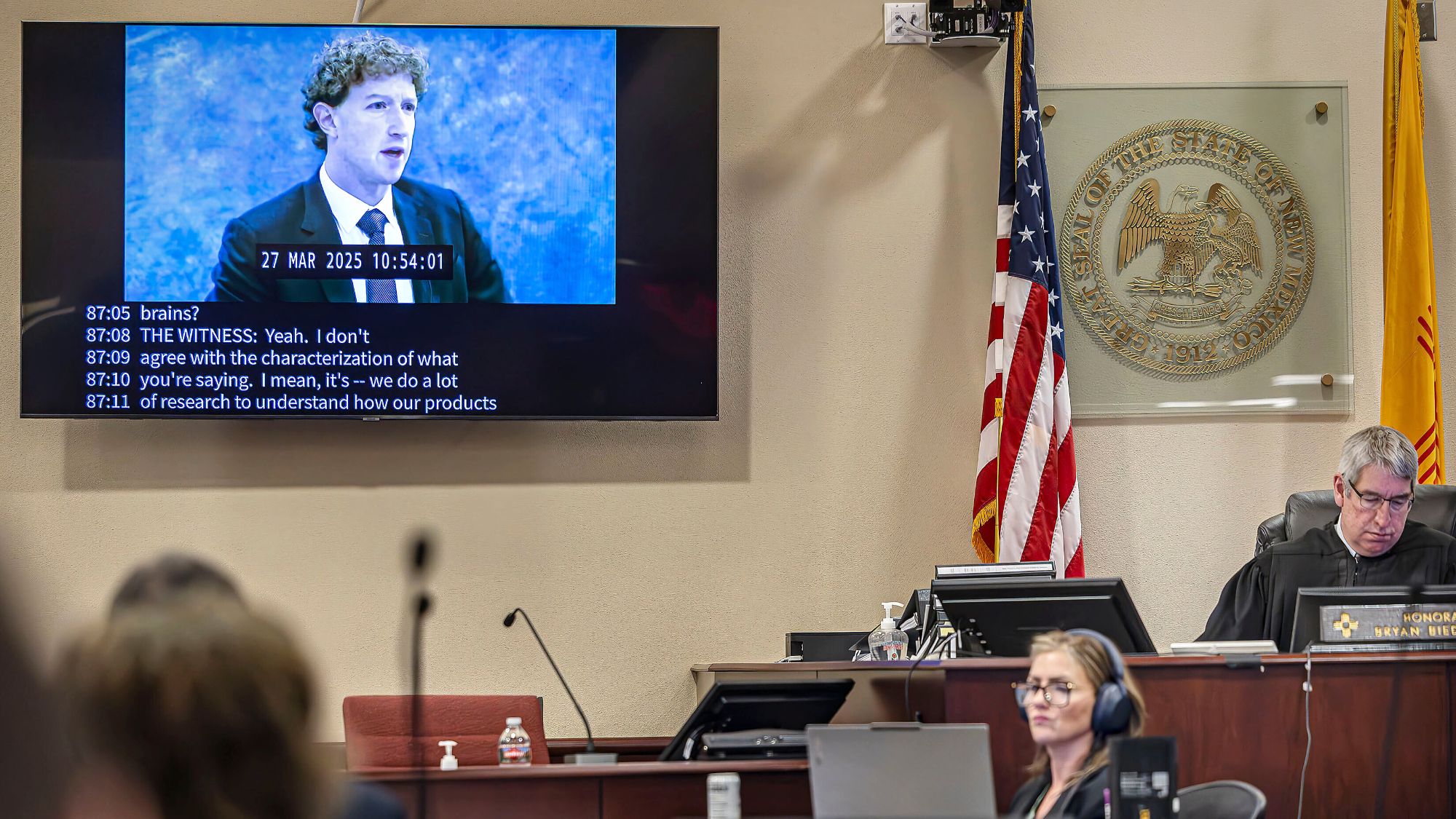
    A New Mexico jury yesterday found that Meta knowingly harmed children’s mental health, enabled child sexual exploitation and misled users about the safety of its Instagram, Facebook and WhatsApp platforms. The jurors ordered Meta to pay $375 million in civil penalties for thousands of violations of the state’s Unfair Practices Act. It was the first major courtroom loss for Meta in a growing number of lawsuits accusing it and other social media giants of harming or failing to protect young people. 

    Who said what
    The verdict is a “historic victory for every child and family who has paid the price for Meta’s choice to put profits over kids’ safety,” said New Mexico Attorney General Raúl Torrez, who filed the suit in 2023. During the seven-week trial, the BBC said, the jurors “were presented with internal Meta documents and heard testimony from former employees,” including whistleblower Arturo Béjar, who testified that Meta was aware underage users were being served sexualized content and that “his own young daughter was propositioned for sex by a stranger on Instagram.” 

    The jurors “ordered a maximum penalty for each violation,” The Wall Street Journal said, but “Meta made 160 times” the $375 million fine “in its most recent quarter” alone. Shares of the $1.5 trillion company were “up 5% in early after-hours trading following the verdict,” The Associated Press said. Still, the “landmark decision” in Santa Fe “signals a changing tide against tech companies and the government’s willingness to crack down” on social media’s harms to young people. 

    “Parents, policymakers and the tech industry watched the New Mexico case closely for its potential to force Meta to change the design of its products,” The New York Times said. But the trial judge, not the jury, will rule on any compulsory changes for Meta at the trial’s second stage in May.

    What next?
    “We will continue to defend ourselves vigorously,” said Meta spokesperson Andy Stone, “and we remain confident in our record of protecting teens online.” A jury in Los Angeles “has been deliberating for more than a week” in a separate “bellwether social media addiction trial” accusing Meta and YouTube of “harming the mental health of a user through addictive design features,” the Times said.


    TODAY’S ICE story

    Minnesota sues for evidence in Pretti, Good killings

    What happened
    Minnesota yesterday sued the Trump administration for access to evidence related to three federal shootings during ICE’s “Operation Metro Surge,” including the killings of Renee Good and Alex Pretti. The lawsuit said the federal government’s “arbitrary and capricious” refusal to cooperate or share any evidence with state investigators came from leaders at the Justice Department and Homeland Security Department, and violated Minnesota’s 10th Amendment right to enforce its own laws and the Administrative Procedures Act.

    Who said what
    “We are prepared to fight for transparency and accountability that the federal government is desperate to avoid,” Hennepin County Attorney Mary Moriarty told reporters. Minnesota Attorney General Keith Ellison stressed “how absolutely extraordinary it is, how rare and unprecedented it is, how completely unnecessary it is, if justice is our goal, for us to have to file this lawsuit.” 

    DHS said in a statement that the federal government is investigating all three shootings. The FBI is leading the Pretti probe, DHS said, while federal prosecutors are investigating two agents for making false statements about their arrest of Venezuelan immigrant Julio Sosa-Celis — though not for shooting him in the leg. The Good shooting was “still under investigation,” the statement said, though its claims that the unarmed mother “weaponized her vehicle” and the officer shot her “in self-defense” were “contradicted by video evidence,” The New York Times said. Trump officials previously said the Good killing “was not under investigation, The Minnesota Star Tribune said.

    What next?
    Minnesota officials “say they are seeking a court order requiring federal agencies to turn over evidence so the state can determine whether any criminal charges are warranted,” Minnesota Public Radio said.


    TODAY’S SPACE Story

    NASA unveils plan for $20B moon base, Mars missions

    What happened
    NASA yesterday announced that in the next few years it will start building a permanent base on the moon and send three small helicopters to Mars aboard a pioneering nuclear-powered robotic spacecraft. “This is the moment where we should all start believing again,” NASA’s new administrator, Jared Isaacman, said at an international space conference in Houston. “NASA once changed everything, and we’re going to do it again.”

    Who said what
    NASA’s “years of talking about lunar outposts in vague terms for sometime in the indefinite future” appear to have ended with this new “road map” with “specific plans and timelines,” The New York Times said. Isaacman said that NASA has committed to return astronauts to the moon “before the end of President Trump’s term” and ahead of “real geopolitical rival” China’s planned 2030 crewed lunar landing. 

    As part of Isaacman’s revamp of NASA’s flagship Artemis lunar program, the Lunar Gateway orbiting station, which is “largely already built,” will be shelved, Reuters said. The new plan to repurpose its components to build the $20 billion moon base raises questions about the “future roles” of “key” Artemis partners Japan, Canada and the European Space Agency. Experts also questioned the feasibility of launching a Mars-bound spacecraft powered by nuclear electric propulsion in 2028. The “dominant reaction” among spaceflight experts, cosmologist Katie Mack said, “is somewhere on the spectrum between mockery and dismay.”

    What next?
    Issacson said Artemis 3, now a mission to test the Orion space capsule’s integration with lunar landers, is scheduled for 2027, while Artemis 4 will send astronauts to the moon in 2028. Yesterday’s announcements came “one week before NASA’s targeted launch of Artemis 2,” the first crewed flight around the moon since 1972’s Apollo 17, Space.com said. 


    It’s not all bad

    Families living near Rio de Janeiro’s Pedra Branca State Park are growing banana plants to help protect the area’s biodiversity. The park is the world’s largest urban forest, spanning 17 neighborhoods, and its landscape exists due to agroforestry, an agricultural system that promotes a “deep integration of crop species, animals and trees,” said The Guardian. The banana farmers are boosting this system while also reaping the benefits of financial and food security.


    Under the radar

    The newest prison drug: paper

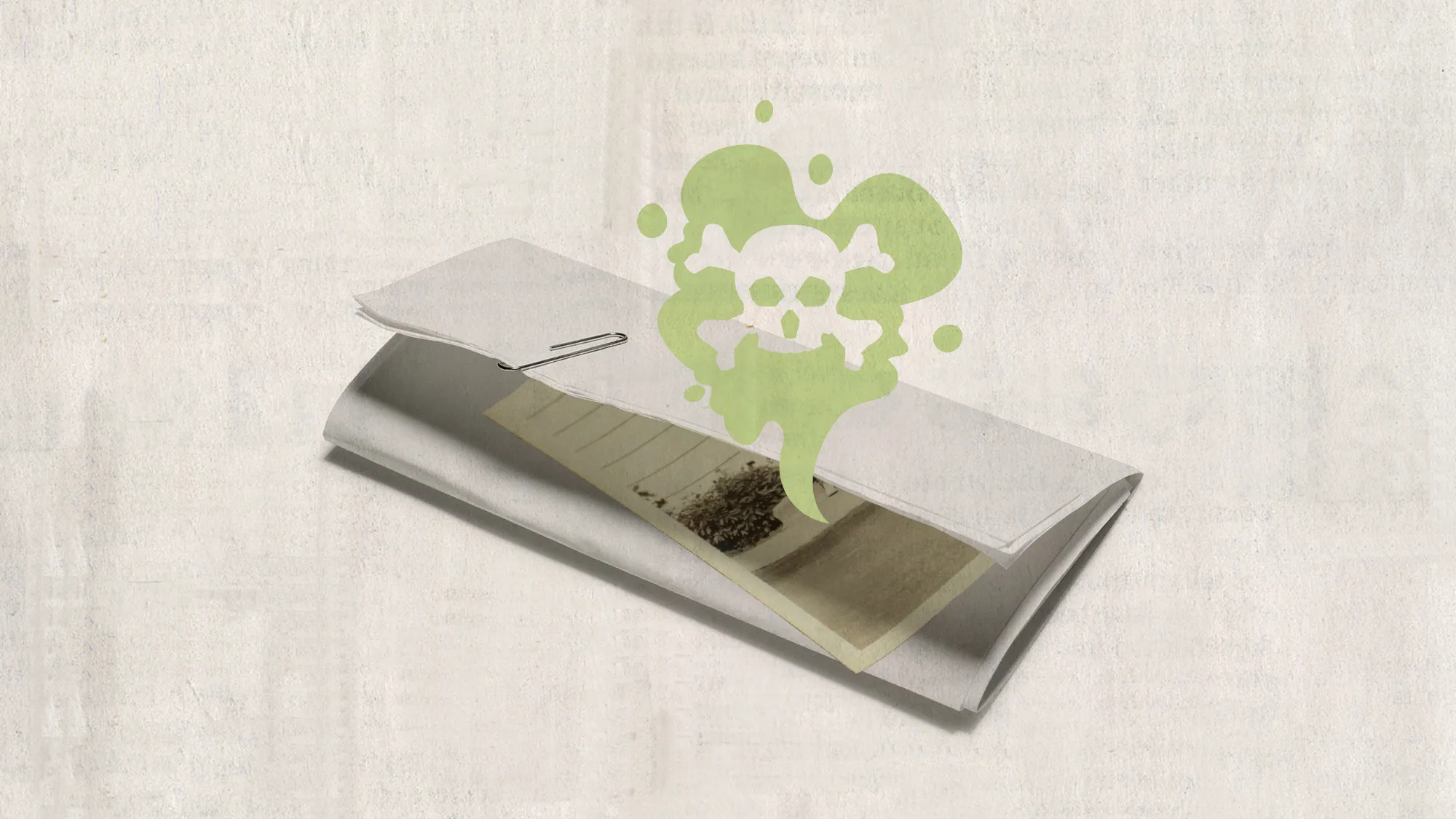
    When you think of drugs in prisons, powders, pills and needles probably come to mind. But correctional facilities across the U.S. are grappling with something much more ubiquitous: paper. An uptick in drug-laced paper smuggling has fueled a rash of deadly overdoses among inmates.

    The problem stretches from “New York to Texas to Hawaii,” and at least 16 states have prosecuted individuals for introducing drug-laced paper into correctional facilities, The New York Times said. Paper is often seen as an easy way to smuggle in drugs because it’s a “lifeline in jail, a tether to parents, partners and children in the outside world.”

    Cook County, Illinois, is the epicenter of the problem, but last year a librarian in Massachusetts was “accused of smuggling sheets of paper infused with synthetic marijuana” into a Dartmouth jail, said CBS News. This year, an attorney in Houston claimed he was “tricked into smuggling drug-laced paper into the Harris County jail,” said KTRK-TV Houston.

    The drugs themselves make prohibition difficult because “as quickly as the authorities ban one substance, narco-chemists drum up novel, more potent variations that have not been outlawed,” said the Times. In 2024, Cook County jail officers found a single piece of paper with 10 different chemicals sprayed on it, a “mix of opioids, depressants, cannabinoids and stimulants all jumbled together” like “a Rosetta Stone of synthetic drugs.”

    Simply outlawing paper would “rob” inmates of “what they missed most in lockup: human connection,” said the Times. To “dismissively say we’re going to ban everything from coming in, it was just something that I didn’t want to do,” said Cook County Sheriff Tom Dart.


    On this day

    March 25, 1911

    A fire at the Triangle Shirtwaist Factory in New York City killed 146 people, in one of the deadliest industrial accidents in U.S. history. Working conditions at the factory were heavily scrutinized after the fire, leading to a series of legislative reforms and changes in workplace safety standards.


    TODAY’S newspaperS

    ‘No good Iran options’

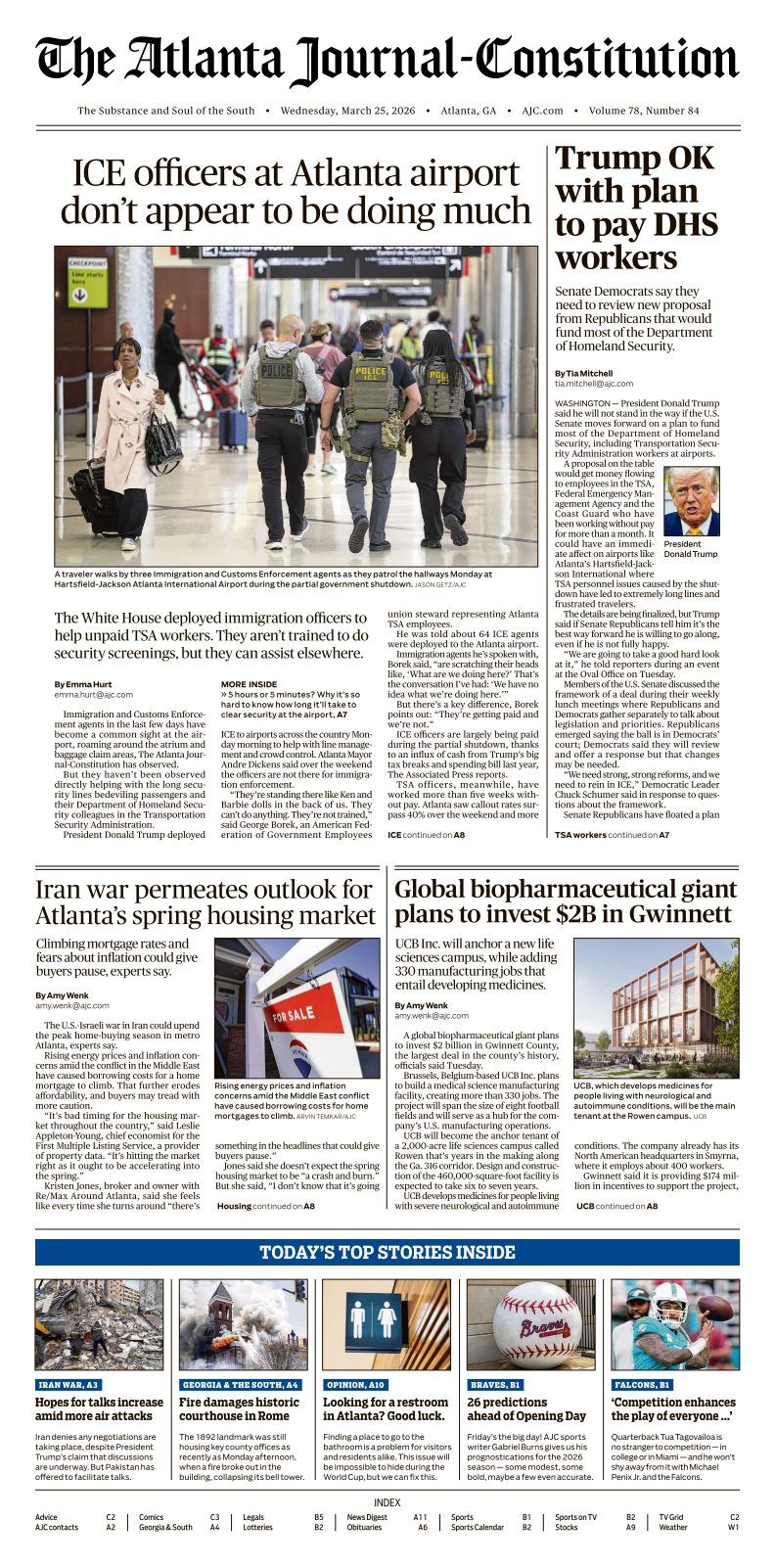
    “Oil supply crunch is spreading from Mideast to the rest of world,” The Wall Street Journal says on Wednesday’s front page. “Trump says Iran is negotiating, as strikes continue,” says the Los Angeles Times. “Trump claims conflict is won,” The Washington Post says. “Saudi prince said to urge U.S. to continue Iran war,” The New York Times says. “Israel says war isn’t ending even as Trump touts peace talks,” The Sacramento Bee says. “Ex-defense secretary: No good Iran options,” says the Austin American-Statesman. “Pressure building at airport impasse,” says USA Today. “Airport disruptions abound,” The Dallas Morning News says. “ICE officers at Atlanta airport don’t appear to be doing much,” says The Atlanta Journal-Constitution. “Plan to end airport chaos emerges,” the Chicago Tribune says.

    ► See the newspaper front pages


    Tall tale

    Worth the wait

    Jim Rush and his son Jimmy finally claimed a complimentary meal after three decades of waiting. A sign in Wintzell’s Oyster House in Mobile, Alabama, promises: “Free oysters to any man 80 years old accompanied by his father.” “We’ve been talking about it for 30 years,” Jimmy’s 77-year-old brother, Carl, told The Washington Post. Jimmy celebrated his 80th birthday on Feb. 23, and he and his 99-year-old dad drove an hour to collect their dozen free oysters. The Rush family paid for the food for their 60 guests.


    Morning Report was written and edited by Nadia Croes, Catherine Garcia, Scott Hocker, Anya Jaremko-Greenwold, Justin Klawans, Rafi Schwartz, Peter Weber and Kari Wilkin, with illustrations by Stephen Kelly and Julia Wytrazek.

    Image credits, from top: Jim Weber / Santa Fe New Mexican via AP, Pool; Octavio Jones / AFP via Getty Images; Gregg Newton / AFP via Getty Images; Illustration by Julia Wytrazek / Getty Images
     

    Recent editions

    • Evening Review

      Iran war triggers energy crisis

    • Morning Report

      Trump’s uncertain Iran offramp negotiations

    • Evening Review

      AI warfare in Iran

    VIEW ALL
    TheWeek
    • About Us
    • Contact Future's experts
    • Terms and Conditions
    • Privacy Policy
    • Cookie Policy
    • Advertise With Us
    • FAQ
    Add as a preferred source on Google Add as a preferred source on Google

    The Week is part of Future US Inc, an international media group and leading digital publisher. Visit our corporate site.

    © Future US, Inc. Full 7th Floor, 130 West 42nd Street, New York, NY 10036.