The Week The Week
flag of US
US
flag of UK
UK
https://cdn.mos.cms.futurecdn.net/flexiimages/jacafc5zvs1692883516.jpg

SUBSCRIBE & SAVE

Less than $3 per week

Sign in
  • View Profile
  • Sign out
  • The Explainer
  • The Week Recommends
  • Newsletters
  • Cartoons
  • From the Magazine
  • The Week Junior
  • Student Offers
  • More
    • Politics
    • World News
    • Business
    • Health
    • Science
    • Food & Drink
    • Travel
    • Culture
    • History
    • Personal Finance
    • Puzzles
    • Photos
    • The Blend
    • All Categories
  • Newsletter sign up Newsletter
  • Brand Logo
    DHS reopening, Iran war deadline and MAHA’s mixed day

     
    TODAY’S NATIONAL story

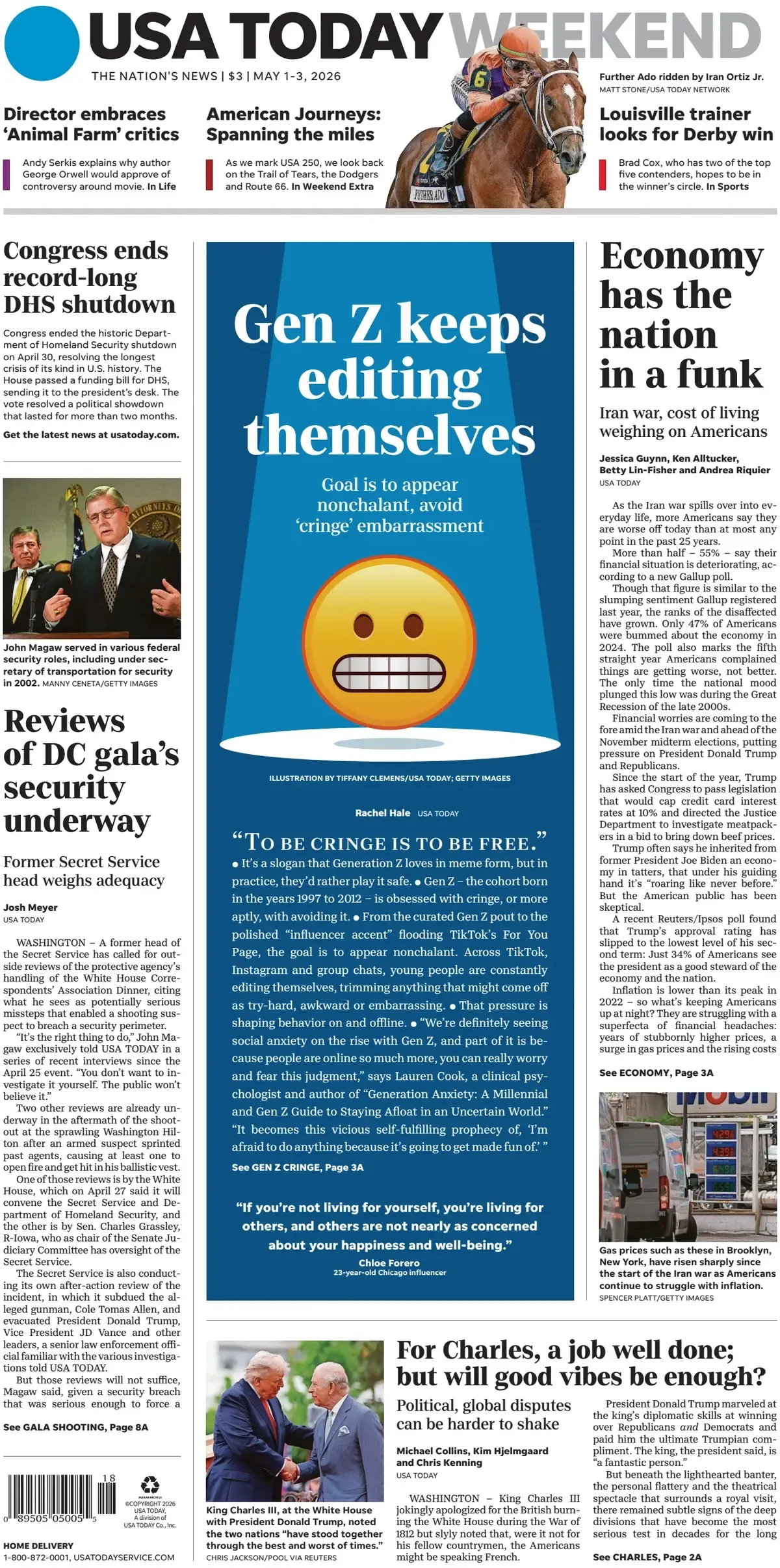
    DHS shutdown ends after 76 days, GOP climbdown

    What happened
    The House yesterday passed a Senate bill funding all of the Department of Homeland Security except for its immigration enforcement arms, and President Donald Trump signed it, ending the longest-ever partial government shutdown after 76 days. DHS agencies including the Coast Guard, Secret Service, FEMA and TSA are now funded through September. ICE and Customs and Border Protection never lost funding thanks to the GOP’s 2025 megabill. 

    Who said what
    After weeks of delay and GOP infighting, the House “unanimously” approved the DHS bill “through voice vote with little fanfare,” suggesting Republicans were “finally ready to put the impasse behind them,” CBS News said. After Democrats refused to fund ICE and CBP without new guardrails, GOP leaders agreed to finance the rest of DHS and separately give Trump $70 billion for deportation operations through a filibuster-proof GOP-only reconciliation bill.

    If the House had “waited for the Senate to pass a reconciliation bill, as some GOP lawmakers insisted, it would have left DHS closed until mid-May,” Axios said. House Speaker Mike Johnson (R-La.) had been facing a “growing revolt from centrists in his party,” CNN said, and his “major retreat” on holding out for ICE funding was a “major win for Democrats.”

    What next?
    After lawmakers “return in mid-May,” The New York Times said, Republicans will “try to meet the president’s June 1 deadline” to get their $70 billion ICE-CBP bill to his desk. 


    TODAY’S IRAN WAR story

    White House claims Iran war ‘terminated’

    What happened
    The White House yesterday argued that the War Powers Act deadline to either wind down the Iran war or get congressional authorization is not today, as Congress assumed, because the 60-day clock stopped when President Donald Trump ordered a ceasefire on April 7. “For War Powers Resolution purposes,” an official told reporters, the hostilities “have terminated.” 

    Who said what
    “We are in a ceasefire right now, which our understanding means the 60-day clock pauses or stops,” Defense Secretary Pete Hegseth said in a Senate hearing yesterday. His assertion “met with outrage from Democrats and skepticism from Republicans,” The Wall Street Journal said. “The U.S. military continues to enforce a military blockade,” which is “considered an act of war under international law.” 

    “Nothing in the text or design of the War Powers Resolution suggests that the 60-day clock can be paused or terminated,” said Katherine Yon Ebright, a war powers expert at the Brennan Center, to The Associated Press, and Congress needs to push back against this “sizeable extension of previous legal gamesmanship” over the law.

    What next?
    In yesterday’s hearing, ostensibly about the Pentagon’s $1.45 trillion budget request, Hegseth “did not say how long the war with Iran could continue,” The New York Times said. But he repeatedly "accused lawmakers of prematurely declaring the war a failure.” 


    TODAY’S PUBLIC HEALTH Story

    Trump pulls surgeon general pick, vexing MAHA

    What happened
    President Donald Trump yesterday tapped radiologist Dr. Nicole Saphier to be U.S. surgeon general, withdrawing the stalled nomination of nutrition influencer Dr. Casey Means, an ally of Health Secretary Robert Kennedy Jr. and the Make America Healthy Again movement. Saphier (pictured above) is Trump’s third nominee, after Means and Dr. Janette Nesheiwat.

    Who said what
    The “MAHA movement had pushed hard for Means’ nomination,” The Washington Post said, and it blamed its failure on Sen. Bill Cassidy (R-La.) and two other Republican senators skeptical of her qualifications and stance on vaccines.

    Trump yesterday called Saphier, a former Fox News contributor, an “INCREDIBLE COMMUNICATOR” on “complicated health issues.” Kennedy called her a “longtime warrior for the MAHA movement.” But unlike Means, Saphier “does not appear to be a heroine” of MAHA, The New York Times said. The movement’s “leaders view her as too conventional” for her tempered praise of vaccines and criticism of Kennedy, though she’s “also embraced” some of f his agenda, including “flexible” immunization schedules.

    What next?
    Even as MAHA lost its “favored influencer for surgeon general,” it “notched a big win on pesticide regulation” in a House farm bill, Axios said. Yesterday’s events highlighted how MAHA retains “clout on matters related to the food supply” but “can be a political liability” on “vaccines and other public health matters.”


    It’s not all bad

    A Polish influencer raised $67 million for cancer research during a nine-day livestream. The 23-year-old, who goes by the name Latwogang, was joined by Polish musicians, actors and athletes, including speed skater Vladimir Semirunniy, who donated his silver Olympic medal to the cause. The initial goal was to raise $137,000 for the Cancer Fighters charity.


    Under the radar

    ‘Freedom Trucks’ deliver AI-washed history

    Ahead of the nation’s 250th anniversary in July, six mobile museums are crisscrossing the U.S. to showcase the country’s history. But these “Freedom Trucks,” funded by the right-wing nonprofit PragerU, heavily feature artificial intelligence. And critics say they present a whitewashed version of the past.

    The “traveling exhibition of touchscreen displays” and “Revolutionary War artifacts” is designed to teach children about America’s founding, said The New Yorker. The trucks, which “received a $14 million grant from the federal Institute of Museum and Library Services,” feature AI-generated displays of early figures in colonial America, including George Washington, Betsy Ross and the Marquis de Lafayette. Each AI video includes a clip of President Donald Trump.

    “Several Black luminaries are mentioned” in the trucks, among them Frederick Douglass, Martin Luther King Jr. and Rosa Parks, said The Guardian. But the majority of the exhibits are geared “toward the white men who led the charge to nationhood.” Christianity also features heavily in the displays. The AI-generated Washington proclaims that “our rights are a gift from God,” and a nearby placard states: “The foundational principles of America are rooted in the Western and Judeo-Christian traditions.” 

    At the same time, many dark moments in U.S. history are apparently downplayed. Slavery is “presented as a sort of wrinkle in America’s perfect design that was ironed out in time,” said The Guardian, and Native Americans are barely covered. The trucks are a “work of propaganda that promises to tell only one side of American history,” said Book Riot.


    On this day

    May 1, 1971

    Amtrak officially began operations, six months after Congress authorized the consolidation of private U.S. intercity trains into a national passenger rail network. On its first day, Amtrak ran 184 trains compiled from the best equipment of the acquired railroads. The last of these “Heritage Fleet” train cars was retired in 2019.


    TODAY’S newspaperS

    ‘Gas pains’

    Gov. Janet Mills “pulls out of Senate race in Maine,” The Boston Globe says on Friday’s front page. “Popular area pastor enters Kansas Senate race as Democrat,” The Kansas City Star says. “Oil hits four-year high amid volatility,” The Minnesota Star Tribune says. “Trump: Blockade may last months,” the Detroit Free Press says. “Ohio gas prices spike again,” The Columbus Dispatch says. “Gas pains,” says the Chicago Sun-Times. “Economy has the nation in a funk,” USA Today says. “National debt now tops 100% of GDP,” The Wall Street Journal says. “Public rejects Trump’s ballroom,” The Washington Post says. “Iran war gives recycled plastics surprise boost,” says the Los Angeles Times. 

    ► See the newspaper front pages


    Tall tale

    Ghost in the machine

    A widow in Washington state surprised mourners at her husband’s memorial service by having a life-sized hologram of him participate in his own funeral. Pam Cronrath had promised Bill she would budget $2,000 for his “super wake” but ended up spending “at least 10 to 15 times” that, she told the BBC. She wrote Bill’s speech and a company created the hologram from old recordings. “People were aghast” when the hologram appeared, Cronrath said. “Some genuinely couldn’t understand how it was happening.”


    Morning Report was written and edited by Nadia Croes, Catherine Garcia, Scott Hocker, Anya Jaremko-Greenwold, Justin Klawans, Rafi Schwartz, Peter Weber and Kari Wilkin, with illustrations by Stephen Kelly and Julia Wytrazek.

    Image credits, from top: Scott Olson / Getty Images; Graeme Sloan / Roy Rochlin / Getty Images; Celal Gunes / Anadolu / Getty Images
     

    Recent editions

    • Evening Review

      Tech backlash in schools

    • Morning Report

      Supreme Court curbs Black voting power

    • Evening Review

      FIFA is floundering

    VIEW ALL
    TheWeek
    • About Us
    • Contact Future's experts
    • Terms and Conditions
    • Privacy Policy
    • Cookie Policy
    • Advertise With Us
    • FAQ
    Add as a preferred source on Google Add as a preferred source on Google

    The Week is part of Future US Inc, an international media group and leading digital publisher. Visit our corporate site.

    © Future US, Inc. Full 7th Floor, 130 West 42nd Street, New York, NY 10036.