The Week The Week
flag of US
US
flag of UK
UK
https://cdn.mos.cms.futurecdn.net/flexiimages/jacafc5zvs1692883516.jpg

SUBSCRIBE & SAVE

Less than $3 per week

Sign in
  • View Profile
  • Sign out
  • The Explainer
  • The Week Recommends
  • Newsletters
  • Cartoons
  • From the Magazine
  • The Week Junior
  • Student Offers
  • More
    • Politics
    • World News
    • Business
    • Health
    • Science
    • Food & Drink
    • Travel
    • Culture
    • History
    • Personal Finance
    • Puzzles
    • Photos
    • The Blend
    • All Categories
  • Newsletter sign up Newsletter
  • Brand Logo
    Iran deal, Swiss referendum and Trump birthday bash

     
    TODAY’S IRAN WAR story

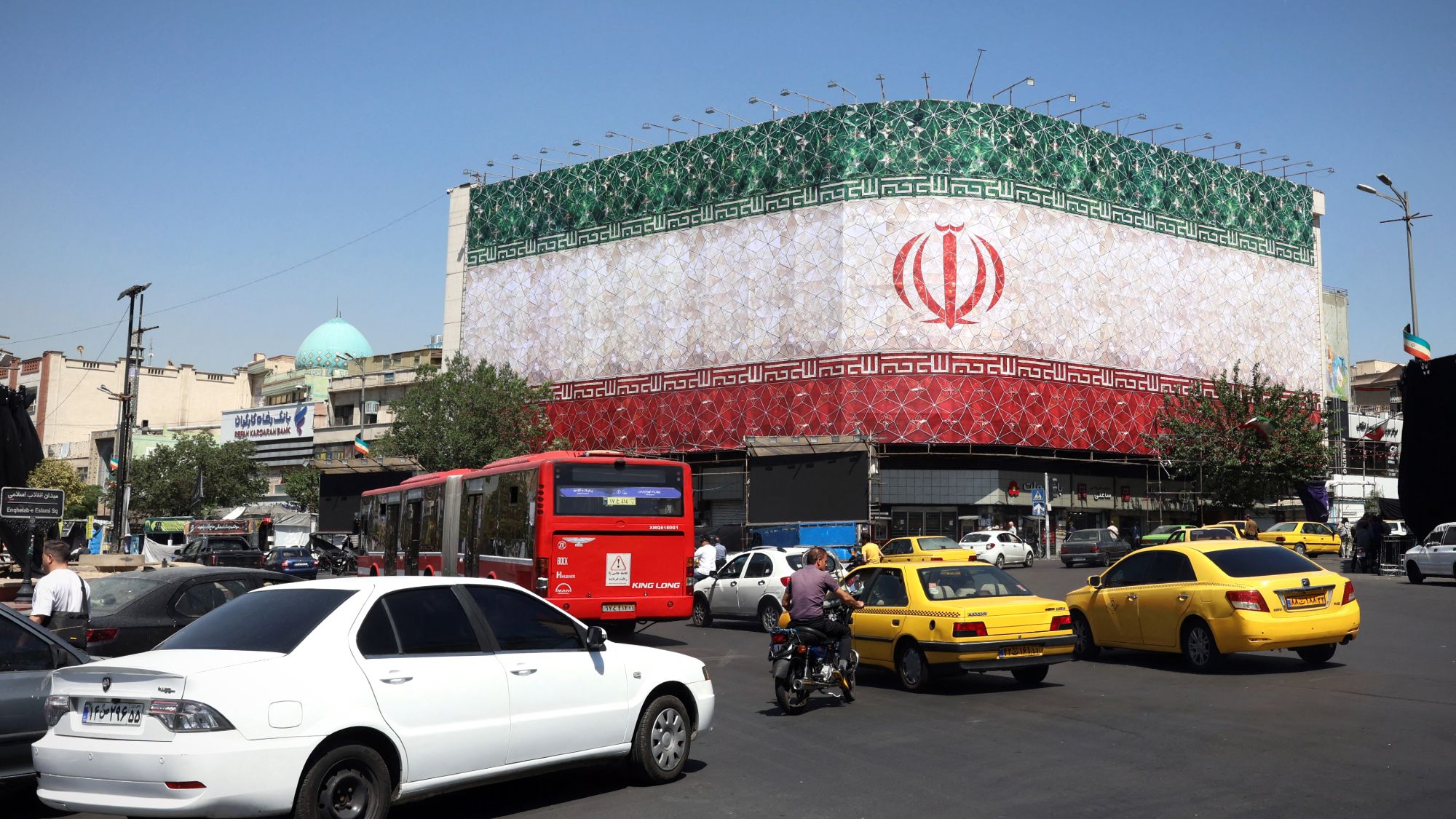
    US and Iran announce interim peace deal

    What happened
    President Donald Trump and Iran yesterday said they had reached a preliminary deal to end hostilities and reopen the Strait of Hormuz. Neither side released the text of their memorandum of understanding, but it was slated to go into effect on Friday after a signing ceremony in Geneva and last for 60 days. During that period, Iran and the U.S. would negotiate Iran’s nuclear status and U.S. and global sanctions on Tehran. 

    Who said what
    The “Deal” with Iran “is now complete,” Trump said on social media. “Ships of the World, start your engines. Let the oil flow!” He later said implementation was pushed back to Friday “for purposes of mine removal.” 

    The U.S. and Iran “offered conflicting accounts” of what happens after the deal is signed, CNN said. Iran’s deputy foreign minister said negotiations would begin when the U.S. releases billions in frozen funds, a claim rejected by U.S. officials. Trump told The New York Times yesterday the agreement would assure that the Strait of Hormuz was “permanently toll-free” and that Iran “cannot develop or purchase a nuclear weapon.” In both cases, the Times said, Trump “appeared to be celebrating” a “return of the prewar status quo” or “Iranian concessions that the country has not yet made.”

    What next?
    The interim deal, if signed, “likely returns the region to a status that existed before the war, but with Iran having proven its ability to disrupt shipping in the strait,” The Associated Press said. Solving the Iranian nuclear impasse in 60 days is also “a tall order,” Axios said, “given how difficult it was to reach the much less detailed memorandum of understanding.”


    TODAY’S EUROPE story

    Swiss voters reject capping population size

    What happened
    Swiss voters yesterday rejected a referendum that would have capped the country’s population at 10 million by limiting migration. The initiative, proposed by the right-wing Swiss People’s Party, lost 55% to 45%, with 59% of voters participating. About 30% of Switzerland’s 9.1 million residents are foreign-born. 

    Who said what
    Immigration “has long been a sensitive issue in Europe, as nations grapple with an aging population and increasing anti-foreigner sentiment,” The Associated Press said. But unlike in other European countries, “most foreigners in Switzerland are Europeans.” The Swiss People’s Party “favors limits on migration,” The New York Times said, but it “broadened the measure’s appeal by focusing on kitchen-table issues like housing costs and traffic congestion” to try and “appeal to centrist voters who otherwise view immigration positively.”

    The referendum “was closely watched in Brussels,” Politico said. “A ‘yes’ vote would have set Switzerland on a collision course” with the European Union, jeopardizing their free-movement and trade agreements.

    What next?
    Polls had “suggested a tight race,” the Times said, and the “final margin appeared larger than most analysts had expected.” Still, the referendum’s “relatively narrow margin” will “heap pressure on the government to take more concerted action to address the public backlash to immigration,” Politico said. 


    TODAY’S WHITE HOUSE Story

    Trump hosts birthday cage match at White House

    What happened
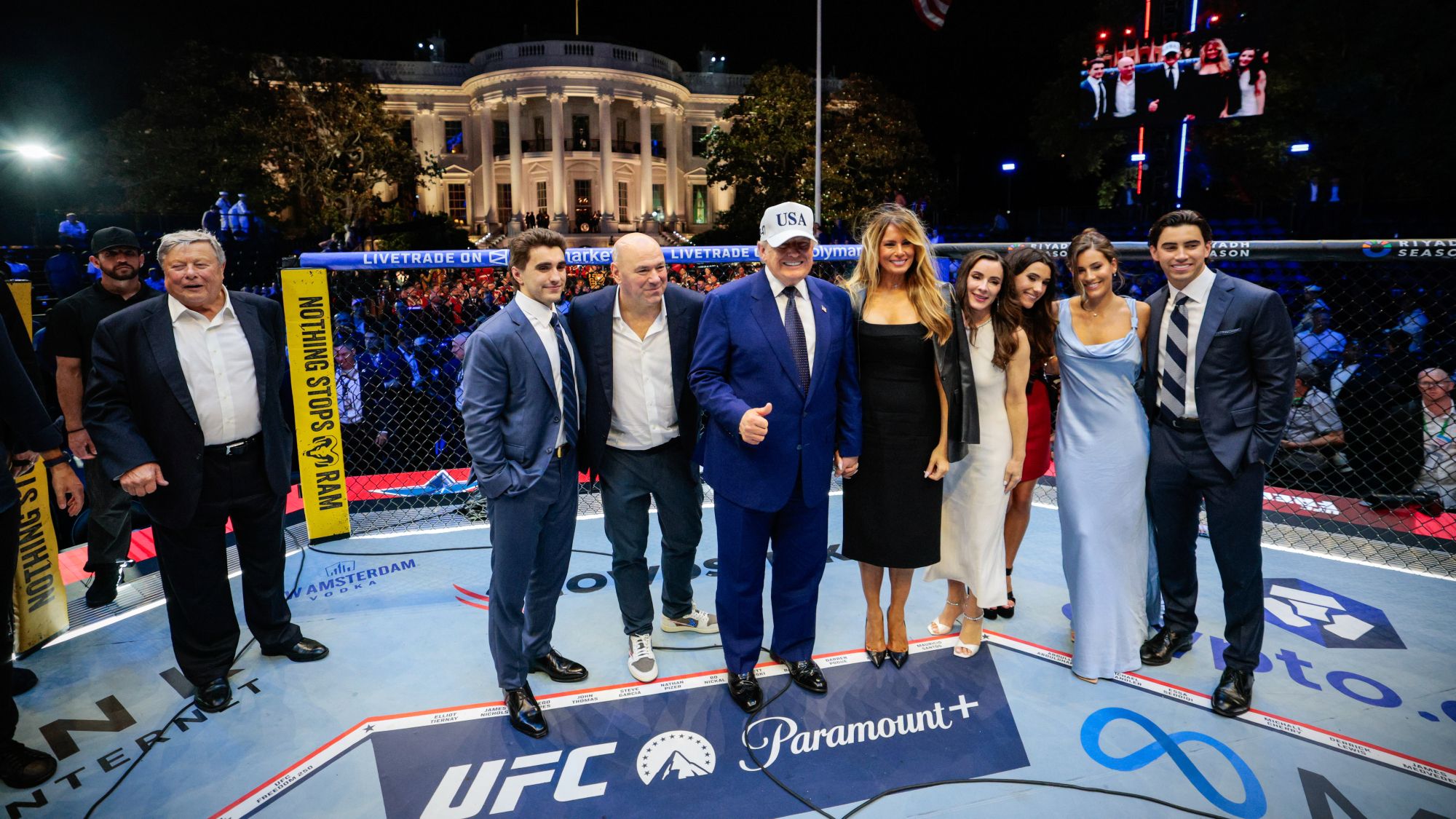
    President Donald Trump celebrated his birthday last night by hosting a UFC mixed martial arts cage match on the South Lawn of the White House. Trump began the spectacle by watching a military flyover from the Blue Room Balcony with his friend UFC chief Dana White, and ended it by watching fireworks from inside the blood-splattered cage.

    Who said what
    Using the White House lawn “for a violent sporting event sponsored by light beer and cryptocurrencies was overwhelmingly unpopular, garnering the support of just 31% of Republicans and 11% of independents in a Reuters-Ipsos poll,” The Washington Post said. But the crowd, which included at least nine Cabinet secretaries, “reveled in the unabashed masculinity of the scene,” The Wall Street Journal said, “cheering on fighters as they bloodied each other’s faces.” 

    What next?
    Secretary of State Marco Rubio described the fights as a “gift to the American people.” But it was “streamed exclusively on Paramount+,” a subscription service whose "owners have close ties to Trump," the Journal said. And despite Trump’s effort to "tie the fights to larger celebrations” of America’s 250th anniversary, The Associated Press said, the event “was so geared toward himself” that fellow G7 leaders “pushed back their get-together” so he “could attend his cage-match party and then fly to Europe” overnight.


    It’s not all bad

    Chinese researchers were astonished to find “strange” undersea animals, “many believed to be new to science,” living off of millions of carcasses in a massive whale graveyard in the Indian Ocean, said CBS News. The discovery of the thriving communities of crustaceans, mollusks and bone-eating worms support the hypothesis that whale graveyards “act as evolutionary hot spots,” the researchers reported in the journal Nature. These dynamic ecosystems give scientists a new insight into what’s happening on the dark ocean floor.


    Under the radar

    FDA green-lights first new sunscreen in 20 years

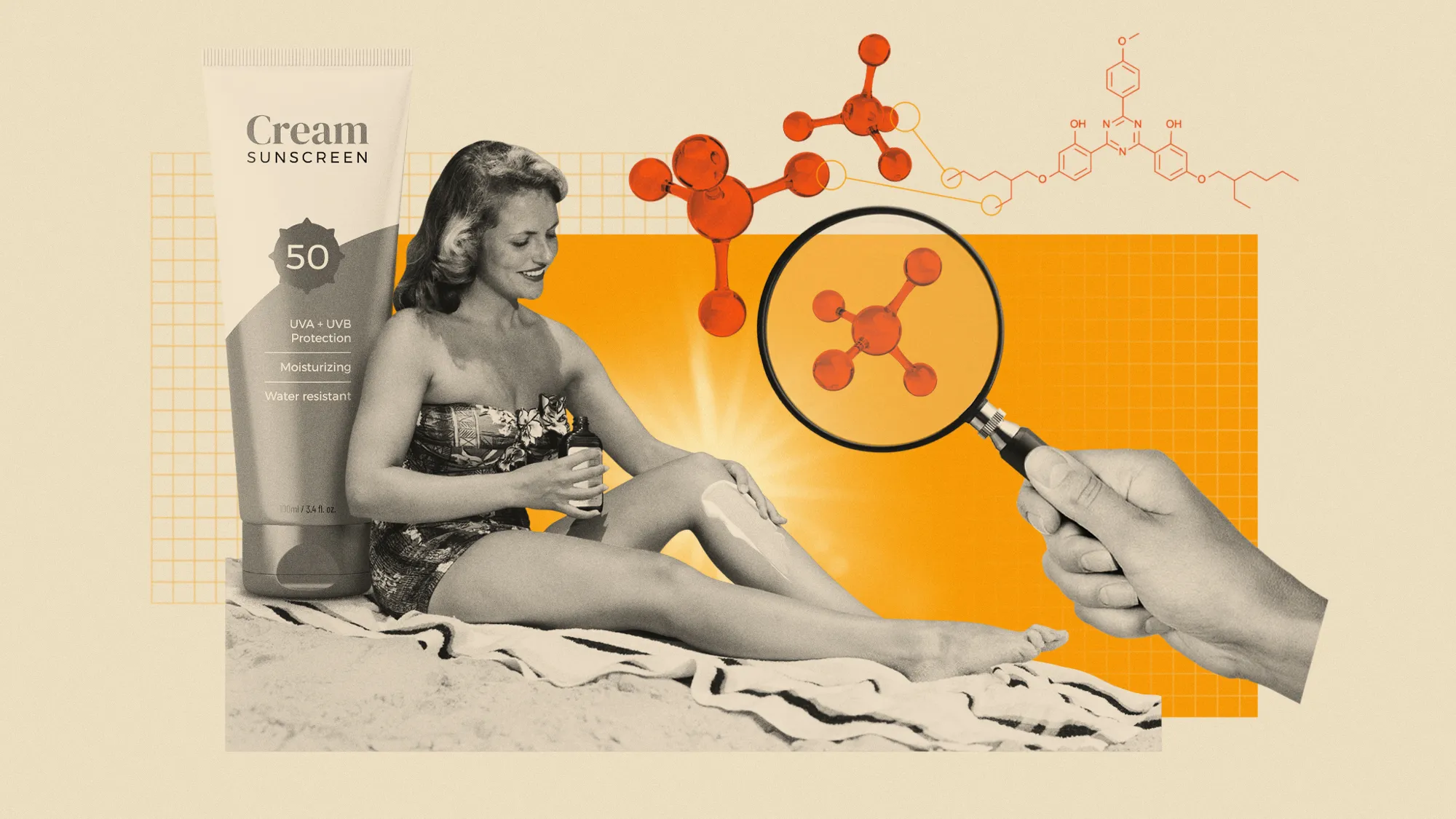
    The Food and Drug Administration has approved the use of bemotrizinol (BEMT) in U.S. over-the-counter sunscreens. The broad-spectrum UV filter chemical has been popularly used in European and Asian brands of sunblock for decades and offers benefits other sunscreen ingredients don’t. 

    “For too long, American consumers have been applying sunscreen and believing they were fully protected,” said Alexa Friedman, a senior scientist at the Environmental Working Group, in a statement. Efforts to approve new sunscreen ingredients were “bogged down for decades by the FDA’s bureaucratic system,” said The Associated Press. Bemotrizinol’s approval marks the “first ingredient to go through a streamlined process authorized by Congress in 2020.”

    UVB’s “high-energy radiation” is typically “associated with sunburns and can cause genetic mutations that lead to skin cancer,” said Scientific American. The “longer-wavelength radiation” of UVA rays can “penetrate deeper into the skin than UVB, breaking down the skin’s structure and creating harmful skin‑aging molecules.” 

    While most U.S. sunscreens are effective against UVB radiation, they provide “significantly lower UVA protection,” said a 2021 study in the journal Photodermatology, Photoimmunology & Photomedicine. But BEMT is capable of “protecting against both ultraviolet A and B rays” and without “leaving white streaks” like sunscreens with zinc oxide, said the AP. In addition, BEMT is “highly photostable,” said Yahoo Health, so it “remains effective when exposed to sunlight for extended periods.”

    An anti-sunscreen movement has grown amid an “increasing distrust of the medical establishment,” said The Washington Post. Much of the concern focuses on chemical sunscreens, which get absorbed into the skin. Another benefit of bemotrizinol, said NBC News, is its “low levels of absorption.”


    On this day

    June 15, 1667

    Jean Baptiste-Denys, the personal physician to France’s King Louis XIV, performed the first documented human blood transfusion. The doctor transfused sheep’s blood into an injured 15-year-old boy who later recovered. Today, 16 million components of blood are transfused into patients each year in the U.S., according to the American Red Cross.


    TODAY’S newspaperS

    ‘Trump turns 80’

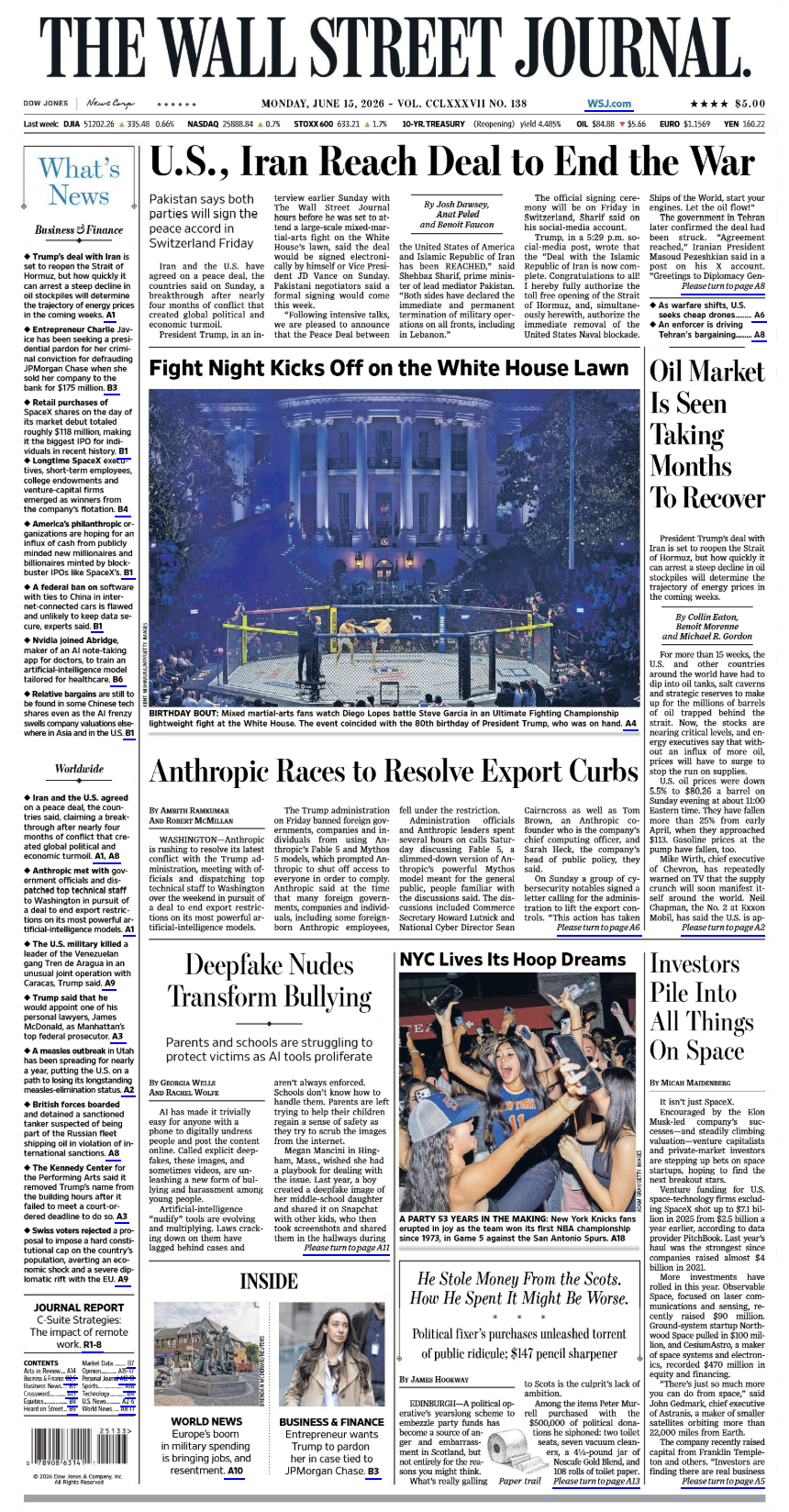
    “Trump says U.S., Iran have a peace deal,” the Los Angeles Times says on Monday’s front page. “Oil market is seen taking months to recover,” The Wall Street Journal says. “Voters are unhappy about much more than gas prices,” The Washington Post says. “As Trump turns 80, scrutiny of his health is hard to avoid,” The New York Times says. “Trump’s legacy hinges on courts,” says USA Today. “Epstein paid Palm Beach deputy to get special treatment in jail, ex-aide alleges,” the Miami Herald says. “New Medicaid work rules create headaches,” The Boston Globe says. New York Knicks’ “win for the ages” in NBA Finals “united the city and gave fans ‘pure joy,’” says the New York Daily News. 

    ► See the newspaper front pages


    Tall tale

    Double jeopardy

    A Florida man was arrested for burglary while en route to court to face a prior burglary charge. Before his hearing, Devon Turner allegedly attempted to break into an RV while a family was inside, said the Cape Coral Police Department. Turner, 34, was wearing leggings and a tank top when arrested and told officers he was trying to find more suitable clothing for his court date. Police said they also found methamphetamine inside his backpack.


    Morning Report was written and edited by Nadia Croes, Catherine Garcia, Scott Hocker, Anya Jaremko-Greenwold, Justin Klawans, Rafi Schwartz, Peter Weber and Kari Wilkin, with illustrations by Stephen Kelly and Julia Wytrazek.

    Image credits, from top: AFP via Getty Images; Stefan Wermuth / AFP via Getty Images; Evan Vucci / Reuters / Bloomberg via Getty Images; Illustration by Stephen P. Kelly / Getty Images
     

    Recent editions

    • Sunday Shortlist

      Spielberg’s sci-fi thriller

    • Saturday Wrap

      The chaos at 60 Minutes

    • Evening Review

      Climate change threatens the World Cup

    VIEW ALL
    TheWeek
    • About Us
    • Contact Future's experts
    • Terms and Conditions
    • Privacy Policy
    • Cookie Policy
    • Advertise With Us
    • FAQ
    Add as a preferred source on Google Add as a preferred source on Google

    The Week is part of Future US Inc, an international media group and leading digital publisher. Visit our corporate site.

    © Future US, Inc. Full 7th Floor, 130 West 42nd Street, New York, NY 10036.