The Week The Week
flag of US
US
flag of UK
UK
https://cdn.mos.cms.futurecdn.net/flexiimages/jacafc5zvs1692883516.jpg

SUBSCRIBE & SAVE

Less than $3 per week

Sign in
  • View Profile
  • Sign out
  • The Explainer
  • The Week Recommends
  • Newsletters
  • Cartoons
  • From the Magazine
  • The Week Junior
  • Student Offers
  • More
    • Politics
    • World News
    • Business
    • Health
    • Science
    • Food & Drink
    • Travel
    • Culture
    • History
    • Personal Finance
    • Puzzles
    • Photos
    • The Blend
    • All Categories
  • Newsletter sign up Newsletter
  • Brand Logo
    Primary battles, Guard costs and Spokane arson charges

     
    TODAY’S ELECTIONS story

    Democratic primaries hand wins to leftist, center factions

    What happened
    The Democratic Party’s moderate and progressive wings each won key primaries in Michigan, Virginia, Missouri, Kansas and Washington state yesterday. But the highest-profile showdown between the two factions, the Senate primary in Michigan between progressive Dr. Abdul El-Sayed and establishment-backed Rep. Haley Stevens, was too close to call this morning.

    Voters in Kansas defeated a Republican ballot measure that would have turned state Supreme Court appointments into partisan races — a “referendum designed to overturn Kansas’ constitutional right to abortion,” Politico said — and Missouri voters overwhelmingly rejected a GOP-led amendment that would have made it harder to pass voter-approved ballot measures. Missouri Secretary of State Denny Hoskins (R) yesterday rejected a citizens’ petition to force a November referendum on the GOP Legislature’s newly redrawn congressional districts.

    Who said what
    The winners in the Democrats’ moderate faction include Rep. Marie Gluesenkamp Perez (Wash.), who fended off a leftist challenger; former Rep. Elaine Luria (Va.) and Richmond-area prosecutor Shannon Taylor, who won swing-district primaries; and Rep. Wesley Bell (Mo.), who prevailed in his rematch against democratic socialist former Rep. Cori Bush. But progressive climate activist William Lawrence won a three-way primary against two moderates in Michigan and will face Rep. Tom Barrett (R) in the fall, “a competitive contest that will test whether left-wing populism is viable in swing districts,” The New York Times said. 

    What next?
    The race between El-Sayed and Stevens is this year’s “most significant test” of how Democratic voters are “weighing questions of ideology and electability,” CNN said. El-Sayed’s thin lead this morning was “much narrower than what the most recent polling had shown” in the must-win race to succeed retiring Sen. Gary Peters (D), the Times said. The victor will face former Rep. Mike Rogers (R).


    TODAY’S MILITARY story

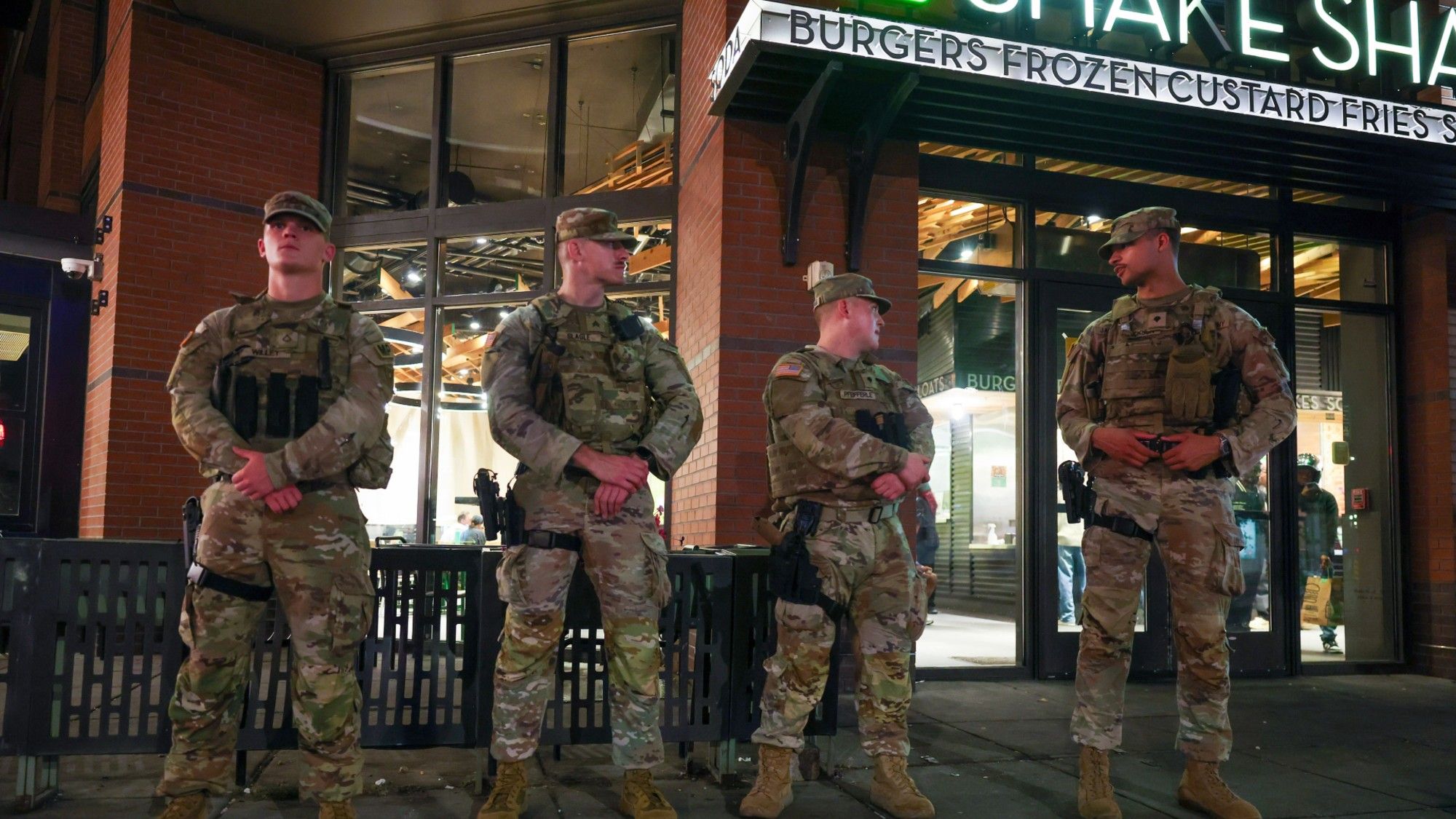
    DC Guard deployment to cost estimated $1.4B extra

    What happened
    President Donald Trump’s National Guard deployment to Washington, D.C., will cost the federal government another $1.4 billion through the end of his term in 2029, according to a Defense Department estimate for Congress obtained by news organizations yesterday. The estimate “offers a glimpse of how much taxpayer money will be spent” on a deployment local officials call an “infringement of their city’s autonomy,” said The Associated Press.

    Who said what
    The White House “has not disclosed the full cost of the mission so far,” The Washington Post said, so the Pentagon’s new figure represents the “most comprehensive accounting yet” of Trump’s “unprecedented use of the military.” In January, the Congressional Budget Office estimated the deployment was costing about $55 million per month, or more than $700 million to date. “The National Guard are not pawns and taxpayer dollars are not a piggy bank for Trump’s political stunts,” Sen. Elizabeth Warren (D-Mass.) said in a statement.

    What next?
    About 4,600 military personnel were stationed in D.C. as of last week, and the new estimate assumes that an average of 2,500 National Guard members will be there for the remainder of Trump’s term. But it’s unclear if governors will “extend their state units for more than two years,” said the AP. Many local governments have “challenged the deployments in court,” said the Post.


    TODAY’S CRIME Story

    Alleged Spokane arsonist questioned on previous fires

    What happened
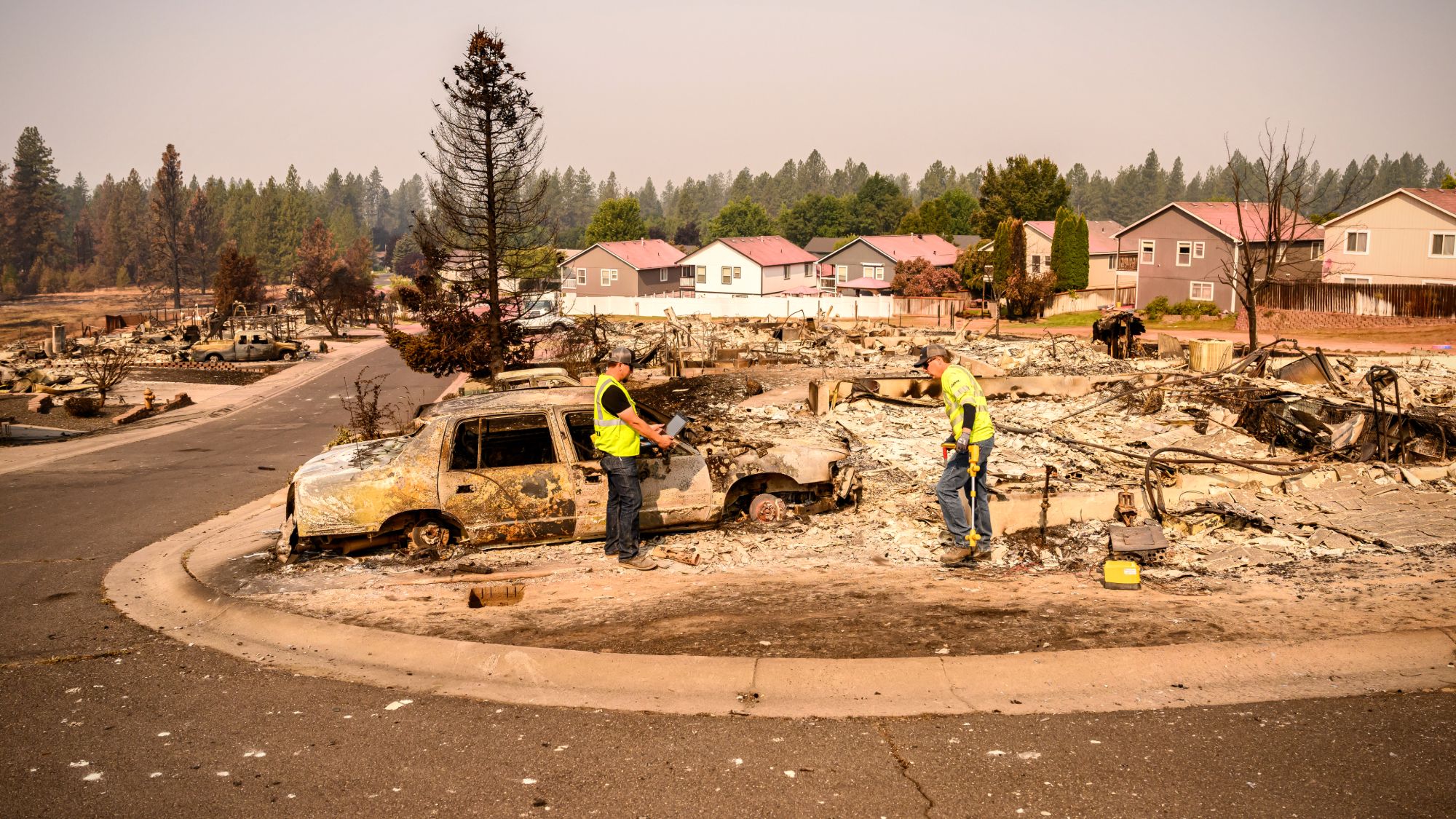
    A Spokane resident charged with first-degree arson for allegedly starting the biggest of three wildfires surrounding Washington’s second-largest city was questioned by police during two fire investigations last year, according to court documents released yesterday. Aaron Farinacci, who was arrested Monday evening and made his first court appearance yesterday, served nearly a decade in prison in Arizona for fatally shooting his father during an argument over washing dishes. Spokane’s three fires, which have destroyed more than 700 buildings, are “ranked as the top firefighting priority in the ​U.S.,” Reuters said.

    Who said what
    Two sheriff’s deputies stopped Farinacci, 37, near the fast-growing Old Trails Fire on Saturday, but they were “unaware” of his “prior fire-related contacts,” The Associated Press said. Spokane County Sheriff John Nowels said Farinacci was carrying waterproof matches, a butane lighter and cigarettes. Nowels credited local resident Paul Child, 64, for noticing and reporting Farinacci’s suspicious behavior at the site where the fire began. When smoke appeared 10-15 minutes after he saw Farinacci bending over the grass and acting nervous, Child told The Spokesman-Review, “my immediate thought was that SOB started a fire.”

    What next?
    Farinacci is expected to enter a plea at his arraignment tomorrow. First-degree arson is punishable by up to life in prison.


    It’s not all bad

    Through Library Dads, Khari Arnold helps fathers in the Atlanta area discover a love of reading with their children. Arnold launched the group after he started taking his young daughter, Aria, on weekly trips to the library. He watched as both her vocabulary and their bond grew, and he began inviting other fathers to join them. The Library Dads has expanded to multiple libraries, where members enjoy storytime and activities while strengthening their relationships with their children and one another.


    Under the radar

    Too much TV linked to a smaller brain volume

    Television might actually be rotting our brains. Frequent TV watching in midlife was associated with reduced volume in the parts of the brain vulnerable to Alzheimer’s disease, according to a study published in Alzheimer’s & Dementia.

    Surprisingly, the brain volume reduction was not tied to sedentary behavior but specifically to watching TV. “People whose jobs involved sitting for much of the day tended to have healthier-looking brains,” said ScienceAlert. And “when the researchers accounted for differences in overall physical activity, that didn’t seem to impact the outcome.”

    The results showed that men were particularly vulnerable to these brain changes. “This could be because men and women accumulate sedentary time differently,” study lead author Natan Feter said to ScienceAlert. “Women may interrupt their sitting more often,” or “biological differences in how the brain responds to prolonged sedentary behavior” may be to blame. In general, women also “tend to prefer TV programming in shorter chunks,” said ScienceAlert. 

    The study “shows an association, not a cause-and-effect relationship” between TV and dementia, Feter said to Healthline. The researchers also “relied on self-reported data for TV consumption, which can be less precise than timed tracking,” said a news release about the study.

    “For years, we’ve focused on how much people sit,” said senior study author David Raichlen. But these findings “suggest we should also pay attention to what they’re doing while they’re sitting.” Working from home, while sedentary, is more “intellectually stimulating” than watching TV, said the release. “We might eventually see a different approach to health guidance” as a result of this research. 


    On this day

    Aug. 5, 1981

    President Ronald Reagan fired more than 11,000 air traffic controllers who were on strike over wages and work hours. Reagan’s decision to sack the striking workers was controversial at the time, and many experts have blamed the mass firings for the air traffic industry shortages and other problems in the following decades.


    TODAY’S newspaperS

    ‘World stops flinching’

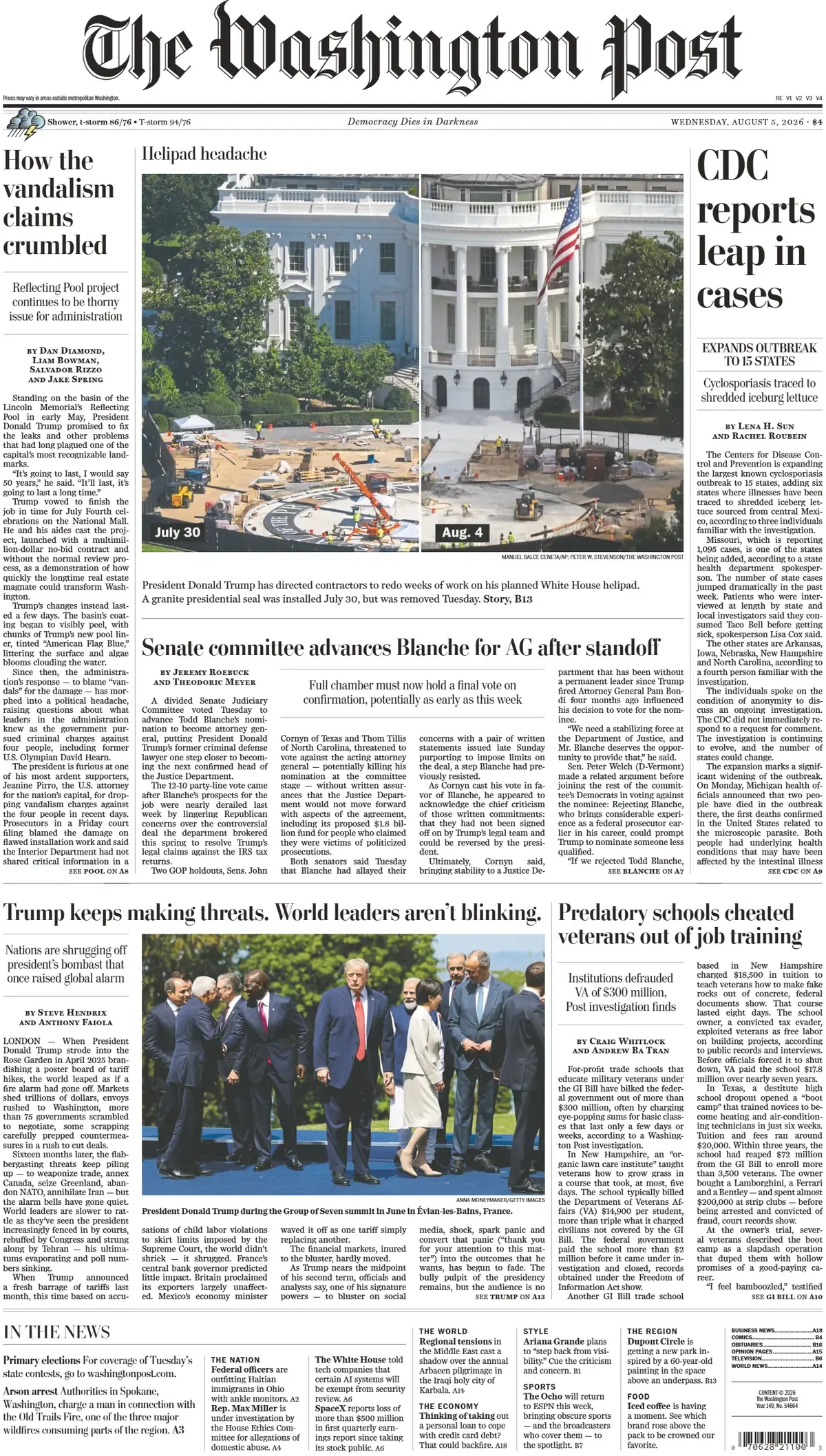
    Todd Blanche’s “nomination for AG clears crucial hurdle after deal” with two GOP senators, the Austin American-Statesman says on Wednesday’s front page. “Tense meeting between Pirro and president” on Reflecting Pool fiasco, The New York Times says. “The vandalism claims crumbled,” the project “continues to be thorny issue for administration,” The Washington Post says. “Iran bets all of its chips on control of Strait,” posing “risk of new escalation with U.S., economic harm,” The Wall Street Journal says. “Trump still makes threats, but world stops flinching,” The Philadelphia Inquirer says. Rep. Max Miller’s (R-Ohio) “seat could flip to Dems” as his “decision to stay in race may hurt GOP,” The Columbus Dispatch says. “Edison tower sparked Eaton fire” in Altadena, says the Los Angeles Times.

    ► See the newspaper front pages


    Tall tale

    Getting away pot-free

    A New Zealand police officer who admitted to throwing away confiscated drugs to avoid paperwork has been allowed to remain on the force. During a 2024 traffic stop, the unidentified cop discovered a large bag filled with what was believed to be cannabis and drug paraphernalia, took it back to the police station and chucked it into a dumpster. An independent tribunal found that prosecutors failed to prove his actions stemmed from malicious motives rather than simple “laziness,” said 1News.


    Morning Report was written and edited by Nadia Croes, Catherine Garcia, Scott Hocker, Anya Jaremko-Greenwold, Justin Klawans, Rafi Schwartz, Peter Weber and Kari Wilkin, with illustrations by Stephen Kelly and Julia Wytrazek.

    Image credits, from top: Sarah Rice / Bloomberg via Getty Images; Tasos Katopodis / Getty Images; Josh Edelson / AFP via Getty Images; Illustration by Stephen P. Kelly / Getty Images / Shutterstock
     

    Recent editions

    • Evening Review

      America’s dwindling missile stockpile

    • Morning Report

      Pirro in trouble with Trump

    • Evening Review

      A merging of two wars?

    VIEW ALL
    TheWeek
    • About Us
    • Contact Future's experts
    • Terms and Conditions
    • Privacy Policy
    • Cookie Policy
    • Advertise With Us
    • FAQ
    Add as a preferred source on Google Add as a preferred source on Google

    The Week is part of Future US Inc, an international media group and leading digital publisher. Visit our corporate site.

    © Future US, Inc. Full 7th Floor, 130 West 42nd Street, New York, NY 10036.