The Week The Week
flag of US
US
flag of UK
UK
https://cdn.mos.cms.futurecdn.net/flexiimages/jacafc5zvs1692883516.jpg

SUBSCRIBE & SAVE

Less than $3 per week

Sign in
  • View Profile
  • Sign out
  • The Explainer
  • The Week Recommends
  • Newsletters
  • Cartoons
  • From the Magazine
  • The Week Junior
  • Student Offers
  • More
    • Politics
    • World News
    • Business
    • Health
    • Science
    • Food & Drink
    • Travel
    • Culture
    • History
    • Personal Finance
    • Puzzles
    • Photos
    • The Blend
    • All Categories
  • Newsletter sign up Newsletter
  • Brand Logo
    Debt milestone, UAE’s Iran embargo and cancer vaccine

     
    TODAY’S ECONOMY story

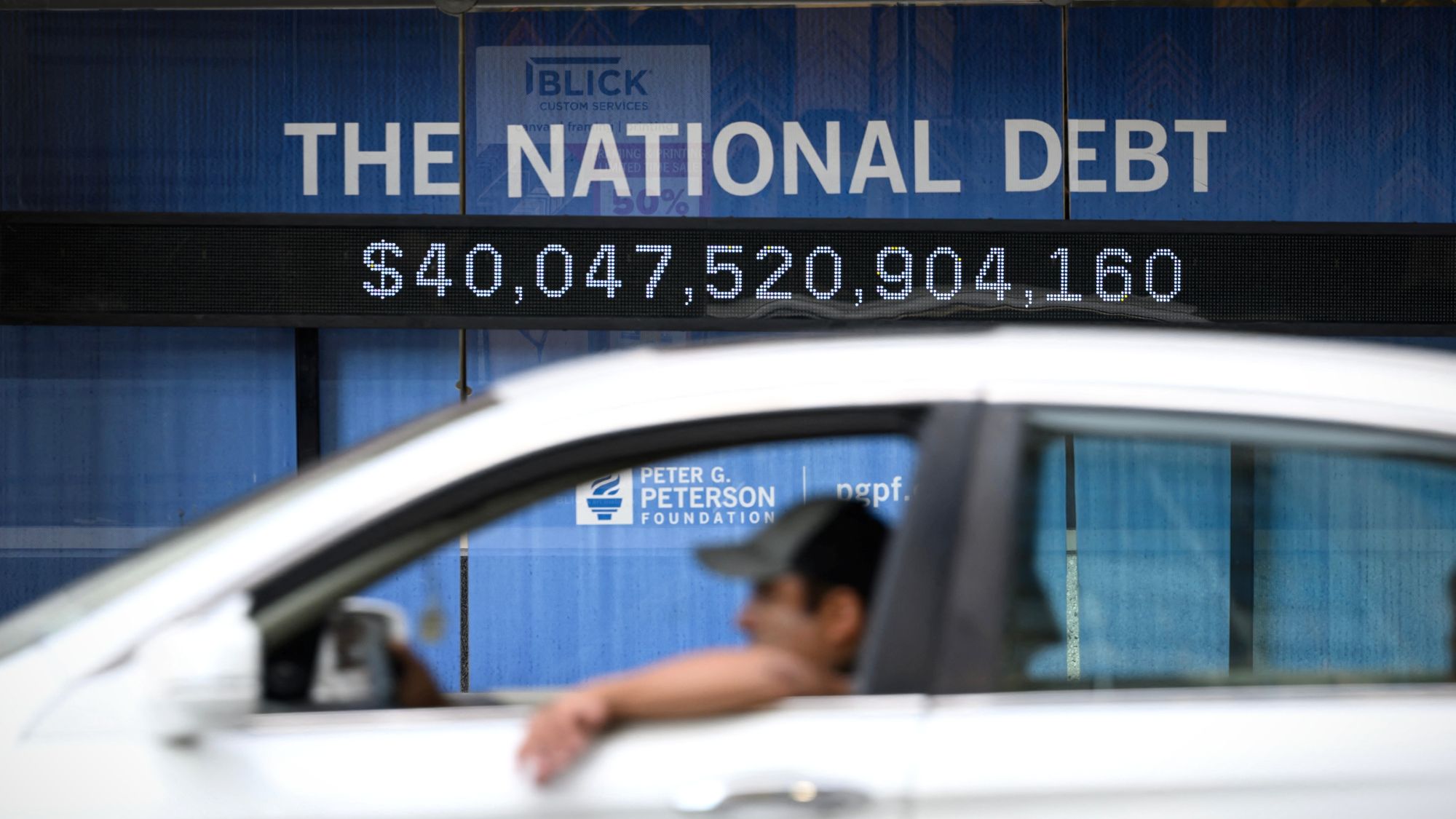
    US national debt tops $40T after doubling in a decade

    What happened
    The U.S. gross national debt yesterday hit $40 trillion for the first time, just five months after reaching $39 trillion. The new debt figure is an “ominous milestone for an economy that sits on a shaky fiscal foundation after decades of borrowing to pay for the rising costs of the military, social safety net programs” and President Donald Trump’s tax cuts, The New York Times said. About $1.1 trillion of the more than $2 trillion the U.S. will borrow this year will go toward “soaring interest payments to investors who have purchased America’s debt.” 

    Who said what
    The “federal government’s IOU has now more than doubled in less than a decade,” from $19.95 trillion when Trump was first sworn in, Reuters said. Much of the added debt funded the Covid-19 response. But Trump, who “branded his second presidency as one focused on cost-cutting,” has “largely ignored the dwindling number of fiscal hawks in his Republican Party,” and his “landmark second-term” tax-and-spending bill “will ​add another $4.7 trillion in debt.” 

    The bipartisan “inability of lawmakers to confront the debt comes with long-term risks,” the Times said. The “best-case scenario” in an “unsustainable” fiscal trajectory, said Margaret Spellings of the Bipartisan Policy Center. “AI disruption, a recession, global war or any number of other events could quickly push us over the edge from a challenge into a full-blown crisis.”

    What next?
    The “exploding debt” is “already affecting Americans’ pocketbooks by raising borrowing costs” and squeezing wages, said The Associated Press. The U.S. is expected to hit the current $41.1 trillion statutory debt limit “sometime between late winter and mid-summer,” forcing Congress to “again vote on whether to raise or suspend it.” 


    TODAY’S IRAN WAR story

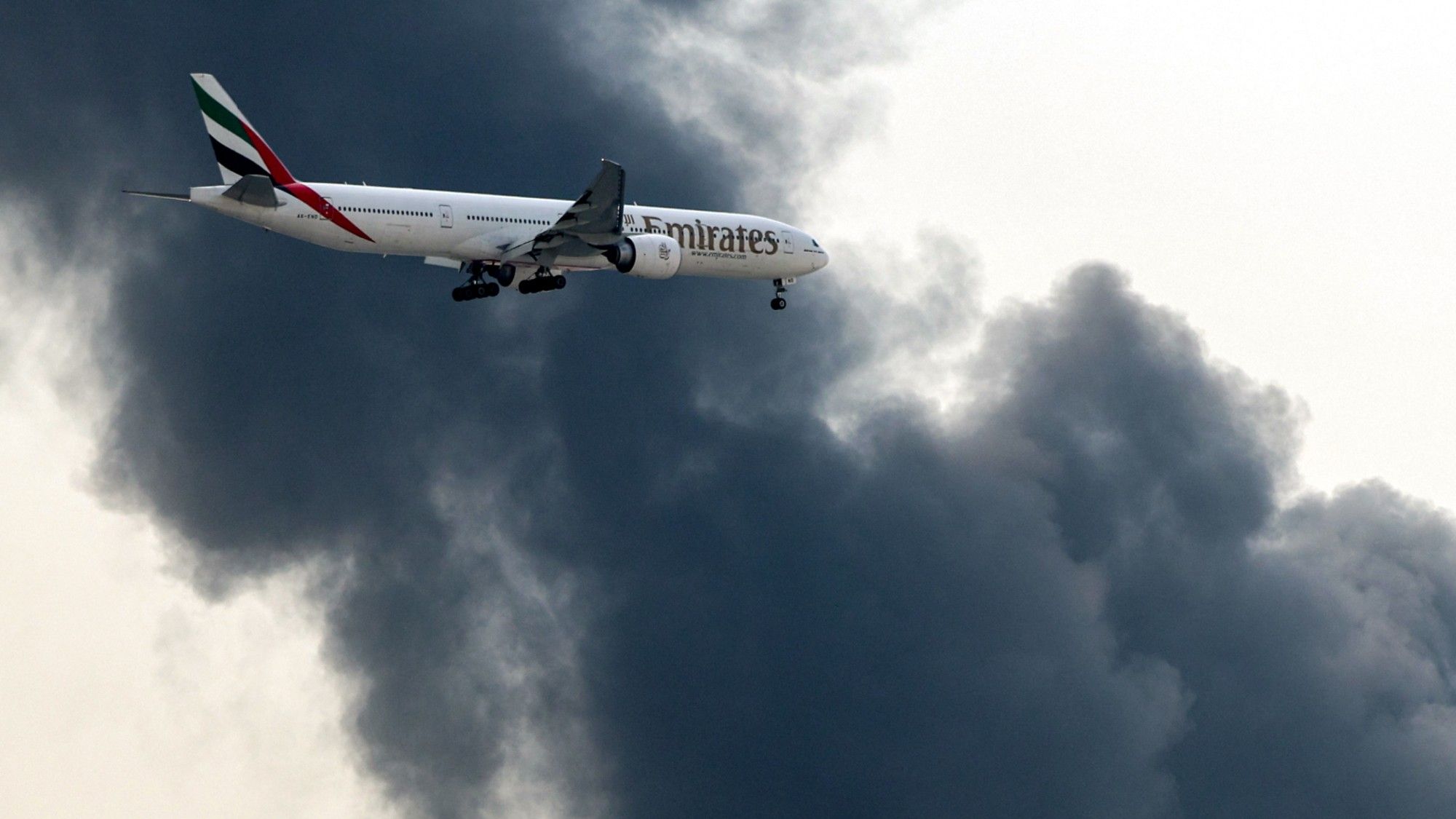
    UAE severs Iran trade amid threats from Tehran, Trump

    What happened
    The United Arab Emirates yesterday said it had halted “all trade, commercial exchanges and financial transactions” with Iran “until future notice” due to “escalations that undermine regional and international peace and security.” Hours earlier, the UAE had accused Tehran of firing two missiles into its territory. Iran’s Foreign Ministry called that accusation “baseless” and possibly a “false flag operation.” 

    Iranian Gen. Ali Abdollahi later warned “countries on the southern shores of the Persian Gulf” that “any assistance” given the U.S. military “amounts to participation” in its war. President Donald Trump last night threatened that “ANY country that allows its financial institutions” or other entities to “provide any type of lifeline to Iran will itself face TREMENDOUS Economic Consequences.”

    Who said what
    The UAE is one of Tehran’s “biggest economic lifelines,” The Wall Street Journal said, and Trump’s “effort to squeeze Iran into submission will depend heavily” on Dubai. It’s unclear if the U.S. “played a role in the embargo decision,” The New York Times said, but it was announced “hours after a call” from Trump to the Emirati leader.

    What next?
    “If implemented broadly,” the UAE’s trade severance could significantly harm Iran’s economy, the Journal said. But “severing those links will be difficult” and “could hurt Dubai’s role as a freewheeling global hub for commerce.” 


    TODAY’S MEDICINE Story

    Moderna, Merck say skin cancer vaccine trial a success

    What happened
    Moderna and Merck yesterday said that a large trial of their experimental mRNA cancer vaccine was successful in reducing recurrence of melanoma and preventing the deadly skin cancer from spreading to other organs. The results “mark the first successful late-stage trial for a personalized mRNA cancer therapy,” The Wall Street Journal said, “validating decades of research” and “paving the way for a potentially new life-extending treatment” for people diagnosed with melanoma and other cancers.

    Who said what
    The ongoing study involves 1,137 high-risk melanoma patients whose cancer was surgically removed and genetically sequenced. The treatment combines Merck’s immunotherapy drug Keytruda with intismeran, a “made-to-order mRNA vaccine” created by analyzing and weaponizing “mutations found in the patients’ own tumors,” CNN said. The companies didn’t detail the results, but an earlier mid-stage trial showed that pairing intismeran with Keytruda reduced the risk of melanoma recurrence or death by 49% versus Keytruda alone. Moderna’s stock closed up 177% yesterday.

    What next?
    Moderna and Merck said they planned to “present the details” of their latest “large, closely watched trial” at an “international medical meeting and to regulators,” The New York Times said. “Investors and researchers will be watching closely to see how effective and tolerable the vaccine proves to be,” the Journal said. 


    It’s not all bad

    In a U.S. first, surgeons in Houston successfully corrected an abdominal birth defect while the fetus was in the womb. Maisie Savage was 20 weeks into her pregnancy when she learned that her son, Theo, had gastroschisis, which causes the intestines to grow outside the body. The Londoner flew to Houston, where doctors used pioneering keyhole surgery techniques to push the intestines back in. Theo, now 5 months old, is the third baby to ever undergo the in utero procedure.


    Under the radar

    Blueberries juice Africa’s fresh produce push

    “For once, the color associated with a boom in Zimbabwe is blue, not gold,” said The Economist. The country’s blueberry industry is thriving. Zimbabwe is exporting 40 times the amount of fruit compared to 10 years ago as part of a wider fresh produce drive across the continent.

    “The success of Zimbabwean blueberries, Kenyan flowers and South African oranges” would suggest there’s “huge potential for African agriculture to play the sort of role long envisioned for manufacturing,” said The Economist. And if Africa can capitalize on such success stories, there will be “fruitful returns.”

    One major reason for the African blueberry boom is improved trade with China. Zimbabwe maintains strong export links to the EU, the U.K. and Malaysia, but China offers a market “capable of absorbing considerably larger volumes,” said Fruitnet. Growing consumer interest in healthy eating has made “premium fresh fruits” much more attractive to Chinese importers.

    New commercial agreements have also strengthened Zimbabwe’s position. China’s zero-tariff policy for 53 African nations, including Zimbabwe, took effect at the start of May. And the first arrival of blueberries into China represented “far more than a symbolic shipment,” said Fruitnet. It marked the “opening of a potentially significant new trade channel” for the industry.

    “African agribusinesses have responded to rising global incomes and the demand for fresh produce” with more than just blueberries, said The Economist. But a wider emphasis on fresh fruit could be a “boon for Africa” and “force a rethink of what’s meant by farming and manufacturing.”


    On this day

    August 20, 2012

    Indie film studio A24 was launched in New York City. Within a few years, A24 had grown into a powerhouse studio, attracting Hollywood stars and producing numerous award-winning films. In 2022 alone, the studio released “Everything Everywhere All at Once” (seven Oscars, including Best Picture) and “The Whale” (two Oscars).


    TODAY’S newspaperS

    ‘War and tax cuts’

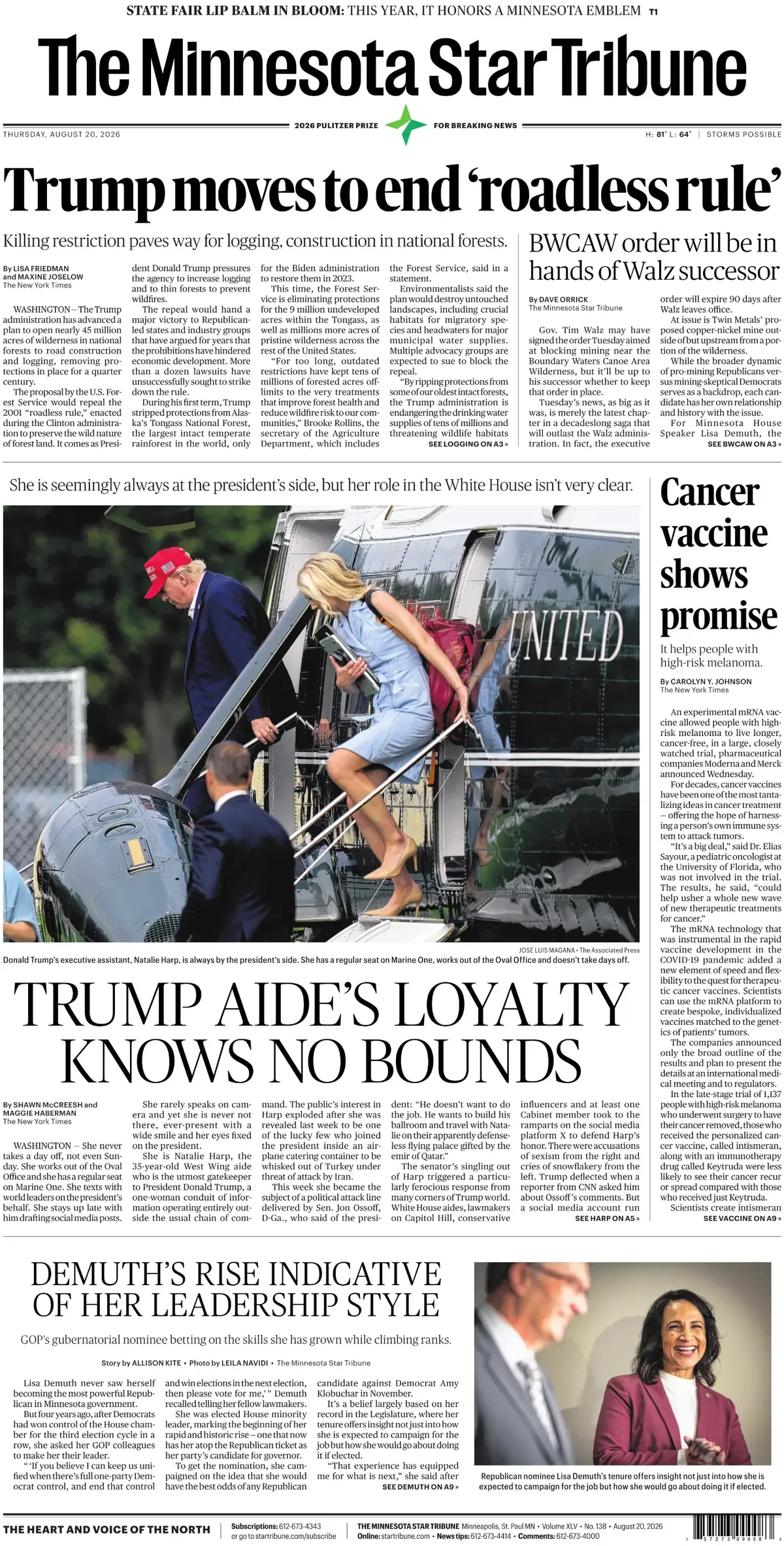
    “U.S. debt eclipses $40 trillion,” a “share of GDP” nearing “levels not seen since World War II,” The Wall Street Journal says on Thursday’s front page. “War and tax cuts power sprint to milestone,” The New York Times says. “Trump’s ballroom is rising at a breakneck speed,” The Philadelphia Inquirer says. “Billions approved for Dulles revamp,” says The Washington Post. “Trump expects to meet with North Korea’s Kim” as “U.S., South Korea cut duration of military drills,” says the Arizona Republic. Trump aide Natalie Harp’s “loyalty knows no bounds,” The Minnesota Star Tribune says, “but her role in the White House isn’t very clear.” 

    ► See the newspaper front pages


    Tall tale

    Weapons of brass destruction

    Tuba players and trombonists could soon pay more for their instruments, as the Trump administration proposes adding brass-wind devices to its national security tariffs list. The Commerce Department’s Bureau of Industry and Security asserts that the U.S. is too reliant on foreign metal production, potentially threatening supplies in a national emergency. This logic is “nonsense,” said Reason. “A tuba is not a semiconductor,” and there’s “no indication that the military is running low on bugles.”


    Morning Report was written and edited by Will Barker, Nadia Croes, Catherine Garcia, Scott Hocker, Anya Jaremko-Greenwold, Justin Klawans, Rafi Schwartz, Peter Weber and Kari Wilkin, with illustrations by Stephen Kelly and Julia Wytrazek.

    Image credits, from top: Mandel Ngan / AFP via Getty Images; AFP via Getty Images; Adam Glanzman / Bloomberg via Getty Images; Illustration by Julia Wytrazek / Getty Images
     

    Recent editions

    • Evening Review

      The desertification fight

    • Morning Report

      Trump’s hit-and-miss primary night

    • Evening Review

      Will Paramount leave Hollywood?

    VIEW ALL
    TheWeek
    • About Us
    • Contact Future's experts
    • Terms and Conditions
    • Privacy Policy
    • Cookie Policy
    • Advertise With Us
    • FAQ
    Add as a preferred source on Google Add as a preferred source on Google

    The Week is part of Future US Inc, an international media group and leading digital publisher. Visit our corporate site.

    © Future US, Inc. Full 7th Floor, 130 West 42nd Street, New York, NY 10036.