The Week The Week
flag of US
US
flag of UK
UK
https://cdn.mos.cms.futurecdn.net/flexiimages/jacafc5zvs1692883516.jpg

SUBSCRIBE & SAVE

Less than $3 per week

Sign in
  • View Profile
  • Sign out
  • The Explainer
  • The Week Recommends
  • Newsletters
  • Cartoons
  • From the Magazine
  • The Week Junior
  • Student Offers
  • More
    • Politics
    • World News
    • Business
    • Health
    • Science
    • Food & Drink
    • Travel
    • Culture
    • History
    • Personal Finance
    • Puzzles
    • Photos
    • The Blend
    • All Categories
  • Newsletter sign up Newsletter
  • Brand Logo
    Canada trade war, Kushner outreach and humanoid world records

     
    TODAY’S TRADE story

    Trump’s Canada tariffs take force, firing up trade war

    What happened
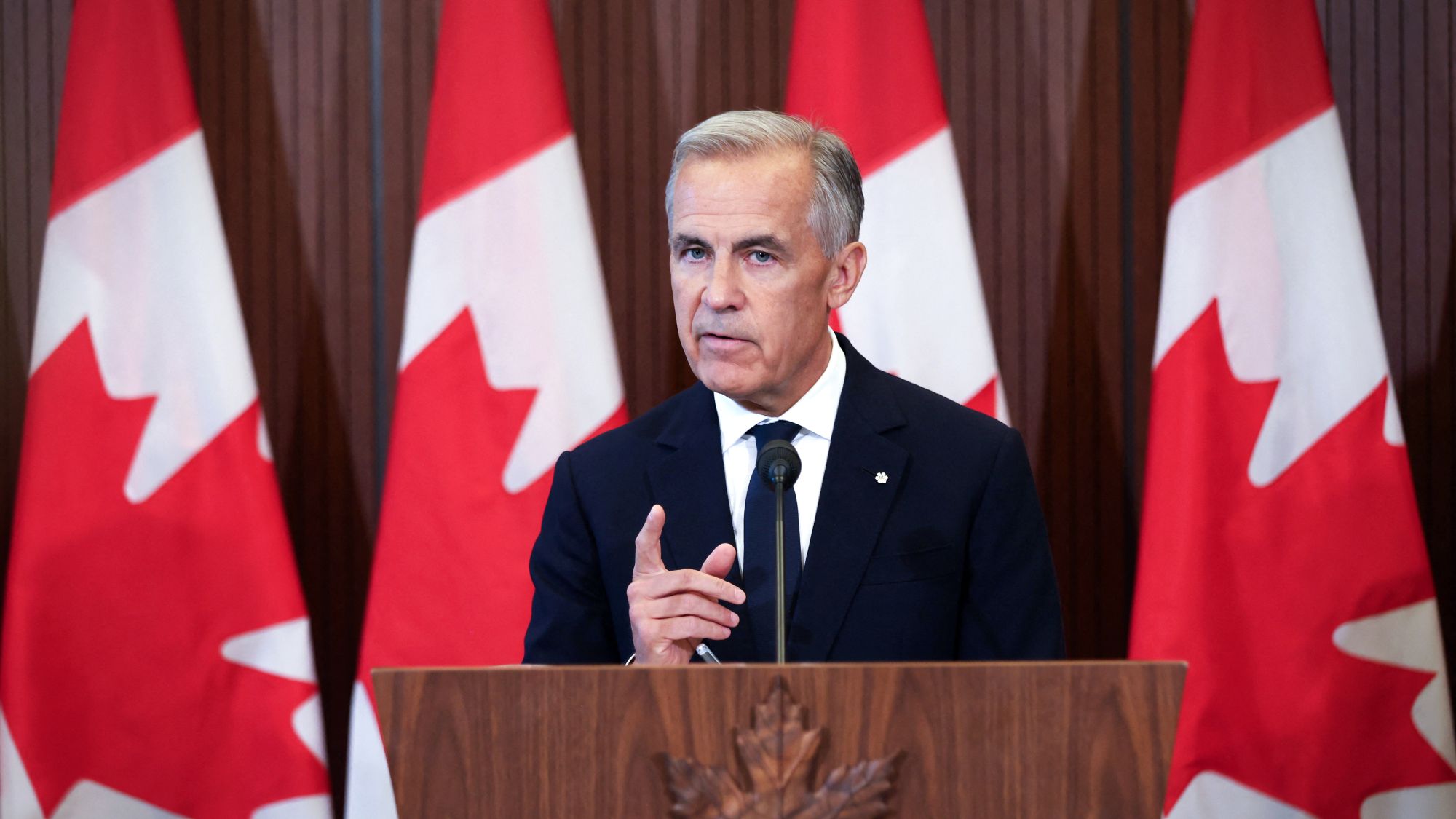
    President Donald Trump’s 50% tariffs on $20 billion in Canadian imports took effect Saturday after negotiations collapsed. Canadian Prime Minister Mark Carney (pictured above) said U.S. negotiators “asked too much and offered too little,” and Ottawa would roll out “dollar for dollar” retaliatory tariffs starting Sept. 8. Trump’s latest tariffs cover about 5% of Canadian imports, ranging from wine, dairy and hockey sticks to overcoats and some Christmas ornaments. 

    Who said what
    U.S. Trade Representative Jamieson Greer said Canada rejected the “best treatment” of any major U.S. trading partner. The U.S. terms were “uneconomic” and “unfair,” Carney said, and “unacceptable” last-minute demands would have restricted Canada’s ability to strike trade deals with other countries, among other infringements on sovereignty. “Canada wants the benefits of being a State, without being one!!!” Trump said yesterday on social media. 

    The “dumbest trade war in history” just “got dumber,” The Wall Street Journal said in an editorial. Trump is taxing an “array of consumer goods” a “mere 10 weeks before midterm elections,” when his approval rating is already “frigid” in part because voters believe he is “waging blunderbuss wars without a strategy, and on trade they’re right.”

    What next?
    Unlike some of the other laws Trump has used to impose tariffs, the 1930 Smoot-Hawley Tariff Act used here “does not appear to impose a time limit on the duties,” CNN said. “We should be prepared to duke it out for two years,” until Trump leaves office, Manitoba Premier Wab Kinew said, “and then hopefully, sanity will return.” 


    TODAY’S POLITICS story

    Jeffries, Kushner meet as Trump eyes loss of House

    What happened
    House Democratic leader Hakeem Jeffries (N.Y.) and Jared Kushner, a top outside adviser to his father-in-law, President Donald Trump, “met privately in recent weeks” and “discussed potential areas of common ground,” The New York Times reported yesterday. The meeting “shows the depth of Republican Party angst over losing their congressional majority,” The Associated Press said, and White House efforts to “stem any potential political fallout” on Trump if Democrats “wrest majority control” in November.

    Who said what
    Kushner and Jeffries (pictured above) “discussed housing, immigration and the high cost of living,” the Times said, all issues where compromise “seems remote.” The Trump GOP’s “my-way-or-the-highway approach to governing” has “failed the American people,” Jeffries said yesterday, and “the question is whether Republicans will join us” in “fighting for an affordable America.”

    House Speaker Mike Johnson (R-La.) “bristled” yesterday when asked about the meeting, the AP said. “I don’t know what that’s about,” but Kushner “hedges his bets” and isn’t “directly involved” in “day-to-day” White House operations, he said on Fox News. “I’m telling you, we’re going to defy history and hold this majority.”

    What next?
    Trump has “mostly steered around Congress in his second term, trampling its powers and prerogatives” with “little pushback from GOP leaders,” the Times said. “All that is likely to change if Democrats control either chamber,” the AP said.


    TODAY’S TECHNOLOGY Story

    Chinese robots top human records at humanoid games

    What happened
    Chinese robots ran faster and jumped higher than human record-holders on Saturday, the first day of the World Humanoid Robot Games in Beijing. One humanoid ran the 100-meter sprint in 9.39 seconds, surpassing Usain Bolt's 9.58-second world record, while another covered 400 meters in 39.7 seconds, topping Wayde van Niekerk’s 43.03-second record. Both robots were made by Beijing’s X-Humanoid, as was a third that reached 2.88 meters in the standing high jump, besting Javier Sotomayor’s 2.45 meters. 

    Who said what
    The five-day Olympics-like event is a “spectacle demonstrating China’s rapid progress in advanced robotics,” The Associated Press said. China “makes the majority of the world’s humanoid robots,” but they are “still mostly used for demonstrations, performances and research — at least for now.” The sprinting performances were a “sharp improvement” over last year, Reuters said, though “braking was an issue, as the machines slammed into ​a thick mat” after the finish line and had to be carried off on stretchers. 

    What next?
    More than 2,000 humanoid robots are competing in 30 sporting events like soccer, table tennis and boxing. But there are also 21 scenario-based contests like “EV charging, restaurant work” and “industrial assembly,” Reuters said. And the “real test” is whether the humanoids can “also handle packaging ‌and warehouse operations while reliably performing precision tasks” that test “their ability to work like humans in less flashy jobs.” 


    It’s not all bad

    Through his TV show “Navajo Highways,” Pete Sands brings the Navajo language to “kids who might otherwise never hear it,” said Utah’s KSL News. Sands, a member of the Navajo Nation, created the children’s puppet series to share his culture, with Navajo people performing the characters. “Navajo Highways” airs on FNX, and adults are fans too. Several Navajo elders were moved to tears at a screening, Sands said. The show is “something that’s meaningful to people.”


    Under the radar

    Malta’s moment in the cinema spotlight

    The EU’s smallest country, located just south of Sicily, has become one of the most popular filming locations over the past decade. Malta has hosted more than 30 movie and TV productions in each of the past three years, including “Jurassic World Rebirth,” Ridley Scott’s “Gladiator II” and Guy Ritchie’s upcoming “Viva la Madness.” The island microstate has stood in for Greece, southern France, the Caribbean, and Essos in “Game of Thrones.”

    Malta is “really punching above its weight,” said Adrian Wootton, the CEO of the British Film Commission, to The Guardian. It has been “very aggressive in a positive way.”

    One reason for its success is that productions benefit from a “hefty 40% tax rebate,” said Variety. It’s probably the “most generous cash rebate in the world,” said Aidan Elliott, an executive producer of “Gladiator II” and “Napoleon.” But as it goes with “generous rebates,” said Deadline, there has been “some local pushback.”

    Malta’s infrastructure is “being tested to the limits as its cities, towns and villages regularly turn into film sets,” said The Guardian. Road closures and parking restrictions have become a “bugbear” for locals.

    And critics say Malta’s rise as a filming location has “come at the cost of neglecting local cinematic talent,” said The Guardian. It’s “tempting to sit back and believe the local film industry to be strong simply because many foreign productions shoot” in Malta, said film producer Malcolm Scerri Ferrante at the Times of Malta. But volume alone “does not constitute a robust film industry and certainly not an indigenous one.”


    On this day

    August 24, 1991

    Ukraine declared independence from the Soviet Union, becoming one of numerous Eastern Bloc countries to break away from the USSR before it collapsed later that year. Russia, which invaded Ukraine in 2022, is escalating its attacks on the country, killing at least 16 people in one strike last week.


    TODAY’S newspaperS

    ‘Get out if you can’

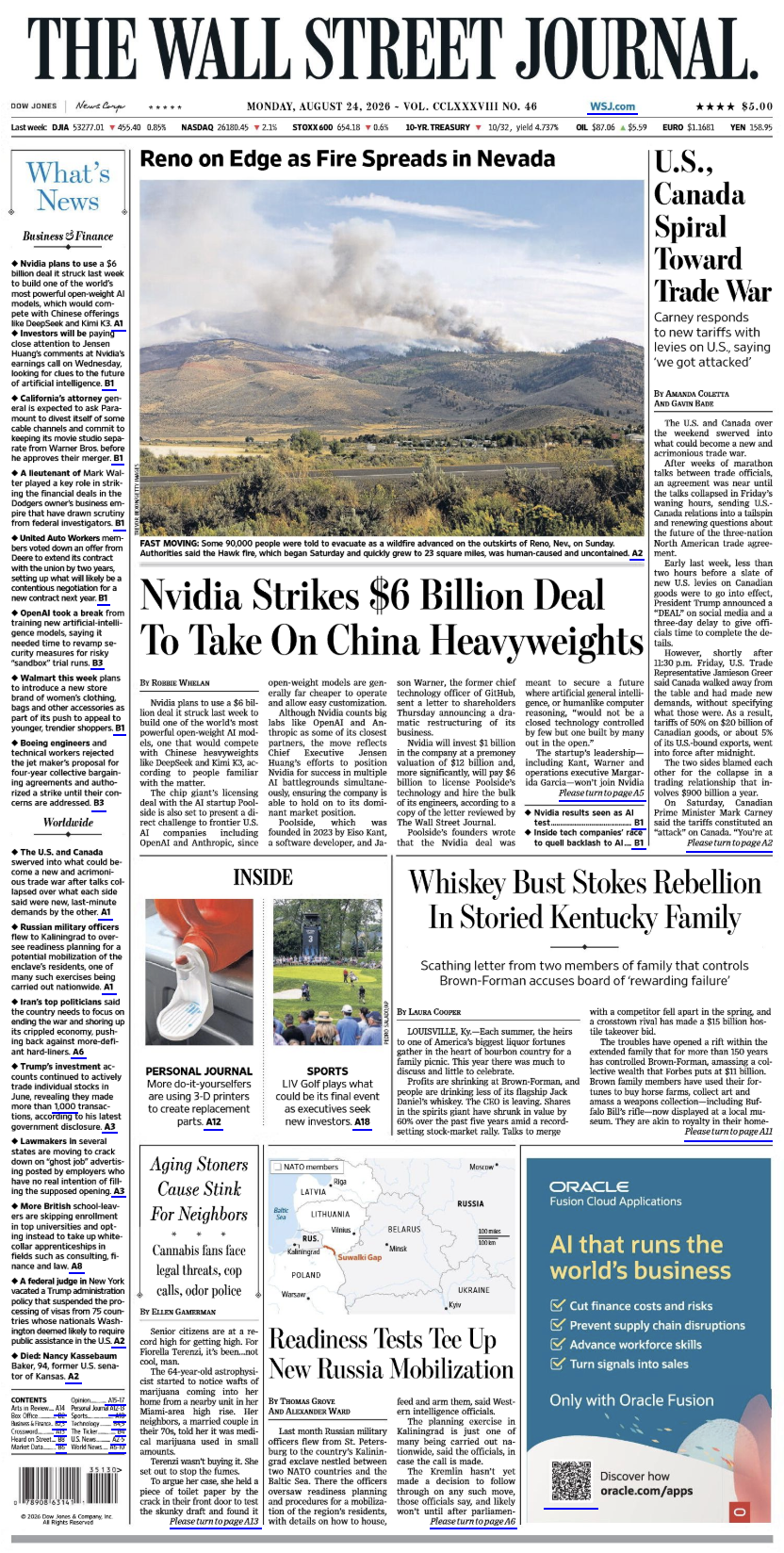
    “U.S., Canada spiral toward trade war,” The Wall Street Journal says on Monday’s front page. “Canada’s aim to not bow to U.S. facing test,” says the Houston Chronicle. “‘Get out if you can’ — Evacuation widens as wildfire caused by humans nears Reno,” says the Las Vegas Journal Review. “Federal cuts aim to stem crisis on Colorado River,” the Los Angeles Times says. “Republicans pivot on data centers, flip to negative,” says The Washington Post. “Fury over data centers quickly shifts midterms,” The New York Times says. “Religion crossing political highway” as “more Democrats tout faith in key red states,” says USA Today. “DeSantis ally who supported death penalty for child abusers could face it,” says the Miami Herald. 

    ► See the newspaper front pages


    Tall tale

    Truth in advertising

    An English town council has apologized after a temporary “Dead End” sign was placed at the top of a road leading to a cemetery. Drivers in Wimborne had been using the route as a way to go around traffic closures, but because there was no through access, they had to do complicated U-turns to get out. Residents initially thought a prankster put up the sign, but a council spokesperson clarified that a city worker put it there, with the “best intentions.”


    Morning Report was written and edited by Nadia Croes, Catherine Garcia, Scott Hocker, Anya Jaremko-Greenwold, Justin Klawans, Harriet Marsden, Rafi Schwartz, Peter Weber and Kari Wilkin, with illustrations by Stephen Kelly and Julia Wytrazek.

    Image credits, from top: Dave Chan / AFP via Getty Images; Tom Williams / CQ-Roll Call Inc. via Getty Images; Kevin Frayer / Getty Images; Illustration by Julia Wytrazek / Getty Images
     

    Recent editions

    • Sunday Shortlist

      An 80s family fights dinosaurs

    • Saturday Wrap

      The WNBA’s culture wars

    • Evening Review

      Pivot from Asia?

    VIEW ALL
    TheWeek
    • About Us
    • Contact Future's experts
    • Terms and Conditions
    • Privacy Policy
    • Cookie Policy
    • Advertise With Us
    • FAQ
    Add as a preferred source on Google Add as a preferred source on Google

    The Week is part of Future US Inc, an international media group and leading digital publisher. Visit our corporate site.

    © Future US, Inc. Full 7th Floor, 130 West 42nd Street, New York, NY 10036.