The Week The Week
flag of US
US
flag of UK
UK
https://cdn.mos.cms.futurecdn.net/flexiimages/jacafc5zvs1692883516.jpg

SUBSCRIBE & SAVE

Less than $3 per week

Sign in
  • View Profile
  • Sign out
  • The Explainer
  • The Week Recommends
  • Newsletters
  • Cartoons
  • From the Magazine
  • The Week Junior
  • Student Offers
  • More
    • Politics
    • World News
    • Business
    • Health
    • Science
    • Food & Drink
    • Travel
    • Culture
    • History
    • Personal Finance
    • Puzzles
    • Photos
    • The Blend
    • All Categories
  • Newsletter sign up Newsletter
  • Brand Logo
    Army resignation, ballroom green light and Tupac verdict

     
    TODAY’S MILITARY story

    Army secretary resigns amid clashes with Hegseth

    What happened
    Army Secretary Dan Driscoll submitted his resignation to President Donald Trump yesterday, leaving the Army with no Senate-confirmed top leadership as it battles Iran and other challenges. Driscoll had “clashed repeatedly with Defense Secretary Pete Hegseth over the ouster of key combat-tested Army leaders,” The New York Times said. Hegseth’s string of “firings and feuds” has “left the Army essentially rudderless.” He ousted Army Chief of Staff Gen. Randy George, a Driscoll ally, in April.

    Who said what
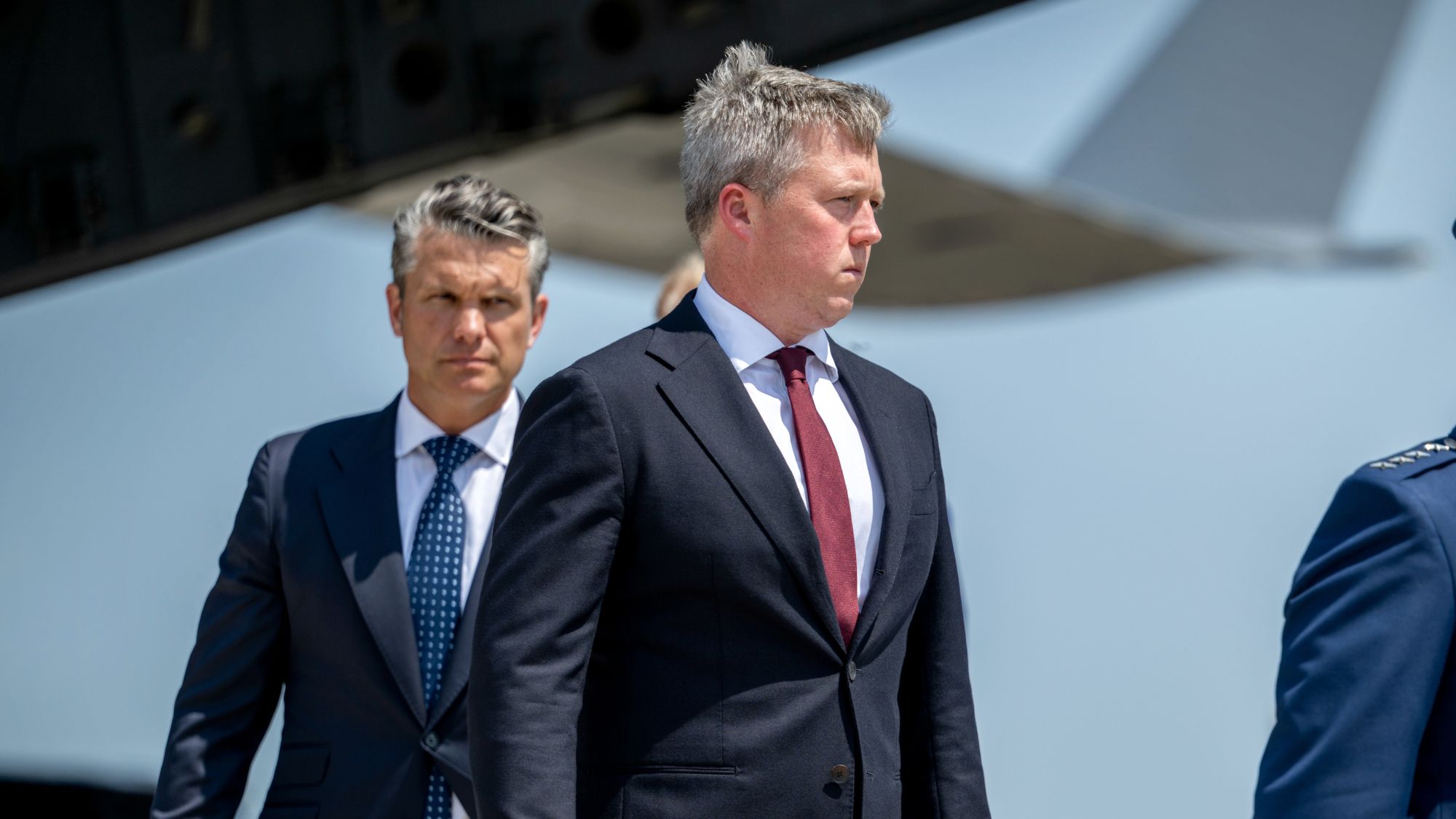
    Driscoll (pictured above center, with Hegseth) “brought up concerns” with Trump about “Army transformation and readiness and Hegseth’s blocking those efforts specifically by firing the generals who were responsible,” a source told CNN and The Atlantic. Driscoll was a “major force behind trying to cut the red tape for military contractors to quickly develop more drones and counter-drone capabilities,” The Associated Press said. Gen. Christopher LaNeve, whose “meteoric rise under Hegseth” led to his role as acting Army chief of staff, “is pulling the plug on a drone modernization program” championed by Driscoll.

    Driscoll “was until recently seen as a potential candidate to replace” Hegseth if he resigned or “fell out of favor” with Trump, the Times said. Hegseth may have “banished another enemy, Driscoll,” Tom Nichols said at The Atlantic. But his prize is that “more than ever,” he “now owns every aspect of the Pentagon’s dysfunction.”

    What next?
    Driscoll is “expected to leave the Pentagon in coming days,” The Wall Street Journal said. Senior administration officials said Hegseth’s choice to replace him, Pentagon spokesperson Sean Parnell, “likely would struggle to be confirmed” by the Senate, the Times said.


    TODAY’S WHITE HOUSE story

    Split Supreme Court lets Trump build his ballroom

    What happened
    The Supreme Court yesterday cleared the way for President Donald Trump to finish his 90,000-square-foot White House ballroom, ruling in a 5-4 decision that the congressionally chartered historical preservation group that won in two lower courts lacked standing to challenge the project. Chief Justice John Roberts dissented with the three liberal justices, calling the ballroom construction “likely unlawful” because it hadn’t been approved by Congress. 

    Who said what
    “The White House is an iconic American building whose symbolism and history are wrapped up in its architecture,” Roberts wrote, and it’s crucial to “ensure that those responsible follow the rules in deciding what to tear down and what to build up at the People’s House.” The court’s majority “insisted it was not resolving the legal arguments over the president’s power to unilaterally make major changes to the White House,” Politico said. But their unsigned opinion, The Wall Street Journal said, “effectively” gives a “green light” for “construction crews to continue their nearly round-the-clock work” to complete the project before the legal questions are resolved. 

    What next?
    In court documents, the White House said the $400 million ballroom’s framework should be completed by November and the full project done in August 2028. 


    TODAY’S CRIME Story

    Duane Davis convicted in Tupac Shakur’s murder

    What happened
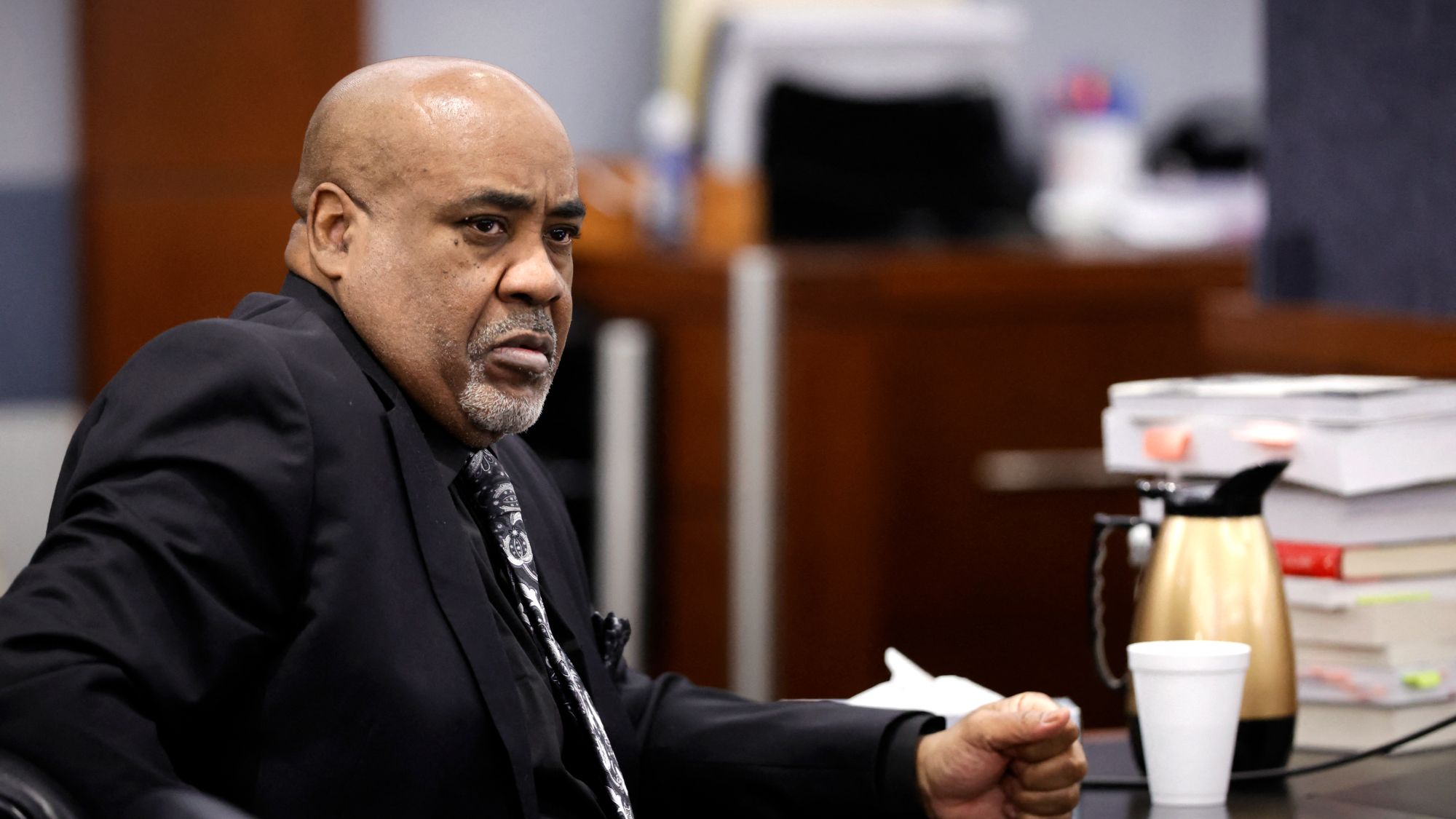
    A jury in Las Vegas yesterday found former gang leader Duane “Keffe D” Davis (pictured above) guilty of first-degree murder for orchestrating the 1996 drive-by killing of rap icon Tupac Shakur. During the three-week trial, prosecutors leaned on Davis’ public admissions that he procured and handed a fellow Crips member the gun that killed Shakur. Davis’ lawyer said his client’s admissions, including in his 2019 memoir, were “fiction” to “make money” from Shakur’s murder. 

    Who said what
    Prosecutors said Davis and his nephew, Orlando Anderson, “went hunting” for Shakur after Anderson was beaten amid a bitter bicoastal rap feud between Shakur’s Death Row Records label, allied with the Bloods gang, and Sean “Diddy” Combs’ Bad Boy Records, protected by the Crips. Both factions were in Las Vegas for a Mike Tyson fight.

    The case “had languished” for years “as important evidence, including the murder weapon, remained missing and key witnesses” refused to cooperate, The New York Times said. Davis “began speaking to the police” in 2008 to avoid serious drug charges, but the plea deal that made him “untouchable” was rendered moot after he “began repeatedly addressing the shooting publicly” under the “mistaken belief that he was fully immune from prosecution.”

    What next?
    Davis, 63, faces up to life in prison when he is sentenced Oct. 13.


    It’s not all bad

    A British man has become the first person to undergo brain surgery with live AI assistance. Rhys Hibbert, 48, was at risk of losing his sight as a benign tumor pressed on his optic nerves, and doctors successfully removed it while avoiding vital blood vessels and nerves. AI analyzed the procedure in real time, highlighting hidden structures and safer areas in which to operate. Researchers hope to develop and roll out the technology more widely to help other patients facing similarly complex surgery.


    Under the radar

    Morocco’s attempt to rebrand Western Sahara

    On a “peninsula where the Sahara meets the Atlantic,” the city of Dakhla is advertised to visitors as “Morocco’s hidden gem,” said the BBC. But tourists flying to this part of Western Sahara might not know they will be “landing in one of the world’s longest ongoing territorial disputes.”

    A former Spanish colony, Western Sahara was annexed by Morocco in 1975. Since then, it has been the subject of a dispute between Morocco and the indigenous Sahrawi people, led by the Polisario Front. The U.N. now classifies the region as a “non-self-governing territory,” and Morocco occupies and administers about 80% of it. Numerous U.N.-brokered talks to resolve Western Sahara’s future have failed.

    Morocco has been pouring considerable resources into Western Sahara. Since 2015, it has spent $9.5 billion trying to “level it up,” said The Spectator. There are now water desalination plants, 620 miles of motorways, and plans for eight “green hydrogen plants” and a “centrepiece” $1.4 billion Dakhla Atlantic Port.

    But Morocco’s annexation has created “one of the world’s most enduring yet overlooked refugee crises,” said Metro. For the past 50 years, the Sahrawi people have been “forced to live under occupation or go into exile,” mostly in the Algerian desert.

    In recent years, the international consensus has shifted and consolidated in favor of Morocco’s “autonomy plan” for Western Sahara. Spain has endorsed the framework, and France and the U.S. have recognized Morocco’s sovereignty over the region. In October, the U.N. Security Council approved a resolution that gave the “strongest backing yet” to Moroccan control, while “making no mention of the independence referendum” sought by the Polisario Front, said Bloomberg.


    On this day

    September 1, 1985

    A U.S.-French expedition led by Robert Ballard discovered the wreck of the RMS Titanic, 73 years after the luxury liner hit an iceberg and sank to the bottom of the Atlantic Ocean. Today, wreck hunters find sunken ships fairly often, including an ancient Roman shipwreck discovered off the Sicilian coast last month.


    TODAY’S newspaperS

    ‘Hidden gusher of money’

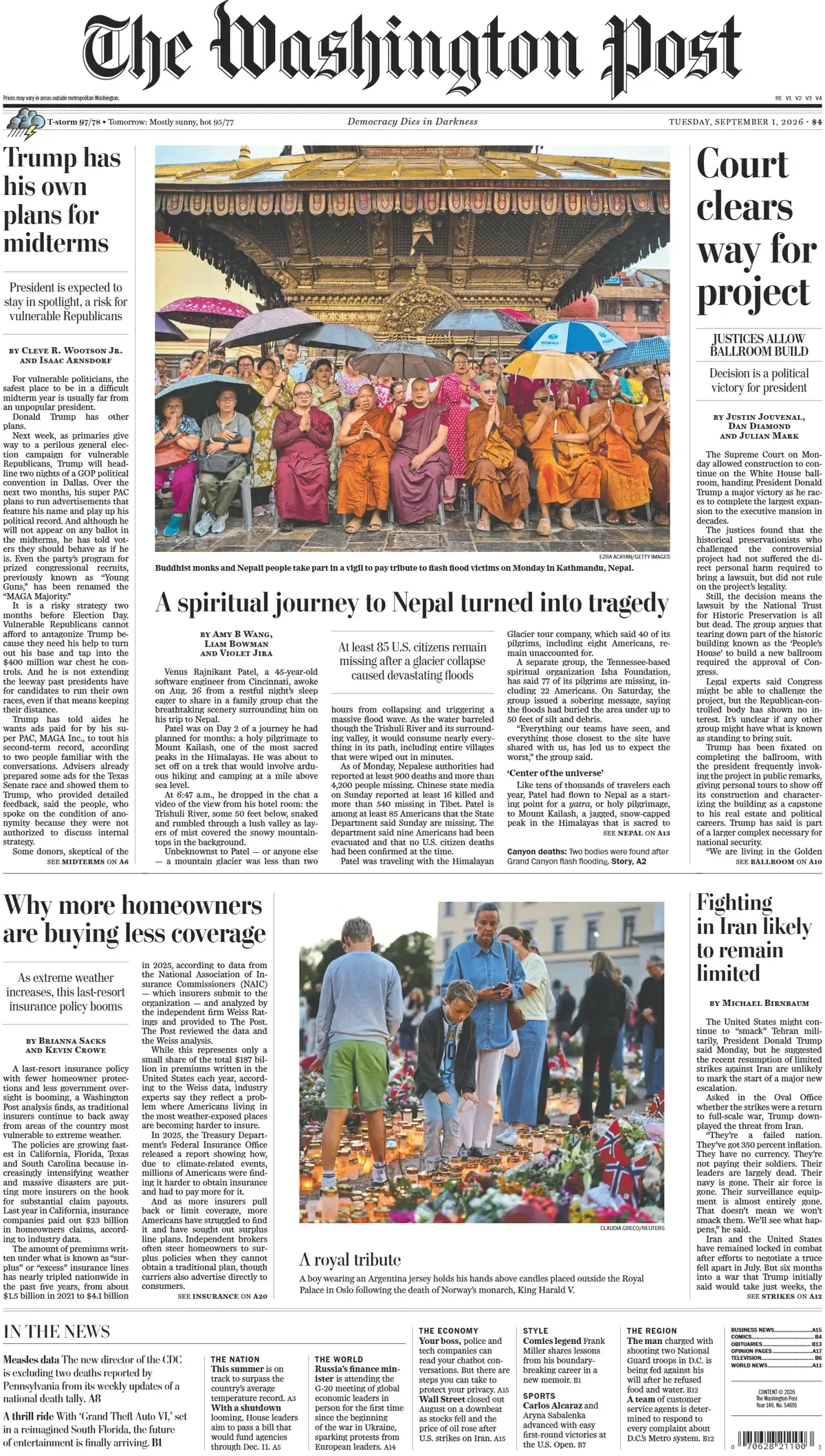
    “Hidden gusher of money is upending the midterms,” including “$1 billion in anonymous donations” for “battleground races,” The New York Times says on Tuesday’s front page. “Trump has his own plans for the midterms,” though his decision to “stay in the spotlight” poses a “risk for vulnerable Republicans,” The Washington Post says. “U.S. invites Russian official to G20 talks,” drawing “protest” from Europe, the Chicago Tribune says. “Amazon sued over ad rates,” The Wall Street Journal says. “Grand Canyon flash flood kills 2, with others missing,” the Arizona Republic says. “Experts point to El Niño in Grand Canyon flood,” says the Los Angeles Times. “Hundreds feared stuck in tunnels” as deaths in Himalayan flooding “surpass 950,” says the Houston Chronicle.

    ► See the newspaper front pages


    Tall tale

    Digital warfare

    At the 65th German Finger Wrestling Championships in Bavaria last month, 150 competitors faced off in matches lasting from a “few seconds to nearly one minute,” said UPI. The sport involves two participants sitting opposite each other, with their middle fingers linked with a leather loop. The goal is to pull your opponent across the table — and it’s not for the faint of heart (or finger). The pain during a contest is “excruciating,” senior champion Ferdinand Seitz told Euronews.


    Morning Report was written and edited by Will Barker, Nadia Croes, Catherine Garcia, Scott Hocker, Anya Jaremko-Greenwold, Justin Klawans, Rafi Schwartz, Peter Weber and Kari Wilkin, with illustrations by Stephen Kelly and Julia Wytrazek.

    Image credits, from top: Daniel Heuer / Bloomberg via Getty Images; Aaron Schwartz / AFP via Getty Images; Steve Marcus / Pool / AFP via Getty Images; Illustration by Julia Wytrazek / Getty Images
     

    Recent editions

    • Evening Review

      Trump’s South Carolina victory

    • Morning Report

      Iran war veers back into dueling strikes

    • Sunday Shortlist

      Wile E. Coyote takes Acme to court

    VIEW ALL
    TheWeek
    • About Us
    • Contact Future's experts
    • Terms and Conditions
    • Privacy Policy
    • Cookie Policy
    • Advertise With Us
    • FAQ
    Add as a preferred source on Google Add as a preferred source on Google

    The Week is part of Future US Inc, an international media group and leading digital publisher. Visit our corporate site.

    © Future US, Inc. Full 7th Floor, 130 West 42nd Street, New York, NY 10036.