There are around 2,600 billionaires in the world, according to Forbes, and these moguls are worth a combined $12.2 trillion. This wealth has allowed them to travel the world in private luxury vehicles. As the planet continues to feel the effects of global warming, though, studies have shown that these lifestyles are contributing to climate change.
The wealthiest individuals "make a huge contribution to climate change through carbon-hungry activities," BBC reported. It is true that "most people in wealthy countries are consuming in ways that are accelerating climate catastrophe," the outlet added. However, "Wealthy people set the tone on consumption to which everybody aspires. That's where the toxic effects are," Halina Szejnwald Brown, professor emerita of environmental science at Clark University, told BBC.
Wealthy Americans in particular "have higher carbon footprints than other wealthy people," Scientific American reported, citing a study from the World Inequality Report. Studies such as these have become abundant in recent years. But what do the figures actually show?
The Week
Escape your echo chamber. Get the facts behind the news, plus analysis from multiple perspectives.
SUBSCRIBE & SAVE
Sign up for The Week's Free Newsletters
Join more than 350,000 subscribers and keep yourself informed with a selection of The Week’s most interesting, enlightening and entertaining stories - plus daily puzzles.
Join more than 350,000 subscribers and keep yourself informed with a selection of The Week’s most interesting, enlightening and entertaining stories - plus daily puzzles.
Latest Videos FromThe Week US
How are the wealthy directly contributing to climate change?
When looking specifically at the United States, "40% of total U.S. emissions were associated with income flows to the highest earning 10% of households" in 2019, according to an August 2023 study in the journal PLOS Climate. This represents earners who are bringing in around $180,000 per year, and factors in carbon emissions from industries in which each household has invested.
The top of the food chain — Americans in the top 1% of all earners — contributed disproportionately more negative environmental effects, PLOS reported, being responsible for up to 15 to 17% of carbon emissions. These Americans, who represent households making more than $550,000, had investment holdings that accounted for up to 43% of these emissions.
The top 0.1% of American earners, meanwhile, were described by PLOS as "super-emitters" of carbon emissions, especially when factoring in the ultra-wealthy with significant income from investments in carbon-heavy industries, which drives more than 50% of these individuals' emissions. These estimated 43,200 super-emitter U.S. households, whose income ranges in the multi-millions or billions, each generate around 3,000 tons of carbon pollution every year.
It's recommended that the average person "should limit their carbon footprint to around 2.3 tons a year to tackle climate change," CNN noted, meaning that "super-emitters" generate more than 1,300 times the recommended amount of pollution.
What role do private jets play?
When considering the wealthy's impact on climate change, the first thing that comes to mind is likely a private plane.
When it comes to the skies, private jets "emit at least 10 times more pollutants than commercial planes per passenger," per a recent report from the Institute for Policy Studies. While "just a small portion of these carbon emissions [4%] are due to private jet use," the report noted, "there is a stark imbalance between a jet carrying at most a handful of people...versus a commercial aircraft loaded with hundreds of passengers." This means that the ultra-wealthy "are responsible for a highly disproportionate amount of carbon emissions from air travel."
Covid-19 has exacerbated the use of chartered planes, and emissions "have increased by more than 23% as private jet use has risen by about a fifth" since the pandemic's start, Simple Flying reported. The outlet noted that for a typical flight between New York City and Washington, D.C., a private jet would "emit an estimated 7,913 pounds of CO2 per passenger." The average commercial flight would emit just 174 pounds.
What role do superyachts play?
Superyachts are "by far the worst asset to own from an environmental standpoint," Indiana University professors Richard Wilk and Beatriz Barros told DW. The outlet noted that "two-thirds of these super-rich emissions are created by...superyachts."
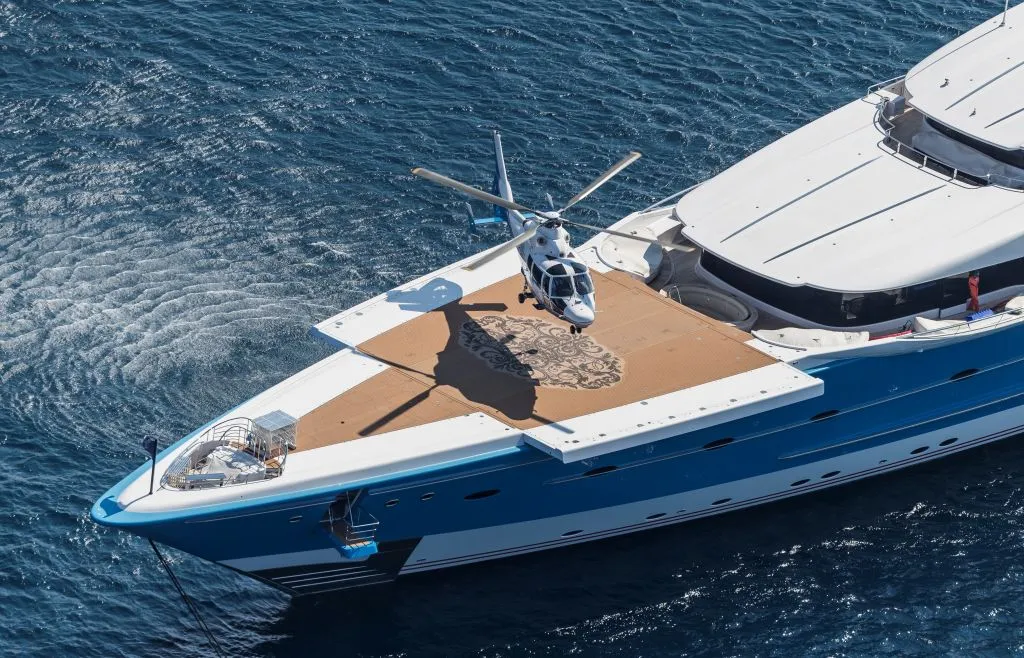
A study from these professors found that "a superyacht with a permanent crew, helicopter pad, submarines and pools emits about 7,020 tons of CO2 a year." But this is just an average, and some of these ships emit many more tons of emissions. Eclipse, currently the world's third-largest superyacht, is owned by billionaire Roman Abramovich and was cited by the study as giving off 22,440 tons of CO2 in 2018. Abramovich, called "the biggest polluter" by the study, was responsible in total for emitting more than 33,000 tons of CO2 from his modes of transportation.
"Whether it’s this or private jets or trips to space, they’re just sticking two fingers up at the rest of society," Peter Newell, a professor at Sussex University, told The Guardian. "They’re not comfortable with the constraints that come with accepting collective responsibility for the fate of the planet."