Sign up to get Today’s Best Articles in your inbox
Join 350,000+ subscribers and keep yourself informed with a selection of
The Week’s most interesting, enlightening and entertaining stories - plus daily puzzles.
You are now subscribed
Your newsletter sign-up was successful
Want to add more newsletters?
An account already exists for this email address, please log in.
Has the anti-AfD firewall failed in Germany?
Far-right party set to break through in state elections, as cordon sanitaire designed to keep them out backfires
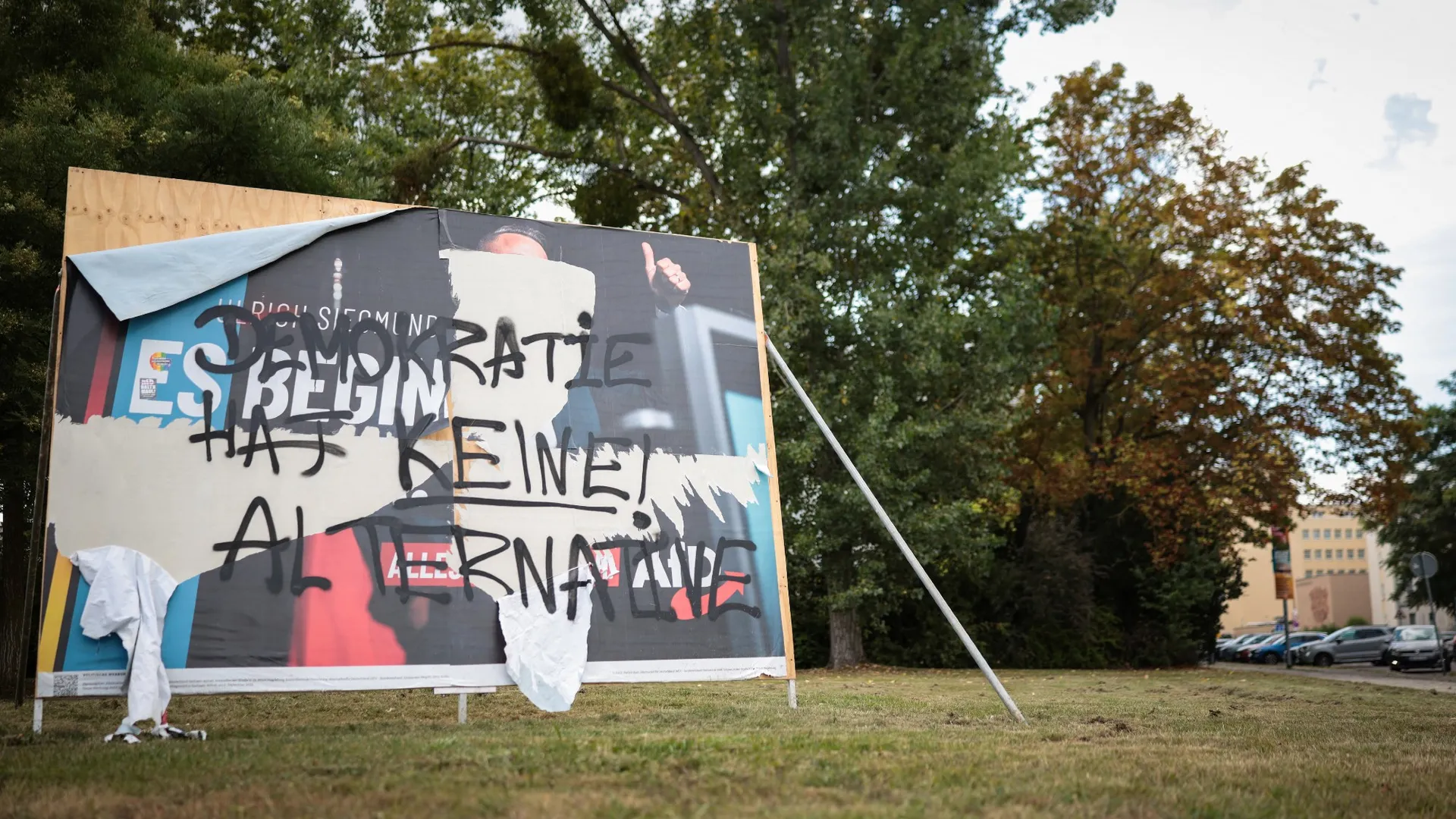
Once a fringe movement, the far-right Alternative für Deutschland party is on course to take control of a German state for the first time, and blast through a post-war consensus designed to keep extremists out of power.
With polls suggesting that 40% of voters in Saxony-Anhalt intend to support the AfD in next week’s vote, it is now “completely undemocratic to permanently exclude” the party, said left-wing party leader Sahra Wagenknecht. “The firewall has failed.”
What did the commentators say?
Germany’s political “firewall”, the Brandmauer, is an agreement between mainstream parties that they will all refuse to work with extremists, forming coalitions or otherwise cooperating with each other instead. It has succeeded in keeping the AfD out of power at state and federal level until now but it has done nothing to harm the party’s popularity. If anything, being excluded has contributed to its rise in national polls, where it now enjoys a clear lead over all the mainstream parties.
The Week
Escape your echo chamber. Get the facts behind the news, plus analysis from multiple perspectives.
Join more than 350,000 subscribers and keep yourself informed with a selection of The Week’s most interesting, enlightening and entertaining stories - plus daily puzzles.
Join more than 350,000 subscribers and keep yourself informed with a selection of The Week’s most interesting, enlightening and entertaining stories - plus daily puzzles.
Maintaining the firewall has created a “hollowed-out centre”, said politics professor Alexander Görlach in Jacobin magazine. Building majorities that exclude the far-right “has led to uncomfortable compromises”: parties on the left and centre-right have made coalitions “born of necessity rather than conviction”. Not only has this alienated some voters – in some cases even driving to extremist alternatives – it has also blurred the distinctions between mainstream parties, reinforcing the AfD’s line that they are carbon-copy “cartel parties”.
The Brandmauer also means the AfD has “no incentive” to moderate its policies in order to gain power, as some other populists in Europe have done, said The Economist. Behind the firewall, the party is protected “from the disappointment that accountability in a democracy implies”, Christian Stecker, a political scientist at TU Darmstadt, told the magazine.
It’s certainly “plausible” that the firewall “has contributed” to this “specifically German phenomenon of rapid growth combined with increasing radicalisation”, said Thorsten Benner of Berlin’s Global Public Policy Institute on Foreign Policy. AfD supporters can currently back ever more extreme positions, free from “the risk of having to live with the consequences of their choice”.
What next?
If current polling proves accurate, the AfD could secure an absolute majority in the Saxony-Anhalt state election on 6 September – a rarity under Germany's proportional-voting system.
Sign up to get Today’s Best Articles in your inbox
A free daily email with the day’s biggest news and analysis – and the best features from TheWeek.com
The consequences of that “would be far-reaching”, said The Centre for Strategic & International Studies. It would not only “create a shock to the ideological spectrum” but also, for the first time, enable a far-right party in Germany “to put some of its agenda into practice”, on issues such as education, security and cultural identity. That could “catapult the far-right into power across Europe’s biggest economy”, said The Spectator. Or it could “be the beginning of the end”, as the AfD “confronts squaring its lavish election promises with sky-high voter expectations”.
Elliott Goat is a freelance writer at The Week Digital. A winner of The Independent's Wyn Harness Award, he has been a journalist for over a decade with a focus on human rights, disinformation and elections. He is co-founder and director of Brussels-based investigative NGO Unhack Democracy, which works to support electoral integrity across Europe. A Winston Churchill Memorial Trust Fellow focusing on unions and the Future of Work, Elliott is a founding member of the RSA's Good Work Guild and a contributor to the International State Crime Initiative, an interdisciplinary forum for research, reportage and training on state violence and corruption.