Sign up to get Today’s Best Articles in your inbox
Join 350,000+ subscribers and keep yourself informed with a selection of
The Week’s most interesting, enlightening and entertaining stories - plus daily puzzles.
You are now subscribed
Your newsletter sign-up was successful
Want to add more newsletters?
An account already exists for this email address, please log in.
Putin said Russian conscripts weren't fighting in Ukraine. The Russian Defense Ministry says they are.
It seems Russian President Vladimir Putin and his military are not on the same page.
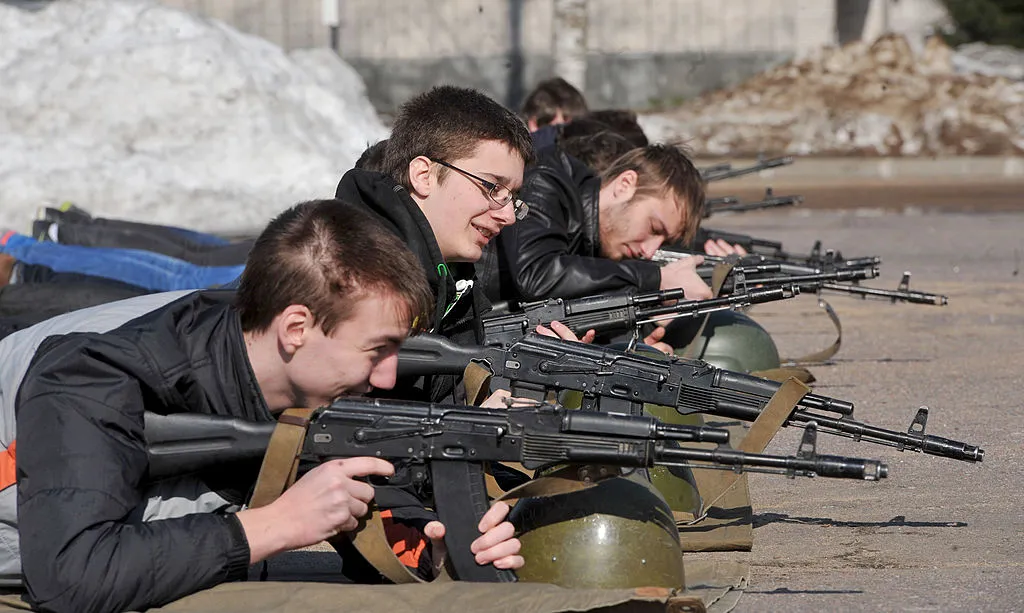
The Russian Defense Ministry said Wednesday that conscripts had been sent to war in Ukraine, contradicting Putin's assertion that conscripted soldiers "are not participating and will not participate" in the conflict, The New York Times reports.
The Center for Strategic and International Studies reported in 2020 that Russia's army comprised 260,000 conscripts — who serve 12-month stints — and 410,000 volunteers, or "contract soldiers." CSIS also said Russia has been working to reduce its reliance on conscripts since 2008.
The Week
Escape your echo chamber. Get the facts behind the news, plus analysis from multiple perspectives.
Join more than 350,000 subscribers and keep yourself informed with a selection of The Week’s most interesting, enlightening and entertaining stories - plus daily puzzles.
Join more than 350,000 subscribers and keep yourself informed with a selection of The Week’s most interesting, enlightening and entertaining stories - plus daily puzzles.
"The deployment of often young and poorly trained conscripts" in Russia's wars in Afghanistan (1979–1989) and Chechnya (1994–1996 and 1999–2000) was deeply unpopular in Russia, the Times notes.
Russian Maj. Gen. Igor Konashenkov said Wednesday that "some of the conscripts" sent to fight in Ukraine had been captured by Ukrainian forces but that "almost all" of them have been recalled to Russia, according to Radio Free Europe.
Kremlin spokesman Dmitry Peskov said Putin was told that his order to exclude conscripts from the "special military operation" had been "fulfilled" and has ordered in an investigation to "punish those responsible for not fulfilling that instruction," the Times reported.
Sign up to get Today’s Best Articles in your inbox
A free daily email with the day’s biggest news and analysis – and the best features from TheWeek.com
Grayson Quay was the weekend editor at TheWeek.com. His writing has also been published in National Review, the Pittsburgh Post-Gazette, Modern Age, The American Conservative, The Spectator World, and other outlets. Grayson earned his M.A. from Georgetown University in 2019.