Sign up to get Today’s Best Articles in your inbox
Join 350,000+ subscribers and keep yourself informed with a selection of
The Week’s most interesting, enlightening and entertaining stories - plus daily puzzles.
You are now subscribed
Your newsletter sign-up was successful
Want to add more newsletters?
An account already exists for this email address, please log in.
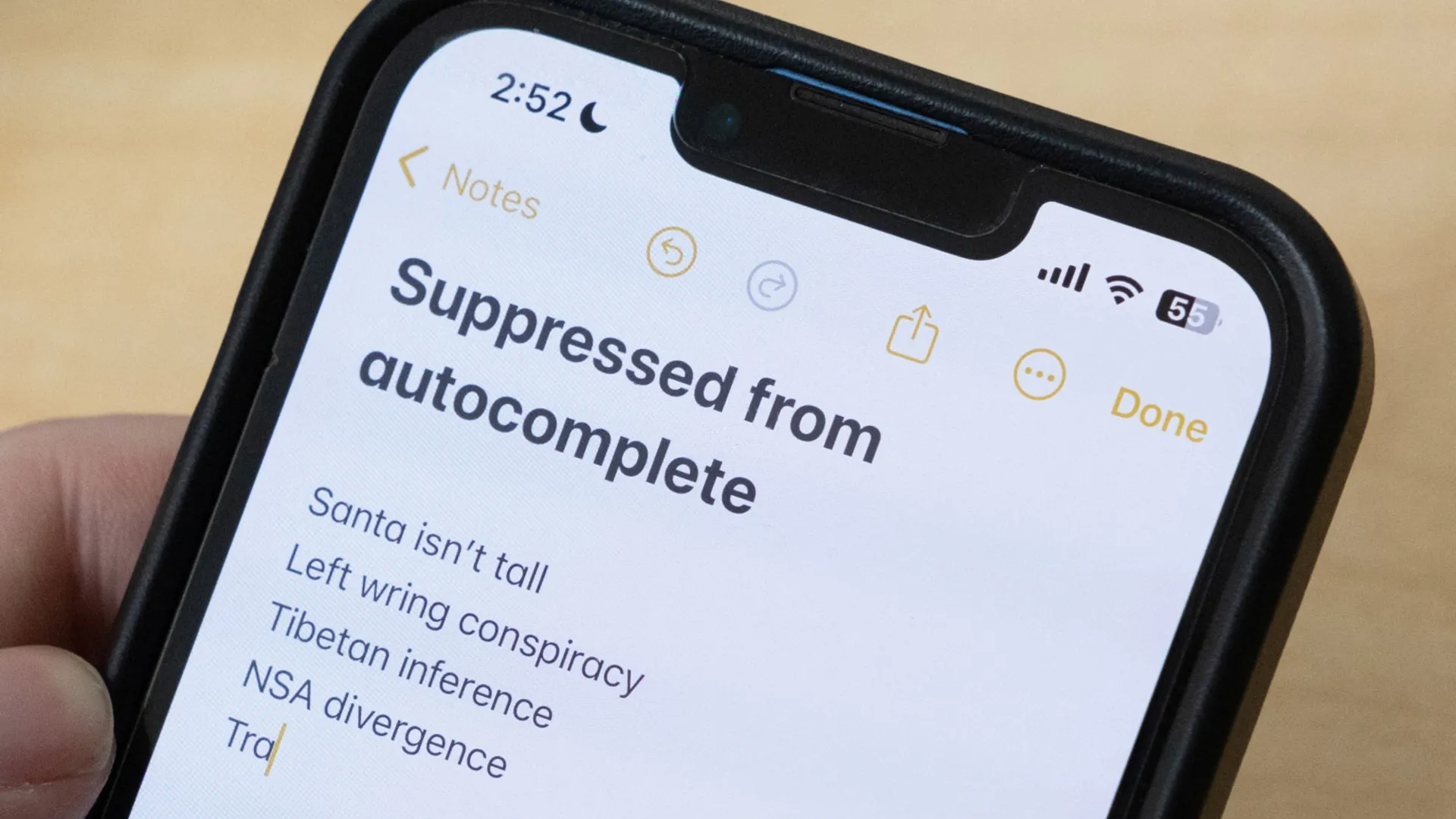
It may seem strange that your iPhone doesn’t want to autocorrect certain words or phrases — but this is apparently quite intentional. Apple reportedly maintains a list of “gray words” it blocks from its products’ autocorrect features. Some say this is a small but notable form of censorship.
What words are on Apple’s gray list?
Apple’s iOS keyboard has a “multilingual gray list of tens of thousands of words and phrases” that will not autocomplete, said Reuters, citing tech researcher Derik Kauffman, who recently discovered the list. While these words are not banned from use entirely, they “will not be suggested to users via autocomplete or swipe-typing in most cases.” Kauffman estimates a total of about 100,000 gray-listed words.
Kauffman published a website tracking Apple’s gray list. Some entries are racially charged, including “Nazis were good,” “Auschwitz” and “towel head,” alongside terms related to terrorist attacks. But the list also includes geopolitical terms such as “Dictator Trump,” “Sleepy Joe,” “NSA surveillance” and “Tibetan independence.” Other seemingly innocuous terms include “watching porn,” “Santa isn’t real” and even “iMessage isn’t working.” Different languages are similarly affected; in Hebrew, iOS won’t autocomplete “occupied territories,” while in Arabic it won’t autocomplete “Hamas movement.”
The Week
Escape your echo chamber. Get the facts behind the news, plus analysis from multiple perspectives.
Join more than 350,000 subscribers and keep yourself informed with a selection of The Week’s most interesting, enlightening and entertaining stories - plus daily puzzles.
Join more than 350,000 subscribers and keep yourself informed with a selection of The Week’s most interesting, enlightening and entertaining stories - plus daily puzzles.
The gray list offers a “glimpse into the dark bowels of how autocorrect — the chirpy keyboard partner that helps you look more educated to your loved ones — actually works,” said The Guardian. And Apple has previously said iOS will “avoid offering inappropriate or offensive predictive suggestions.” But it is also likely that the list’s discovery is “going to raise censorship concerns,” said Digital Trends, especially since some have made comparisons to Chinese smartphones, which often place state-sanctioned “restrictions on what you can do or type on them.”
It is also not the first time that Apple has “run into trouble when predictive technology suggests embarrassing or controversial texts to users,” said The Guardian, as Google has encountered similar problems. And if the company is going to fiddle with autocorrect, it is “something users should be really well aware of and have some ability to customize,” David Greene, senior counsel at the civil liberties group Electronic Frontier Foundation, told Reuters. “This is something that should not be secret.”
Sign up to get Today’s Best Articles in your inbox
A free daily email with the day’s biggest news and analysis – and the best features from TheWeek.com
Justin Klawans has worked as a staff writer at The Week since 2022. He began his career covering local news before joining Newsweek as a breaking news reporter, where he wrote about politics, national and global affairs, business, crime, sports, film, television and other news. Justin has also freelanced for outlets including Collider and United Press International.