The Week The Week
flag of US
US
flag of UK
UK
https://cdn.mos.cms.futurecdn.net/flexiimages/jzblygzdxr1769609154.gif

SUBSCRIBE

Try 6 weeks free

Sign in
  • View Profile
  • Sign out
  • The Explainer
  • Talking Points
  • The Week Recommends
  • Podcasts
  • Newsletters
  • From the Magazine
  • The Week Junior
  • More
    • Politics
    • World News
    • Business
    • Health
    • Science
    • Food & Drink
    • Travel
    • Culture
    • History
    • Personal Finance
    • Puzzles
    • Photos
    • The Blend
    • All Categories
  • Newsletter sign up Newsletter
  • The Week Evening Review
    Trump’s midterm apathy, Sweden’s election, and AI’s antiaging drug

     
    TODAY’S BIG QUESTION

    Does Trump want to win the midterms?

    President Donald Trump is seemingly intent on making the midterm elections a referendum on his increasingly unpopular presidency, doubling down on policies — data centers, tariffs, war with Iran — disfavored by voters. This leads some observers to wonder if he really cares about GOP victories in November.

    What did the commentators say?
    Trump is “not spending a ton of his mindshare on the races,” said White House reporter Maggie Haberman to The New York Times. The president believes GOP candidates “should be doing more to defend what he sees as his many accomplishments,” and he’s committing the bulk of his time to “legacy projects” like the “triumphal arch” and ballroom instead of policy and governance.

    House and Senate candidates usually try to “detach themselves from the national brand” when their party’s president is down in the polls, said Jonathan Chait at The Atlantic. But Trump is making that “impossible,” launching a national ad campaign “focused on himself” and holding last week’s GOP convention highlighting the “synonymity of the party and its leader” to voters. 

    The president “probably” cares about the midterms outcome but “not enough to permit Republicans to acknowledge his lack of popularity,” said Chait. Ultimately, Trump’s “interest in politics is purely egocentric.” 

    This leaves his ideological allies in a tough spot. Trump “often sounds as if he’s campaigning against the Republican Senate,” said The Wall Street Journal in an editorial. GOP seats in “at least six races are in serious jeopardy,” and even traditional red states like Kansas and Nebraska are looking shaky. But Trump has made it difficult for his party by launching a “tariff brawl” with Canada and working to oust GOP incumbents like Sen. John Cornyn of Texas. 

    What next?
    The president is “signaling that he might not accept the outcome” if Republicans lose in November, said Bruce Stokes at Chatham House. A Democratic win in the House or Senate would likely lead to two years of investigations into Trump’s “corporate donors and alleged ‘pay-to-play’ arrangements,” as well as “investments by foreign sovereign wealth funds in Trump-family-linked businesses.” That provides a “powerful incentive” for Trump to “undermine the outcome” of the election.


    QUOTE OF THE DAY

    ‘They would enjoy the hell out of it. Mutual assured destruction. It services no greater good.’

    California Gov. Gavin Newsom (D) to CNN on why he “wouldn’t run” for president in 2028 if former Vice President Kamala Harris decides to run again. Doing so would be an electoral “gift” for everybody else, he added.


    the explainer

    Swedish elections balance on a knife-edge

    Preliminary results from Sweden’s general election suggest the center-left opposition has a three-seat lead over the right-wing ruling bloc that had promised ministerial seats to the far-right. The final result is unlikely to be announced until tomorrow or Thursday, but “weeks of uncertainty” and protracted coalition talks are expected, said the Financial Times.

    Who’s competing?
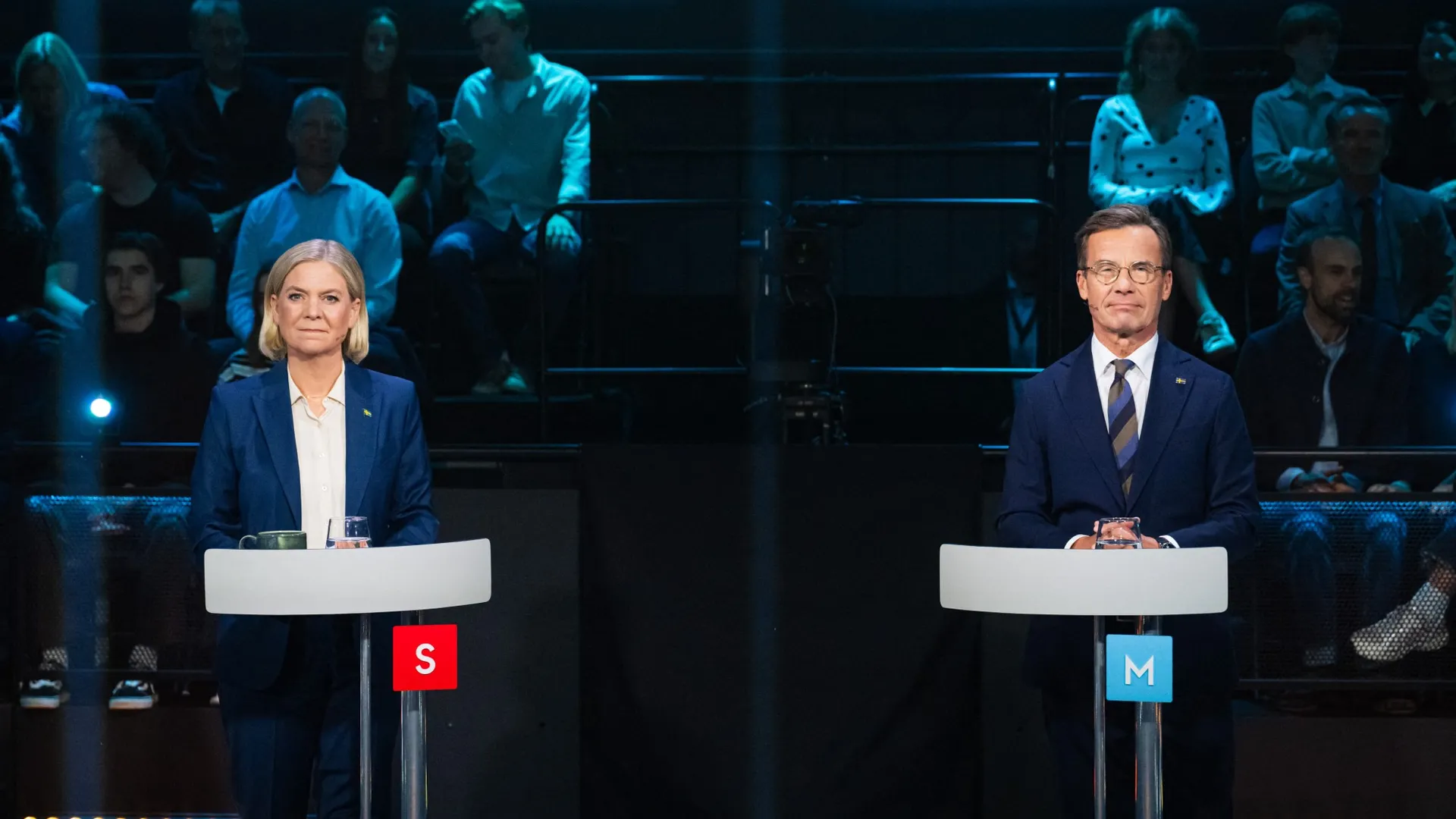
    The country’s center-right prime minister, Ulf Kristersson, is fighting for reelection on a platform of cutting asylum numbers and reducing gang shootings. His main rival, Magdalena Andersson (pictured above with Kristersson), the leader of the center-left Social Democrats, has been focusing on the economy, the welfare state, and suppression of the country’s growing far-right faction.

    Sweden uses a “mandate distribution” voting system, a type of proportional representation that means “coalitions are the norm” and “smaller parties often have outsized influence,” said Politico. With the “razor-thin victory margin” currently projected for the left, that will be “true again this time.”

    Why has this election been so tight?
    The friction between the two main blocs has been growing since the right-wing coalition “broke a long-standing taboo” by partnering with the Sweden Democrats, an anti-immigration party with “neo-Nazi roots,” said The Guardian. With a campaign slogan of “Make Sweden Sweden again,” the party touts policies that include banning headscarves and expanding a “repatriation grant” worth $35,900 to immigrants who are already Swedish citizens. And Kristersson has promised cabinet positions to Sweden Democrats members if the right-wing bloc is reelected, which has led to an “unusually heated and polarized” election campaign.

    What should we take from the results so far?
    The final result, and the fate of the far-right, will be closely watched elsewhere in other European countries where similar nationalist movements are gaining ground. But if Europe’s centrists were hoping to take lessons from Sweden on how to beat the populist right, these “confusing” results leave the situation “far from clear,” said The Economist. 

    Although Sweden Democrats have suffered their first decline in support since their party’s founding, they won’t be “too unhappy,” said the outlet. Previously ostracized, they have now “attained mainstream acceptance that was once unthinkable.”


    Statistic of the day

    5.5 million lbs.: The amount of ice and snow that melts annually on Mount Everest from urine runoff directly onto the glacier and fuel combustion at Everest Base Camp, according to research published in the journal Regional Environmental Change. During climbing season, the “teeming tourist village” burns fuel running “large-screen TVs” and “heated tent floors,” said The Independent.


    in the spotlight

    AI may have cracked the antiaging code

    A pharmaceutical company claims to have used artificial intelligence to discover a drug that reverses the impacts of aging. The finding highlights how the technology could make the drug discovery process easier or at least faster.

    Beating the ‘aging clocks’
    Last year, Insilico Medicine, a company that “aims to accelerate drug discovery” using artificial intelligence, announced that a clinical trial of one of its drug candidates suggested AI could help treat a chronic lung disease, said The New York Times. The disease, idiopathic pulmonary fibrosis, or IPF, is sometimes referred to as Alzheimer’s of the lungs. Now, new data from the same clinical trial shows an even “more intriguing possibility”: The drug, called rentosertib, could “also slow the aging process.” 

    The company used AI to assist in generating rentosertib’s molecular structure. The drug may be capable of reducing the biological markers of age as measured by six separate “aging clocks,” or AI technology “designed to predict a person’s morbidity and mortality,” said a new study published in the journal Nature Biotechnology,

    ‘Not replacing scientific intuition’
    The results of this study are the first to show “very clearly” that “predicted biological age can be reduced,” said Vadim Gladyshev, a Harvard Medical School professor who helped build one of the aging clocks, to the Times. Still, Gladyshev acknowledges that the study is far from conclusive, citing the small sample size and the unreliability of aging clocks. 

    Most notably, Insilico’s drug has “not yet been tested in healthy patients,” said the Times. Because the company conducted its clinical trial solely with IPF patients, the results may be specific to this condition.

    The idea of “reducing aging” has become the “obsession of some tech bro-types,” but the “actual utility of aging clocks is up for debate,” said Gizmodo. While some researchers believe that such “catch-all measurements” could be useful, there’s still a “long way to go before they become truly meaningful markers.” 

    AI is not “replacing scientific intuition,” and it’s “unlikely to do so anytime soon,” said Forbes. But it can “make the costly time-consuming R&D work” of preparing for clinical trials “more efficient.”


    Good day 🏆

    … for double winners. Welsh actor Matthew Rhys has made Emmy history as the first person to win two lead acting awards in one night, for his roles in the supernatural comedy series “Widow’s Bay,” which set a single-season record for a comedy with 14 wins, and the psychological crime thriller “The Beast in Me.” 


    Bad day 🥃

    … for whisky traditionalists. A “whisky war” has broken out with Scotland after “English single malts were given protected status,” said The Telegraph. The designation recognizes English malts as a distinctive whisky category, the same recognition as Scotch, Welsh and Irish whiskies. And the Scottish Whisky Association is now “considering retaliation against its southern rivals.”


    Picture of the day

    Fueling anger

    Protesters burn tires and block roads in the Syrian city of al-Bab. Demonstrations over the government’s decision to increase fuel prices are taking place across the country in the first major unrest since longtime ruler Bashar al-Assad was ousted in 2024.
    Bakr Alkasem / AFP / Getty Images


    Puzzles

    Daily sudoku

    Challenge yourself with The Week’s daily sudoku, part of our puzzles section, which also includes guess the number

    Play here


    The Week recommends

    Soul-stirring podcasts you may have missed

    We have officially reached past the halfway point of the year, and it’s time to say goodbye to summer. Before you move on to the next season and start preparing for cooler autumn days, here are a few of the best podcasts the summer had to offer.

    Paper Trail (ProPublica)
    The new podcast from the nonprofit ProPublica newsroom covers some of its “most important long reads,” said Podcast Review, such as a piece about “whether people who kill their abusers should walk free.” Host Jessica Lussenhop “acts as a guide” as “new leads are followed, sources are interviewed and truths are revealed.” (Apple Podcasts, ProPublica, Spotify)

    Search Engine: A Road Trip Through the Data Center Debate (Independent)
    Jasmine Sun, a tech worker turned independent journalist, spent 10 days traveling through Wisconsin and Michigan investigating data centers. Her trip, also chronicled on her Substack, “produced a vivid picture” of how people are “dealing with major tech companies bulldozing through their communities” to build massive data centers to serve their “highly lucrative AI ambitions,” said Vulture. (Apple Podcasts, Spotify)

    Where the River Took Us (Texas Monthly)
    This docu-podcast covers the tragic flood of the Guadalupe River that occurred on the Fourth of July. In this “beautifully crafted yet distressing series,” Texas Monthly senior editor Aaron Parsley tells a story that “begins with a peaceful family holiday and ends with the death of his nephew,” said Podcast Review. (Apple Podcasts, Spotify, Texas Monthly)

    Read more


    Poll watch

    Americans’ satisfaction with K-12 education has dropped to 32% — the lowest in nearly three decades and down 11% over the past two years, according to a Gallup survey of 1,200 U.S. adults. And 47% of those polled give K-12 schools a “poor” rating for preparing students to think critically.


    INSTANT OPINION

    Today’s best commentary

    ‘When a return to the office is a return to sex discrimination’
    Gleb Tsipursky at The Hill
    A recent Organization Science study analyzed “everyday gender discrimination” and found that women experience “far fewer gendered offenses when working remotely,” says Gleb Tsipursky. As employers “roll out return-to-office rules, the risk is clear: Mandates are not neutral. They can recreate the exact conditions that drive women out of roles, teams and entire fields.” The “core takeaway is not that remote work is perfect — it’s that location changes exposure to bias.”

    ‘We are ignoring the cause of homelessness and how to solve it’
    Michele Steeb at USA Today
    What if Americans “judged success not by whether people had housing but by whether they discovered or rediscovered who they were created to become”? says Michele Steeb. The federal government’s “Housing First approach” made “housing placement the primary intervention and measure of success, while removing expectations for treatment, sobriety, employment or progress toward self-sufficiency. In doing so, it too often treated the symptom of homelessness” while “leaving the deeper human crises that frequently accompany and perpetuate it unaddressed.”

    ‘Can a party be leftist and Zionist?’
    Tamam Abusalama at Al Jazeera
    Can a “party or an individual be both leftist and Zionist”? says Tamam Abusalama. The “short answer” is “no.” Touted in “Israel and beyond as a legitimate ideological belief,” being both is a “political technology designed to shield Zionism from any critique while preserving the structures of oppression.” Whatever “position early Zionists staked out on the political spectrum, what the movement ultimately produced — the state of Israel — was in direct contradiction with the anti-colonial, anti-racist politics the left was supposed to stand for.”


    WORD OF THE DAY

    diatom

    A type of microscopic algae found in water and soil. Diatomaceous earth, a “naturally occurring, soft sedimentary rock” made from the fossilized remains of diatoms, is used in the trending “Japanese manicure,” said Refinery29. The result is a “slight pink sheen that lasts for about two weeks,” said nail expert Gabriella Ferenczi to the outlet.


    Evening Review was written and edited by Will Barker, Theara Coleman, Nadia Croes, Scott Hocker, Anya Jaremko-Greenwold and Joel Mathis, with illustrations by Stephen Kelly.

    Image credits, from top: Illustration by Stephen P. Kelly / Getty Images; Jonathan Nackstrand / AFP / Getty Images; asbe / Getty Images; asbe / Getty Images
     

    Recent editions

    • Morning Report

      AI-linked stocks slip before traders shake off worries

    • Evening Review

      Will Burnham be the last prime minister of the UK?

    • Morning Report

      Reform defends £72m in donations amid crackdown

    VIEW ALL
    TheWeek
    • About Us
    • Contact Future's experts
    • Terms and Conditions
    • Privacy Policy
    • Cookie Policy
    • Advertise With Us
    • FAQ
    Add as a preferred source on Google Add as a preferred source on Google

    The Week UK is part of Future plc, an international media group and leading digital publisher. Visit our corporate site.

    © Future Publishing Limited Quay House, The Ambury, Bath BA1 1UA. All rights reserved. England and Wales company registration number 2008885.