The Week The Week
flag of US
US
flag of UK
UK
https://cdn.mos.cms.futurecdn.net/skoGBi9qKFoUtnNWkovjJQ.jpg

SUBSCRIBE

Try 6 Free Issues

Sign in
  • View Profile
  • Sign out
  • The Explainer
  • Talking Points
  • The Week Recommends
  • Podcasts
  • Newsletters
  • From the Magazine
  • The Week Junior
  • More
    • Politics
    • World News
    • Business
    • Health
    • Science
    • Food & Drink
    • Travel
    • Culture
    • History
    • Personal Finance
    • Puzzles
    • Photos
    • The Blend
    • All Categories
  • Newsletter sign up Newsletter
  • Brand Logo
    Venezuela blockade, Hegseth refusal and jobless uptick

     
    TODAY’S INTERNATIONAL story

    Trump vows naval blockade of most Venezuelan oil

    What happened
    President Donald Trump announced on social media last night that he had ordered a “TOTAL AND COMPLETE BLOCKADE OF ALL SANCTIONED OIL TANKERS going into, and out of, Venezuela.” The military campaign to block oil exports, the lifeblood of Venezuela’s economy, will “only get bigger” until President Nicolás Maduro and his government “return to the United States of America all of the Oil, Land and other Assets that they previously stole from us,” Trump wrote.

    Who said what
    “Venezuela is completely surrounded by the largest Armada ever assembled in the History of South America,” Trump wrote, and must return “our Oil, Land” and other assets “IMMEDIATELY.” The post marked a “major escalation of his pressure campaign” against Maduro, The Wall Street Journal said, though “it was unclear how many tankers would be affected.” An “effective embargo” is already in place following last week’s U.S. seizure of a sanctioned oil tanker off the coast of Venezuela, Reuters said. 

    Trump’s announcement yesterday “underscored” his focus on Venezuela’s oil, which was largely put “under state control in the 1970s,” CNN said. The Trump administration says its naval buildup and controversial strikes on civilian boats in the region are about fighting drug trafficking. But “behind the scenes,” officials have “focused intently on Venezuela’s oil reserves,” The New York Times said. Trump “has said both privately and publicly that the United States should take Venezuela’s oil” for years.

    “Oil industry experts and former U.S. officials questioned the legal and policy rationale of Trump’s declaration,” The Washington Post said. “A naval blockade is unquestionably an act of war,” Rep. Joaquin Castro (D-Texas) said on social media. “A war that the Congress never authorized and the American people do not want.”

    What next?
    A “high-level meeting” scheduled for today “could result in new orders to U.S. naval and air forces gathered in the Caribbean” and “more forceful U.S. naval operations in the next several days,” the Post said, citing a person familiar with the situation. Trump has also been threatening land strikes in Venezuela. But “if he were to authorize some activity on land, then it’s war,” White House Chief of Staff Susie Wiles said in a Vanity Fair interview published yesterday, and “then Congress” would need to assent.


    TODAY’S MILITARY story

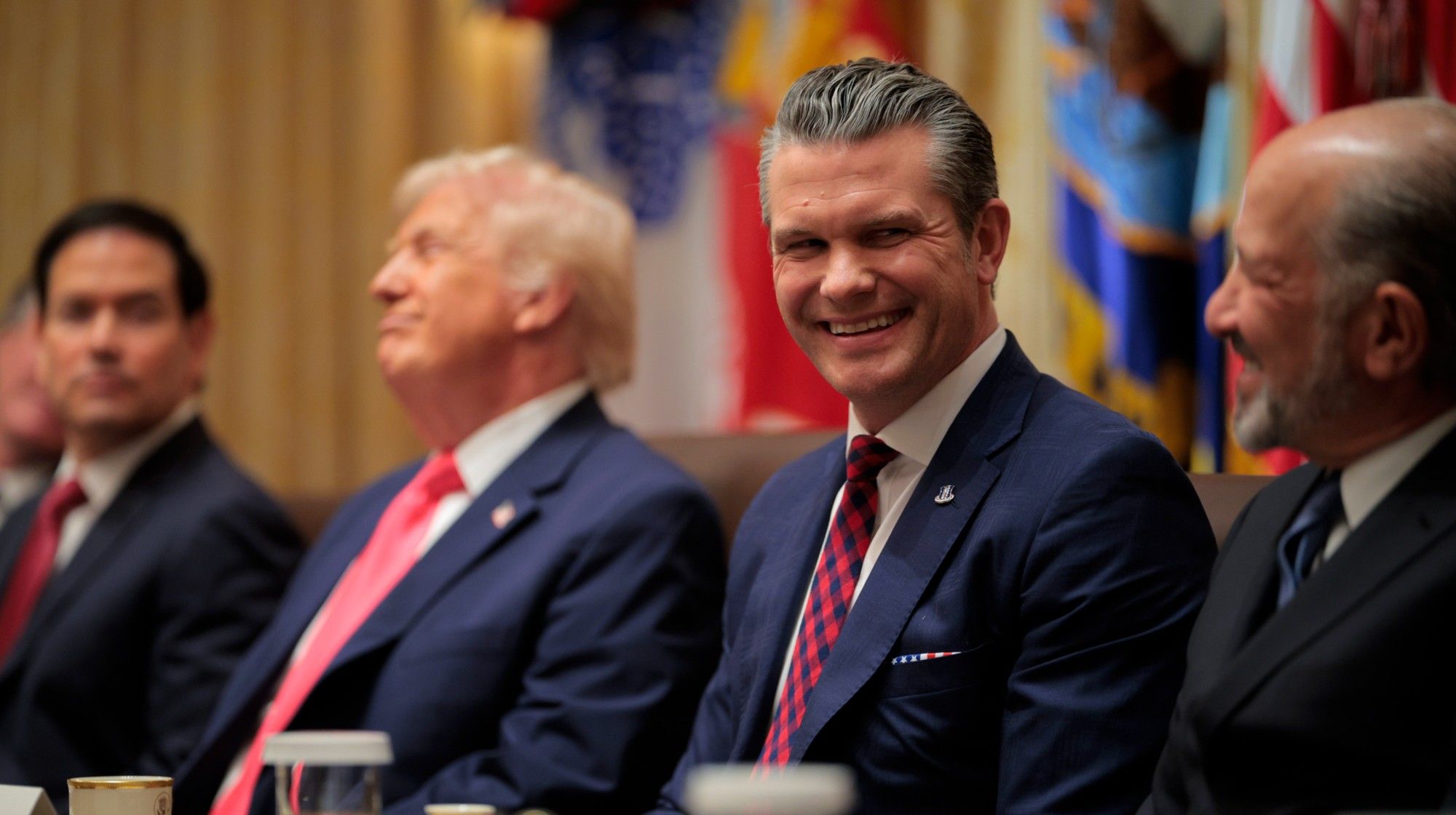
    Hegseth rejects release of full boat strike footage

    What happened
    Defense Secretary Pete Hegseth yesterday rebuffed bipartisan calls to release video of the military killing two survivors of a Sept. 2 missile strike on a speedboat allegedly carrying cocaine across the Caribbean. “We’re not going to release a top secret, full, unedited video of that to the general public,” he told reporters after a briefing for senators. And in Congress, only “appropriate committees will see it.”

    Who said what
    Hegseth and other top officials briefed the full House and Senate yesterday “amid bipartisan pressure for more transparency” and growing “questions about the nature and legality” of the boat strikes, The New York Times said. “Most Republicans exiting the briefing backed the Trump administration’s decision to limit access” to the full video, but Democrats said the administration’s excuse about protecting military secrets was undermined by the 20 boat strike clips it had already posted online, including of the initial Sept. 2 attack. “They just don’t want to reveal the part that suggests war crimes,” said Sen. Elizabeth Warren (D-Mass.).

    Lawmakers from both parties agreed the briefing “left them in the dark” about President Donald Trump’s “goals when it comes to President Nicolás Maduro” and Venezuela, The Associated Press said. Hegseth told reporters the boat bombing campaign was focused on eradicating cartels “poisoning the American people.” But White House Chief of Staff Susie Wiles told Vanity Fair that Trump “wants to keep on blowing boats up until Maduro cries uncle.” 

    What next?
    Hegseth said the Pentagon would show the full, unedited video to the House and Senate armed services committees today. The Senate was “on the brink of giving final approval to a defense policy bill that would freeze” a quarter of Hegseth’s travel budget “if he failed to give Congress unedited video of all the strikes, as well as the orders that led to them,” the Times said. 


    TODAY’S ECONOMY Story

    Unemployment rate ticks up amid fall job losses

    What happened
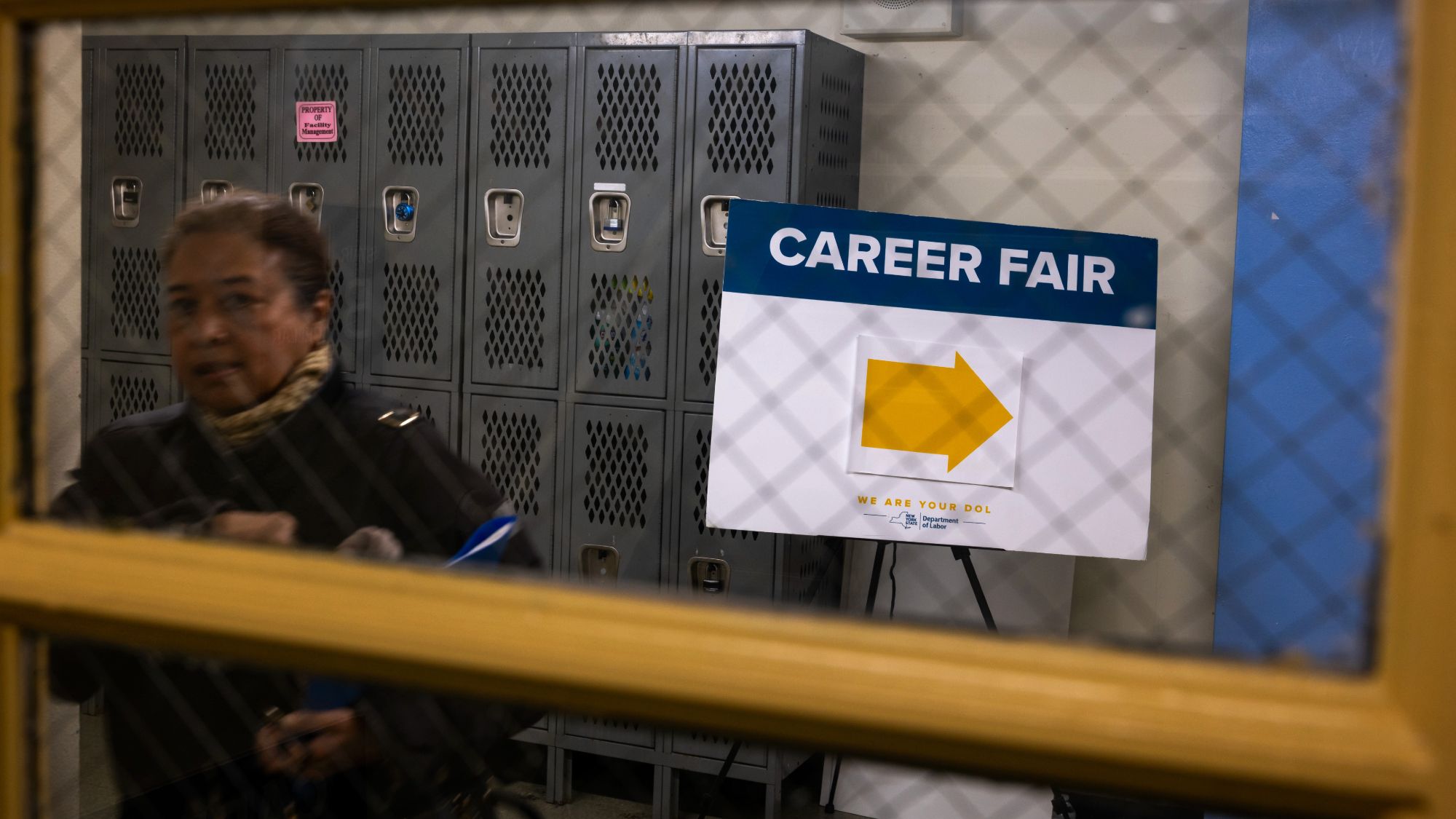
    The U.S. gained 64,000 jobs in November but lost 105,000 in October, the Commerce Department reported yesterday, and the unemployment rate climbed to 4.6%, the highest since 2021. Along with the net loss of 41,000 jobs, the department also revised August and September’s payroll numbers downward by 33,000 jobs. Wages grew an anemic 0.1% last month, the smallest gain since 2023. The October jobs report was delayed because of the government shutdown.

    Who said what
    “Taken together,” the data released yesterday “point to one of the weakest American labor markets in years,” The Wall Street Journal said. Hiring has “clearly lost momentum,” The Associated Press said, “hobbled by uncertainty over President Donald Trump’s tariffs” and the “lingering effects” of inflation-fighting high interest rates. 

    The “economy is flashing new warning signs,” but October’s steep losses “reflected the exit of tens of thousands of federal workers who took a deferred resignation package earlier this year,” The Washington Post said. “All roads lead back to policy out of Washington, D.C.,” RSM chief economist Joseph Brusuelas told the Journal. “I’m not saying this is a harbinger of a recession, but we have some real challenges to the economy that we didn’t have one year ago.”

    What next?
    The delayed jobs numbers, and a separate Commerce Department report yesterday that showed flat retail sales, “buttressed the Federal Reserve’s decision to cut interest rates last week,” the Post said. After that meeting, Fed Chair Jerome Powell “warned that official statistics could be overstating job creation by 60,000 jobs a month.” 


    It’s not all bad

    When students at Kellenberg Memorial High School in Uniondale, New York, need to relax or forget about classes, they turn to the four dogs, two peacocks, five peahens and nine parrots that live on campus. One visit with a dog is “sometimes worth two to the guidance counselor,” Kellenberg’s principal, Brother Kenneth Hoagland, told The Washington Post. Students interact with the animals throughout the day and say they feel more at ease when the pets are nearby.


    Under the radar

    AI griefbots create a computerized afterlife

    Some people who have lost loved ones are turning to a new industry to communicate with the dead: using artificial intelligence “griefbots” that mimic a deceased relative. Proponents say these AI griefbots can be a helpful part of the healing process surrounding death — but some tech experts are wary.

    While this AI niche started small, there are “now more than half a dozen platforms that offer this service straight out of the box, and developers say that millions of people are using them to text, call or otherwise interact with re-creations of the deceased,” said Nature. The large language models (LLMs) that these griefbots train from often use “data such as a person’s text messages and voice recordings to learn language patterns and context specific to that person.” 

    “After getting over the initial shock of hearing the incredibly accurate representation of his voice, I definitely cried,” Andy O’Donnell, who used a griefbot to speak with his deceased father, told The New York Times. Despite such stories of virtual emotional connection, “questions about exploitation, privacy and their impact on the grieving process are multiplying,” said The Guardian. 

    The “intentions behind griefbots might seem compassionate,” but their “broader implications require careful consideration,” said Natasha Fernandez at the University of Alabama at Birmingham’s Institute for Human Rights. Possible exploitation of grieving people is one of the biggest concerns, as “grieving individuals in their emotional vulnerability may be susceptible to expensive services marketed as tools for solace.”


    On this day

    December 17, 1903

    Orville and Wilbur Wright achieved the first sustained flight in an airplane in Kitty Hawk, North Carolina. The brothers’ experimental craft, known as the Wright Flyer, was damaged beyond repair following four short flights, but it helped usher in the era of modern aviation.


    TODAY’S newspaperS

    ‘Still no answers’

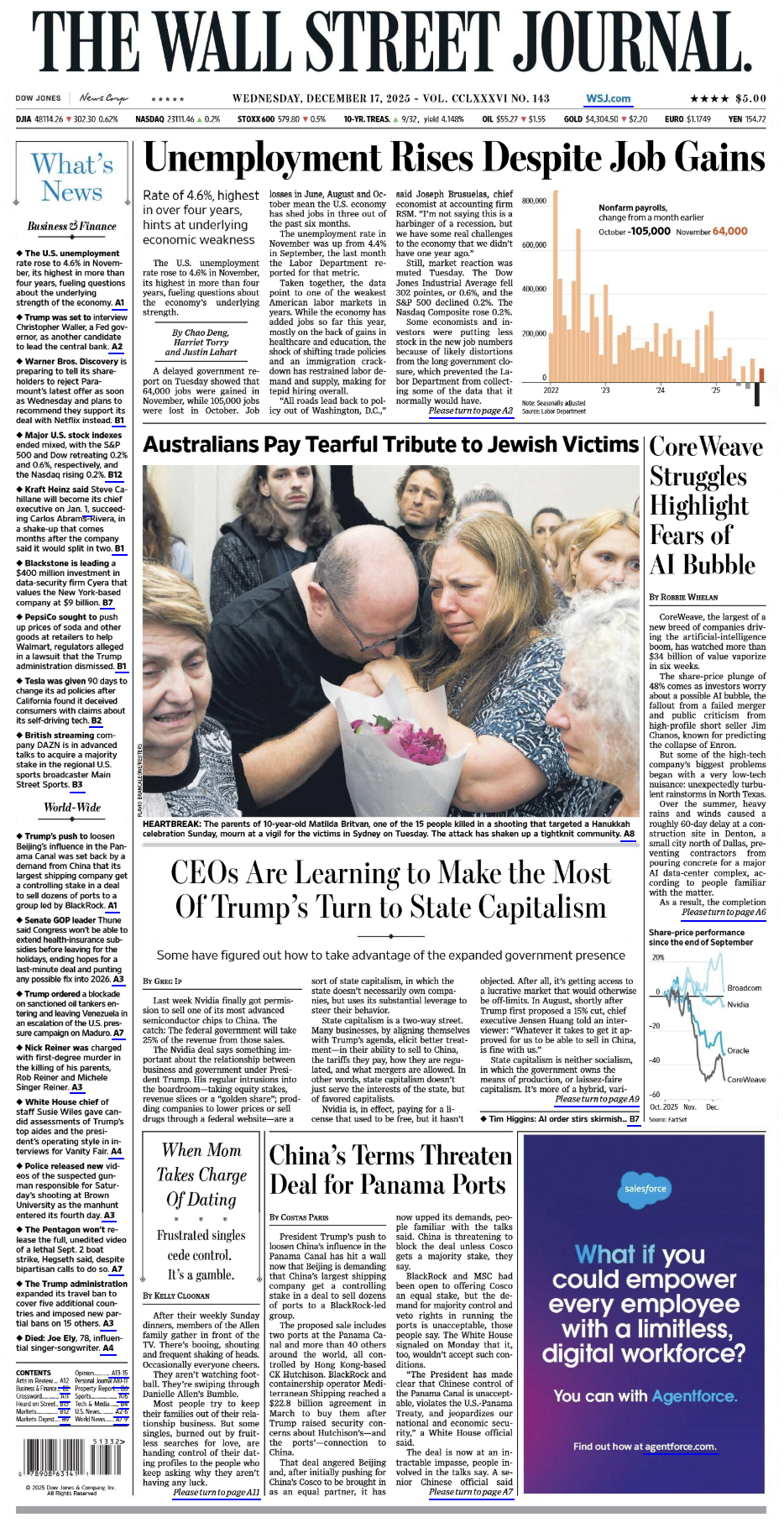
    “Unemployment rises in warning for U.S. economy,” The New York Times says on Wednesday’s front page. “Trump tries to tame ire on costs,” The Washington Post says. “CEOs are learning to make the most of Trump’s turn to state capitalism,” says The Wall Street Journal. “FBI seeks leads in Brown shooting,” the Arizona Republic says. “Still no answers,” says The Boston Globe. “Reiner son faces murder charges in double slaying” and “could get the death penalty or life in prison without parole if convicted,” the Los Angeles Times says. The “Reiners’ awful struggle could be any of us” as many “families confront anguish of addiction,” says USA Today.

    ► See the newspaper front pages


    Tall tale

    Unwrapping for presents

    Strippers from across Portland, Oregon, are participating in their annual Tatas for Toys fundraiser, which earns so much money that the group is a top donor of gifts to Doernbecher Children’s Hospital. The “pretty PG-13” benefit leans “more silly than sexy,” said Willamette Week, and it has raised $183,000 over the last 14 years. Dancers visit local stores to purchase toys for the hospital’s Child Life Therapy Program, including dolls and stuffed animals used to teach patients how IVs work.


    Morning Report was written and edited by Nadia Croes, Catherine Garcia, Scott Hocker, Anya Jaremko-Greenwold, Justin Klawans, Rafi Schwartz, Peter Weber and Kari Wilkin, with illustrations by Stephen Kelly and Julia Wytrazek.

    Image credits, from top: Miguel J. Rodriguez Carrillo / AFP via Getty Images; Chip Somodevilla / Getty Images; Spencer Platt / Getty Images; Illustration by Julia Wytrazek / Getty Images
     

    Recent editions

    • Evening Review

      Trump’s ‘high-speed’ peace deals

    • Morning Report

      US freezes UK tech investment deal

    • Evening Review

      Australia’s painful reckoning

    VIEW ALL
    TheWeek
    • About Us
    • Contact Future's experts
    • Terms and Conditions
    • Privacy Policy
    • Cookie Policy
    • Advertise With Us
    • FAQ
    Add as a preferred source on Google

    The Week UK is part of Future plc, an international media group and leading digital publisher. Visit our corporate site.

    © Future Publishing Limited Quay House, The Ambury, Bath BA1 1UA. All rights reserved. England and Wales company registration number 2008885.