The Week The Week
flag of US
US
flag of UK
UK
https://cdn.mos.cms.futurecdn.net/skoGBi9qKFoUtnNWkovjJQ.jpg

SUBSCRIBE

Try 6 Free Issues

Sign in
  • View Profile
  • Sign out
  • The Explainer
  • Talking Points
  • The Week Recommends
  • Podcasts
  • Newsletters
  • From the Magazine
  • The Week Junior
  • More
    • Politics
    • World News
    • Business
    • Health
    • Science
    • Food & Drink
    • Travel
    • Culture
    • History
    • Personal Finance
    • Puzzles
    • Photos
    • The Blend
    • All Categories
  • Newsletter sign up Newsletter
  • Brand Logo
    GOP health revolt, Jack Smith deposition and Oscars streaming leap

     
    TODAY’S HEALTH CARE story

    House GOP revolt forces vote on ACA subsidies

    What happened
    The House last night passed a health care bill proposed by Speaker Mike Johnson (R-La.) that would lower some costs modestly but not extend expiring Affordable Care Act subsidies. Defying Johnson (pictured above), four of the Republicans who pushed his bill to its narrow 216-211 passage also signed a discharge petition yesterday, clinching the 218 signatures needed to force a vote on a Democratic proposal to extend the subsidies for three years. 

    Who said what
    Several politically vulnerable Republicans had pushed Johnson to allow a vote on their proposals to extend the ACA credits for a year or two, with new limits, to avert a sharp rise in premiums for 24 million Americans in January. “But with most Republicans opposed to the subsidies, Johnson refused to allow an extension in his bill, fomenting the strongest rebellion among Republicans from swing districts to date,” The Washington Post said. 

    “To me, the clean three-year extension is not ideal,” said Rep. Michael Lawler (R-N.Y.), one of the four Republicans who signed the Democrats’ petition. “But doing nothing is not an answer.” Johnson “forced this outcome,” said fellow moderate rebel Rep. Brian Fitzpatrick (R-Pa.).

    The “stunning maneuver” by the House GOP “splinter group” was “all but guaranteed to prolong Republican infighting over health care, an issue that has bedeviled the party for years, into a midterm election year” with “considerable headwinds,” The New York Times said. It was also the “latest evidence” that Johnson’s “grip on his fractious majority has slipped” as “rank-and-file Republicans openly question his leadership and flout his wishes,” advancing four “once rare” discharge petitions, a feat last achieved in 1938. “I have not lost control of the House,” Johnson told reporters yesterday.

    What next?
    Johnson’s bill “is dead on arrival in the Senate and will do little to quell a major intraparty split over the future of the subsidies,” Politico said. Senate GOP leaders say the three-year extension, if it passes the House next month, is also “doomed to die” in the upper chamber, but “House GOP moderates are now discussing options with their Senate counterparts about a bipartisan compromise bill that could pass both chambers” before the end of January, after the subsidies have lapsed.


    TODAY’S JUSTICE story

    Jack Smith tells House of ‘proof’ of Trump’s crimes

    What happened
    Former special counsel Jack Smith yesterday told members of the House Judiciary Committee that his investigators had uncovered “proof beyond a reasonable doubt” that President Donald Trump “engaged in a criminal scheme to overturn the results of the 2020 presidential election,” according to his prepared remarks for the closed-door deposition. Smith said his team also found “powerful evidence” that Trump had illegally hoarded classified documents and “repeatedly tried to obstruct justice.” Due to Justice Department policy, both investigations were dropped after Trump won last year’s election.

    Who said what
    Yesterday’s “day-long deposition” gave lawmakers their “first chance, albeit in private, to question Smith” about his twin criminal investigations of Trump, The Associated Press said. It “unfolded against the backdrop of a broader retribution campaign by the Trump administration against former officials involved in investigating Trump and his allies.” 

    Smith himself faces a “renewed wave of Republican attacks,” said NBC News. He had repeatedly requested a “public forum for his testimony to set the record straight” about his investigations and their nonpartisan nature, Politico said, but committee Chair Jim Jordan (R-Ohio) “declined that request.” Jordan told reporters after the interview that he had “learned some interesting things,” but declined to elaborate. 

    What next?
    Jordan said “he had not ruled out the possibility of Smith appearing in a public venue,” Politico said, and Democrats supported that idea. Had Smith testified publicly yesterday, Rep. Jamie Raskin (D-Md.) told reporters, “it would have been absolutely devastating to the president.” Trump previously “told reporters that he supported the idea of an open hearing,” the AP said.


    TODAY’S CULTURE Story

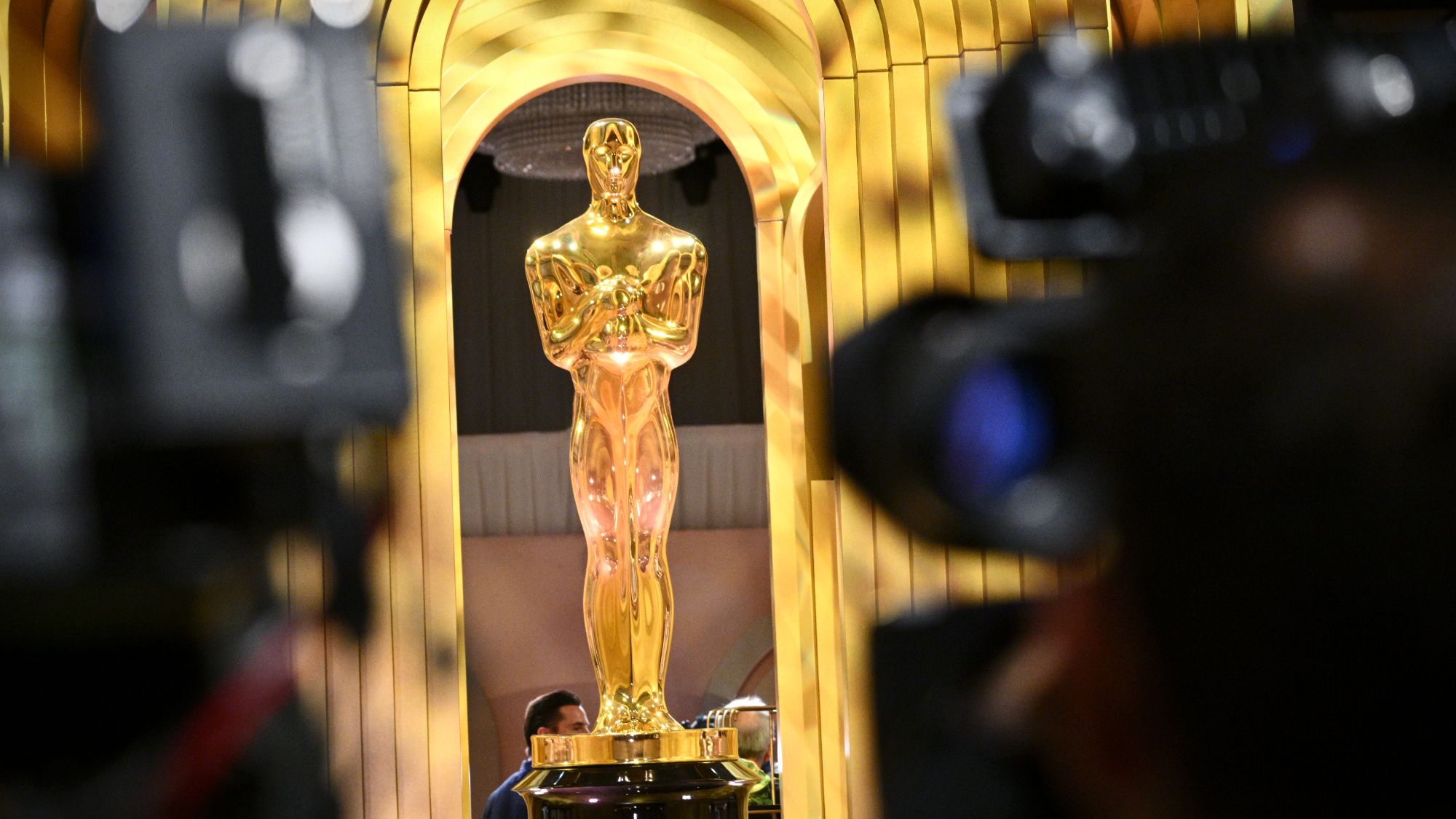
    Oscars jump to YouTube in 2029 after decades at ABC

    What happened
    The Academy Awards will be broadcast worldwide on YouTube beginning in 2029, the Academy of Motion Picture Arts and Sciences announced yesterday. ABC, which has broadcast the Oscars exclusively since 1976, will continue doing so until the 100th Academy Awards in 2028.

    Who said what
    The Oscars will be the first major award show to “completely jettison broadcast television,” The Associated Press said. Putting “one of the most watched non-NFL broadcasts in the hands of Google” is a “seismic shift” for Hollywood and the media industry. YouTube “secured Oscars rights in a bidding war that reportedly included competitors such as ABC, NBC and, at one point, Netflix,” The Washington Post said. 

    ABC “did not want to overpay,” after finding it “harder in recent years to turn a profit from the show,” Reuters said. This year’s Oscars drew 19.7 million viewers on ABC, a “five-year high” but far fewer than the record 57 million in 1998. YouTube is believed to have “shelled out over nine figures for the Oscars,” Variety said, citing insiders. Disney was “surprised” the “sole streamer” won the bidding war, but losing to YouTube “doesn’t sting as hard” as if a “direct competitor” like NBC had prevailed.

    What next?
    YouTube will stream the Oscars, “including red carpet coverage, behind-the-scenes content and Governors Ball,” live and “free of charge” from 2029 through at least 2033, Variety said. “There will continue to be commercials.” Nominations for the 2026 Oscars, hosted by Conan O’Brien, will be announced Jan. 22. Without ABC’s production control, the Academy “can do whatever they want” in 2029, one insider told Variety. “You can have a six-hour Oscars hosted by MrBeast.”


    It’s not all bad

    Grandmothers in Colorado, Nebraska and Texas are setting up tables in public spaces and inviting strangers to stop and chat or ask for advice. Grandma Stand is a volunteer network founded by Mike Matthews, whose own grandmother, Eileen Wilkinson, was the first grandma to participate; he estimates she spoke with at least 1,000 people before her death in 2018. It’s “refreshing” to sit down for a “true face-to-face connection,” Nancy McClendon, a volunteer from McKinney, Texas, told the CBC.


    Under the radar

    The curious history of hanging coffins

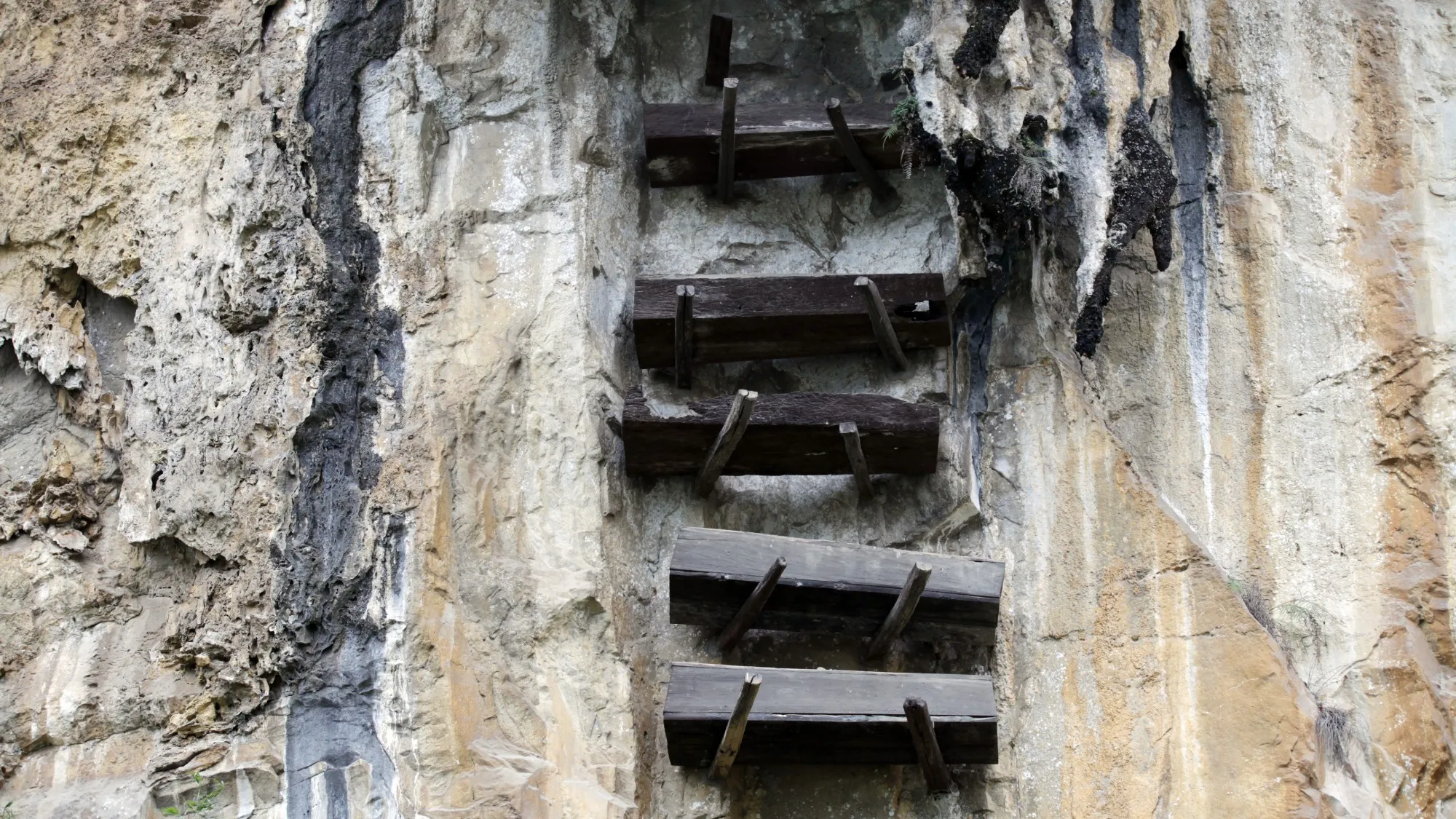
    Ancient peoples in southern China practiced a funeral tradition of “hanging coffins” for thousands of years, and according to a study published in the journal Nature Communications, their descendants still live in the region today. The findings “provide valuable insights into the genetic, cultural and historical roots of this burial custom,” said the study’s authors.

    For millennia, inhabitants of modern-day Yunnan and Fujian provinces carried their dead high into the mountains and “pegged” their wooden coffins into crevices in “exposed cliffs,” said Live Science. It’s thought that they used wooden scaffolding, rope pulleys or man-made trails to ascend the rocky cliffs.

    Hanging coffins are “considered auspicious,” wrote a Yuan dynasty chronicler sometime between 1279 and 1368. “The higher they are, the more propitious they are for the dead. Furthermore, those whose coffins fell to the ground were considered more fortunate.”

    The new study examined 11 bodies dating back as far as 2,000 years and used genome sequencing to confirm them as belonging to the Bo people, known in regional folklore by “names such as ‘Subjugators of the Sky' and 'Sons of the Cliffs,'” the study said. Several thousand people of Bo descent still live in Yunnan province. 

    But the practice of suspending remains on a cliff face can also be found in other Southeast Asian cultures. Hanging coffins are one of the burial customs of the Kankanaey people of Sagada, on the island of Luzon in the Philippines. And in Indonesia, shaped coffins known as erong, guarded by carved wooden representations of the dead, were placed in high caves and cliffside niches by the Toraja people until the 1960s.


    On this day

    December 18, 1957

    The world’s first full-scale nuclear power plant for peacetime use, the Shippingport Atomic Power Station in Pennsylvania, began generating electricity. The plant helped power the Keystone State until its decommissioning in 1989. Today, there are about 440 nuclear power plants worldwide, according to the World Nuclear Association.


    TODAY’S newspaperS

    ‘Revolt in GOP’

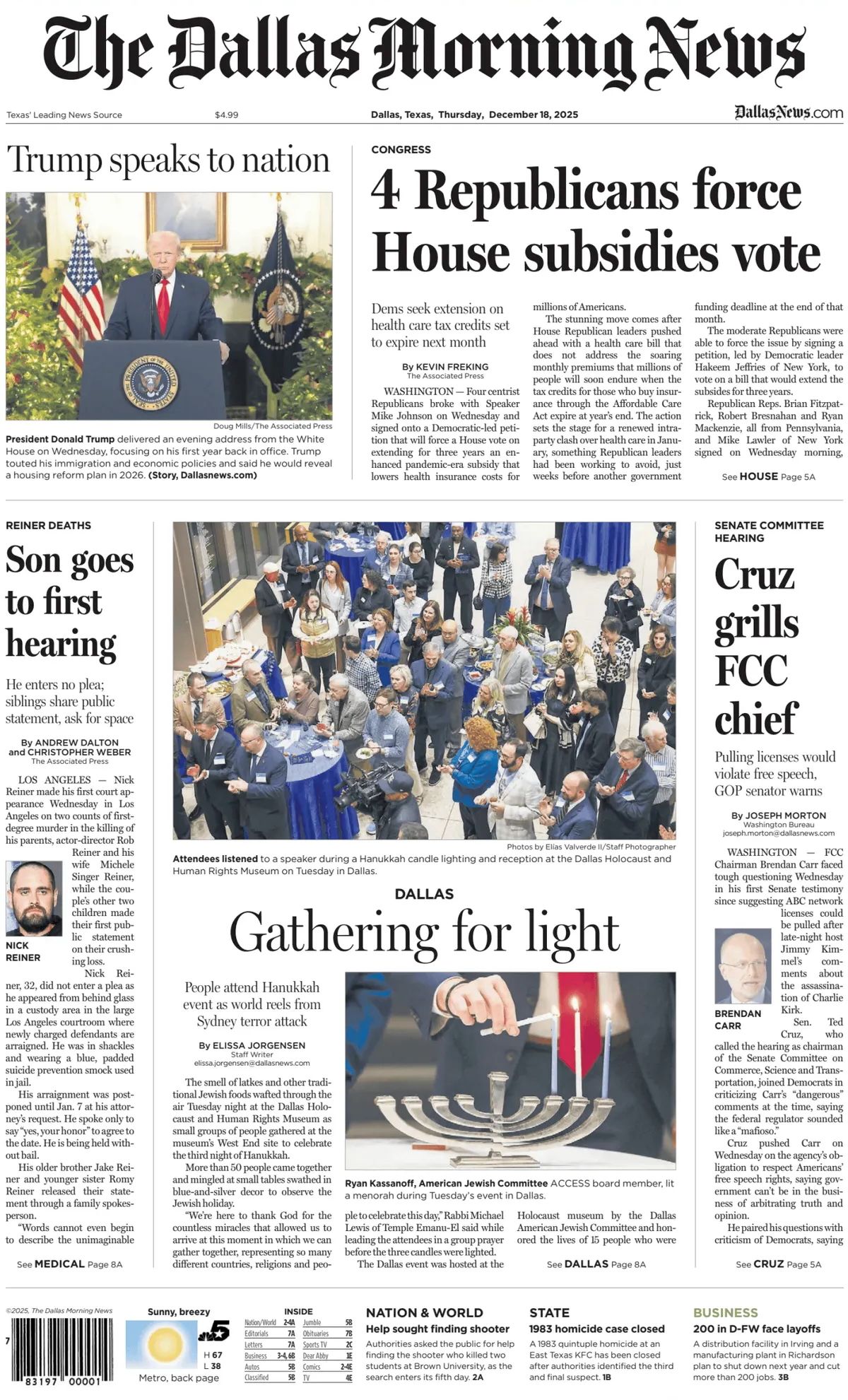
    “U.S. to disband premier weather research hub” as White House “cites the lab’s climate work as ‘alarmism,’” The New York Times says on Thursday’s front page. “Bill with Hegseth penalty prevails” as “Pentagon budget clears Senate, heads to Trump,” The Washington Post says. “4 Republicans defy speaker, force vote on ACA subsidies,” the Chicago Tribune says. “Revolt in GOP on health exposes party rift,” The Wall Street Journal says. GOP Sen. Ted Cruz “grills FCC chief,” warns “pulling licenses would violate free speech,” The Dallas Morning News says. “And the Oscars go to … YouTube,” the Los Angeles Times, while “Paramount’s hostile bid rejected” by Warner Bros. Discovery. 

    ► See the newspaper front pages


    Tall tale

    High-fructose high-tops

    Denny’s is branching out from serving pancakes to selling footwear. The diner chain’s $195 Sticky Kicks high-tops are filled with “real Denny’s syrup” that’s inedible and for “style only,” the company cautioned. Designed by shoe artist Mache, Sticky Kicks were created in honor of National Syrup Day (Dec. 17). The sneakers are “impractical, unnecessary and completely over the top,” said Denny’s Chief Brand Officer Ellie Doty, “which is exactly why we love them.”


    Morning Report was written and edited by Nadia Croes, Catherine Garcia, Scott Hocker, Anya Jaremko-Greenwold, Justin Klawans, Chas Newkey-Burden, Rafi Schwartz, Peter Weber and Kari Wilkin, with illustrations by Stephen Kelly and Julia Wytrazek.

    Image credits, from top: Kevin Dietsch / Getty Images; Eric Lee / Bloomberg / Getty Images; Michael Buckner / Variety via Getty Images; View Stock / Getty Images
     

    Recent editions

    • Evening Review

      Trump vs. BBC: what’s at stake

    • Morning Report

      UK will return to Erasmus exchanges from 2027

    • Evening Review

      Trump’s ‘high-speed’ peace deals

    VIEW ALL
    TheWeek
    • About Us
    • Contact Future's experts
    • Terms and Conditions
    • Privacy Policy
    • Cookie Policy
    • Advertise With Us
    • FAQ
    Add as a preferred source on Google

    The Week UK is part of Future plc, an international media group and leading digital publisher. Visit our corporate site.

    © Future Publishing Limited Quay House, The Ambury, Bath BA1 1UA. All rights reserved. England and Wales company registration number 2008885.