The Week The Week
flag of US
US
flag of UK
UK
https://cdn.mos.cms.futurecdn.net/skoGBi9qKFoUtnNWkovjJQ.jpg

SUBSCRIBE

Try 6 Free Issues

Sign in
  • View Profile
  • Sign out
  • The Explainer
  • Talking Points
  • The Week Recommends
  • Podcasts
  • Newsletters
  • From the Magazine
  • The Week Junior
  • More
    • Politics
    • World News
    • Business
    • Health
    • Science
    • Food & Drink
    • Travel
    • Culture
    • History
    • Personal Finance
    • Puzzles
    • Photos
    • The Blend
    • All Categories
  • Newsletter sign up Newsletter
  • Brand Logo
    Wind power ‘gutting,’ ‘battleship’ revival and Greenland grab

     
    TODAY’S ENERGY story

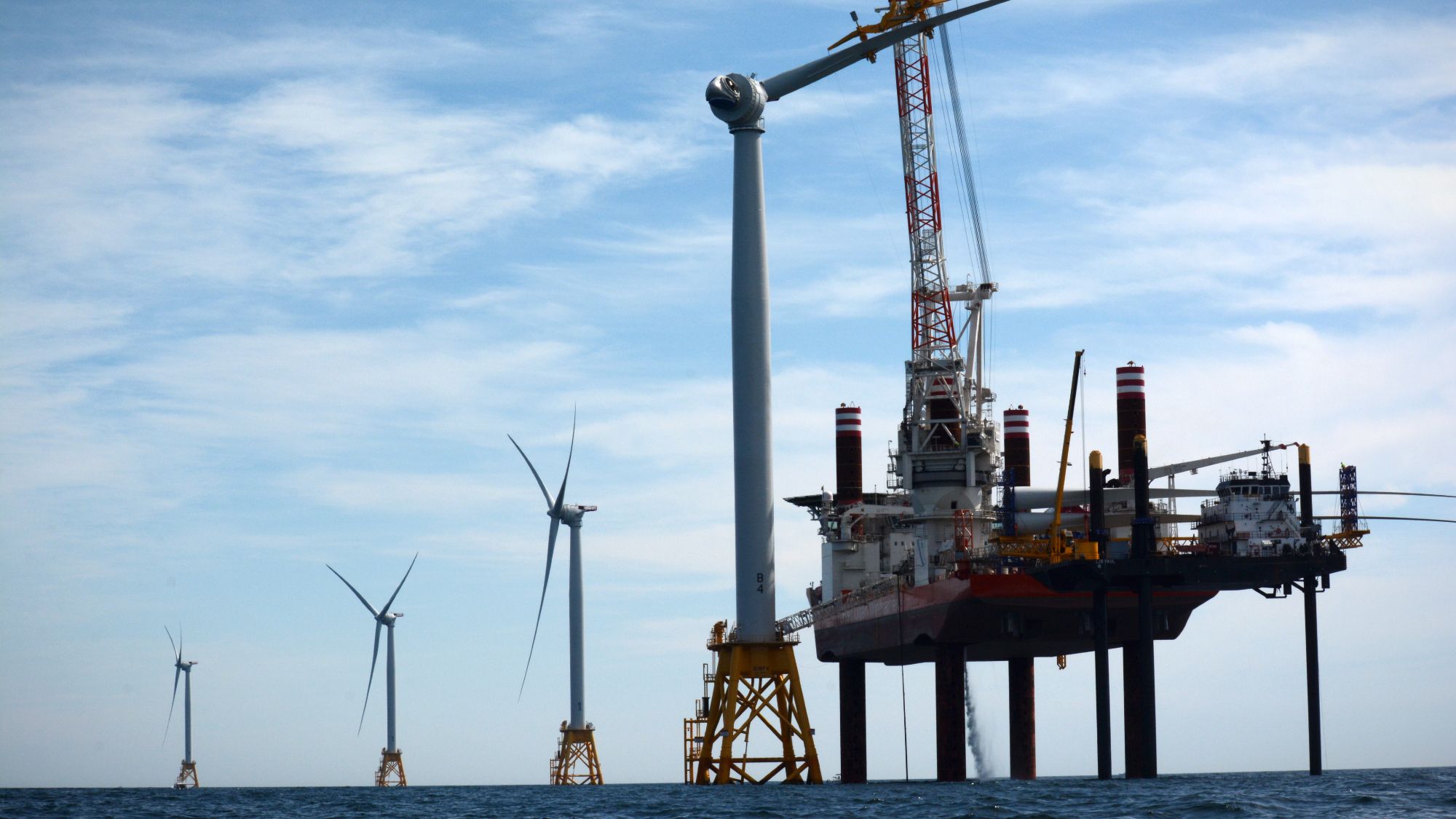
    Trump halts wind power projects, citing ‘security’

    What happened
    The Interior Department yesterday said it was “pausing — effective immediately” — all “large-scale offshore wind projects under construction” in the U.S. “due to national security risks” identified by the Pentagon in “recently completed classified reports.” The announcement effectively halts five wind energy projects off the East Coast from Virginia to New England, leaving just two operational wind farms in U.S. coastal waters.

    Who said what
    Halting the wind farms was the “most sweeping broadsides yet against the renewable energy source” most directly in President Donald Trump’s “crosshairs,” Axios said. Trump has boosted fossil fuels and hampered renewable energy throughout his time in office, but he has been on a personal “crusade” against wind power “ever since, 14 years ago, he failed to stop an offshore wind farm visible from one of his golf courses in Scotland,” The New York Times said. Now his administration is “essentially gutting” America’s “nascent offshore wind industry.” 

    Interior Secretary Doug Burgum cited the classified “emerging national security risks” in a statement, but White House spokesperson Taylor Rogers said Trump “has been clear” that  “wind energy is the scam of the century.” Connecticut Gov. Ned Lamont (D), whose constituents were among the 2.5 million households and businesses expected to benefit from the blocked wind farms, said Trump’s “erratic anti-business move” would “drive up the price of electricity” across the region. 

    Trump’s “bogus ‘national security risks’” excuse will also “set back the cause of generating enough energy to meet the demands of the AI boom,” The Washington Post said in an editorial. A federal judge two weeks ago struck down Trump’s executive order blocking wind energy projects, calling it illegal, “arbitrary and capricious.” But the “administration’s decision to cite potential national security risks could complicate legal challenges” going forward, The Associated Press said.

    What next?
    Burgum said on Fox News he was working with wind farm companies “to see if there’s a way to actually mitigate this.” But the indefinite “pause” has already “threatened to stymie a long-debated bipartisan energy permitting bill winding its way through Congress,” Politico said, and the “rising electricity prices” from sidelining nearly complete “major new power sources” could pose a “political problem for Trump’s party.” 


    TODAY’S MILITARY story

    Trump unveils new ‘Trump class’ US warships

    What happened
    President Donald Trump yesterday announced he was working with the U.S. Navy to design and build a “Trump class” fleet of “battleships” that would form a centerpiece of America’s revamped “Golden Fleet.” The new warships will “be the fastest, the biggest and by far 100 times more powerful than any battleship ever built,” Trump told reporters at Mar-a-Lago, standing alongside Defense Secretary Pete Hegseth, Navy Secretary John Phelan and renderings of the proposed vessel. The last U.S. battleship was decommissioned in 1992.

    Who said what
    Trump said construction would begin “almost immediately” on the first of up to 25 Trump-class ships, the USS Defiant, which would be delivered in “two and a half years.” A U.S. official told The Associated Press that construction was planned to begin in the early 2030s. “There is no funding in the current Pentagon budget” for the warships, Politico said.

    The new ships, as described by Trump, “will be armed with hypersonic missiles, nuclear cruise missiles, rail guns and high-powered lasers,” the AP said, “all technologies that are in various stages of development by the Navy,” with some previously abandoned as impractical. Massive new $5 billion warships are “exactly what we don’t need” to defend “against the Chinese threat,” retired Rear Adm. Mark Montgomery, now at the Foundation for Defense of Democracies, told The Wall Street Journal. “They are focused on the president’s visual that a battleship is a cool-looking ship.”

    What next?
    “This ship is never going to sail,” Mark Cancian, a military expert at the Center for Strategic and International Studies, told The Washington Post. He predicted it would “take four, five, six years” to just develop the ship. Trump said he would meet with defense contractors in Florida next week to accelerate production.


    TODAY’S INTERNATIONAL Story

    Danes ‘outraged’ at Trump’s revived Greenland push

    What happened
    President Donald Trump yesterday revived his early-term campaign to take control of Greenland, a self-ruling territory of NATO ally Denmark. Trump has publicly coveted the large Arctic island’s mineral wealth, but “we need Greenland for national security, not for minerals,” he told reporters yesterday. “We have to have it,” he added, and Louisiana Gov. Jeff Landry (R) will “lead the charge.” 

    Who said what
    Trump unexpectedly named Landry (pictured above) as his “special envoy to Greenland” on Sunday. Landry said on social media yesterday he would work to “make Greenland a part of the U.S.” in his new “volunteer position,” which “in no way affects my position as Governor of Louisiana!” It’s illegal to “annex another country,” Danish Prime Minister Mette Frederiksen and Greenland’s Prime Minister Jens-Frederik Nielsen said in a joint statement. “Greenland belongs to the Greenlanders, and the U.S. shall not take over Greenland.” 

    Trump’s fixation on Greenland “gradually drifted out of the headlines” following his initial push, The Associated Press said. But Danish officials protested in August after “at least three people with connections to Trump” reportedly “carried out covert influence operations in Greenland.” And earlier this month, the Danish Defense Intelligence Service assessed that the U.S. was using its economic power to “assert its will” and threaten military force against both friends and foes.

    What next?
    Opinion polls in Greenland “show overwhelming opposition to becoming part of the US,” the BBC said. And Trump’s refusal to “rule out using force to secure control of the island” has “shocked Denmark.” Danish Foreign Minister Lars Lokke Rasmussen told local media yesterday he was “deeply outraged” by the developments and would summon U.S. Ambassador to Denmark Ken Howery for an explanation. 


    It’s not all bad

    Hal Yoak always enjoyed woodworking, and after retiring, he decided to turn his hobby into a home business selling handmade toys. The 100-year-old former teacher crafts toy cars, dinosaurs on wheels, helicopters and other novelties inside his garage in Garden Grove, California. During the holidays, Yoak opens the garage door and invites the community to come inside and shop. Working on his toys “keeps me going,” he told ABC7.


    Under the radar

    Data centers could soon be orbiting in space

    Artificial intelligence increasingly requires so much space and power that we may run out of both on Earth. To get around those limitations, tech companies are looking to do business in space by creating celestial data centers that harness solar power. Operating in the vacuum of space requires less cooling, but it could create other costs and ecological problems. 

    These orbital systems would “benefit from continuous solar energy generated by arrays of photovoltaic cells,” Benjamin Lee, a computer architect and an engineer at the University of Pennsylvania, said to Scientific American. A move to space could “resolve long-standing challenges around powering data center computation in a carbon-efficient manner.” 

    The cost to send satellites into orbit has “decreased over the years,” but it’s “still prohibitively expensive to launch and operate these things in space,” said The Verge. Space-based computing will “not become cost-effective unless rocket launch costs decline substantially,” said Scientific American. Experts also warn that these systems could have “even bigger environmental and climate effects than their earthly counterparts.”

    Having data centers “visible in the night sky at dawn or dusk” presents a problem because some observers “rely on twilight to hunt for near-Earth asteroids,” said Scientific American. Also, it could worsen the space junk problem, as “more hardware is launched and more debris and fragments fall back through the atmosphere.”


    On this day

    December 23, 1888

    Vincent van Gogh cut off part of his left ear during what was believed to be a bout with mental illness. The injury, two years before the Dutch painter’s death, became part of his legend. Though he sold only one painting in his lifetime, Van Gogh is now considered one of the greatest artists in history.


    TODAY’S newspaperS

    ‘Nothing seems affordable’

    “To new middle class, nothing seems affordable,” The New York Times says on Tuesday’s front page. “Holiday giving season falls short this year,” The Dallas Morning News says. “Hot on wish list: professional Santas,” says the Houston Chronicle. “Wegovy’s pill form is granted approval by FDA,” The Wall Street Journal says. Senate Minority Leader Chuck Schumer (D-N.Y.)  “rips Epstein ‘coverup,’ pushes for Senate suit to force release of more than ‘tiny fraction’ of files,” the New York Daily News says. Sen. Ted Cruz (R-Texas) “eyes a presidential run as rivalry with Vance heats up,” The Washington Post says. “Vance declines to condemn bigotry,” the Los Angeles Times says. “Chiefs to announce move to Kansas, new stadium,” says The Kansas City Star. 

    ► See the newspaper front pages


    Tall tale

    Spaghetti and eyeballs

    A husband in Sicily is suing a restaurant after it posted a TikTok video showing him eating dinner with a woman who was not his wife. Codacons, an Italian consumer rights group, is standing up for the unidentified man, whose wife saw the video and asked for a divorce. The restaurant violated privacy laws by not having “clear permission” to film the man and his date, said a Codacons spokesperson, and the video exposed them to “unpredictable consequences.”


    Morning Report was written and edited by Nadia Croes, Catherine Garcia, Scott Hocker, Anya Jaremko-Greenwold, Justin Klawans, Rafi Schwartz, Peter Weber and Kari Wilkin, with illustrations by Stephen Kelly and Julia Wytrazek.

    Image credits, from top: Mark Harrington / Newsday RM via Getty Images; Tasos Katopodis / Getty Images; Samuel Corum / Sipa / Bloomberg via Getty Images; Illustration by Marian Femenias-Moratinos / Getty Images
     

    Recent editions

    • Evening Review

      Why is Trump redacting Epstein files?

    • Morning Report

      Israel expands West Bank settlements

    • Sunday Shortlist

      ‘Joyous’ festive theatre delights

    VIEW ALL
    TheWeek
    • About Us
    • Contact Future's experts
    • Terms and Conditions
    • Privacy Policy
    • Cookie Policy
    • Advertise With Us
    • FAQ
    Add as a preferred source on Google

    The Week UK is part of Future plc, an international media group and leading digital publisher. Visit our corporate site.

    © Future Publishing Limited Quay House, The Ambury, Bath BA1 1UA. All rights reserved. England and Wales company registration number 2008885.