The Week The Week
flag of US
US
flag of UK
UK
https://cdn.mos.cms.futurecdn.net/flexiimages/jzblygzdxr1769609154.gif

SUBSCRIBE

Try 6 weeks free

Sign in
  • View Profile
  • Sign out
  • The Explainer
  • Talking Points
  • The Week Recommends
  • Podcasts
  • Newsletters
  • From the Magazine
  • The Week Junior
  • More
    • Politics
    • World News
    • Business
    • Health
    • Science
    • Food & Drink
    • Travel
    • Culture
    • History
    • Personal Finance
    • Puzzles
    • Photos
    • The Blend
    • All Categories
  • Newsletter sign up Newsletter
  • Brand Logo
    Trump’s pitch, Anthropic’s ultimatum and air safety defeat

     
    TODAY’S POLITICS story

    Trump tells skeptical America the US is winning

    What happened
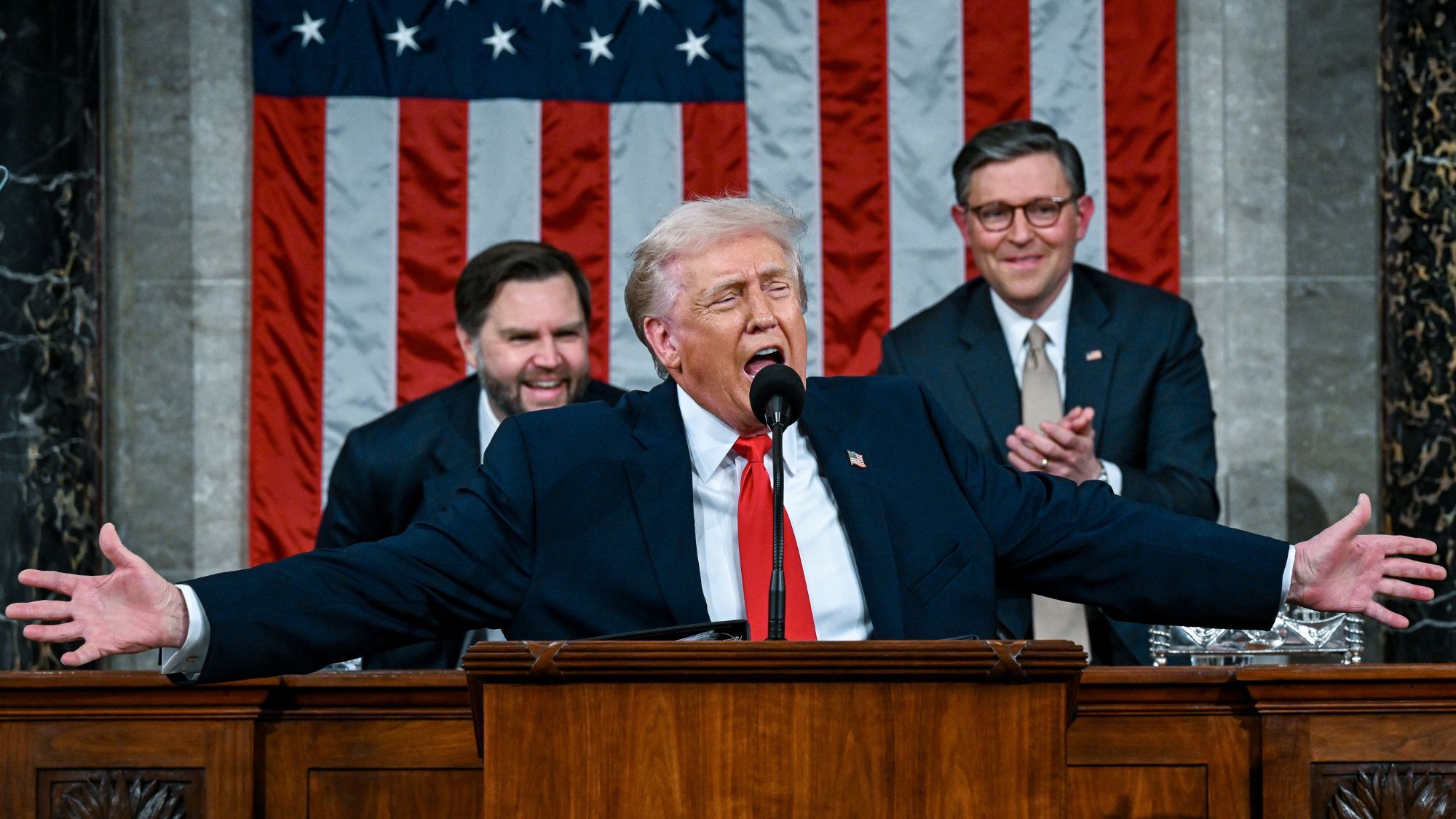
    President Donald Trump last night delivered the first State of the Union address of his second term. He used his record-long speech to defend his economic policies, attack Democrats and award medals to the Team USA hockey goalie, a Korean War veteran, an Army helicopter pilot wounded in Trump’s Venezuelan operation and two National Guard members shot near the White House last year, one of whom died. Virginia Gov. Abigail Spanberger focused on the economy in the main Democratic rebuttal.

    Who said what
    The “core” of Trump’s speech was a “calculation that he can persuade Americans that the economy is in better shape than many think it is,” The Wall Street Journal said. He told the country “he had unleashed a new age of economic prosperity,” but polls suggest most Americans disagree, and Trump’s “natural impulses as a salesman” conflict with the “political imperative” to show he understands their “economic anxiety.” When he slammed the Supreme Court for striking down his sweeping tariffs, Republicans “did not respond with raucous applause as they did for other policies,” Axios said.

    Trump blamed Democrats “for many of the nation’s ills,” including high prices, immigration and rising health care premiums, and he “seemed to get angrier as the speech progressed,” The Associated Press said. “Sometimes what’s not said is as notable as what is,” however, and Trump didn’t mention his aggressive ICE raids or the deaths of Alex Pretti and Renee Good. “Nor did Trump mention the Epstein files” or other “key vulnerabilities,” CNN said, And he “didn’t spend much time at all on his prescriptions for the economy and affordability.” 

    Still, he “offered a broad-based sweep of kitchen-table economic issues,” and by Trump’s standards, “he turned in a disciplined performance, largely sticking to prepared remarks” and “avoiding the sometimes-bizarre asides that often pepper his speeches,” Reuters said. “By the standards of most politicians, it would have been a dark performance,” but Trump advisers pushing him to “dial down his rhetoric” were “likely relieved.”

    What next?
    Trump “delivered marching orders” for Congress to “finalize his agenda,” with a “notable request for lawmakers to avoid action on tariffs,” Burgess Everett and Nicholas Wu said at Semafor. But with the midterms approaching and “Republican fears of losing the House increasing,” it’s “increasingly challenging to see” how he can get much accomplished domestically before his next State of the Union.


    TODAY’S AI story

    Hegseth gives Anthopic ultimatum on guardrails

    What happened
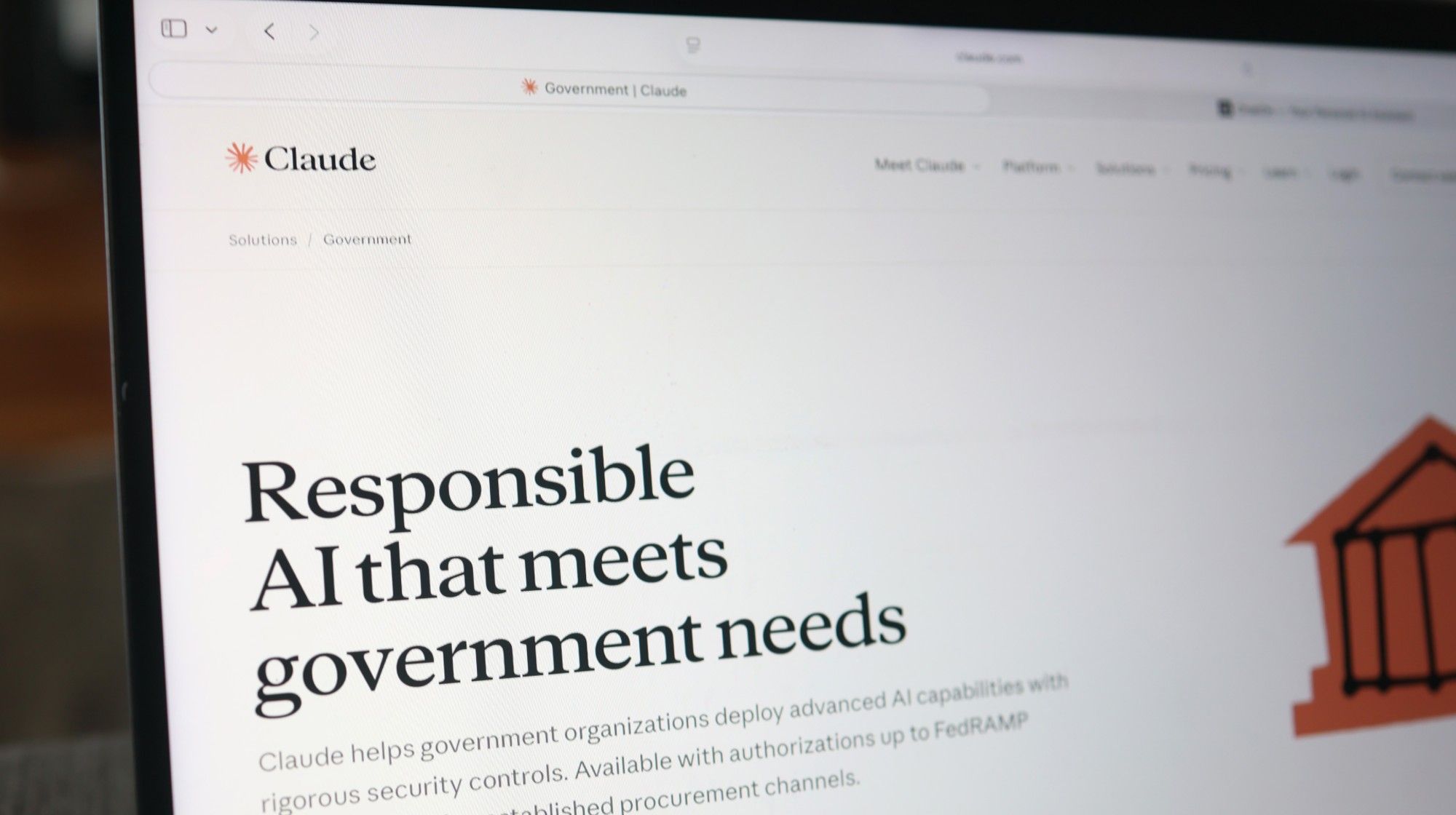
    Defense Secretary Pete Hegseth yesterday gave Anthropic until Friday to allow the Pentagon unrestricted access to its Claude artificial intelligence tool or face serious consequences. In a “tense meeting,” Axios said, Hegseth told Anthropic CEO Dario Amodei that if his firm did not drop its safety guardrails, the Pentagon would cancel its $200 million contract and “declare Anthropic a ‘supply chain risk,’ or invoke the Defense Production Act to force the company to tailor its model to the military’s needs.” 

    Who said what
    Anthropic has “aggressively positioned itself to be a key player in national security” and was the first AI firm to “integrate its technology into the Pentagon’s classified networks,” The Washington Post said. But tensions have mounted over Amodei’s “ethical concerns about unchecked government use of AI,” The Associated Press said, especially for “fully autonomous armed drones” and “AI-assisted mass surveillance that could track dissent.” Some Trump administration officials have lambasted Anthropic’s “hard-line on domestic surveillance and AI weapons” as “Woke AI,” NPR said. 

    Yesterday’s meeting “ended in a stalemate,” as Amodei “reiterated the company’s red lines and said they wouldn’t interfere with the Pentagon’s operations,” The Wall Street Journal said. Either of Hegseth’s threatened sanctions “would be nearly unprecedented,” and a supply-chain risk designation would affect “a swath of companies, including many in the tech sector.” Defense Production Act experts “questioned whether it could be used to force Anthropic to drop the limitations it seeks to maintain,” the Post said. 

    What next?
    The Pentagon’s threats are “extreme,” legally questionable and “strategically counterproductive,” Lawfare said. But the “deeper problem” is that the “terms governing how the military uses the most transformative technology of the century are being set through bilateral haggling between a defense secretary and a startup CEO,” not by Congress. 


    TODAY’S AVIATION SAFETY Story

    House votes down Senate air safety legislation

    What happened
    The House yesterday failed to pass a bipartisan aviation safety bill that won unanimous approval in the Senate in December. The 264-133 House vote fell just short of the two-thirds majority required under special fast-track rules typically used for non-controversial bills. Nearly all 133 no votes came from Republicans. The bill would have required most aircraft to carry advanced location tracking technology, ADS-B In, that the National Transportation Safety Board said would have prevented last year’s deadly midair collision near Washington, D.C.

    Who said what
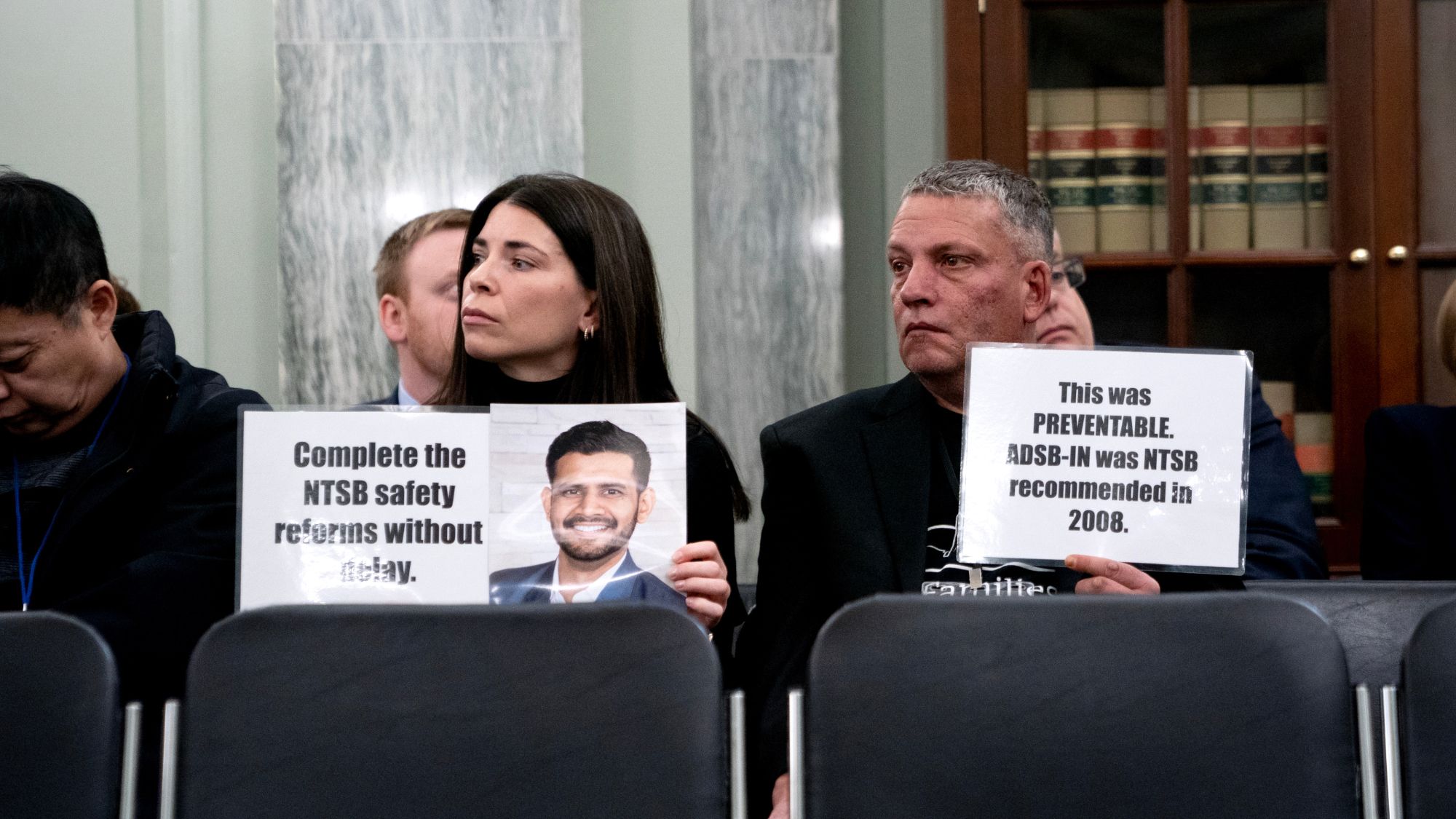
    The Senate’s ROTOR Act is strongly backed by the families of the 67 people who died in the January 2025 collision between an Army helicopter and an American Airlines flight. It was also supported by labor groups, NTSB Chair Jennifer Homendy and, until Monday night, the Defense Department. But it “ran into headwinds in the House from several powerful Republican committee leaders,” NPR said. 

    The bill’s defeat was a “major win” for Transportation Committee Chair Sam Graves (R-Mo.), a longtime advocate for smaller private aircraft, Politico said. Graves argued that his rival ALERT Act addressed all 50 NSTB recommendations to prevent future collisions. But Homendy and the victims’ families oppose his legislation because it does not require the use of ADS-B In, as the NSTB has advocated since 2008.

    What next?
    The victims’ families said in a statement they were “devastated” by the Senate bill’s defeat and urged “House leadership to bring the ROTOR Act back for a vote that lets the majority pass it.” Given that Speaker Mike Johnson (R-La.) and his top lieutenants voted no yesterday, “it is unlikely that the House will revive the bill,” The New York Times said. Sen. Ted Cruz (R-Texas), the ROTOR Act’s lead sponsor with Sen. Maria Cantwell (D-Wash.), called yesterday’s vote a “temporary delay” and predicted the bill will “become the law of the land.”


    It’s not all bad

    Nobel laureate and chemist Omar Yaghi has developed a device that pulls clean drinking water out of the air, even in the driest conditions. The unit uses ultra-low-grade thermal energy to operate and could produce up to 264 gallons of water every day, a lifesaver in desert communities and islands prone to hurricanes. The invention is a “science capable of reimagining matter,” Yaghi told The Guardian, and he hopes further climate-friendly inventions will give the next generation a “planet worthy of their hopes.”


    Under the radar

    South Africans stew amid Johannesburg water crisis

    Though Johannesburg is often called the City of Gold, the residents of South Africa’s largest city aren’t feeling very fortunate amid a significant water shortage. Many residents have been without water for several weeks.

    The water shortage is the result of factors that have plagued South Africa, and specifically Johannesburg, for years, including “municipal neglect, corruption and well-documented mismanagement,” said NPR. Now, 6.6 million people in the Johannesburg metropolitan area are facing hardship in getting clean water.

    While Johannesburg has long had trouble maintaining its water system, a “tremendous infrastructure collapse” in the past couple of years has turned the “maintenance backlog to full-scale system failure,” said South African business website BusinessTech. Things are so bad, said William Gumede, a public policy professor at Johannesburg’s Wits University, that it “might eventually be cheaper and easier to start from scratch, building another city, than to rescue the current one.”

    The South African government is taking steps to abate the crisis. Officials recently gave Africa’s largest bulk water supplier, Rand Water, an “urgent license to take more water from a key river system” for four months, said Bloomberg, and send this extra water to Johannesburg. 

    Meanwhile, water taps “remain dry across large parts of Johannesburg,” said local newspaper the Daily Maverick. Local leaders have pressed for additional changes, but there has been a “long history of commitments without delivery, and a proliferation of task teams has not inspired confidence,” said a spokesperson for South Africa’s People’s Water Forum. There must be “concrete action that reaches every community, especially the most marginalized.”


    On this day

    February 25, 1986

    Ferdinand Marcos fled the Philippines for exile in Hawaii, ending 21 years of dictatorial rule. Marcos, who died in 1989, is still a controversial figure in the Philippines, and his family remains active in national politics. His son, Ferdinand “Bongbong” Marcos Jr., is the country’s current president.


    TODAY’S newspaperS

    ‘State of defiance’

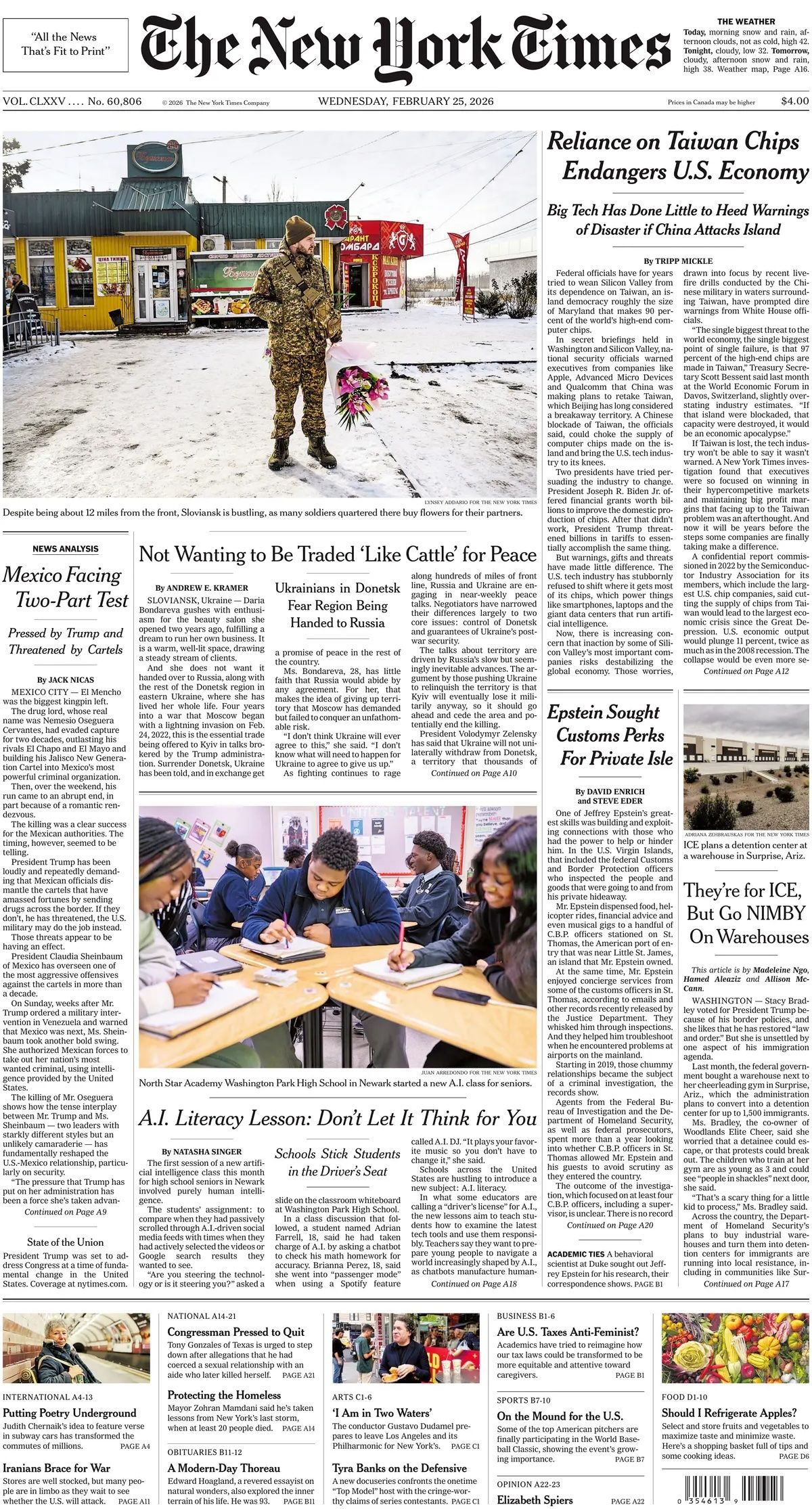
    “Trump speech previews midterms message” in State of the Union speech, The Washington Post says on Wednesday’s front page. “Trump seeks to quell anxiety on economy,” The Wall Street Journal says. “Trump, in a weak position, projects power,” the Los Angeles Times says. Democrats project “state of defiance,” says the Chicago Sun-Times. “Silicon Valley’s rich get richer,” says The Mercury News. Ukrainians in Donetsk “not wanting to be traded ‘like cattle’ for peace,” The New York Times says. “Mexico cartel clashes fueling FIFA worries” ahead of World Cup, the Austin American-Statesman says. “Upheaval in Mexico could last days, weeks,” USA Today says. “Ex-ICE lawyer testifies” that “cadets trained to ‘violate the Constitution,” says the Arizona Republic.

    ► See the newspaper front pages


    Tall tale

    Wing and a prayer

    A Turkish soccer player stopped his team’s match to revive a seagull that had been hit by the ball. The incident occurred during a game between Istanbul Yurdum Spor and Mevlanakapi Guzelhisar, after Yurdum Spor’s goalkeeper kicked the ball into the air, striking the bird. His teammate Gani Catan ran to the fallen seagull and immediately started chest compressions; within two minutes, the bird was moving again, and it is now being treated for wing damage.


    Morning Report was written and edited by Nadia Croes, Catherine Garcia, Scott Hocker, Anya Jaremko-Greenwold, Justin Klawans, Rafi Schwartz, Peter Weber and Kari Wilkin, with illustrations by Stephen Kelly and Julia Wytrazek.

    Image credits, from top: Kenny Holston / The New York Times / Bloomberg via Getty Images; Michael M. Santiago / Getty Images; Stefani Reynolds / Bloomberg via Getty Images; Per-Anders Pettersson / Getty Images
     

    Recent editions

    • Evening Review

      How long can Russia hold out?

    • Morning Report

      Police arrest Mandelson over alleged leaks to Epstein

    • Evening Review

      Can Keir Starmer save the Chagos deal?

    VIEW ALL
    TheWeek
    • About Us
    • Contact Future's experts
    • Terms and Conditions
    • Privacy Policy
    • Cookie Policy
    • Advertise With Us
    • FAQ
    Add as a preferred source on Google

    The Week UK is part of Future plc, an international media group and leading digital publisher. Visit our corporate site.

    © Future Publishing Limited Quay House, The Ambury, Bath BA1 1UA. All rights reserved. England and Wales company registration number 2008885.