The Week The Week
flag of US
US
flag of UK
UK
https://cdn.mos.cms.futurecdn.net/flexiimages/jzblygzdxr1769609154.gif

SUBSCRIBE

Try 6 weeks free

Sign in
  • View Profile
  • Sign out
  • The Explainer
  • Talking Points
  • The Week Recommends
  • Podcasts
  • Newsletters
  • From the Magazine
  • The Week Junior
  • More
    • Politics
    • World News
    • Business
    • Health
    • Science
    • Food & Drink
    • Travel
    • Culture
    • History
    • Personal Finance
    • Puzzles
    • Photos
    • The Blend
    • All Categories
  • Newsletter sign up Newsletter
  • Brand Logo
    Catholic schism, synthetic cell breakthrough and Sudan war crimes

     
    TODAY’S RELIGION story

    Vatican excommunicates splinter sect over bishops

    What happened
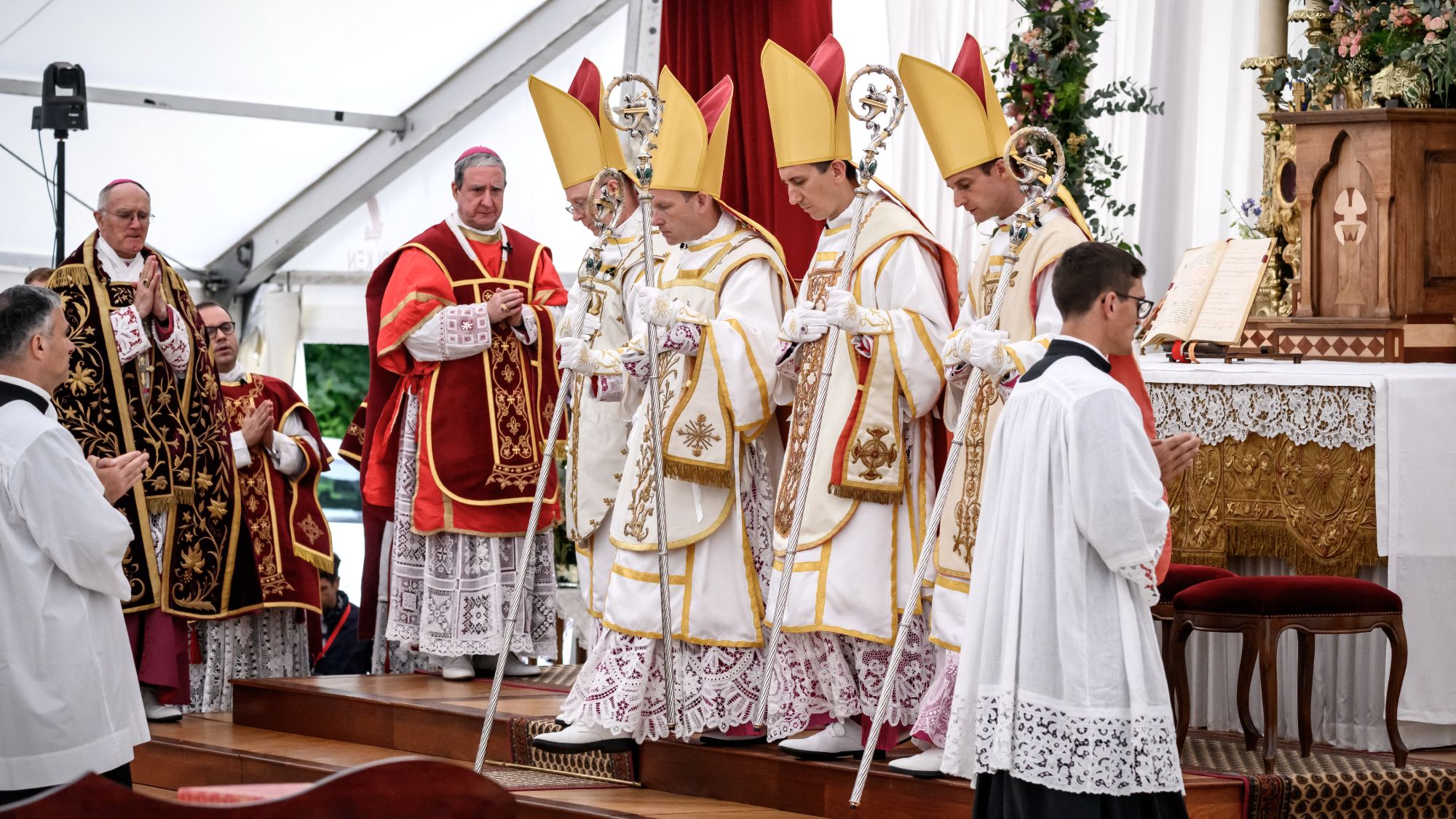
    An anti-modernist Catholic breakaway group yesterday consecrated four new bishops without the consent of Pope Leo XIV, a violation of canon law that incurs automatic excommunication for the new prelates and the two bishops who ordained them. This morning, the Vatican “went above and beyond the minimal sanctions” and also declared all 750 priests of the Society of St. Pius X “to be schismatic, and therefore excommunicated,” The Associated Press said. And it said the lay followers “who adhere formally” to the society are schismatic and excommunicated as well.

    Yesterday’s five-hour ceremony at the SSPX seminary in Econe, Switzerland, was a blow to Leo’s “efforts to bridge divisions within the church,” The New York Times said. The pope on Monday had pleaded with the group to call off what he called a “sin of extreme gravity.”

    Who said what
    SSPX, formed by the late Archbishop Marcel Lefebvre, uses an old version of the Latin Mass and rejects the modernizing reforms of Vatican II. The group claims 600,000 members worldwide and maintains that “only it is upholding the true faith of Christ,” the AP said. But even many “conservative and traditional” Catholics “opposed the consecrations as an act of severe disobedience.” 

    What next?
    The Vatican’s response, especially “targeting the priests, the faithful and the sacraments they can receive,” was “particularly harsh, and reversed concessions the Vatican had granted the SSPX in recent years,” the AP said. In 2009, Pope Benedict XIV reversed the excommunications Pope John Paul II had declared against Lefebvre and the four bishops he consecrated in 1988, but yesterday’s sanctions suggest that “after nearly five decades of trying to negotiate with the society, the Holy See has had enough.” 


    TODAY’S SCIENCE story

    New synthetic cells tiptoe toward creating life

    What happened
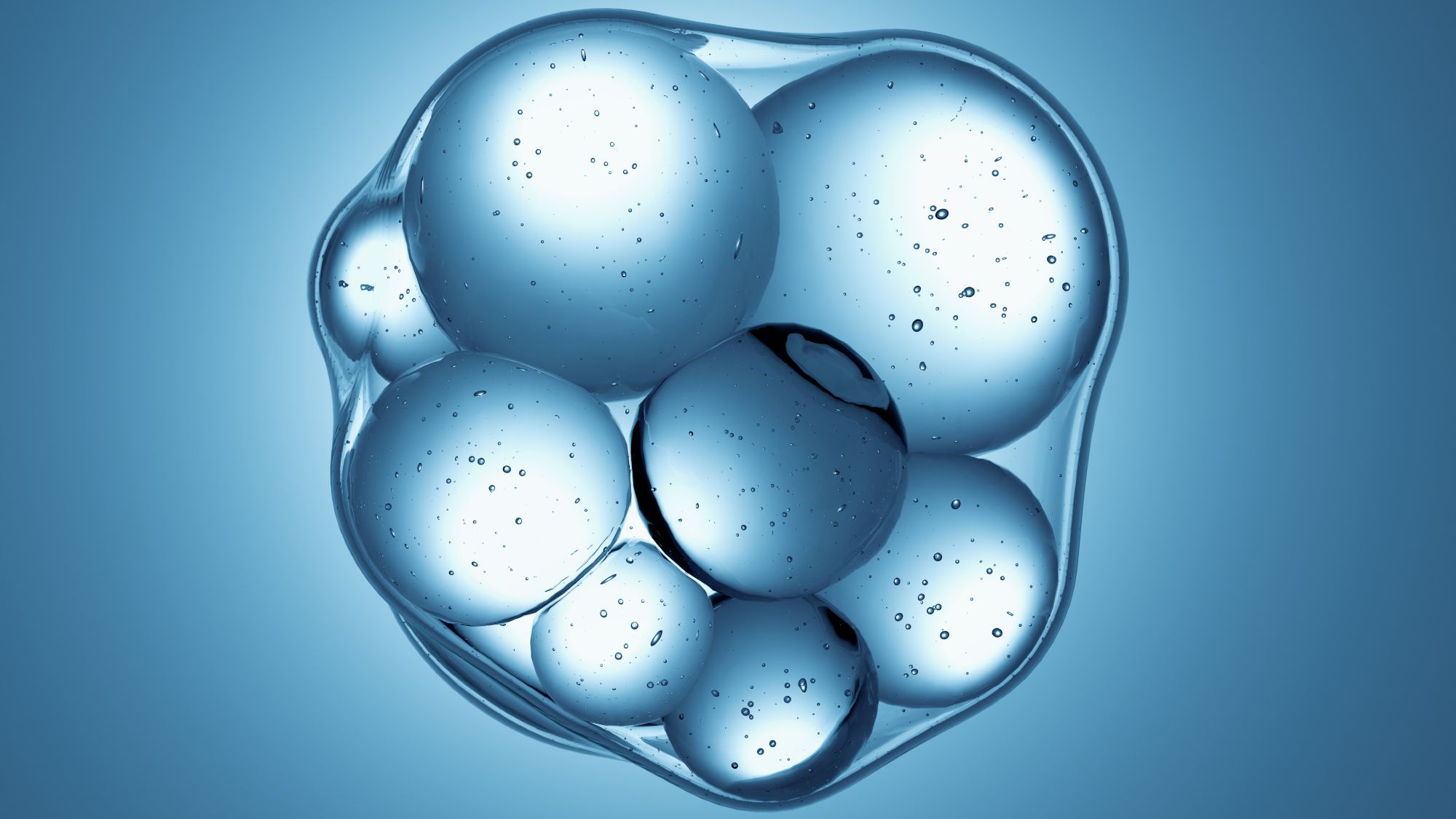
    Scientists at the University of Minnesota yesterday announced that they created synthetic cells from non-living chemicals that can perform many of the functions of living cells, like feeding, growing, dividing and replicating their genetic material. Lead researcher Kate Adamala said she named them SpudCells after Sputnik but also “because I’m mostly made of potatoes.” Her team said they are the “first synthetic cell with a complete cell cycle.” 

    Who said what
    The SpudCell is a “major step” toward “discovering the alchemy by which chemicals can be turned into life,” The New York Times said. With just 36 genes, it’s a “limited and fragile prototype,” CNN said, “but it could help scientists better understand the origins of life” and potentially solve “human problems” like “new cancer treatments and novel ways to capture carbon or manufacture chemicals.” The SpudCell could also “challenge our preconceived notions of what’s considered ‘life,’” said Futurism. 

    “We’re going to remember this moment,” said computational cell biologist Roseanna Zia, who wasn’t involved in the research. The “shake-the-ground accomplishment here” was the ability of SpudCells to compete with each other, leading to more sophisticated progeny.

    What next?
    While Adamala’s research undergoes peer review, she and three colleagues created a public-benefit institution to disseminate the SpudCell “recipe” and collaborate with scientists worldwide to improve and utilize the breakthrough. 


    TODAY’S WAR CRIMES Story

    Amnesty accuses Sudanese militia of ethnic cleansing

    What happened
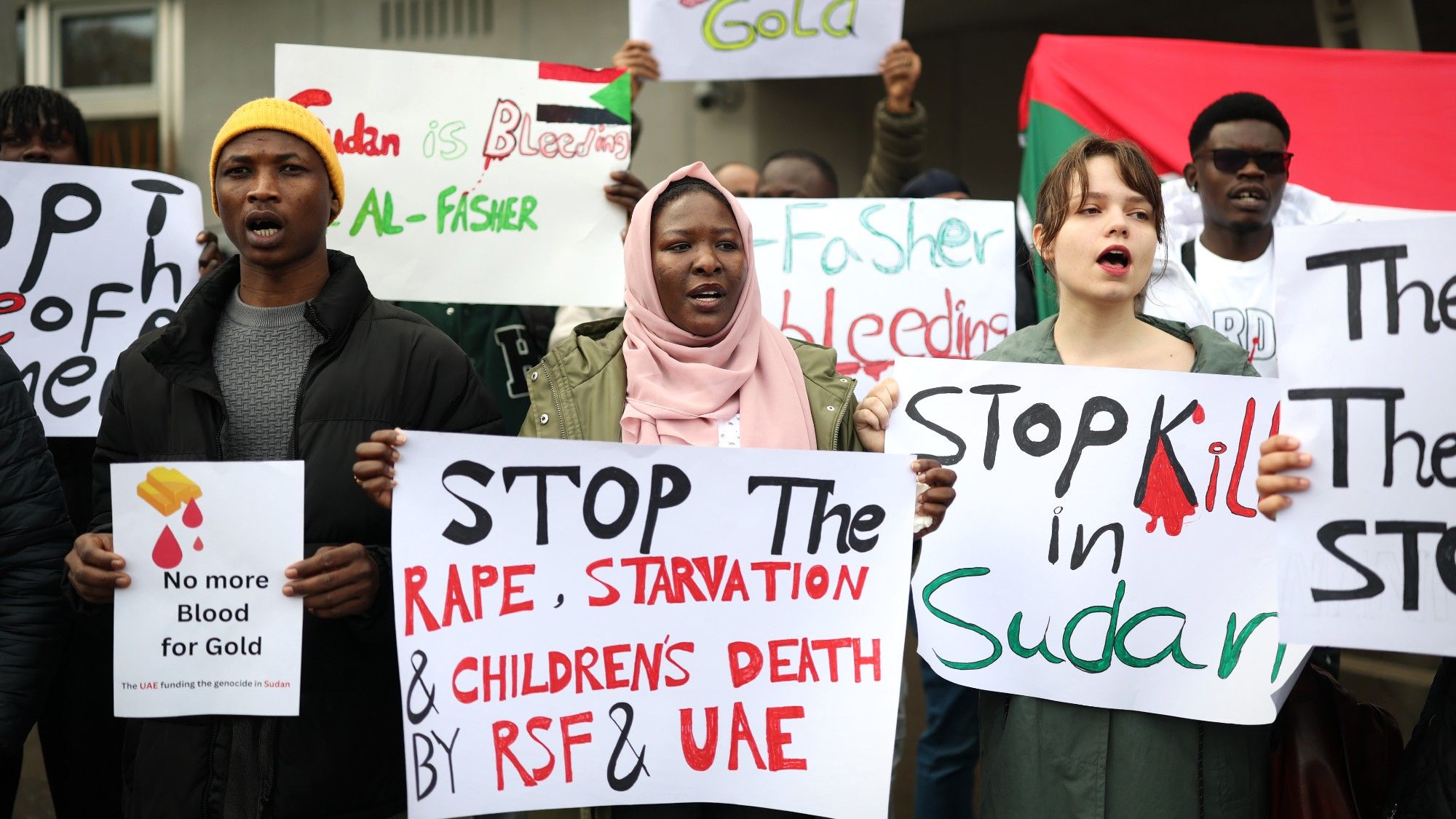
    Sudan’s Rapid Support Forces paramilitary group “committed crimes against humanity and ethnic cleansing” during its 2024-25 campaign to capture the city of el-Fasher in North Darfur, Amnesty International said in a report yesterday. “The RSF’s crimes included murder, forcible transfer, imprisonment, torture, rape, sexual slavery, other forms of sexual violence, enslavement, extermination and persecution.”

    Who said what
    Amnesty analyzed video and documentary evidence and interviewed 246 people for its report, including 208 survivors, 39 of whom were children. The report “accused the RSF of deliberately targeting children,” The Guardian said. 

    The public was “warned of the horrors that civilians in el-Fasher confronted as the RSF laid siege to the city,” said Amnesty International Secretary-General Agnès Callamard. The resulting atrocities are a “stain on the conscience of humanity.” A United Nations fact-finding mission said in February the RSF’s el-Fasher siege bore the “hallmarks of genocide” against non-Arab communities.

    What next?
    Sudan’s “ongoing civil war” between the army and RSF has “killed hundreds of thousands of people” and displaced more than 14 million, the BBC said. A “nationwide ceasefire” is “immediately needed” in Sudan, said Amnesty. There must also be an “independent and adequately resourced international force” assigned to “protect civilians against crimes by all parties to the conflict.”


    It’s not all bad

    Three former National Oceanic and Atmospheric Administration employees have created a new website, Climate.us, to replace Climate.gov, the federal site shuttered last year by the Trump administration. Climate.us publishes the same accurate and “easy-to-understand information,” NPR said, including 15 years’ worth of climate news and key graphs, maps, classroom materials and climate literary resources. Dozens of volunteers, including 80 scientists, have joined the effort and will serve as expert fact-checkers.


    Under the radar

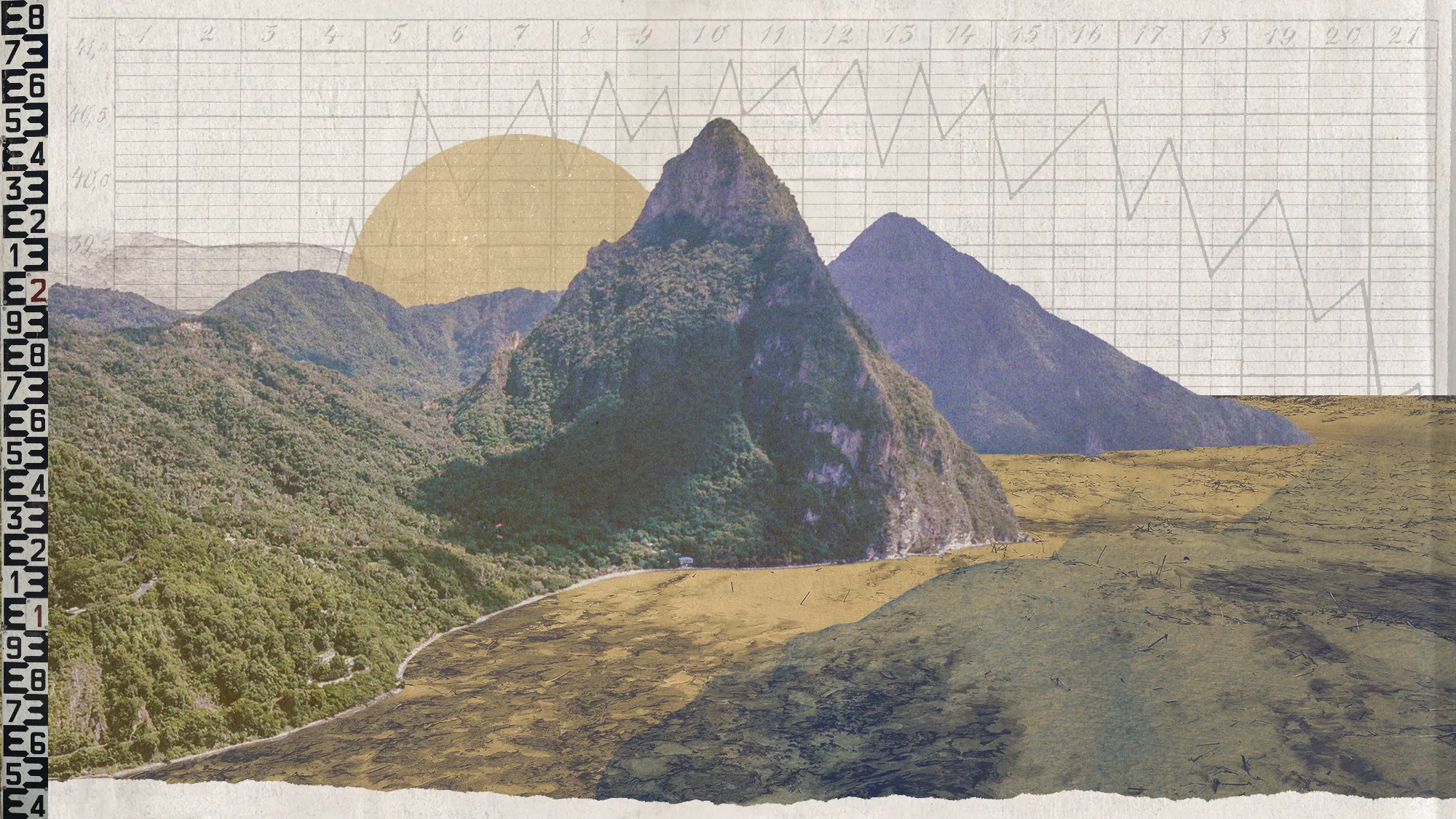
    High and dry: St. Lucia’s battle to fix water woes

    A crisis is brewing on the small Caribbean island of St Lucia. For “more than a decade,” residents have lived with an “intermittent water supply,” said The Guardian. But a recent emergency-level shortage has upended day-to-day life for thousands, turning everything from “normal hygiene” practices to “food preparation” into a struggle. And “millions of dollars of investment,” including $80 million from World Bank financing, have merely “scratched the surface” when it comes to tackling the water supply issues pushing islanders “to the brink.”

    Water supply is among St Lucia’s “most politically contentious issues,” with the two major political parties, the Labour Party and United Workers Party, “routinely trading accusations” that resources have been “mismanaged,” said The Guardian. The island’s one water company, the Water and Sewerage Company (WASCO), has a monopoly on supply.

    WASCO’s provision of water to homes and businesses is hampered by service issues including leaks, blockages and damage to key transmission lines,” said the St. Lucia Times. But there’s also a “complex mix of challenges” at play, ranging from climate change to the island’s “aging infrastructure.” Rainfall patterns are now far “less predictable,” and the island grapples with “drier years alternating with wetter ones.”

    As a temporary solution, citizens are urged to “engage in rainwater harvesting,” said the St. Lucia Times. In the longer term, the government has promised “significant investment” and a “dedicated committee” to examine WASCO’s future. The supplier’s slogan declares that “water is life,” and with that vital liquid hard to come by, the company and its systems are “gravely ailing.”


    On this day

    July 2, 1776

    The Second Continental Congress passed a resolution declaring that “these United Colonies are, and of right ought to be, free and independent States.” John Adams long argued that July 2 should be celebrated as the new country’s birthday, but he lost that battle, and Independence Day is observed on July 4, when the Declaration of Independence was adopted.


    TODAY’S newspaperS

    ‘Raking in cash’

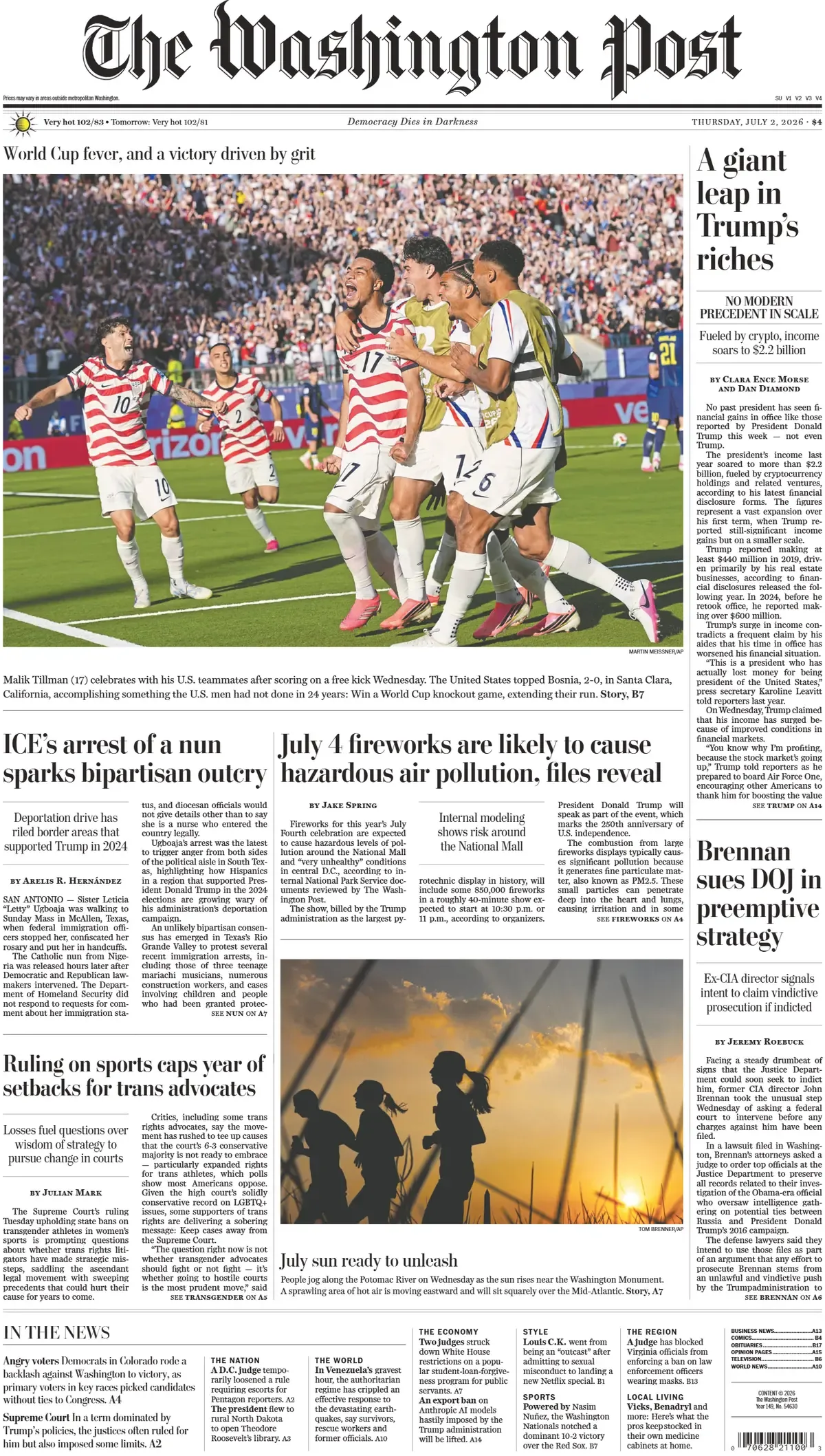
    “Trump businesses reaped $2 billion, 2025 filings show,” The New York Times says on Thursday’s front page. “President is raking in cash from deals in the Middle East,” The Wall Street Journal says. “D.C.’s July 4 facelift raises some eyebrows,” the Los Angeles Times says. “A different kind of American pride” as “Team USA fans celebrate country, roots and 2-0 victory,” The Mercury News says. “ICE’s arrest of a nun sparks bipartisan outcry,” The Washington Post says. “Heat wave to leave millions sweltering during holiday,” says USA Today. “Venezuela quake death toll tops 2,295,” says the Miami Herald. 

    ► See the newspaper front pages


    Tall tale

    Fan with a plan

    For less than what he would have spent to attend one World Cup match, Will Vickers is traveling to seven European countries in seven days for seven watch parties with locals. It was too expensive to fly to North America, and the English college student “didn’t want to watch the games in my room,” he told Reuters. To make his tour work, he’s taking buses and trains and couch-surfing. It’s “not like being at a match,” Vickers said. But it’s “really not far off.”


    Morning Report was written and edited by Helen Brown, Nadia Croes, Rebekah Evans, Catherine Garcia, Scott Hocker, Anya Jaremko-Greenwold, Justin Klawans, Rafi Schwartz and Peter Weber, with illustrations by Stephen Kelly and Julia Wytrazek.

    Image credits, from top: Fabrice Coffrini / AFP via Getty Images; Yana Iskayeva / Getty Images; Jeff J Mitchell / Getty Images; Illustration by Julia Wytrazek / Getty Images
     

    Recent editions

    • Evening Review

      The Armed Forces reboot

    • Morning Report

      US Supreme Court defies Trump on birthright citizenship

    • Evening Review

      Putin’s reckoning in Crimea

    VIEW ALL
    TheWeek
    • About Us
    • Contact Future's experts
    • Terms and Conditions
    • Privacy Policy
    • Cookie Policy
    • Advertise With Us
    • FAQ
    Add as a preferred source on Google Add as a preferred source on Google

    The Week UK is part of Future plc, an international media group and leading digital publisher. Visit our corporate site.

    © Future Publishing Limited Quay House, The Ambury, Bath BA1 1UA. All rights reserved. England and Wales company registration number 2008885.