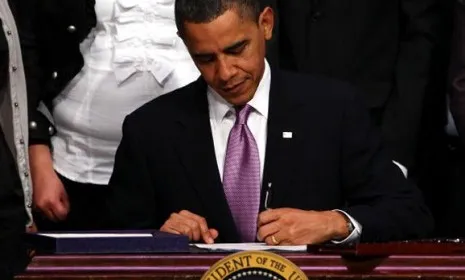
In defense of 'ObamaCare,' one year on
Everyone knows the Affordable Care Act is flawed, says Jonathan Cohn at The New Republic. But we must build on the law, not scrap it and pretend it never existed
It's been exactly a year since President Obama signed the Affordable Care Act into law. And a year later, the same polarizing arguments about health care reform persist, writes Jonathan Cohn at The New Republic. Opponents are still clamoring for it to be repealed — as Mitt Romney did this morning — while supporters continue to point to its potential benefits to the impoverished and unemployed. Yes, "it's easy to find the flaws" in what we ended up with. Thanks to the many political compromises that led to its creation, the act itself is probably the "third- or fourth-best solution" to our problems. But it's worth sticking with, writes Cohn. Here, an excerpt:
More than 30 million additional people will have health insurance because of this law. The coverage, if not always as generous as it should be, will be enough to keep many if not most of the newly insured out of bankruptcy — and it will be available to almost everybody, regardless of pre-existing condition or insurance status. ...
The way to improve the law is to build upon it — to bolster the insurance coverage, reach those Americans the law as written will not reach, and to strengthen the experiments in cost control that work. The best analysis of the law remains the one Senator Tom Harkin gave: The Affordable Care Act is not a mansion. It’s a starter home. But it’s got a solid foundation, a sturdy roof, and room for expansion.
The Week
Escape your echo chamber. Get the facts behind the news, plus analysis from multiple perspectives.
Sign up for The Week's Free Newsletters
From our morning news briefing to a weekly Good News Newsletter, get the best of The Week delivered directly to your inbox.
Read the entire piece at The New Republic.
A free daily email with the biggest news stories of the day – and the best features from TheWeek.com
-
The UK’s supposed Christian revivalThe Explainer Research has shown that claims of increased church attendance, particularly among young people, ‘may be misleading’
-
How long can Keir Starmer last as Labour leader?Today's Big Question Pathway to a coup ‘still unclear’ even as potential challengers begin manoeuvring into position
-
Child-free train carriages: has push for adults-only spaces gone too far?Talking Point Under-12s ban on premium commuter train carriages in France sparks backlash across the political divide
-
The billionaires’ wealth tax: a catastrophe for California?Talking Point Peter Thiel and Larry Page preparing to change state residency
-
Bari Weiss’ ‘60 Minutes’ scandal is about more than one reportIN THE SPOTLIGHT By blocking an approved segment on a controversial prison holding US deportees in El Salvador, the editor-in-chief of CBS News has become the main story
-
Has Zohran Mamdani shown the Democrats how to win again?Today’s Big Question New York City mayoral election touted as victory for left-wing populists but moderate centrist wins elsewhere present more complex path for Democratic Party
-
Millions turn out for anti-Trump ‘No Kings’ ralliesSpeed Read An estimated 7 million people participated, 2 million more than at the first ‘No Kings’ protest in June
-
Ghislaine Maxwell: angling for a Trump pardonTalking Point Convicted sex trafficker's testimony could shed new light on president's links to Jeffrey Epstein
-
The last words and final moments of 40 presidentsThe Explainer Some are eloquent quotes worthy of the holders of the highest office in the nation, and others... aren't
-
The JFK files: the truth at last?In The Spotlight More than 64,000 previously classified documents relating the 1963 assassination of John F. Kennedy have been released by the Trump administration
-
'Seriously, not literally': how should the world take Donald Trump?Today's big question White House rhetoric and reality look likely to become increasingly blurred
