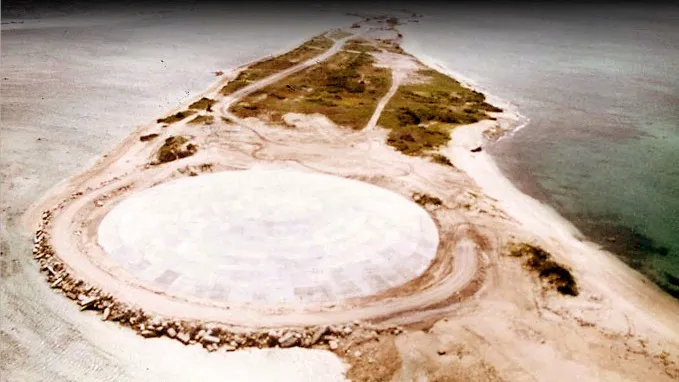
In 1977, a concrete dome was built on Runit Island, part of the Marshall Islands, to contain the radioactive fallout from nuclear tests conducted in previous decades. But now the Runit Dome, also called The Tomb, is deteriorating. And with rising sea levels, the radioactive waste could contaminate the Pacific Ocean and displace hundreds of people.
A 1958 U.S. military nuclear test on the island left behind a crater nearly 33 feet deep, and that pit became a dumping ground for the debris from myriad other tests conducted in the 1940s and ’50s. Now, the dome contains more than 120,000 tons of contaminated material, including lethal quantities of plutonium.
“Groundwater has penetrated the otherwise-unlined crater,” said Science Alert. The water in the dome is “soaking the radioactive waste with the daily rise and fall of the tide,” said ZME Science. And the Tomb’s outer shell contains cracks, “allowing contaminated waste to wash into the surrounding lagoon,” said the Australian Broadcasting Corporation (ABC).
Runit Dome is about 20 miles from a human population that regularly uses the lagoon. But the U.S. Department of Energy claims it’s “not in imminent danger of collapse,” said ABC.
Residents “fear nuclear contamination,” said The Cool Down. “Legacies of nuclear testing and military land requisitions by a foreign power have displaced hundreds of Marshallese for generations,” U.N. Special Rapporteur Paula Gaviria Betancur said in 2024, and the “adverse effects of climate change threaten to displace thousands more.” |